CI
Côte d’Ivoire
Cocoa coast, world's largest basilica & West African cool
Cocoa coast, world's largest basilica & West African cool
Côte d’Ivoire (Ivory Coast) is West Africa’s economic powerhouse — a country of 1,500 kilometres of Atlantic coastline, dense tropical forest, UNESCO-listed rainforest reserves and the remarkable story of Abidjan — a modern African metropolis of 5 million people that was built almost entirely in the second half of the 20th century, and which now ranks as the most dynamic city in French-speaking West Africa. The country produces 40% of the world’s cocoa, maintains some of the most intact West African rainforest outside the Congo Basin, and has a cultural life — music (coupé-décalé), art and fashion — that influences the entire Francophone world. The basilica of Yamoussoukro, modelled on St Peter’s in Rome, is the largest Christian church in the world.
The commercial capital and the most cosmopolitan city in West Africa has a skyline visible for miles — the Plateau business district on a peninsula between the lagoon and the ocean has a scale and energy that surprises everyone who arrives expecting a small African city. The Treich-Ville market, the artisan village of Ma Campagne, the seafood restaurants of Vridi and the nightlife of Marcory reflect a city in confident, creative stride.
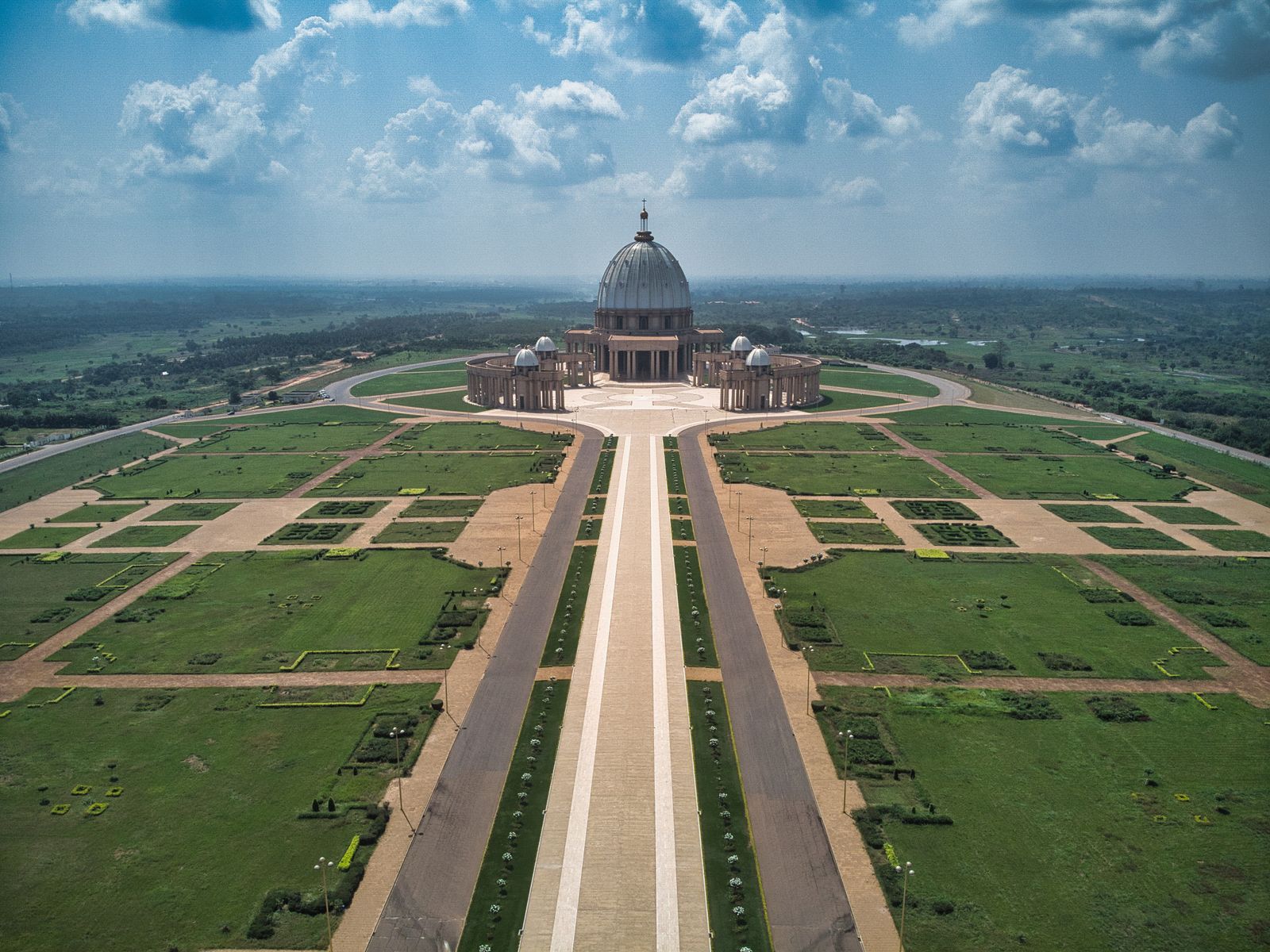
The world’s largest Christian basilica, built by President Félix Houphouët-Boigny between 1985 and 1989, is a scale-for-scale copy of St Peter’s in Rome — but bigger. The 158-metre dome, the stained-glass windows (depicting the president alongside the apostles), the air-conditioned interior and the improbable location in the middle of a mid-sized Ivoirian city make it one of the most extraordinary buildings in Africa.
A UNESCO World Heritage Site and one of the last large fragments of primary tropical rainforest in West Africa. Taï harbours pygmy hippopotamuses, chimpanzees (studied by Jane Goodall-associated researchers since the 1970s), forest elephants, over 235 bird species and extraordinary biodiversity. The park is remote but accessible with planning.
The former French colonial capital, a UNESCO World Heritage Site 40 km from Abidjan, preserves a haunting quarter of crumbling 19th-century colonial mansions along a coconut-palm beach. The national costume museum, artisan village and beach restaurants make it a rewarding half-day from Abidjan.
fermented cassava couscous served with fried fish and fresh tomato salsa) is the national dish, eaten at roadside maquis restaurants that are Abidjan’s greatest food institution.
chicken or guinea fowl slow-cooked in an earthenware pot with vegetables and palm oil) is the signature celebration dish.
fried plantain with chilli sauce) accompanies everything. Ivoirian chocolate and coffee are among the world’s finest at source;
Flag Spéciale, brewed in Abidjan by SOBRACI since 1960 — the dominant beer of Côte d’Ivoire, a pale lager drunk cold at every maquis (open-air restaurant), football match and social gathering throughout the country.
The second major Ivorian lager brand, also brewed in Abidjan — slightly lighter than Flag and the preference of many younger Ivorians. Both beers are ubiquitous at the maquis culture that defines Abidjan’s social life.
Félix Houphöet-Boigny International (ABJ) in Abidjan is the largest hub in Francophone West Africa. Air France, Ethiopian Airlines and Air Maroc serve the main routes. For trip planning, see the official Cu00f4te d’Ivoire tourism portal.
💡 Paris is the primary European gateway — Air France and Corsair operate direct CDG–ABJ services in 6h, reflecting Côte d’Ivoire’s Francophone connections. Ethiopian Airlines via Addis is the best option from the UK.
💡 Accra (1h30) and Lagos (1h30) are the main West African neighbours. Ethiopian Airlines via Addis Ababa connects all of East and Southern Africa to Abidjan.
💡 Uber operates in Abidjan with transparent pricing — far more reliable than street taxis for navigating the city. Grand Bassam is accessible by shared taxi from Adjamé bus station.
💡 Air Côte d’Ivoire covers the main domestic routes from ABJ. Yamoussoukro (4h road) and Grand Bassam (45 min road) are best reached by car or taxi.
November to April is the best window — Grand Bassam and Assinie beaches calm, Abidjan’s outdoor restaurants pleasant, the north dry. December to March are the driest months (26–33°C). May to October brings the long rains in the south; the north (Korhogo, Kong) remains drier.
Côte d’Ivoire uses the CFA franc (XOF) shared across 8 West African nations. Abidjan is the most expensive city in French-speaking West Africa; food and local transport are affordable.
Attiéké (cassava couscous — fermented and coarsely grained cassava, steamed until soft and slightly sour, served with fried fish, alloco (fried plantain) and piment sauce) is the defining Ivorian dish, eaten at every meal.
Bande de thôn — yellowfin tuna steak grilled over charcoal and served with attiéké, alloco, chilli sauce and cold Ivoire beer — is the finest quick meal in Abidjan’s maquis culture.
The Sofitel Abidjan Hôtel Ivoire (the landmark hotel of West Africa since 1963, with an ice rink, casino and multiple restaurants, from XOF 100,000–300,000/night) has hosted every head of state in the region.
Abidjan for two days, Grand Bassam for one, Assinie for one, Yamoussoukro for one, Man for one, Korhogo for one. Côte d’Ivoire — the most economically dynamic country in West Africa — has the continent’s largest basilica, the finest seafood coast in West Africa and a remarkable political recovery story.
Abidjan — a city of 5 million, the largest city in Francophone West Africa, built on a lagoon with the Plateau business district (skyscrapers from the cocoa boom of the 1970s, when Côte d’Ivoire was the world’s largest cocoa producer) — the Cocody neighbourhood (the finest market in Abidjan, the Marche de Cocody), the Treichville neighbourhood (nightlife, maquis (open-air restaurants), attiéké (cassava couscous) vendors) and the waterfront of the Ebrié Lagoon.
💡 Côte d’Ivoire produces approximately 40% of the world’s cocoa — the highest share of any country for any commodity in the world. The Ivorian cocoa economy feeds roughly 6 million people directly and supplies the majority of cocoa used in European and North American chocolate. Every bar of Cadbury, Lindt or Kit-Kat has a significant probability of containing Ivorian cocoa.
A full day in Treichville — the liveliest neighbourhood in Abidjan, a working-class district on the southern lagoon island with the Marché de Treichville (the largest market in the city, with fresh fish, fufu vendors, cloth merchants and the constant sound of Coupé-Décalé and Zouglou music from every shop) and an evening at a maquis (an open-air restaurant under a corrugated tin roof, eating grilled fish, alloco (fried plantain) and attiéké — the defining Ivorian meal).
💡 Coupé-Décalé (a genre of dance music originated in Abidjan in 2002 by Ivorian DJ Douk Saga, now the most widely listened-to music genre in Francophone Africa) is characterised by its bouncing bassline, call-and-response vocals and complex footwork dance style. The name roughly translates as “cut and run” — a reference to the hustler identity of young Ivorians working abroad and sending money home.
45 min from Abidjan. Grand Bassam (UNESCO World Heritage Site) — a 19th-century French colonial port town on a narrow strip of land between the Atlantic and the Ebrié Lagoon, with French colonial government buildings and merchant houses in various states of photogenic decay, the finest beach immediately west of the colonial quarter (calm, clean, with local fishing boats), and a busy Sunday market of Akan cloth (kente-adjacent woven fabrics).
💡 Grand Bassam was the first capital of Côte d’Ivoire under French colonial rule (1893–1900), abandoned after a series of yellow fever epidemics killed the colonial administration. The French moved the capital to Bingerville, then eventually to Abidjan. Grand Bassam’s colonial buildings, abandoned when the colonial function moved, have survived in a state of photogenic decay for 120 years.
1h30 from Abidjan. Assinie — a narrow peninsula of Atlantic beach between the ocean and the Tendo Lagoon — has consistently been described as the finest beach in West Africa. The Atlantic side has strong surf (surfing popular); the lagoon side is flat and calm for swimming. Assinie was the location of Henri Verneuil’s 1973 film “Le Clan des Siciliens” and Yann Arthus-Bertrand’s most famous aerial photographs.
💡 Assinie was briefly the capital of Côte d’Ivoire under the French before Grand Bassam — it was the first permanent French settlement in the region (1687). The beach was later used as a location for several French films and became a hideaway for Paris’s creative class in the 1970s.
4h from Abidjan. Yamoussoukro — the administrative capital of Côte d’Ivoire (the political capital, the largest city, is Abidjan) — with the Basilica of Our Lady of Peace (completed 1990, larger than St. Peter’s Basilica in Rome, the largest basilica in the world by area at 30,000m², built by President Félix Houphöet-Boigny as a personal act of faith and gift to the Pope, who consecrated it) and the Sacred Crocodiles of Yamoussoukro.
💡 The Basilica of Our Lady of Peace in Yamoussoukro cost an estimated US$300 million to build at a time when Côte d’Ivoire’s economy was in severe difficulty. Pope John Paul II consecrated it in 1990 on the condition that a hospital be built alongside (the Polyclinique exists but has been poorly funded). The building seats 7,000 inside and 11,000 in the external colonnades; it is rarely more than 10% full.
5h from Yamoussoukro. Man — the gateway to the western mountains (Dent de Man, 1,032m — the distinctive “tooth” peak visible from the city) — with traditional Dan and Guéré mask culture (the west of Côte d’Ivoire is the heartland of African sacred mask tradition, used in initiation rites and judicial proceedings; the wooden Ge mask of the Dan people is one of the most collected objects in African art history) and the suspended bridges over the Cavally River.
💡 The Dan (Yacouba) people of western Côte d’Ivoire and Liberia are masters of the Ge mask tradition — each mask represents a specific spiritual force and is owned by a lineage, not an individual. The masks are “activated” in ceremonies that combine music, dance and costume into a complete spiritual performance. Museums worldwide hold thousands of Dan masks; none is as powerful as one in active ceremonial use.
1h flight from Abidjan or Man. Korhogo — the capital of the Senufo people in the north of Côte d’Ivoire — with the Kufulo sacred forest (where the Poro secret society has held initiations for centuries), the Senufo painted cotton cloth (Kolougbà — hand-painted with mud and plant dyes in geometric and figurative patterns, sold in the Korhogo market at CVF 3,000–10,000 per metre) and the Senufo blacksmiths (hereditary metal-workers who also serve as diviners). Fly from Abidjan (ABJ).
💡 The Poro society of the Senufo people is one of the most significant male initiation institutions in West Africa — the Poro forest school (lasting up to 21 years in the traditional form, reduced to several weeks in modern practice) transforms boys into men through a curriculum of moral, spiritual, practical and social education. Women are forbidden from the Poro forest; to see the Poro mask (“the spirit of the forest”) means death.
E-visa available for most nationalities before arrival. Check the official portal before travelling.
West Africa’s most connected hub with direct flights to Paris, Brussels, London (via Casablanca), Dubai and numerous African capitals.
Shared with 7 other West African nations and pegged to the Euro. ATMs in Abidjan; carry cash in Yamoussoukro and the interior.
Abidjan has the finest restaurants, nightlife and architecture in West Africa. The Cocody and Plateau districts are safe and sophisticated. Yéké yéké (attiéké and chicken grillades) from street stands at night is unmissable.
French is the official language; Dioula is the trade language of the north. English is limited outside international hotels.
Woro-woro (shared taxis) and gbaka (minibuses) navigate Abidjan. For intercity travel, comfortable coach services connect major towns.
Point your camera at menus, signs or street text for instant translation. Download the language pack offline before you arrive for full use without data.
FreeReal-time and offline exchange rates for all world currencies — converts prices instantly so you always know what you are paying in your home currency.
FreeFind and book hotels, guesthouses and apartments with free cancellation on most rates — one of the widest selections of accommodation worldwide.
FreeCôte d'Ivoire sits within easy reach of several other destinations — each with a completely different character.

