LR
Liberia
Africa’s oldest republic, West Africa surf & pygmy hippos
Africa’s oldest republic, West Africa surf & pygmy hippos
Liberia is West Africa’s most enigmatic country — Africa’s oldest republic (founded 1847 by freed American slaves, three decades before most of Europe’s nations had unified) with a unique cultural heritage that blends American and West African traditions in ways found nowhere else on the continent. The Americo-Liberian plantation houses, churches and courthouses of Monrovia and the interior reflect a history unlike any other in Africa. Liberia also has West Africa’s finest surf, some of the most untouched lowland rainforest remaining on the continent, the legendary chimpanzee research sites of Bossou and Sapo National Park — one of the most biodiverse protected areas in West Africa.
A fishing village on Cape Mount Peninsula with West Africa’s most consistent and renowned surf breaks — Cotton Tree Point and Shipwreck Point — attracting a small but dedicated surf community and offering empty waves of quality rivalling much more famous destinations. The village itself has traditional Vai culture and a relaxed, authentic atmosphere.
Liberia’s largest protected area in the Sinoe rainforest is one of the Upper Guinea Forest’s most important remaining blocks — home to the West African pygmy hippo (critically endangered), forest elephants, chimpanzees, Jentink’s duiker and an extraordinary density of forest birds. The park’s remoteness means it receives very few visitors and the forest is almost entirely intact.
The capital’s unique Americo-Liberian legacy — Cape Mesurado’s 19th-century churches, the Providence Island (where the first freed slaves landed in 1822), the historical plantation houses of the interior and the distinctive Kpelle, Vai and Bassa craft traditions — create a cultural landscape unlike anywhere else in Africa.
Rice cooked in a spiced tomato and pepper sauce with chicken or fish — the Liberian version is saucier and more richly spiced than most West African jollof, with a distinctive smoky undertone from cooking over a wood fire. One of the best versions in the region.
Spicy goat or fish broth with chillis, ginger and country pepper — the universal restorative dish of Liberia, eaten at any hour, especially after celebrating.
Pounded cassava rolled into a dense ball and eaten with palm nut soup or egusi soup — the staple of Liberia’s eastern communities.
palm nut broth with chicken or fish and leafy greens) are the national staples.
Rice cooked in a rich sauce of dried meat, smoked fish and vegetables — a Liberian one-pot meal that resembles a drier, meatier version of jollof, eaten at family gatherings and as the standard Sunday lunch throughout the country.
pounded cassava, eaten with soup) are traditional. The American influence brings peanut butter used in stews and sweet potato pies. Fresh Atlantic seafood — barracuda, snapper, crab — is excellent and inexpensive on the Monrovia waterfront.
Roberts International Airport (ROB), 56km from Monrovia, is the main gateway. Brussels Airlines, Air Maroc and Ethiopian Airlines serve major routes. For trip planning, see the official Liberia tourism portal.
💡 Brussels Airlines (7h direct) and Royal Air Maroc via Casablanca (5h from CMN) are the most direct European connections. Paris and London connect via Abidjan or Accra.
💡 Abidjan (1h30) and Accra (1h30) are the most convenient West African hubs. Ethiopian Airlines (Addis Ababa, 8h direct) is the main connection from East Africa.
💡 Monrovia is 56km from Roberts Airport on a paved road (1h30). The road to Sapo (via Greenville or Zwedru) is roughly 6–8 hours and requires a 4WD; conditions worsen significantly in the wet season.
💡 A 4WD with driver (US$80–150/day) is the most practical option for Sapo National Park and upcountry travel. Monrovia itself is navigated by shared taxi and motorbike taxi.
November to April is the dry season — the only comfortable time to visit (26–32°C). December to February is ideal: dry roads, clear skies, excellent for Sapo National Park. May to October is the wet season with extremely heavy rain — Liberia has one of the highest annual rainfalls in West Africa.
The Liberian dollar (LRD) and US dollar are both widely used. Affordable overall but Sapo National Park requires organised access.
Palm butter soup (the thick, richly flavoured stew made from palm fruit pulp, simmered with fish or meat and served with rice or fufu &mdash)
Sapo National Park access (the park requires visitors to hire a local guide and stay in the park guesthouse &mdash)
Liberia’s post-war recovery has been uneven — infrastructure outside Monrovia is limited and the road network is poor.
Monrovia for one day, Sapo National Park for two days, Buchanan and Firestone for one, Kru Coast beaches for one, Harper for one, Monrovia farewell for one. Liberia — the oldest republic in Africa, founded by freed American slaves — has the most pristine rainforest in West Africa, pygmy hippos in Sapo National Park and 500km of deserted Atlantic beach.
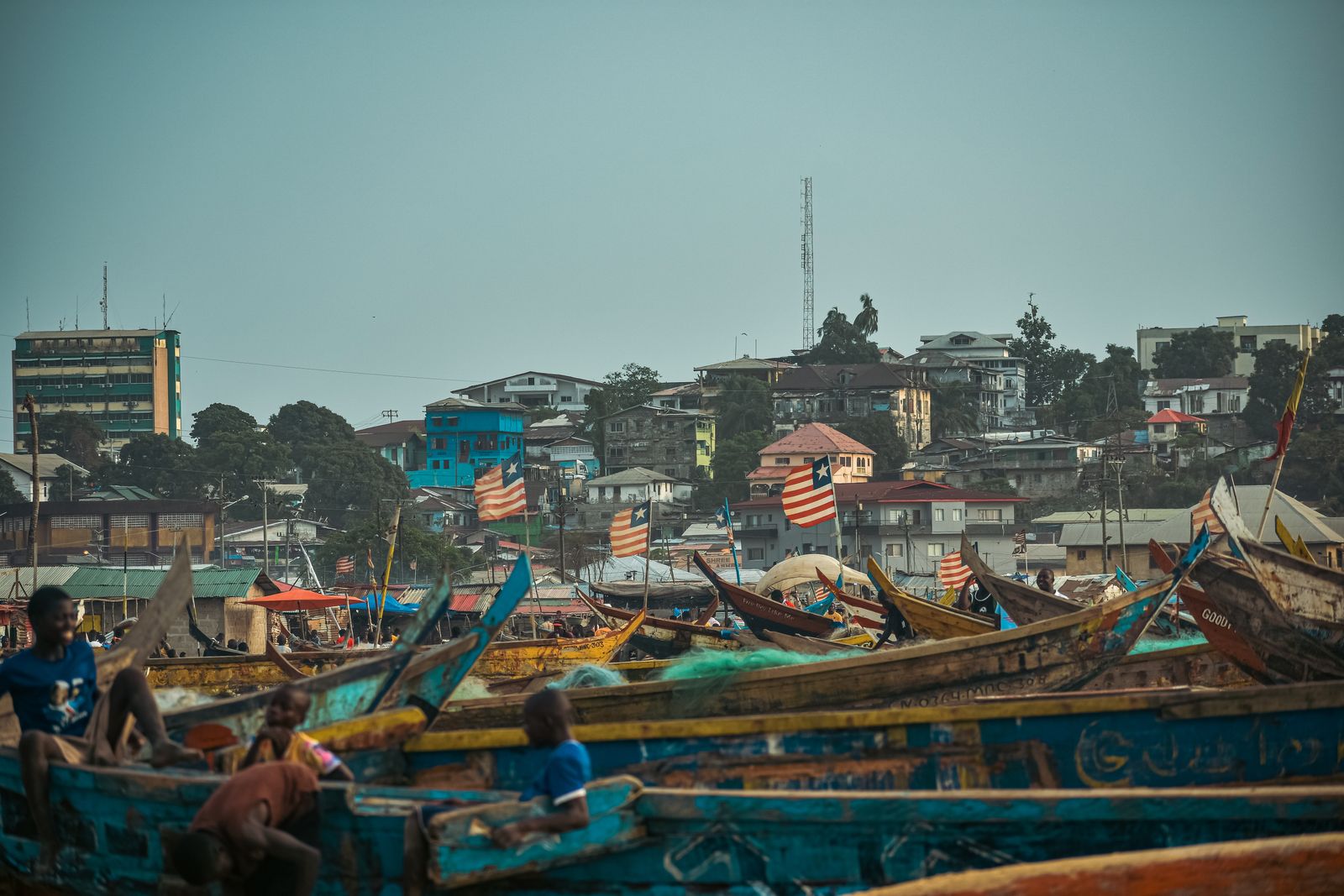
Monrovia — the capital of Liberia (the oldest republic in Africa, founded in 1822 by freed American slaves repatriated by the American Colonization Society, one of only two African countries never colonised by a European power — the other being Ethiopia — population 5 million, devastated by two brutal civil wars 1989–2003) with the Ducor Hotel ruins (the 1960s luxury hotel, abandoned since the civil war, now squatted by thousands of internally displaced people — the most poignant post-war urban landscape in Africa) and the Monrovia market.
💡 Liberia’s founding story is the most unusual in Africa — the country was established as a home for freed American slaves and free-born African Americans repatriated from the USA from 1822 onwards, under the American Colonization Society. The settlers (Americo-Liberians) created a republic modelled on the United States, with a constitution, a Senate, and plantation agriculture worked by indigenous Africans — a tragic historical irony that eventually contributed to the 1980 coup and the subsequent civil wars.
Sapo National Park (1,808km² — the largest protected rainforest in West Africa, part of the Upper Guinea Rainforest Biodiversity Hotspot, with the highest density of pygmy hippopotamuses (Choeropsis liberiensis — the rarest of all large mammals in West Africa, found only in Guinea, Sierra Leone, Ivory Coast and Liberia, approximately 2,500 remaining, weighing 180–275kg compared to the common hippo’s 1,500kg) and chimpanzees, forest elephants, leopards and the extraordinary bird diversity of the Upper Guinea Forest.
💡 The pygmy hippopotamus (Choeropsis liberiensis — the smallest hippo species, solitary and nocturnal compared to the common hippo’s social and diurnal habits, found primarily in the Upper Guinea Forest of West Africa — is one of the rarest large mammals on earth, with the wild population estimated at fewer than 2,500 individuals in five countries. Sapo National Park has the highest density of wild pygmy hippos accessible to researchers and visitors.
A full day in Sapo National Park with a local guide (the pygmy hippos are nocturnal but their trails, wallows and droppings are visible throughout the forest — a patient dawn or dusk wait at a known wallow produces reliable encounters, the most intimate large mammal experience in West Africa — with chimpanzee calls audible throughout the forest and the extraordinary density of forest birds including the rare white-necked rockfowl and the Liberian mongoose).
💡 Sapo National Park was established in 1983 but barely survived the civil wars — rangers were killed, wildlife was poached for bushmeat, and the park’s infrastructure was entirely destroyed between 1989 and 2003. Since 2003, the Society for the Conservation of Nature of Liberia (SCNL) has gradually rebuilt the park’s protection; pygmy hippo populations appear to be stable or recovering, and Sapo is once again the most important protected area in West Africa.
Buchanan (the second city of Liberia — the iron ore port that was the economic engine of Liberia in the 1960s, with the Firestone rubber plantation complex (the world’s largest rubber plantation at its peak, covering 48,000 hectares, established in 1926 by Harvey Firestone in a concession arrangement with the Liberian government that critics called the most exploitative in African colonial history) and the beaches of the Atlantic coast, deserted and undeveloped, some of the finest and loneliest beaches in West Africa).
💡 The Firestone rubber plantation of Liberia (est. 1926 — a 99-year concession covering 1 million acres at a rent of 6 cents per acre per year, with labour provided by the Liberian government through a system that the League of Nations described as “closely analogous to slavery” in 1930 — was one of the largest and most profitable agribusiness operations in 20th-century Africa. The plantation, now owned by Bridgestone, still operates and is one of the world’s largest single natural rubber producers.
The Kru Coast (the Atlantic coastline of Liberia between Buchanan and Harper — 500km of virtually untouched beach, often deserted for miles in each direction, with large Atlantic swells that produce the finest and least-crowded surf in West Africa — the local Kru people have been expert ocean navigators for centuries, the first West Africans to be employed as sailors on European ships due to their exceptional seamanship).
💡 The Liberian surf (the Atlantic swells reaching the Liberian coast are some of the most powerful and consistent in West Africa — the combination of the North Atlantic winter swell, the south-facing coast orientation and the complete absence of development has produced a surfing frontier that attracted the first wave of surf explorers in the 2010s. Infrastructure remains minimal; visiting surfers camp on the beach.
Harper (the southernmost city of Liberia, near the border with Ivory Coast — a colonial town founded by freed American slave Joseph Jenkins Roberts, the first president of Liberia, with the Roberts family homestead and the nearby Cestos-Senkwehn National Park protecting the last intact mangrove estuary in Liberia, with West African manatees and Nile crocodiles in the river channels) and the traditional Grebo and Kru fishing villages of the coast.
💡 Liberia has one of the highest proportions of intact forest cover of any West African country — approximately 43% of the country remains forested, compared to 5–15% in most neighbouring countries. The combination of the civil wars (which depopulated large areas) and the post-war government’s cautious approach to logging concessions has accidentally preserved more forest than deliberate conservation efforts achieved in neighbouring countries.
A final morning in Monrovia: the Broad Street markets, the National Museum of Liberia (covering the foundation period, the civil war and the Ebola epidemic of 2014–2016 — in which Liberia lost 4,800 people and the country was quarantined from the rest of the world) and the extraordinary Capitol Building (modelled directly on the US Capitol, the most direct visual reminder of Liberia’s American heritage) before flying from Monrovia (ROB).
💡 The Liberian civil wars (First Civil War 1989–1997, Second Civil War 1999–2003 — combined death toll estimated at 250,000, with 1 million displaced out of a population of 3.5 million — were among the most brutal in African history, involving systematic atrocity, child soldiers and the complete destruction of the state. The election of Ellen Johnson Sirleaf as president in 2006 (the first female president in African history) and her Nobel Peace Prize in 2011 marked the beginning of genuine post-war reconstruction.
Visa required — apply online via Liberia’s e-visa portal before departure.
Located 55km from Monrovia; direct connections to Accra, Nairobi and Brussels. Monrovia’s Spriggs Payne Airport (MLW) handles domestic routes.
Liberia is rebuilding after two civil wars (1989-2003). Roads outside Monrovia are mostly unpaved. Medical facilities are limited; travel insurance with medical evacuation cover is essential.
Both the LRD and USD are used. USD is the practical currency for most transactions in Monrovia.
Vaccination certificate required for entry.
Roads to Robertsport (3h from Monrovia) and the interior are unpaved; 4WD recommended in the rainy season. Sapo National Park requires advance arrangement through operators.
Point your camera at menus, signs or street text for instant translation. Download the language pack offline before you arrive for full use without data.
FreeReal-time and offline exchange rates for all world currencies — converts prices instantly so you always know what you are paying in your home currency.
FreeFind and book hotels, guesthouses and apartments with free cancellation on most rates — one of the widest selections of accommodation worldwide.
FreeBrowse millions of traveller reviews for restaurants, attractions and hotels — helps identify the best local spots and avoid tourist traps.
FreeLiberia sits within easy reach of several other destinations — each with a completely different character.
