SN
Senegal
Teranga hospitality and Dakar rhythm
Teranga hospitality and Dakar rhythm

A UNESCO island 3km from Dakar: the Maison des Esclaves (House of Slaves) with its Door of No Return, through which enslaved people were shipped to the Americas. The most visited site in Senegal.
Photo: Fawaz.tairou, CC BY-SA 4.0

A pink lake 35km from Dakar: the pink colour comes from Dunaliella salinae algae and high salt content (40%). Salt harvesters wade in the lake collecting pink salt.
Photo: Jjm2311, CC BY-SA 4.0

UNESCO: one of the most important bird reserves in the world, 3rd largest wetland after the Camargue and Douana. Pink flamingos, white pelicans and 400 species of migrating birds.
Photo: Ji-Elle, Public domain

UNESCO: a colonial island city built on the Senegal River: the former capital of French West Africa with its characteristic iron bridge and painted balconied houses.
Photo: Unknown authorUnknown author, Public domain

UNESCO: megalithic stone circles (3rd-16th century AD) spread across 100km: the most extensive megalithic complex in Africa, predating any European colonial presence.
Photo: Mellangoose, CC0

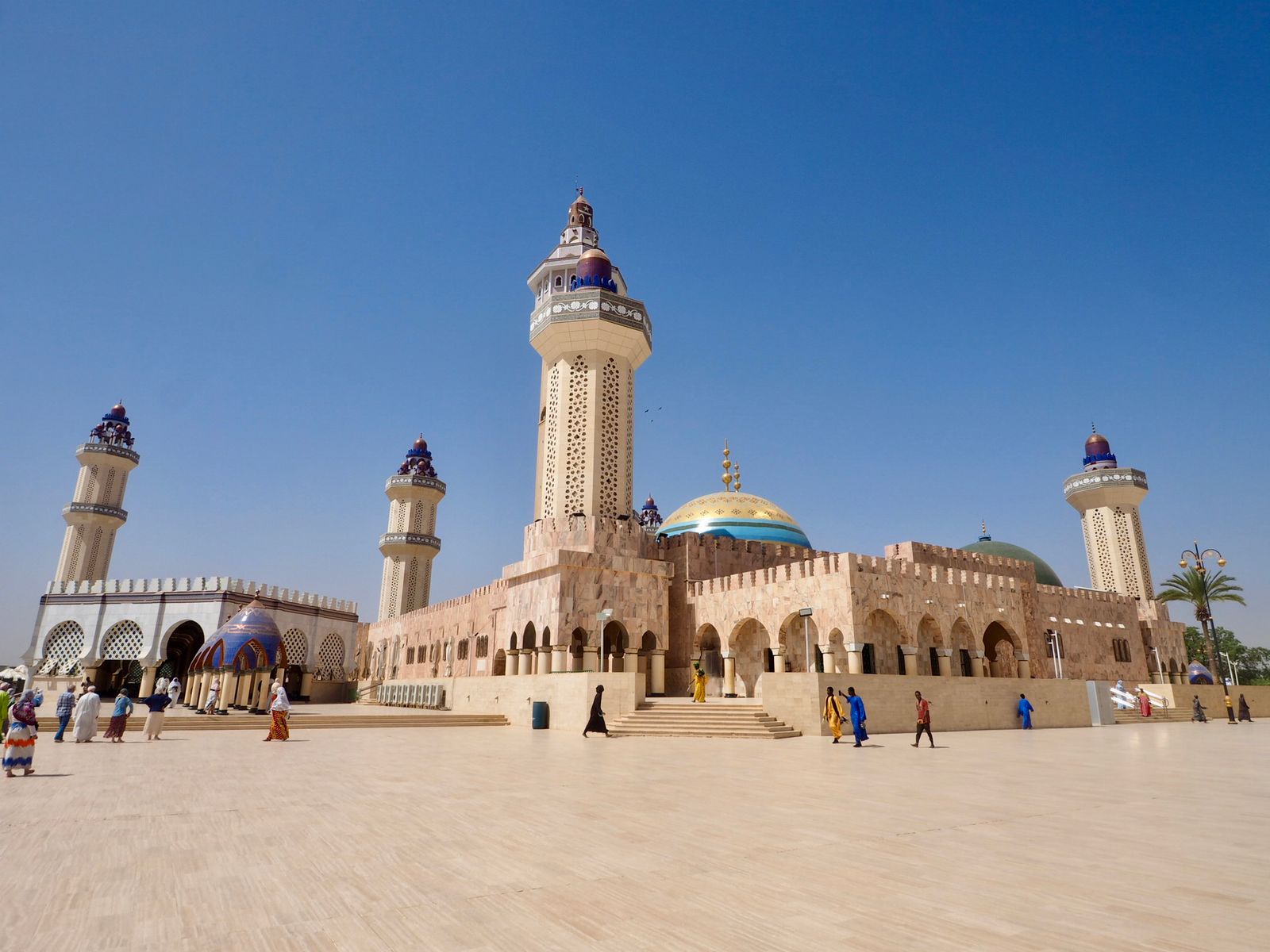
The Grand Mosque of Dakar (1964), the Sandaga Market, and the IFAN Museum of African Arts (one of the finest African art collections on the continent).
Photo: Fawaz.tairou, CC BY 4.0

A UNESCO biosphere reserve of mangrove waterways, islands and baobab forests: pirogue (dugout canoe) journeys through the delta and the Saloum lagoon.
Photo: Issathiome, CC BY-SA 4.0

The forested, beach-fringed south of Senegal: the most culturally distinct region, with the Diola people’s animist traditions and the finest beaches in Senegal.
Photo: Caupolicaningles, CC BY-SA 4.0
Rice cooked in a tomato, fish and vegetable broth in a single pot: the national dish of Senegal. Consumed at every family lunch throughout the country.
Chicken marinated in lemon juice, onions and mustard, then grilled and braised: originally from the Casamance, now the most ordered dish in every Dakar restaurant.
Lamb or chicken cooked in a peanut-tomato sauce: one of the most distinctive West African dishes, rich, nutty and eaten with white rice or couscous.
The finest West African ocean fish (thiof, or white grouper) grilled with lime and served with onion sauce: the speciality of every Saint-Louis and Dakar seafood restaurant.
Three rounds of intensely sweet green tea prepared in a small teapot and poured from height: the Senegalese social ritual that can take two hours.
The Senegalese national drink: dried hibiscus flowers steeped with mint and sugar. Drunk cold throughout the day.
Two Senegalese lagers: cold and correct at any restaurant.
Black-eyed pea fritters: fried in palm oil and eaten with tomato-chilli sauce at breakfast from street vendors.
Dakar Blaise Diagne (DSS) is the new main hub (opened 2017, 50km from Dakar centre). Air Sénégal is the national carrier; Air France, Royal Air Maroc and Turkish Airlines provide European connections. For trip planning, see the official Senegal tourism portal.
Paris is the primary European gateway for Dakar — Air France operates multiple daily CDG–DSS connections. Royal Air Maroc via Casablanca offers competitive fares from UK airports.
Air Sénégal launched direct New York–Dakar flights in 2022. Dakar is the most connected city in West Africa from North America.
The Train Express Régional (TER), which opened in 2021, connects Dakar Blaise Diagne Airport to central Dakar in 45 minutes for CFA 3,500 — the first commuter rail line in Senegal.
The sept-place (Peugeot 504 or 505 7-seater shared taxis departing when full) is the backbone of Senegalese intercity transport — fast, inexpensive and covering every route. Wait at the gare routière for your destination.
November to May is the dry season — Dakar at full volume, the Sine-Saloum Delta calm, the Casamance accessible. January to March is the peak: clear skies and comfortable temperatures (22–28°C). June to October brings rains that make southern Casamance lush but roads difficult.
📅 Senegal is in its best season in January, February, March, April, May, November, December. See where else is good to go in those months, or browse where to go by month.
Senegal is moderately affordable for West Africa — Dakar has become more expensive in recent years, but the Sine-Saloum Delta and Saint-Louis remain excellent value.
Thieboudienne (ceebu jën — “rice and fish” in Wolof) is the national dish of Senegal: broken rice cooked in tomato and fish broth with fermented dried fish (guedj), vegetables and fresh fish.
Senegalese teanga (attaya — the three-glass green tea ceremony, each glass progressively sweeter, taking 30–45 minutes, drunk while sharing conversation) is a social ritual fundamental to Terang.
The Ecolodge de la Réserve in the Sine-Saloum and Maison Rose in Saint-Louis are Senegal’s most acclaimed small hotels — the ecolodge sits on a shell-midden island with pelicans and dolphins outside the window.
Dakar for two days, Gorée Island for one, the Sine-Saloum Delta for two, Saint-Louis for one, the Djoudj Bird Sanctuary for one. Senegal is West Africa’s most traveller-friendly and culturally sophisticated destination.
Dakar sits on the Cap-Vert peninsula — the westernmost point of continental Africa — on a rocky Atlantic headland with the French colonial architecture of the Plateau, the chaotic markets of Sandaga and Kermel, and the IFAN Museum of African Arts (the finest collection of sub-Saharan African art objects in the world outside Paris).
The IFAN museum (Institut Fondamental d’Afrique Noire) holds objects removed from across French West Africa during the colonial period — masks, bronze figures, textiles and ritual objects from 18 West African countries. It is one of the most important collections of African art anywhere.
The Grande Mosque of Dakar (1964, a gift from Morocco, the largest in West Africa at the time of construction) and the Monument of the African Renaissance (a 49m bronze statue on a volcanic hill above Dakar, visible from 12km at sea — depicting a man, woman and child emerging from a volcano in an explicitly socialist-realist style).
The Monument of the African Renaissance (2010, commissioned by President Wade) was controversial in Senegal — the 27-billion CFA franc cost in a country with endemic poverty, the perceived socialist aesthetics, and the fact that it was built by a North Korean state construction company were all criticised.
30-min ferry from Dakar. Gorée Island (population 1,000, no cars, UNESCO World Heritage Site) — the most historically significant island in West Africa, a major transit point for enslaved Africans from 1444 to the abolition of the slave trade. The Maison des Esclaves (House of Slaves) with the “Door of No Return.”
The historical debate about Gorée’s role as a slave transit point (some historians argue the numbers passing through were exaggerated by post-colonial commemoration) does not diminish the emotional weight of the site. Presidents Obama, Clinton, Mandela and many heads of state have passed through the Door of No Return as a symbolic act.
3h from Dakar. The Sine-Saloum Delta (UNESCO Biosphere Reserve) — a 180,000-hectare maze of mangrove channels, tidal creeks and 200 uninhabited islands, with over 300 bird species, dolphins, manatees and the ancient shell midden islands (amas) left by 2,000 years of Serer civilisation.
The amas (shell middens) of the Sine-Saloum are artificial islands made entirely of oyster shells, accumulated over 2,000 years of Serer settlement. Some are 5m high and cover several hectares — the shells below have been compressed into a white limestone-like material. Villages have been built on them continuously.
Full day by traditional pirogue through the delta channels — dolphins follow the boat in the open channels, pelicans and herons line the mangrove edges, and the Serer fishing villages on the shell islands have remained almost completely unchanged in appearance and practice for centuries.
The Atlantic humpback dolphin (Sousa teuszii) lives year-round in the Sine-Saloum delta — one of the few places on earth where this highly endangered species (fewer than 1,500 individuals globally) is reliably seen. The Sine-Saloum holds approximately 150 individuals, the largest single population.
3h30 from Sine-Saloum. Saint-Louis — the first French colonial city in sub-Saharan Africa (founded 1659), built on a narrow island in the Senegal River, UNESCO World Heritage Site — has a distinctive pink-and-white colonial architecture and the Faidherbe Bridge (an iron bridge designed by Gustave Eiffel’s workshop, originally built for another city, transplanted here in 1897).
The Faidherbe Bridge in Saint-Louis was designed for Cairo but was redirected to Saint-Louis when Cairo rejected it. It is 507m long, opens in the centre to allow boats through, and was the first large metal bridge in West Africa. It is entirely pedestrian now and needs structural work.
45 min from Saint-Louis. The Djoudj National Bird Sanctuary (UNESCO World Heritage Site, third-largest ornithological reserve in the world) — 1.5 million birds winter here, including 30,000 pelicans and flamingos, 3 million ducks, and the second-largest breeding colony of white pelicans in the world after the Danube Delta. Fly from Dakar Blaise Diagne (DSS).
The Djoudj pelican colony (Pelecanus onocrotalus — the great white pelican) numbers approximately 10,000 breeding pairs and is one of the most striking wildlife spectacles in West Africa. The birds arrive from northern Europe in November and depart in April.
Both work in Dakar. Moto-taxis (taxis-motos) for short distances.
A thieboudienne plate: XOF 1,500-3,000 (EUR 2.30-4.60). Dakar hotel: EUR 40-80.
Guests are treated as a gift. Accepting food and tea is the correct response.
7-seat shared taxis fill up and go: the standard Senegalese intercity transport.
Orange has the best nationwide coverage.
Thank you and goodbye in Wolof: always warmly received.
Mosquito repellent and prophylaxis essential year-round.
The Thiossane club (Youssou N’Dour’s venue) is the benchmark.
Quick answers to the questions people most often ask before visiting Senegal.
Fly into Blaise Diagne International Airport (DSS), about 50 km from Dakar. Connections run via Paris, Casablanca, Istanbul and Brussels, with some direct European flights.
Many nationalities, including EU, UK and US citizens, can visit visa-free for up to 90 days. Check the rules for your passport before travel.
November to May, the dry season, with January to March the peak (22–28°C). June to October brings rain and heat.
Seven-seat shared taxis (sept-places) connect the main towns, and ride-hailing apps work in Dakar. Tours or hired drivers make the Sine-Saloum Delta and Casamance easier.
The West African CFA franc (XOF). Senegal is moderately priced for West Africa — around CFA 15,000–30,000 per day on a budget.
Ride-hailing in Dakar — the safest and most transparent transport option in the Senegalese capital.
FreeAlternative ride-hailing in Dakar — negotiate fares directly with drivers.
FreeBook Pink Lake tours, Gorée Island day trips, Casamance adventures and Senegalese cultural experiences.
FreeSenegal’s primary messaging platform — essential for contacting guesthouses and local operators.
FreeBook hotels across Dakar, Saly beach resort area and the Casamance region.
FreeTrack XOF (West African CFA Franc) rates — the CFA is pegged to the Euro.
FreeMusic-loving Dakar, colonial Saint-Louis, the memory of Goree Island, the beaches of Saly and the mangroves of the Sine-Saloum Delta — five sides of Senegal.
Senegal sits within easy reach of several other destinations — each with a completely different character.


