ID
Komodo Island
The Dragons and the Pink Beach
The Dragons and the Pink Beach

The Komodo dragon is the world’s largest living lizard — 3 metres long, 70kg, armed with serrated teeth and saliva containing 50 species of bacteria. Wild individuals roam freely across Komodo and Rinca Islands; ranger-guided treks of 30 minutes to 3 hours find them at water holes, under fig trees, and near the ranger station.
💡 Never trek Komodo or Rinca without the assigned ranger — dragons have attacked and killed solo visitors. The ranger knows the routes and feeding schedules. Tip Rp 50,000–100,000.

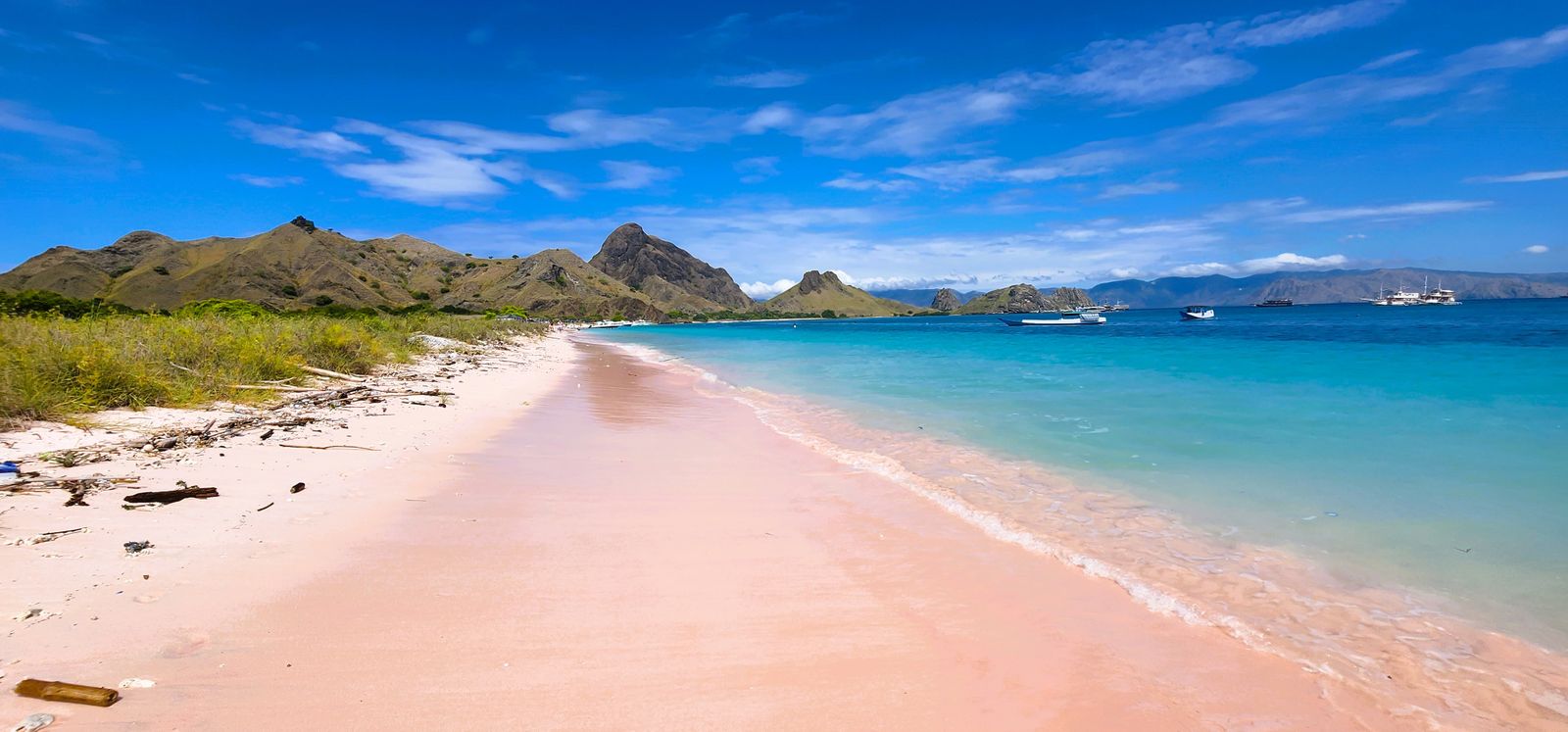
Pink Beach’s blush-coloured sand comes from fragments of red coral mixed with white sand — one of only seven pink-sand beaches in the world. The snorkelling off the beach (5m depth; coral gardens; napoleon wrasse and reef sharks) is among the finest accessible from a beach in Indonesia.
💡 Pink Beach is best before 10am and after 3pm when the day-boat crowds have gone — the snorkelling is as good as the sand, with napoleon wrasse and blacktip reef sharks in the coral gardens.

Manta Point (Karang Makassar) is a cleaning station for reef manta rays — the rays hover in the current while cleaner wrasse remove parasites, often in groups of 5–20 at a time. The site is most productive at high tide when the current direction brings planktonic food from the open ocean.
💡 At Manta Point, stay at the surface and let the mantas come to you — they rise on their own schedule. Diving toward them causes them to flee. The current is strong; a current hook is essential.
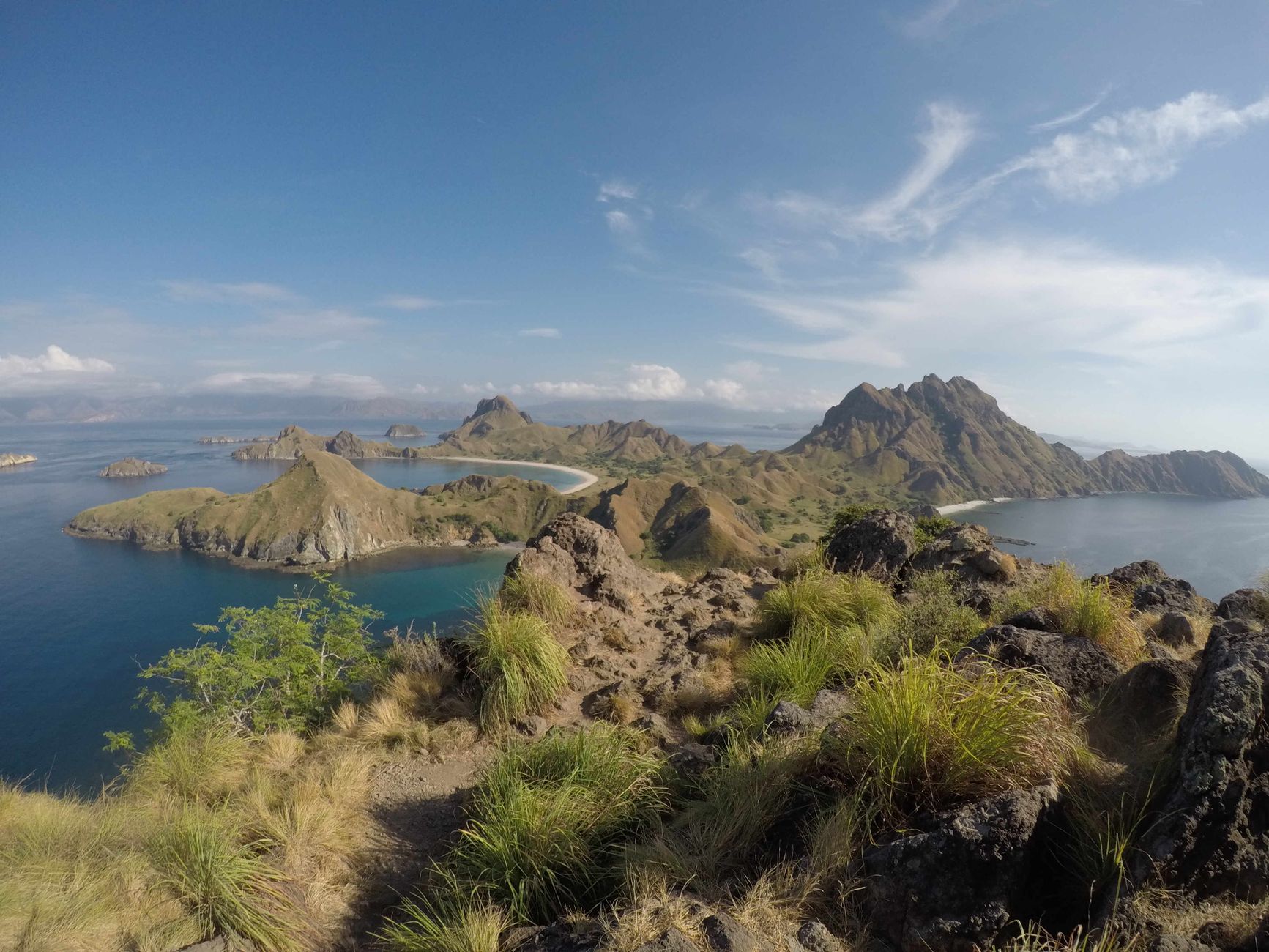
Padar Island’s summit viewpoint (20 min climb from the jetty) looks down over three bays of different colours depending on depth and seabed composition. At sunrise, with the Komodo dragon silhouette profile of the island emerging from the mist, it produces the most reproduced photograph in Indonesian tourism.
💡 The Padar Island sunrise requires a 4am departure from Labuan Bajo — the 20-minute climb from the jetty is straightforward and the three-bay view clears of mist by 7am.
Eating at Komodo is a function of logistics: on the day trip, lunch is a packed meal on the boat (the ikan bakar grilled fish; the white rice; the sambal; provided by the boat operator; included in the day trip price); on the liveaboard, the onboard cook prepares Indonesian meals (the fresh seafood from the local fishermen; the grilled squid and fish at anchor; the morning papaya and the local coffee). In Labuan Bajo, the waterfront restaurant strip (the Kampung Ujung waterfront; the grilled fresh fish restaurants with the harbour view; the tuna, the mahi-mahi, the wahoo, the crayfish caught that morning; IDR 80,000–200,000 for a grilled fish plate with rice and sambal) is the central food experience. The Rumah Makan Mesy (the local rice and fish warung on the main Labuan Bajo waterfront road; IDR 20,000–40,000 for a complete local meal) is the best value food in the town.
Komodo National Park is reached by boat from Labuan Bajo (the port town on the western tip of Flores island; Komodo Airport LBJ; daily flights from Bali with Wings Air or TransNusa; 50 min; IDR 400,000–1,200,000). From Labuan Bajo the options are: the shared day trip boat (IDR 500,000–1,200,000 pp including park entry and ranger; covers Komodo/Rinca dragon trek + Padar viewpoint + Pink Beach + Manta Point; departs 7:30am; returns 5:30pm; the most economical approach), the private charter day boat (IDR 1,500,000–3,000,000 for the boat regardless of group size; up to 8 passengers; more flexible itinerary), or the liveaboard dive boat (USD 150–400 pp/night; 2–4 nights; the full dive programme; the most complete experience). The park can also be reached by the 2-day Lombok–Labuan Bajo overland bus through Sumbawa and the Sape–Labuan Bajo public ferry (the most adventurous and least comfortable approach; 24–36h total).
Never trek Komodo or Rinca without the assigned park ranger — dragons have killed visitors who wandered alone.
The Padar Island viewpoint requires a 4am departure from Labuan Bajo to arrive at sunrise — the 20-minute climb from the jetty gives three bays in different light.
At Manta Point (the feeding station off Karang Makassar), snorkel at the surface and never dive down — the manta rays rise to the surface on their own schedule.
Pink Beach (Pantai Merah) is best before 10am and after 3pm when the day-boat crowds thin — the pink tint is most vivid in raking morning light.
A 2–3 night liveaboard covers sites the day boats never reach — the northern Komodo coast (ghost pipefish, frogfish), Batu Bolong (the finest wall dive in Indonesia), and Crystal Rock (the strongest manta aggregation).
The Komodo National Park requires a minimum Open Water certification for diving — the currents at Crystal Rock and Shotgun are strong enough to challenge experienced divers.
Apr–Dec is the best season (calm seas; good visibility; manta rays most consistently seen Aug–Nov). Jan–Mar: rougher seas; some sites inaccessible; lower prices; the dragons are still there.
Three days based in Labuan Bajo: a Rinca dragon trek, Padar sunrise, Pink Beach, Manta Point, and the Flores inland waterfall as a land day.
4am departure from Labuan Bajo. Padar Island sunrise (the three bays at dawn). Manta Point snorkelling at high tide. Pink Beach afternoon.
💡 Rinca Island (2h from Labuan Bajo by fast boat) has a higher density of dragons near the ranger station than Komodo Island itself — better for shorter visits. Komodo has more habitat for longer treks.
Rinca Island ranger-guided dragon trek (highest dragon density near the ranger station). Snorkelling at Kanawa or Pulau Bidadari. Return to Labuan Bajo for sunset.
💡 The Komodo manta rays are at Manta Point year-round but in highest numbers from April to December when the north-flowing current is strongest. January–March has rough seas and the mantas disperse.
Liveaboard option: Batu Bolong wall dive (the finest in Komodo). Crystal Rock for the manta aggregation. Night dive at the northwest Komodo coast.
💡 Labuan Bajo’s dive operators vary significantly in equipment quality and safety standards — check that tanks are analysed for oxygen content and that briefings cover current direction before each dive.
Komodo is among the more expensive Indonesia destinations due to the boat costs. The day trip (IDR 500,000–1,200,000 pp) is the main cost; the liveaboard is the correct experience. Per person per day.
The shared day trip boat (IDR 500,000–800,000 pp; the most economical approach; the operator manages the park entry, the ranger and the boat itinerary) covers all the main park attractions in a single long day.
The private speedboat for the Padar sunrise (4am departure; IDR 800,000–1,500,000 for the boat regardless of group size; divided between 2–8 passengers) is the single best Komodo investment — the Padar sunrise panorama is worth the 4am alarm.
The private pinisi charter.
Domestic flight and fast boat booking for Labuan Bajo and Komodo National Park access.
Free
Dive safety alerts, depth logging, and decompression planning for Komodo National Park dive sites.
Free
Indonesia marine life identification and wildlife reporting for dragon and manta ray sightings.
Free
Labuan Bajo accommodation and liveaboard boat comparison with safety record filtering.
Free
Komodo National Park entry fee booking and ranger-guided dragon trek reservation.
Free
Download the Labuan Bajo and Komodo National Park offline map before arrival — the park has no mobile signal.
Free
Explore more of Indonesia’s extraordinary cities and landscapes.