BD
Bangladesh
Bengal tigers, river deltas & the world's longest beach
Bengal tigers, river deltas & the world's longest beach
Bangladesh is a country of extraordinary natural drama packed into a small but densely populated delta — one of the world’s great river systems, the Sundarbans mangrove forest (the largest in the world and last refuge of the Bengal tiger), the tea gardens of Sylhet, and the hill tribes and Buddhist monasteries of the Chittagong Hill Tracts. Dhaka, one of Asia’s most chaotic and exhilarating cities, throbs with street food, river ferries and a garment industry that clothes much of the world. The archaeological ruins of Paharpur and Bagerhat are UNESCO World Heritage Sites of pan-Asian significance.
Bangladesh receives relatively few Western tourists and rewards those who come with an intensity of experience — the warmth of local welcome, the extraordinary Rocket paddle-steamer journey down the Padma and Meghna rivers, and landscapes of vivid green rice paddy and river that seem to go on forever.
The world’s largest mangrove forest spans the Bangladesh-India border at the mouth of the Ganges-Brahmaputra delta. A UNESCO World Heritage Site, it supports the world’s largest population of wild Bengal tigers — an estimated 100+ in the Bangladeshi portion. Boat safaris through the intricate waterways past crocodiles, spotted deer and the occasional tiger’s pugmark in the mud are extraordinary. Guided overnight trips from Mongla are the standard approach.
The world’s longest natural sea beach — 120 kilometres of unbroken sand — curves down Bangladesh’s south-eastern coast. Though heavily developed for domestic tourism and busy with Bangladeshi weekenders, the northern end at Himchari and the offshore island of Saint Martin are relatively tranquil. Saint Martin is Bangladesh’s only coral island and a diving and snorkelling destination.
A UNESCO-listed medieval city near Khulna built by the Turkish general Khan Jahan Ali in the 15th century, containing over 360 mosques of which the multi-domed Shat Gombuj Mosque (60 domes) is among the finest examples of early Bengali-Islamic architecture in existence.
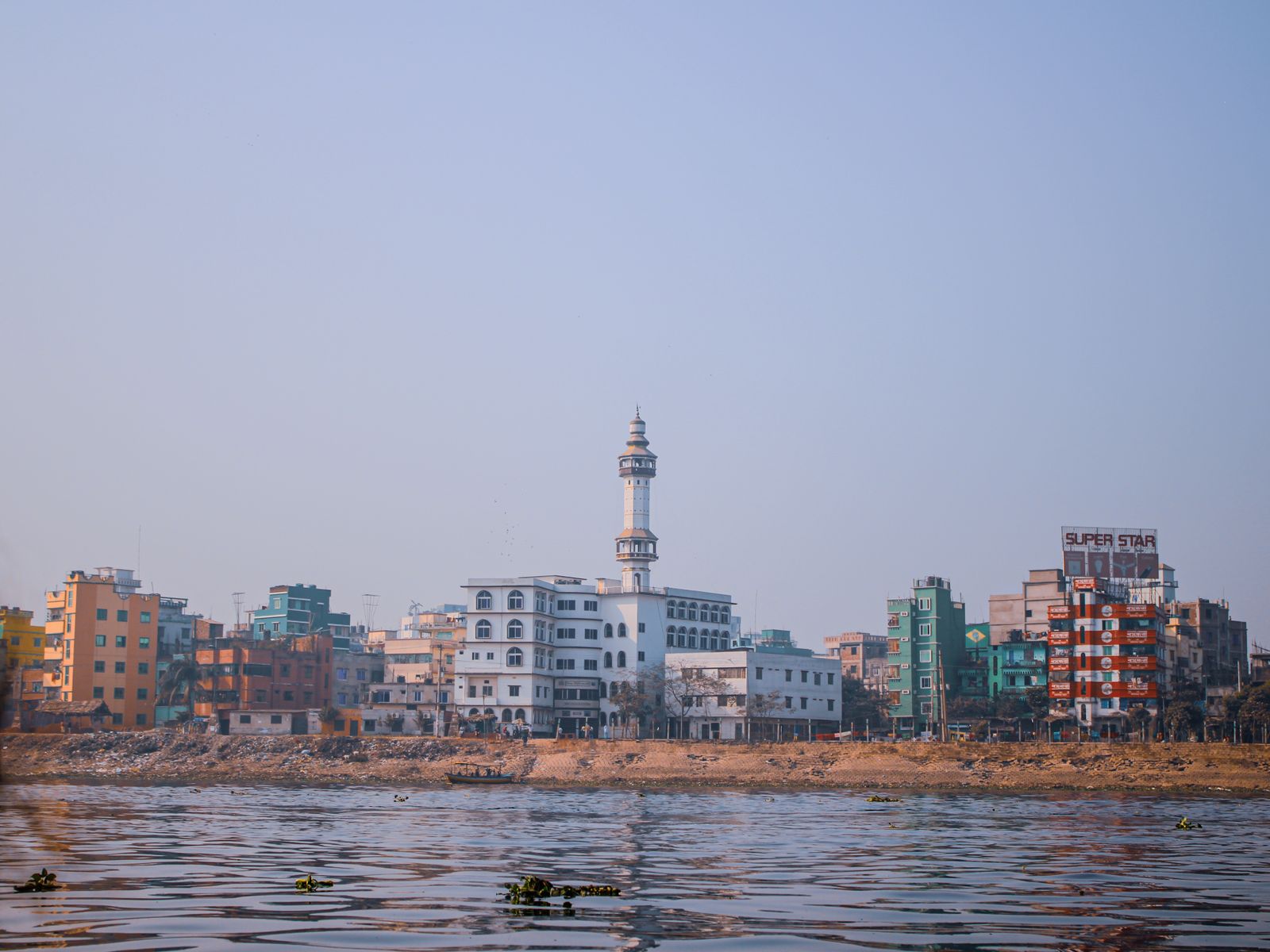
The Mughal-era old city of Dhaka, particularly the Sadarghat river port — one of Asia’s busiest, with hundreds of rocket steamers and country boats navigating the Buriganga River — is an assault on the senses unlike anywhere else. The Armenian Church, Lalbagh Fort, the pink Ahsan Manzil palace and the narrow streets of the old quarter form one of the subcontinent’s most atmospheric historic neighbourhoods.
steamed hilsa fish in mustard and coconut, wrapped in banana leaf) is the national dish — hilsa is revered to the point of cultural identity.
Hilsa fish (Bangladesh’s national fish) cooked in a mustard-turmeric sauce with green chillies — arguably the greatest fish dish of the subcontinent, available only seasonally.
Sweetened yogurt, thickened and set in earthenware pots — the most famous dessert of Bangladesh and West Bengal, best from Bogura.
Fermented rice soaked in water overnight, eaten cold with dried fish, green chilli and mustard oil — the traditional Pohela Boishakh (Bangla New Year) meal.
Spiced rice and lentils cooked dry with ghee, fried onion, cumin and coriander until fragrant and slightly sticky — the comfort food of Bangladesh, eaten on rainy days and at Eid gatherings with beef curry and salad.
are staples. Dhaka’s street food — fuchka (crispy shells filled with tamarind water and chickpeas), chotpoti (spicy chickpea curry) — is outstanding.
set sweetened yoghurt) is the defining dessert.
Hazrat Shahjalal International (DAC) in Dhaka is the main hub. Biman Bangladesh Airlines is the national carrier; Emirates, Qatar Airways and Turkish Airlines serve major routes. For trip planning, see the official Bangladesh tourism portal.
💡 Biman Bangladesh operates a direct Heathrow–Dhaka route in 9h30. Emirates and Qatar Airways via their respective hubs have higher frequency and more consistent reliability.
💡 Kolkata is 1h from Dhaka — the closest international city, and combining Bangladesh with West Bengal India is a natural cultural circuit given shared Bengali language and heritage.
💡 Dhaka traffic is legendary — the city has some of the worst congestion in Asia. Allow 2–3 hours from the airport to any hotel. Travelling before 7am or after 10pm dramatically reduces journey times.
💡 Domestic flights are strongly recommended in Bangladesh — road distances and traffic make overland journeys exhausting. US-Bangla Airlines and Novoair are the most reliable domestic operators.
October to March is the best window — the Cox’s Bazar beach season at its finest, the Sundarbans tiger reserves accessible, Dhaka’s mosques and historic sites in comfortable temperatures. April to June is hot (35–40°C). The monsoon (June–September) is intense but the waterways of the delta fill magnificently.
Bangladesh is among the cheapest countries in Asia — excellent value for accommodation, food and transport, with the USD stretching significantly further than in neighbouring India.
Hilsa (ilish) — the national fish of Bangladesh, a silver herring that migrates from the sea to the Padma and Jamuna rivers to spawn — is the most emotionally important food in the country.
A guided Sundarbans boat tour from Mongla or Khulna (2 days / 1 night, including boat, guide, park fees, food) costs US$80–150pp — one of the most affordable tiger country tours available anywhere in Asia.
The Dhaka Westin and Radisson Blu are Bangladesh’s finest hotels — from BDT 12,000–25,000/night, with the best restaurants in the country and the most reliable infrastructure in a city with frequent power cuts.
Dhaka for two days, the Sundarbans for two, Chittagong and the Hill Tracts for two, Cox’s Bazar for one. Bangladesh is one of the most densely populated and least-visited countries on earth — and genuinely extraordinary.
Dhaka (population 22 million, 44,000 people per km² — the most densely populated megacity on earth) is simultaneously overwhelming and captivating. Old Dhaka (Puran Dhaka) — the Lalbagh Fort (17th century Mughal fort, never completed), the Ahsan Manzil (Pink Palace, 1872, the former residence of the Nawab of Dhaka, now the most ornate colonial building in Bangladesh), the Star Mosque.
💡 The Ahsan Manzil (“Pink Palace”) was the official residence of the Nawab of Dhaka, the wealthiest family in Bengal, from 1872. It contains 28 rooms, a Corinthian-columned facade painted pink, and personal collections including a billiard room and ballroom used to entertain Queen Victoria’s son during his 1875 India tour.
Sadarghat river port — the busiest river port in the world by passenger volume, with 30,000 people arriving and departing on wooden paddle-wheel ferries every day. The Baitul Mukarram National Mosque (1968, the national mosque of Bangladesh, capacity 40,000) and the weavers of Mirpur producing jamdani — the UNESCO-listed muslin weaving tradition of Bangladesh.
💡 Jamdani muslin — a handwoven cotton fabric with geometric floral patterns, produced on traditional looms in Dhaka since Mughal times — is so fine that Mughal emperors called it “woven air.” The finest jamdani (300 thread count) has been produced since the 17th century and UNESCO inscribed it on its Intangible Cultural Heritage list in 2013.
1h flight to Jessore + boat, or overnight ferry from Dhaka. The Sundarbans (UNESCO World Heritage Site, the largest mangrove forest in the world, 10,000km² spanning Bangladesh and India) is home to the largest population of Bengal tigers in Bangladesh — approximately 100 individuals — and 300 species of bird.
💡 The Bengal tiger in the Sundarbans has adapted to swimming between islands — the only swimming tiger population. They kill approximately 50–70 people per year in the Sundarbans, mostly honey collectors and fishermen who enter the forest. Woodcutters traditionally wear masks on the back of their heads, as tigers only attack from behind.
A full day by country boat through the tidal channels — the Sundarbans at high tide, channels reflecting the forest canopy, spotted deer on the mudflats, fishing eagles above, and the possibility of tiger tracks on every riverbank. Irrawaddy dolphins in the larger channels.
💡 The Irrawaddy dolphin (Orcaella brevirostris) lives in the Sundarbans waterways — one of the few remaining coastal populations of a species critically endangered globally. They are identifiable by the absence of a distinct beak. The Sundarbans population is approximately 400 individuals.
1h flight from Dhaka. Chittagong — Bangladesh’s second city and its main port — has the most important ship-breaking yards in the world (Sitakund beach, where supertankers are run aground at high tide and dismantled by hand by 200,000 workers, the steel sold on) visible from the coastal road.
💡 The Chittagong ship-breaking industry dismantles approximately 50–80 large vessels per year — oil tankers, cruise ships, aircraft carriers — in conditions condemned by international labour organisations but representing the primary recycling industry for global shipping steel. Entry is restricted but the scale is visible from the road above.
2h from Chittagong. The Chittagong Hill Tracts (CHT) — a hilly region bordering Myanmar and India, home to 13 indigenous Buddhist hill tribes including the Chakma, Marma and Tripura — is one of the most culturally distinct regions of Bangladesh. Rangamati on Kaptai Lake, surrounded by forested hills.
💡 The Chittagong Hill Tracts have a distinct Buddhist culture entirely different from the Muslim majority of Bangladesh — the Chakma people have their own script, language, weaving tradition and Buddhist monasteries on stilts above the lake. The area requires a special permit for foreign visitors.
1h30 from Rangamati. Cox’s Bazar — 120km of unbroken sandy beach on the Bay of Bengal, the longest natural sea beach in the world — has developed rapidly since the 2000s. The beach at Inani (25km south of Cox’s Bazar town, rocky headlands, entirely undeveloped) is the most atmospheric. Fly from Cox’s Bazar (CXB) to Dhaka.
💡 Cox’s Bazar at 120km continuous beach is the longest natural sea beach in the world — longer than the entire Belgian coast. Despite its scale, it remains largely undeveloped beyond the town itself. The Inani headlands at sunset, with fishing boats returning, are the finest natural scene on the entire beach.
E-visa or visa on arrival available for most nationalities. The process is straightforward and relatively inexpensive.
Bangladesh floods significantly during monsoon season; roads and inland routes can be impassable. November–March is the optimal travel season.
Connected to Singapore, Dubai, London, Bangkok and regional hubs. Biman Bangladesh Airlines flies to over 15 countries.
The Sundarbans mangrove forest, shared with India, is the world’s largest mangrove and home to Bengal tigers and Irrawaddy dolphins. Boat tours from Khulna or Mongla run through November–March.
CNG auto-rickshaws (three-wheelers) and Uber or Pathao ride-apps navigate Dhaka’s legendary traffic. Trains serve long-distance routes; the Rocket paddle-steamer to Khulna is a classic journey.
Avoid Jun–Sep when heavy monsoon flooding affects much of the country. Nov–Feb offers cool, dry weather.
Drink bottled water only. Ensure vaccinations are up to date; consult a travel health clinic before visiting.
— Bangladesh’s leading ride-hailing and delivery app; essential for navigating Dhaka.
Free— Popular transport booking app covering bus, train and ferry tickets across Bangladesh.
Free— Bangladesh’s dominant mobile money platform; useful for paying at markets and small vendors.
Free— Reasonable coverage in Dhaka and major cities; limited in rural areas.
FreePoint your camera at menus, signs or street text for instant translation. Download the language pack offline before you arrive for full use without data.
FreeReal-time and offline exchange rates for all world currencies — converts prices instantly so you always know what you are paying in your home currency.
FreeThe megacity of Dhaka, the long beach at Cox’s Bazar, the Sundarbans mangroves, the tea hills of Srimangal and the peaks of Bandarban — the range of Bangladesh.
Bangladesh sits within easy reach of several other destinations — each with a completely different character.
