MY
Malaysia
Street food capital of the tropics
Street food capital of the tropics

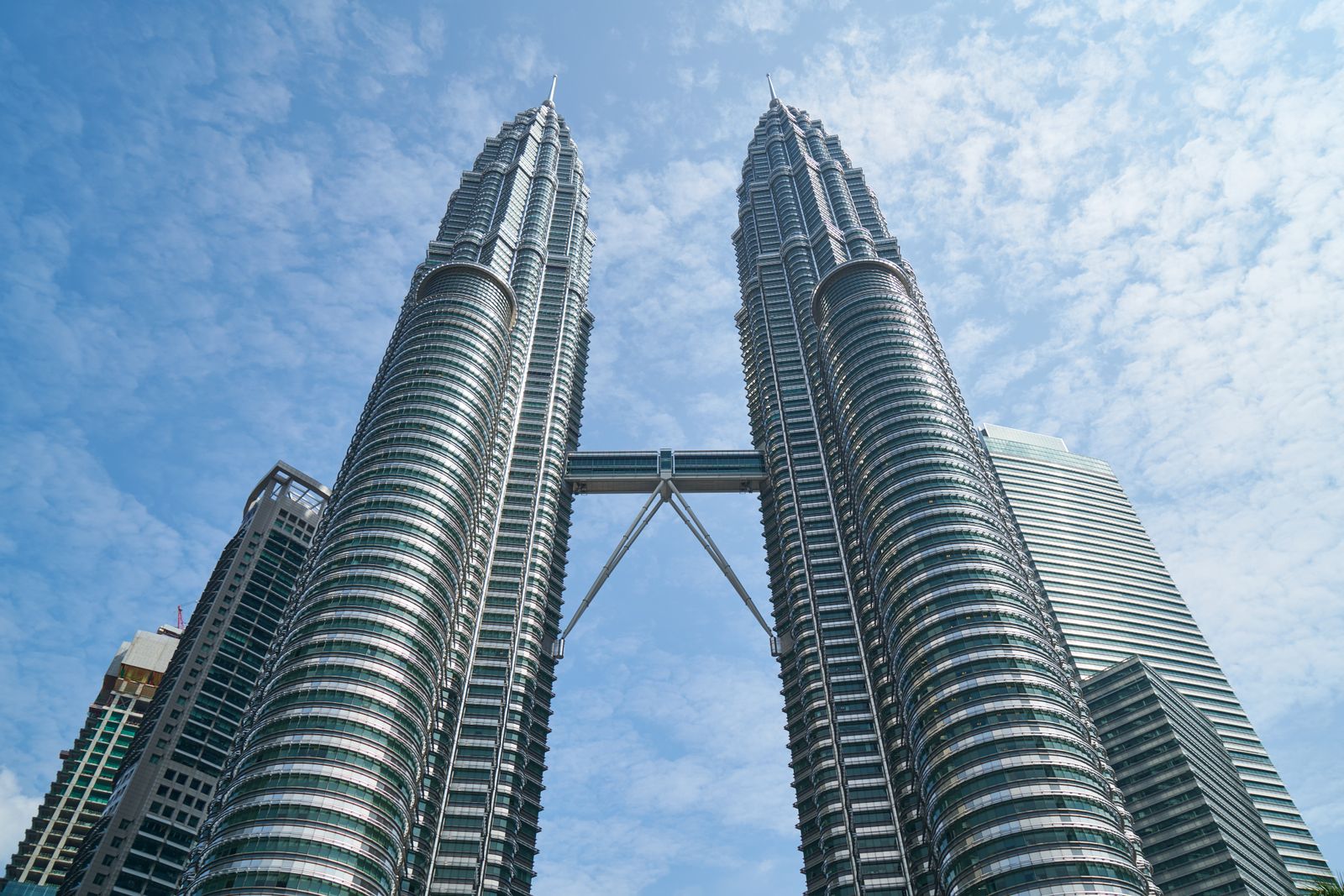
The twin towers at night reflected in the KLCC park fountains, the Skybridge observation deck at 170m and the Batu Caves Hindu temple complex 15 minutes north: the classic KL experience.
Photo: CEphoto, Uwe Aranas, CC BY-SA 3.0

A UNESCO World Heritage city of Chinese temples, colonial shophouses and the world’s finest street food: char kway teow, asam laksa, nasi kandar and the Lorong Baru hawker stalls.
Photo: HundenvonPenang, CC BY-SA 4.0

One of the world’s oldest rainforests (130 million years old): the world’s longest canopy walkway, river boat access to the interior and the possibility of seeing Malayan tigers, tapirs and hornbills.
Photo: Vyacheslav Argenberg, CC BY 4.0

A duty-free archipelago of 99 islands with the Kilim Karst Geoforest Park’s mangrove boat tours, the Skybridge cable car across a mountain ridge and the quietest beaches in Malaysia.
Photo: Andrew Harvey, CC BY 3.0

The Kinabatangan River for proboscis monkeys, orangutans and pygmy elephants at close range; the Danum Valley for the world’s most biodiverse lowland rainforest; and Mount Kinabalu (4,095m) for the finest hike in Southeast Asia.
Photo: Mike Prince from Bangalore, India, CC BY 2.0

Crystal-clear water, sea turtle nesting beaches and some of the best budget diving in Asia. Accessible by speedboat from Kuala Besut on the east coast.
Photo: Vyacheslav Argenberg, CC BY 4.0

A UNESCO Heritage city of Portuguese, Dutch and British colonial architecture above Malay and Chinese kampung culture: the Jonker Street night market and the Baba Nyonya Peranakan museums.
Photo: Atlasmotor, CC BY-SA 4.0

A hill station of tea plantations at 1,500m: the BOH Tea plantation’s glass terrace above the valley, strawberry farms and temperatures 10C below the lowlands.
Photo: Will Ellis from Reading, England, CC BY 2.0
Coconut rice with sambal (chilli paste), anchovies, roasted peanuts, cucumber and a hard-boiled egg. Malaysia’s national dish, eaten for breakfast. The best is at a roadside warung wrapped in banana leaf.
Flat rice noodles stir-fried in pork lard with shrimp, cockles, egg, bean sprouts and dark soy sauce. Penang’s most famous dish; the best comes from hawker stalls that have been serving it for 40 years.
A flaky flatbread made from ghee-enriched dough, cooked on a hot plate until crispy and airy. Served with curry dhal and coconut milk chutney. Eaten at any mamak (Indian-Muslim) stall from midnight to dawn.
A sour tamarind fish broth with thick rice noodles, pineapple, cucumber, onion and shrimp paste. Penang asam laksa was voted the world’s best food by CNN Travel. Not to everyone’s taste; essential to try.
Marinated chicken or beef on bamboo skewers, grilled over charcoal and served with peanut sauce, cucumber and ketupat (rice cake). The national street food; Kajang is the satay capital.
A vast category of small traditional cakes: kuih lapis (layered coconut cake), kuih dadar (pandan crepe with coconut filling) and onde-onde (pandan rice balls with palm sugar). Sold from roadside trays at dawn.
Tiger Beer is the national lager. Teh tarik (“pulled tea”: black tea with condensed milk, poured repeatedly between cups to create a froth) is the all-hours national drink, served at every mamak stall.
Pork ribs slow-simmered in a broth of garlic and spices (peppery in Klang’s style, herbal in Penang). A Chinese-Malaysian breakfast eaten at dawn on weekends.
Kuala Lumpur International Airport (KLIA) is the main hub, served by Malaysia Airlines and AirAsia. Budget terminal KLIA2 handles most AirAsia routes. KL is a major Southeast Asian hub with direct connections across Asia, the Middle East, Europe and Australia. For trip planning, see the official Malaysia tourism portal.
Malaysia Airlines flies direct London Heathrow–Kuala Lumpur. Qatar (via Doha) and Emirates (via Dubai) offer the most connections from UK regional airports.
Australia is one of the best-connected countries to KL — Malaysia Airlines and AirAsia both serve Melbourne, Sydney, Brisbane and Perth directly.
AirAsia’s domestic fares are extremely cheap — KL to Penang from MYR 30 ($6.50) booked ahead. For short hops (Penang to Langkawi: 30 min), flights beat buses completely.
The KLIA Ekspres from the airport to KL Sentral (28 minutes) is the fastest and most reliable airport connection. Buy tickets at the station or online.
Malaysia is warm year-round but the dry/wet seasons vary by coast. The west coast (Kuala Lumpur, Penang, Langkawi) is driest from November to April. The east coast (Perhentian Islands, Tioman) is best from March to October. Borneo varies by location.
📅 Malaysia is in its best season in March, April, May, June, July, August, September, October. See where else is good to go in those months, or browse where to go by month.
Malaysia is excellent value, especially outside Kuala Lumpur’s international hotels. Street food costs almost nothing and is often the best food in the country.
A full hawker centre meal (rice or noodles + two side dishes + drink) costs MYR 8–15 ($1.70–3.20). This is the majority of Malaysians’ daily diet and it’s excellent.
Grab (Southeast Asia’s Uber) is reliable, metered and cheap throughout Malaysia. A 30-minute KL trip costs MYR 12–20. Use it instead of unmarked taxis.
Penang’s modern Malaysian restaurants — Auntie Gaik Lean’s Old School Eatery, Kebaya at Seven Terraces — offer exceptional food at MYR 100–200pp. Far below equivalent quality in Europe or Singapore.
Kuala Lumpur for modern Malaysia, Penang for the best food in the country, Langkawi for beaches and jungle. All connected by budget flights or comfortable trains.
The Petronas Twin Towers — at the time of completion the tallest buildings in the world, still among the most elegant — are best seen from across KLCC Park or from the free viewing area. Bukit Bintang for street food at Jalan Alor in the evening.
Book the Petronas Towers sky bridge online at petronastwintowers.com.my. Free but timed entry only, and it sells out. The view is from floor 41 (sky bridge) rather than the top.
The Hindu Batu Caves temple complex (42m golden Murugan statue at the entrance, 272 rainbow steps to the cave temple) is 30 minutes north by KTM commuter train. Afternoon: the Islamic Arts Museum (one of the finest in the world) and the Merdeka Square area.
KL’s Rapid KL metro system is clean, air-conditioned and cheap — MYR 1.50–4 per trip. The Touch &x27; Go card works across all rail lines.
4h by ETS train from KL Sentral to Butterworth + ferry to Georgetown (10 min). George Town is a UNESCO World Heritage city — a living grid of pre-war shophouses, temples and street art. The food here is the reason many people come to Malaysia at all.
The Penang Hill funicular gives a view over the island and the Straits of Malacca. Take it in the morning before cloud covers the summit.
Penang’s hawker food is the most celebrated in Malaysia: char kway teow (wok-fried rice noodles with cockles and egg), laksa (fish soup with rice noodles), Hokkien mee, nasi kandar. The Ernest Zacharevic street art murals throughout George Town are a genuine cultural phenomenon.
Eat breakfast at the Lorong Selamat char kway teow stall (open from 11:30am, closed by 1pm, queue from 11am) — considered one of the best in Penang.
30-minute flight from Penang to Langkawi. The island is duty-free — alcohol is cheap and available at every 7-Eleven, which is relevant in Muslim-majority Malaysia. The beaches on the west coast (Cenang, Tengah) are excellent; the Langkawi Sky Bridge over the rainforest canopy is impressive.
Rent a scooter on Langkawi — it’s the best way to explore. The island is 480 sq km and most sights require transport. Scooters cost MYR 30–40 per day.
Langkawi’s Kilim Karst Geoforest Park — a mangrove-and-limestone-cave ecosystem — is best explored by boat or kayak. Eagles, monkeys and river otters are regularly seen. The fish farm lunch at the end of most boat tours is surprisingly good.
The bat cave in the mangroves is dark, damp and filled with thousands of cave nectar bats. Go at dusk when they emerge — a cloud of them rising over the mangroves is one of the stranger wildlife spectacles in Southeast Asia.
Fly back to KL from Langkawi (30 min, AirAsia) for your international connection from KLIA. Or add Borneo (Kota Kinabalu, 2.5h from KL) — orangutans, the highest peak in Southeast Asia, dive sites rated among the world’s best.
Kota Kinabalu Airport is served by direct flights from Langkawi and from KL on AirAsia and Malaysia Airlines — a practical Borneo add-on.
Grab is the dominant ride-hailing app in all Malaysian cities.
A plate of char kway teow at a hawker stall: MYR 5-8 (EUR 1-2). Restaurant meals: MYR 20-50.
Covered shoulders and knees are appropriate in mosques, rural areas and smaller towns.
The interplay between Malay, Chinese, Indian and Peranakan cultures produces one of the most interesting social fabrics in Asia.
Both available at KLIA airport. Maxis has the best nationwide 4G coverage.
During Ramadan, most restaurants in Muslim areas are closed during daylight hours. Non-halal restaurants remain open.
KL to Penang: 55 min; KL to Kota Kinabalu: 2h25. Book cheap domestic flights through AirAsia.
Terima kasih (thank you) and selamat pagi (good morning) are received with genuine warmth.
Quick answers to the questions people most often ask before visiting Malaysia.
Malaysia is warm year-round but the dry/wet seasons vary by coast. The west coast (Kuala Lumpur, Penang, Langkawi) is driest from November to April.
Kuala Lumpur International Airport (KLIA) is the main hub, served by Malaysia Airlines and AirAsia. Budget terminal KLIA2 handles most AirAsia routes. KL is a major Southeast Asian hub with direct connections across Asia, the Middle East, Europe and Australia.
Expect roughly MYR 80–150 (about $17–32) a day on a budget and MYR 250–450 (about $53–96) mid-range, or MYR 800+ (about $170+) for a more luxurious trip, per person and excluding flights.
Malaysia uses the MYR.
Plug types: Type G (UK three flat pins, 240V).
The dominant ride-hailing, food delivery and payments app in Malaysia — covers taxis, GrabCar and GrabFood.
FreeKuala Lumpur’s official transit app — plan trips on LRT, MRT, Monorail and RapidKL buses.
FreeFood delivery across Malaysia — wide restaurant coverage in KL, Penang, Johor Bahru and other cities.
FreeBook Batu Caves tours, KL tower entry, Penang food walks and island activities across Malaysia.
FreeBook hotels and resorts across Malaysia — strong coverage of Langkawi, Penang and the East Coast.
FreeExplore Malaysia’s top city destinations — from Penang to Cameron Highlands, each with its own distinct character.
Malaysia sits within easy reach of several other destinations — each with a completely different character.


