TH
Thailand
Island mornings and night-market feasts
Island mornings and night-market feasts

The Grand Palace complex with Wat Phra Kaew (the Emerald Buddha, Thailand’s most sacred image), Wat Pho (the reclining Buddha, 46m long) and Wat Arun (the Temple of Dawn) across the Chao Phraya River.
Photo: Basile Morin, CC BY-SA 4.0

The Sunday Night Market, the Saturday Warorot Market, the 304 temples within the old city moat and the Doi Suthep temple on the mountain above the city.
Photo: CEphoto, Uwe Aranas, CC BY-SA 4.0

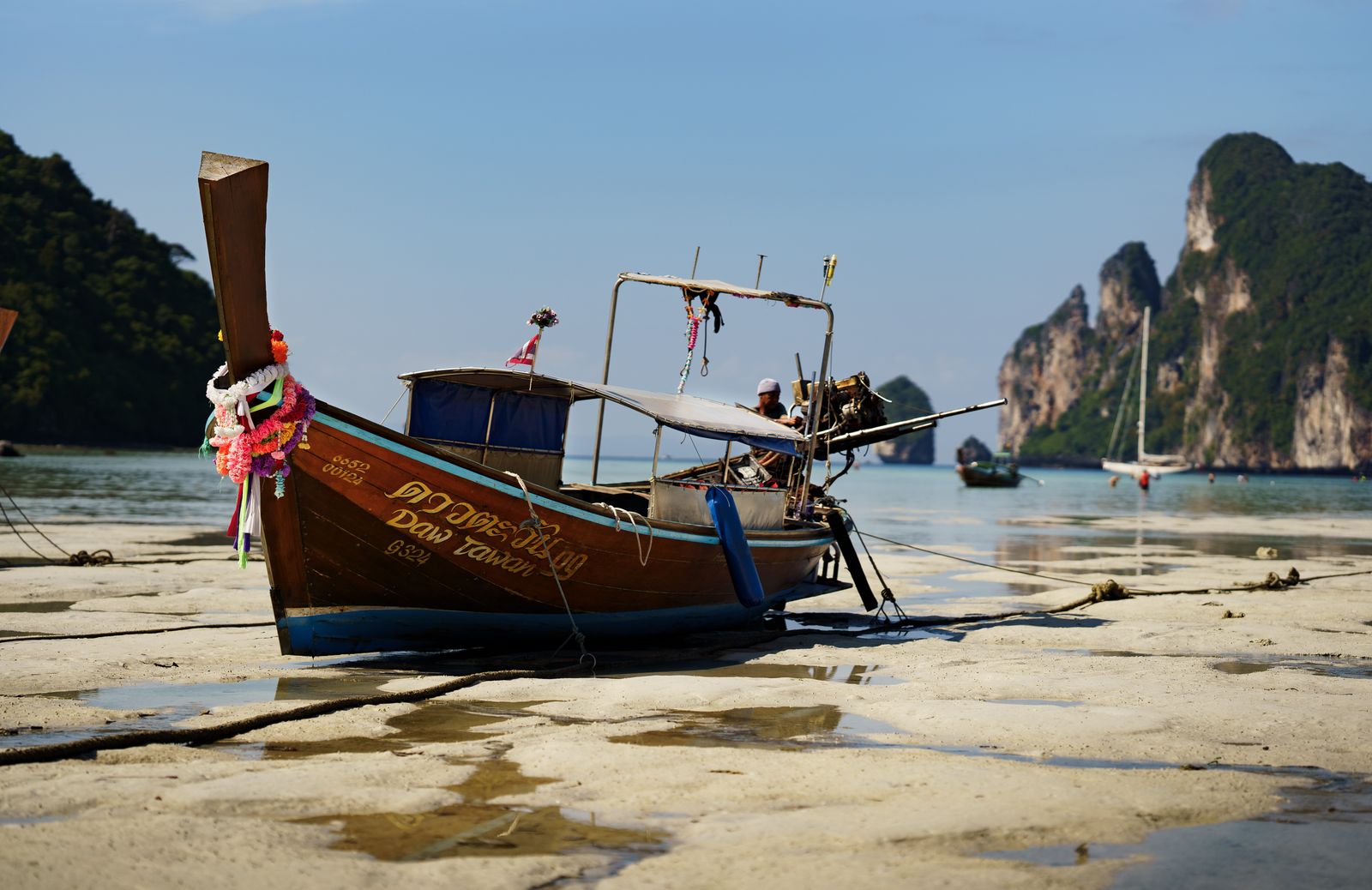
Towering limestone karst cliffs emerging from the Andaman Sea: Railay Beach (accessible only by longtail boat), the four islands of Koh Lanta and Koh Phi Phi’s Maya Bay.
Photo: Vyacheslav Argenberg, CC BY 4.0

Wat Rong Khun (the White Temple), the Black House and the point where Thailand, Myanmar and Laos meet at the Golden Triangle on the Mekong River.
Photo: Vyacheslav Argenberg, CC BY 4.0

The ruins of Thailand’s first capital (13th-14th century): 190 temples spread over 70km, the finest being Wat Mahathat with its lotus-bud towers reflected in a moat.
Photo: Philip Nalangan, CC BY 4.0

Koh Tao: the world’s cheapest PADI dive certification, with some of the finest beginner diving in Asia. Koh Lanta: quieter, less developed, with mangroves and long beaches.
Photo: No machine-readable author provided. Neitram assumed (bas…, CC BY-SA 3.0

The ruins of the Ayutthaya Kingdom (1351-1767): massive sandstone temples, the famous Buddha head entwined in tree roots at Wat Mahathat and 80+ temples spread across an island in the Chao Phraya.
Photo: Evilarry, Public domain

A small town in a mountain valley 3 hours from Chiang Mai: rice fields, waterfalls, hot springs and one of the most relaxed atmospheres in Thailand.
Photo: Vyacheslav Argenberg, CC BY 4.0
Stir-fried rice noodles with egg, tofu or shrimp, bean sprouts, spring onions and ground peanuts, dressed with tamarind, fish sauce and lime. The international face of Thai food.
A hot and sour shrimp soup with lemongrass, kaffir lime leaves, galangal and Thai chillies. Arguably the most complex soup in the world.
Sweet glutinous rice served with fresh mango and coconut cream. Eaten as a street food dessert from March to May when mangoes are in season.
Thai green curry paste (green chilli, lemongrass, galangal) in coconut milk with chicken, eggplant and Thai basil. The fragrant heat is different from Indian curry.
Poached chicken over rice cooked in chicken stock, with ginger-garlic dipping sauce. Hainanese chicken rice as the Thais make it – simpler and purer than the Singapore version.
Thailand’s two national lagers. Ice-cold on a beach. The quality is good.
Strongly brewed Ceylon tea, sweetened with sugar and condensed milk, served over ice with evaporated milk. Orange and intensely sweet.
Thai street food carts selling pad see ew, khao pad, boat noodles and grilled pork on skewers are the finest fast food in the world.
Thailand’s main international gateway is Bangkok Suvarnabhumi (BKK), one of Southeast Asia’s busiest hubs. Don Mueang (DMK) handles budget carriers. Chiang Mai (CNX) and Phuket (HKT) have direct international routes. For trip planning, see the Amazing Thailand tourism portal.
Thai Airways flies direct London Heathrow–Bangkok. Qatar (Doha hub), Emirates (Dubai hub) and Etihad (Abu Dhabi hub) offer the best prices via their Gulf hubs.
Australia is one of the best-connected countries to Thailand — Thai Airways and Jetstar operate direct Sydney–Bangkok routes.
AirAsia and Nok Air offer the cheapest domestic fares — Bangkok to Chiang Mai from ฿600 (~$17) booked ahead. Bangkok Airways monopolises Koh Samui routes and charges accordingly.
The overnight train Bangkok–Chiang Mai (12h, sleeper) is one of the great rail journeys in Southeast Asia. Book on thairailwayticket.com or at Hua Lamphong station.
November to April is Thailand’s dry season — the best time for beaches and temples alike. The rainy season (May–October) brings heat and daily afternoon showers; you can still visit, but the islands are rough. September and October are the wettest months.
📅 Thailand is in its best season in January, February, March, November, December. See where else is good to go in those months, or browse where to go by month.
Thailand is outstanding value at the budget level and reasonable at mid-range. The best food in the country costs almost nothing — street stalls and local restaurants beat hotel restaurants every time.
A pad thai from a street wok costs ฿60–80 (~$1.70–2.20). It is better than most ฿800 versions in hotel restaurants. Eat where Thais eat.
A night at a pool-villa resort in Chiang Mai or a sea-view bungalow in the islands costs ฿1,500–3,000 at this level — good value by Western standards.
Koh Samui and Phuket have private pool villas from ฿8,000–15,000 per night (~$225–420). A fraction of equivalent Caribbean or Maldives prices.
Bangkok for temples and food, Chiang Mai for culture and the north, the islands for the rest. A week works perfectly with two internal flights.
Eat on the street as soon as you land. Pad kra pao (basil pork) from a roadside wok for ฿60 is the correct first meal in Thailand. Walk Yaowarat (Chinatown) in the evening.
Install the Grab app before you arrive — the metered taxis and Grab are the safest options in Bangkok. Avoid unmarked cabs that approach you.
Wat Phra Kaew (Temple of the Emerald Buddha) and the Grand Palace: arrive early (8:30am), dress modestly (shoulders and knees covered or hire a wrap at the gate). Wat Pho for the reclining Buddha. Cross the river to Wat Arun at sunset.
Wat Phra Kaew/Grand Palace requires covered shoulders & knees. Sarongs are available to borrow at the gate. Dress appropriately before going — the rules are enforced.
Chatuchak Weekend Market (Saturday/Sunday only) — 15,000 stalls, every Thai craft, food and curiosity. Or: the Floating Market at Damnoen Saduak (70 min from Bangkok). Asiatique night market on the river in the evening.
The Or Tor Kor fresh market near Chatuchak is where Bangkok’s chefs shop. The tropical fruit section alone is worth the trip.
1-hour flight to Chiang Mai. The Old City is surrounded by a moat and packed with temples — Wat Chedi Luang and Wat Phra Singh are the finest. The Sunday Walking Street market fills the Old City from 4pm.
The best cooking classes in Thailand are in Chiang Mai — half-day market-to-wok courses run ฿1,000–1,500 (~$28–42). Genuinely worth it.
Thailand’s highest peak (Doi Inthanon, 2,565m) is 2h from Chiang Mai — cool forest, waterfalls and the royal chedis at the summit. Afternoon: elephant sanctuary visit (choose an ethical one — no riding).
Elephant Nature Park near Chiang Mai runs full-day ethical elephant visits from ฿2,500. Book ahead — it’s the most visited and most respected ethical sanctuary.
Domestic flight to Koh Samui (KSO), Krabi (KBV) or Phuket (HKT). East coast (Koh Samui, Koh Phangan) is best Nov–Apr; west coast (Krabi, Phuket) can be visited the same period. Book your longtail boat to Koh Lanta or Railay.
Railay Beach (accessible only by boat from Krabi town) has some of the most dramatic limestone karst scenery in Thailand — and no cars, since there’s no road access.
Final day on the water. Take a longtail to a quiet bay. Snorkel. Eat fresh grilled fish at a beach shack. Fly home from the relevant island airport.
The islands are significantly cheaper than the mainland resorts. A bungalow with a sea view on Koh Lanta costs ฿500–800 (~$14–22) per night.
Grab works throughout Thailand in all major cities and tourist destinations.
A street food meal: THB 50-100 (EUR 1-3). Restaurant meals are correspondingly cheap.
Remove shoes, cover shoulders and knees at all wats. Never point feet at a Buddha image or a monk.
Warmth, patience and sanuk (fun) characterise most interactions with Thai people.
The overnight train from Bangkok to Chiang Mai (sleeper berth, 12 hours) is an experience and a money-saver simultaneously.
Drink bottled or filtered water throughout Thailand.
The water festival fills every street with water fights for 3 days. Wonderful or overwhelming depending on your preference.
Both give excellent 4G data at very low prices.
Quick answers to the questions people most often ask before visiting Thailand.
November to April is Thailand's dry season — the best time for beaches and temples alike. The rainy season (May–October) brings heat and daily afternoon showers; you can still visit, but the islands are rough.
Thailand's main international gateway is Bangkok Suvarnabhumi (BKK), one of Southeast Asia's busiest hubs. Don Mueang (DMK) handles budget carriers. Chiang Mai (CNX) and Phuket (HKT) have direct international routes.
Expect roughly ฿800–1,500 (about $22–42) a day on a budget and ฿2,500–4,500 (about $70–125) mid-range, or ฿10,000+ (about $280+) for a more luxurious trip, per person and excluding flights.
Thailand uses the Thai Baht (฿).
Plug types: Type A / B / C (mixed; bring universal adaptor).
The dominant ride-hailing and food delivery app in Thailand — covers taxis, bikes, tuk-tuks and express delivery.
FreeAlternative ride-hailing across Bangkok and major Thai cities — often cheaper than Grab.
FreeBook island-hopping tours, Muay Thai shows, Thai cooking classes and skip-the-line attractions.
FreeThailand’s dominant messaging app — used by hotels, restaurants and tour operators for contact.
FreeBook hotels across Thailand — Agoda is based in Bangkok and has the strongest Thai hotel inventory.
FreeExplore Thailand’s top city destinations — from Chiang Mai to Bangkok, each with its own distinct character.
Thailand sits within easy reach of several other destinations — each with a completely different character.


