MM
Myanmar
Golden temples and misty ancient kingdoms
Golden temples and misty ancient kingdoms
⚠️ Travel advisory: most governments advise against travel
The US advises against all travel to Myanmar, and other governments advise against travel to much of the country, because of armed conflict following the 2021 coup, land mines and arbitrary detention. Check current advice before any visit.
Latest official advice: UK FCDO · US State Department · Reviewed September 2026

2,000+ Buddhist pagodas and temples on a dusty plain: the Shwezigon Pagoda, the Htilominlo Temple and the Dhammayangyi (the largest) visible from a hot air balloon at sunrise – the most striking Buddhist landscape in Southeast Asia.
Photo: Vyacheslav Argenberg, CC BY 4.0

A lake of floating villages and gardens: the leg-rowing Intha fishermen, the Phaung Daw Oo pagoda accessible by long-tail boat and the 5-day rotating market at the lake villages.
Photo: Marc Veraart from Haarlem, Netherlands, CC BY 2.0

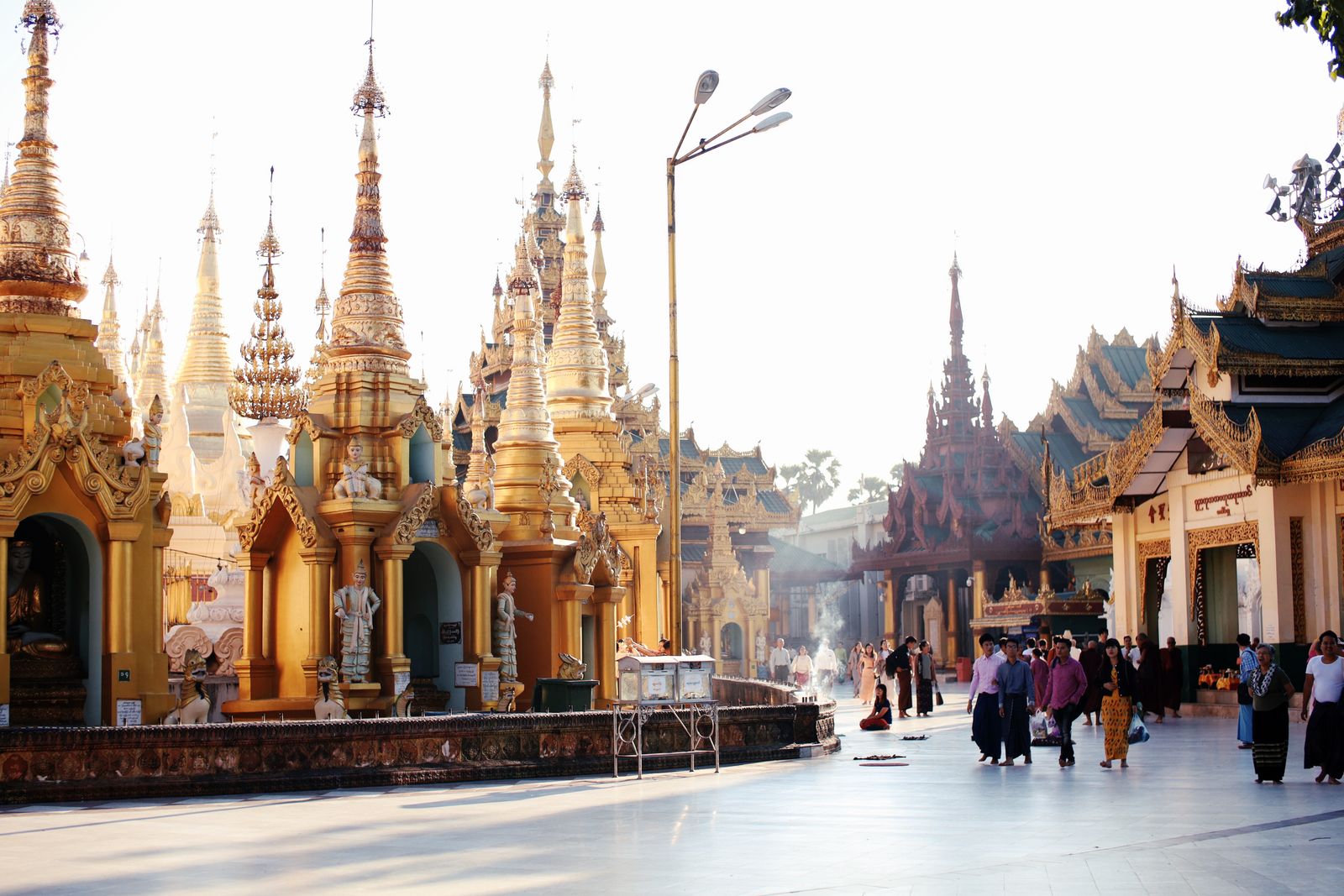
The Shwedagon: a 98m gilded stupa encrusted with 27 tonnes of gold leaf and 4,531 diamonds, standing on a hilltop above Yangon. The most sacred Buddhist site in Myanmar.
Photo: Jakub Hałun, CC BY-SA 4.0

The U Bein Bridge (the world’s longest teak bridge, 1.2km, built 1850) at sunset, the Kuthodaw Pagoda’s 729 marble inscriptions of the Buddhist scriptures and the Mandalay Hill sunset view.
Photo: Vyacheslav Argenberg, CC BY 4.0

A small market town in the Shan highlands: trekking to Palaung and Shan villages, a 2-day hike through tea plantations and the Shan plateau landscape above 1,200m.
Photo: nelumbo, CC BY 2.0

An ancient Buddhist capital of 300 stone temples (15th-18th century) in a jungle valley: far less visited than Bagan but equally atmospheric, accessible by river boat from Sittwe.
Photo: Gerd Eichmann, CC BY-SA 4.0

A 5.5-tonne golden-painted boulder balanced on the edge of a cliff at 1,100m, said to be held by a strand of the Buddha’s hair: one of the most sacred pilgrimage sites in Myanmar.
Photo: Philip Nalangan, CC BY 4.0

A small town of karst scenery: the Saddan Cave’s Buddhist statues accessible by row boat, the Kawgun Cave’s 1,000-year-old votive figures and a limestone landscape of unexpected drama.
Photo: Anagoria, CC BY 3.0
Rice noodle soup in a catfish broth with ginger, lemongrass, banana stem and chickpea fritters: the national breakfast of Myanmar, eaten at bamboo stalls at dawn throughout the country.
Fermented tea leaves with fried garlic, sesame, peanuts, tomato and dried shrimp: the most distinctively Burmese dish, eaten as a starter or palate cleanser.
Thin rice noodles with marinated pork, sesame oil, tomato and bean sprouts: the noodle culture of the Shan Plateau, lighter and more complex than Thai or Vietnamese noodle dishes.
Thick round rice noodles with chicken curry, fried onion and hard-boiled egg: tossed together at the table. Yangon’s favourite weekend breakfast.
Myanmar’s tea shop culture: sweet milky tea drunk at tiny tables on low stools. Palm sugar toddy is the traditional Burmese mildly alcoholic sweet drink.
Myanmar Beer and Dagon are the two national lagers. Cold beer at a riverside restaurant in Mandalay is the correct end to a day.
A mild, oil-heavy curry of pork or chicken with tomato, turmeric and fish sauce: a slower, more restrained curry style than Thai or Indian.
Crispy samosas crumbled over a salad of yellow lentil sauce, onion, coriander and lime: street food eaten standing at Yangon’s street markets.
Both available at the airport. 4G coverage is limited outside major cities.
Myanmar’s banking system remains unreliable. Bring enough cash for your entire trip.
The political situation since the 2021 coup means some areas require extra care. Check your government’s current advisories before travel.
Support local families and avoid hotels with known military connections.
Myanmar’s road network is slow. Yangon to Bagan: 1h flight vs 10h bus.
Despite the political complexity, ordinary Burmese people are among the most warmly hospitable in Southeast Asia.
Remove shoes and cover shoulders and legs at all Buddhist temples.
The Burmese greeting (min-guh-lah-bah). Warmly received.
Yangon (RGN) is the main hub; Mandalay (MDL) and Bagan (NYU) also receive some international flights. Air KBZ and Myanmar Airways serve domestic routes. Check current FCO / State Dept travel advisories before booking.
Bangkok and Singapore are the primary connecting hubs for Yangon. Check current airline schedules as routes have changed since 2021.
Bangkok is the most convenient hub for Myanmar — multiple daily connections to Yangon in 1h30 from both Suvarnabhumi (BKK) and Don Mueang (DMK) airports.
Domestic flights are essential for the classic circuit — road travel is slow and overnight buses unreliable. Book through a local agent as online booking can be difficult from abroad.
Bring USD cash in excellent condition (no folds, no writing, pre-2009 notes often refused). Many hotels and guesthouses price in USD and exchange at local rates.
November to February is the dry season and the ideal window — cool in Inle Lake and Mandalay, clear skies over Bagan, and the country at its most accessible. March to May grows increasingly hot. The monsoon (June–October) brings heavy rains that close some roads.
📅 Myanmar is in its best season in January, February, November, December. See where else is good to go in those months, or browse where to go by month.
Yangon for one day, Bagan for two, Inle Lake for two, Mandalay for two. The classic Myanmar circuit — one of the most compelling itineraries in mainland Southeast Asia. Check current FCO or State Dept advisories before travel.
The Shwedagon Pagoda (98m high, covered in gold leaf, topped with 5,448 diamonds) is the most sacred Buddhist site in Myanmar. At sunset, the sky turning pink behind the gold stupa, it is one of the most visually striking buildings in Southeast Asia.
The Shwedagon can be approached from four staircases at the cardinal points. Remove shoes at the base. The night puja prayer ceremony begins at 7pm and the pagoda operates all night.
1h flight to Bagan (NYU). A 42km² plain with over 3,000 Buddhist temples built between the 9th and 13th centuries — one of the great archaeological sites of Asia. The Ananda Temple (1105, four standing Buddhas) and Dhammayangyi (the largest temple, 12th century).
Hot-air balloon flights over the plain at dawn (October–April, US$350–500pp for 1h) are the most famous Bagan experience. The temples below in the morning mist, balloons drifting over them — book weeks ahead in peak season.
Rent an e-bike (US$5–8/day) and navigate self-guided between the temples. The small unrenovated temples of the east plain — away from the main circuit — have original 12th-century Jataka frescoes still visible inside and are largely unvisited.
The Minnanthu area in the east of the plain has a cluster of smaller temples with intact paintings from the 12th–13th century. Entirely accessible, rarely visited. Most tourists never reach them.
1h flight to Heho (HEH). Inle Lake (116km², 880m altitude) has entire villages built on stilts above the water, floating gardens, and the Intha fishermen who row standing on one leg with their other leg wrapped around the oar.
The leg-rowing technique of the Intha fishermen is entirely specific to this lake — developed to keep both hands free for the conical fishing net. It is not a tourist performance; the fishermen are working.
Boat tour of the floating tomato and flower gardens anchored to the lake bed. Indein village at the southern end: a hilltop covered in hundreds of crumbling stupas in various states of collapse, with a covered walkway up from the boat landing.
Indein’s ruined stupa field is one of the most atmospheric sites in Myanmar — a jungle of ancient pagodas, some restored, others disappearing into vegetation.
1h flight to Mandalay (MDL). Mandalay Hill at sunset (1,700 steps to the top). The Mahamuni Pagoda — a Buddha image encrusted with 15cm of gold leaf applied by male devotees over centuries. The Kuthodaw Pagoda — 729 marble slabs inscribed with the entire Buddhist Tripitaka, the world’s largest book.
The Mahamuni Buddha image has been touched by so many gold-leaf applications that the arms and lower body have merged into a single mass — visually striking and unlike any other sacred image in Southeast Asia.
U Bein Bridge — the world’s longest teak bridge, 1.2km across Taungthaman Lake, built in 1850 — at sunrise or sunset when fishermen in triangular hats work the shallows. Fly back to Yangon for international connections.
U Bein at sunset — the silhouettes of monks and fishermen on the ancient teak walkway with the lake burning gold below — is one of the most reproduced images in Myanmar for good reason.
Myanmar is relatively affordable but USD cash is widely preferred over the kyat. Bring clean, undamaged USD bills — pre-2009 notes and torn bills are often refused.
Mohinga — rice noodles in fish-and-lemongrass broth with crispy fritters, lime and chilli — is Myanmar’s national breakfast and costs US$0.50–1.50 at a roadside stall. The best way to start any day in Myanmar.
Shan cuisine — Shan noodles in tomato and sesame broth, tofu salads, pickled tea leaf salad (lahpet thoke) — is the most distinctive regional food in Myanmar and almost unknown outside the country.
Inle Princess Resort (stilted bungalows over the lake) and Bagan’s Belmond Governor’s Residence are Myanmar’s most considered hotels — from US$200–400/night in the current market.
Quick answers to the questions people most often ask before visiting Myanmar.
November to February is the dry season and the ideal window — cool in Inle Lake and Mandalay, clear skies over Bagan, and the country at its most accessible. March to May grows increasingly hot.
Yangon (RGN) is the main hub; Mandalay (MDL) and Bagan (NYU) also receive some international flights. Air KBZ and Myanmar Airways serve domestic routes. Check current FCO / State Dept travel advisories before booking.
Expect roughly US$30–50 a day on a budget and US$100–180 mid-range, or US$300+ for a more luxurious trip, per person and excluding flights.
Myanmar uses the MMK.
The US advises against all travel to Myanmar, and other governments advise against travel to much of the country, because of armed conflict following the 2021 coup, land mines and arbitrary detention. Check current advice before any visit. Always check current official travel advice before booking.
Ride-hailing in Yangon and Mandalay — the safest and most transparent transport option in major Burmese cities.
FreeMyanmar’s local ride-hailing app — good coverage in Yangon and a locally owned alternative to Grab.
FreeBook Bagan temple sunrise tours, Inle Lake boat trips, Mandalay monastery visits and Burmese experiences.
FreeMyanmar’s widely used messaging app — contact guesthouses, drivers and tour operators.
FreeFacebook Messenger is extremely popular in Myanmar — many local businesses communicate only through this platform.
FreeBook guesthouses and hotels across Myanmar — Bagan and Inle Lake accommodation fills up quickly.
FreeThe golden Shwedagon and colonial Yangon, 2,000 temples of Bagan at sunrise, the floating gardens of Inle Lake, intact Ngapali Beach, and the karst caves of Hpa-An.
Myanmar sits within easy reach of several other destinations — each with a completely different character.


