YT
Mayotte
France's Indian Ocean secret — the world's largest lagoon
France's Indian Ocean secret — the world's largest lagoon

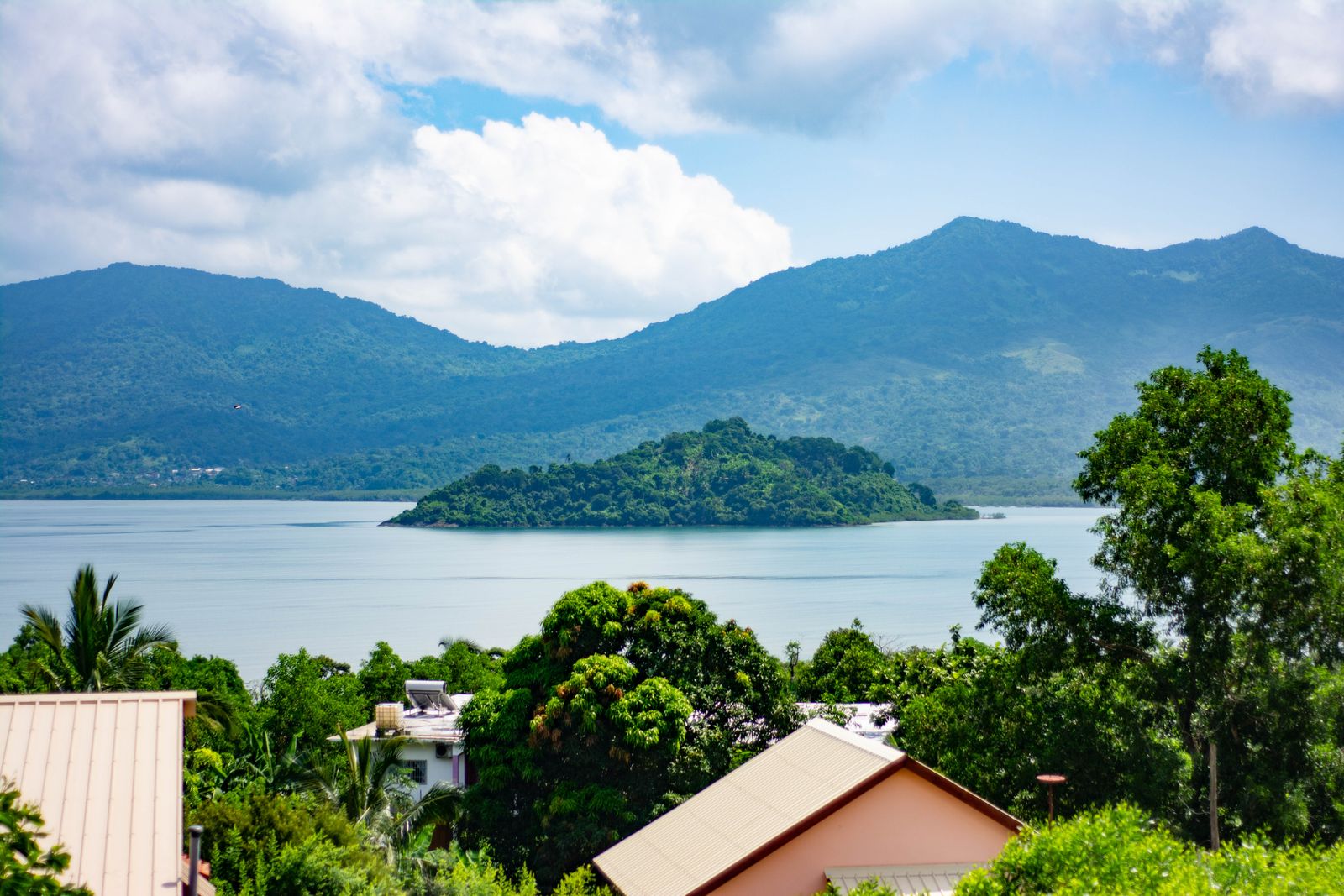
The world’s largest barrier reef lagoon — a 1,100 km² enclosed lagoon of turquoise water surrounded by a double barrier reef. One of the most biodiverse lagoons on earth, home to sea turtles, dugongs (the last significant Indian Ocean population near human habitation), humpback whales (June-September) and 3,000+ marine species.
Photo: Axelspace Corporation, CC BY-SA 4.0

A cluster of uninhabited islets north of Mayotte — white sand beaches in crystal clear water with excellent snorkelling, accessible only by boat from Mtsamboro village. The most beautiful beaches in Mayotte, completely free of tourist infrastructure.
Photo: AudrasJb, CC BY-SA 4.0
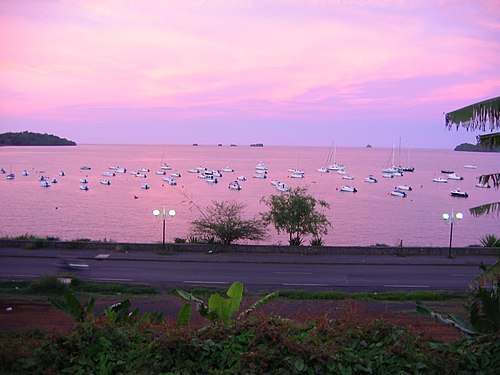
The main town straddling the coast — the colourful morning market (marché du cococter) is one of the finest in the Indian Ocean, with tropical fruits, spices, local crafts and the mix of Comorian and French culture that defines Mayotte’s unique character.
Photo: Julien.noel, Public domain

An emerald crater lake on the smaller of Mayotte’s two main islands — the vivid green colour comes from algae in the saline volcanic water. A short hike from the road reveals extraordinary views; the lake is a spiritual site for the local community.
Photo: Franck Bouttemy http://www.geodiversite.net/auteur197, CC BY-SA 3.0
Mayotte has one of the last viable dugong populations in the Indian Ocean near human habitation — these gentle sea mammals graze on seagrass in the lagoon’s shallow bays and can be spotted from boats. One of the most reliable dugong watching sites in the world.
A freshwater reservoir in the forested highlands of Grande-Terre — the surrounding forest is the last significant remnant of Mayotte’s original native forest, with Mayotte sacred ibis, Comoro blue pigeon and various endemic reptiles. One of the island’s best birdwatching sites.
Mayotte (Wikipedia) →Slowly cooked cassava or banana leaves with coconut milk and local spices — the defining dish of Comoro-Mayotte cuisine, eaten with grilled fish or chicken at every family meal. The coconut milk gives it a rich, silky texture; the local spicing includes cumin, cinnamon and cardamom.
Octopus grilled on skewers over charcoal after marinating in spices, lime and garlic — a Mahorais speciality found at beach restaurants and the Mamoudzou market. The lagoon’s clear water produces particularly fresh and tender octopus.
A large Indian Ocean fish grilled whole over charcoal — the most popular fish at Mayotte’s beach grills, served with rice, mataba and rougail (spiced tomato chutney). The fish is caught daily from the lagoon and has a delicate, sweet flesh.
As a French overseas territory, Mayotte serves the classic ti’punch — white rum from Martinique or Réunion, fresh lime and cane syrup. The French Caribbean cocktail culture is fully established in Mayotte’s restaurants and beach bars.
A Malagasy-influenced stew of zebu beef slow-cooked with wild greens (bredy), tomato and ginger — reflecting the mixed Comorian, Malagasy and French culinary heritage of Mayotte. A deeply flavoured one-pot dish eaten over rice throughout the island.
Mayotte’s proximity to the Comoro Islands — one of the world’s leading vanilla producers — means local markets sell extraordinary fresh vanilla pods, vanilla-infused coffee and ylang-ylang spiced teas at prices far below those found in Europe.
Dzaoudzi-Pamandzi Airport (DZA) on Petite Terre is the gateway. Air France and Corsair serve the main routes from France; Air Austral connects to Réunion. For trip planning, see the official Mayotte tourism portal.
Air France and Corsair (10h from Paris, several weekly) are the primary connections from metropolitan France. Combining Mayotte with Réunion (éUnion, 1h30 by Air Austral) is the most common Indian Ocean itinerary.
Nairobi (2h30) is the most convenient East African gateway. The Comoros (30 min) allow an easy combination; Madagascar (1h30) completes a natural Indian Ocean circuit.
The barge ferry between Petite Terre (airport and prefecture) and Grande Terre (Mamoudzou, the main town) runs 24 hours and costs €1.50 — one of the finest €1.50 journeys in the French overseas territories, crossing the lagoon with the barrier reef visible on the horizon.
The taxi-brousse (shared taxis departing when full from Mamoudzou market) covers all main routes on Grande Terre for €1–6. Car hire is recommended for independent exploration of the southern beaches and Moya Forest.
May to November is the dry season — the best diving visibility, the lagoon at its clearest, the sperm whale season (October–November), cool Trade Winds (23–27°C). December to April is the hot wet season (27–32°C), with heavy rain and rough seas; mangrove kayaking is impressive in the green season.
📅 Mayotte is in its best season in May, June, July, August, September, October, November. See where else is good to go in those months, or browse where to go by month.
Mayotte uses the euro. It is expensive for the Indian Ocean region (French cost-of-living) but cheaper than mainland France.
Mataba (cassava leaves pounded and slow-cooked in coconut milk with crab or fish)
Langouste (Caribbean/Indian Ocean spiny lobster — caught daily in the Mayotte lagoon and outer reef, available at lagoonside restaurants for €25–55 grilled with vanilla butter — Mayotte vanilla is grown on the island)
A helicopter tour of the Mayotte Lagoon (from Dzaoudzi airport, flying over the inner lagoon, the barrier reef, the outer blue water and the volcanic mountains of Grande Terre)
Mamoudzou for one day, the lagoon for one, volcanic interior for one, dugong watching for one, Moya Forest for one, Boueni Bay for one, whale watching for one. Mayotte — a French department in the Indian Ocean — has the world’s largest coral lagoon, the last dugongs in the western Indian Ocean, endemic lemurs and sperm whales off the outer barrier reef.
Mamoudzou — the main town of Mayotte (a French overseas department in the Indian Ocean — between Madagascar and the Mozambique coast, population 330,000 — the only territory in the Indian Ocean archipelago of the Comoros to have voted to remain French in the 1974 and 1976 independence referendums — the most densely populated French territory and one of the most politically complex territories in the Indian Ocean) with the Marché de Mamoudzou (the busiest market in the French Indian Ocean, with Comorian, Malagasy and Swahili food traders) and the barge crossing from Dzaoudzi.
Mayotte’s population (officially 330,000 but unofficially estimated at 400,000+ due to undocumented Comorian migration) is the fastest-growing of any French territory: the birth rate is 5.5 children per woman (the highest in France by far) and up to 50% of the population is estimated to be undocumented migrants from the Comoros, who are eligible for French citizenship if born on Mayotte soil. The resulting immigration crisis and French government response have been front-page news in France since 2023.
The Mayotte Lagoon (the largest coral lagoon in the world — 1,500km², enclosed by a double barrier reef, the outer reef 160km in circumference and the inner fringing reef surrounding the inner lagoon, with coral coverage among the highest in the Indian Ocean — accessed by pirogue from Mamoudzou to the sandbanks, snorkel sites and the turtle nesting beaches of the inner lagoon) and the dolphin and dugong watching in the lagoon’s shallower areas.
The Mayotte Lagoon (designated a Marine Natural Park in 2010 — the most species-rich lagoon in the Indian Ocean, with 760 fish species, 250 coral species and 4 species of sea turtle nesting on the beaches) contains the last viable population of dugongs (Dugong dugon — the Indian Ocean sea cow, the inspiration for mermaid legends, now critically endangered throughout most of its range) in the western Indian Ocean north of Mozambique: approximately 40–60 individuals remaining in the Mayotte Lagoon.
Mamelles (the volcanic hill above Mamoudzou — the finest panoramic view of the double barrier reef lagoon, the islands and the Comoros on the horizon — from the summit at 594m, the entire structure of the lagoon is visible) and Lac Dziani (a saltwater crater lake on the island of Petite Terre — green from microalgae, perfectly round, the product of a relatively recent volcanic eruption — surrounded by flying foxes (Pteropus seychellensis — the Seychelles fruit bat) which roost in the trees in enormous colonies visible from the path).
Lac Dziani (a circular volcanic crater lake on Petite Terre — the smaller of Mayotte’s two main islands, home to the prefecture and the airport — approximately 200m in diameter, coloured bright green by photosynthetic microorganisms (Arthrospira platensis — a cyanobacterium related to the spirulina used in health supplements) that thrive in the slightly brackish water) is one of the most visually distinctive volcanic features in the French Indian Ocean.
A pirogue tour of the inner lagoon in search of dugongs (Dugong dugon — the largest herbivorous marine mammal after the hippopotamus, 2.5–4m long, 300–500kg, feeding on seagrass beds in the lagoon’s shallower waters — Mayotte holds the last viable dugong population in the western Indian Ocean north of Mozambique, at approximately 40–60 individuals, observed most reliably around the seagrass beds of Longoni and Boueni Bay in the early morning) and snorkelling with green turtles on the inner reef.
The Mayotte dugong population (40–60 individuals — the most northerly and most accessible dugong population in the Indian Ocean west of Australia) has been monitored by the Mayotte Lagoon Marine Natural Park since 2010. Dugongs are extremely sensitive to motorboat disturbance; pirogues (paddled wooden boats) are the only approach method permitted within 50m. The seagrass beds they feed on (primarily Thalassia hemprichii and Cymodocea rotundata) are the most extensive remaining in the western Indian Ocean.
The Moya Forest (a 25-hectare remnant coastal forest on the eastern coast — one of the last fragments of native forest in Mayotte and the best site for observing the Mayotte brown lemur (Eulemur fulvus mayottensis — a subspecies of brown lemur found only on Mayotte, introduced from Madagascar 1,500+ years ago by the island’s first settlers, now dependent on the remaining forest fragments) — a 2-hour guided dawn walk produces reliable lemur encounters in the fig and mango canopy) and the beach below.
The Mayotte brown lemur (Eulemur fulvus mayottensis — introduced to Mayotte from northwestern Madagascar by the island’s first Austronesian settlers approximately 1,500 years ago, now restricted to the remaining forest fragments of the island’s coast) is unique among lemur populations in having been accidentally introduced by humans rather than originating on the island. The 19 remaining forest fragments of Mayotte (collectively covering less than 5% of the island) contain the entirety of the Mayotte lemur population.
Boueni Bay (the finest snorkel beach in Mayotte — on the southwest coast, with coral bommies at 2–5m directly accessible from the beach, hawksbill turtles feeding on the reef, dugong feeding grounds 200m offshore and the finest sunset view of the outer barrier reef from the beach) and the traditional M’Biwi village (one of the best-preserved traditional Comorian-style villages on Mayotte, with teak-wood mosques and traditional Swahili-influenced architecture).
Mayotte’s cultural identity (a blend of Comorian (Bantu and Arab), Malagasy (Austronesian), Swahili and French colonial cultures — the population are predominantly Muslim, speak Shimaoré (a Comorian language close to Swahili) and Kibushi (a Malagasy dialect) alongside French — creating one of the most culturally layered societies in the French overseas territories) makes it the most culturally distinct French department in terms of its distance from metropolitan French norms.
October to November: sperm whale watching (the Mozambique Channel — the 1,700km strait between Mozambique and Madagascar, including Mayotte’s waters — is the most important sperm whale habitat in the western Indian Ocean, with resident groups feeding in the deep canyon just outside the barrier reef; morning boat tours offer the highest encounter rates in the Indian Ocean) before flying from Mayotte (DZA).
The Mozambique Channel sperm whale population (Physeter macrocephalus — the world’s largest toothed predator, estimated 300–500 individuals in the Channel, feeding in the deep-water canyons on squid at depths of 500–1,000m) is the most significant whale population accessible from a French department. The channel depth (3,000m+ in places) provides ideal feeding habitat directly adjacent to Mayotte’s shallow lagoon.
Air France flies Mayotte via Paris La Réunion, or via Paris direct. Air Austral connects from Réunion. Kenya Airways serves from Nairobi. Flight time from Paris is approximately 10 hours.
Mayotte is an EU outermost region (since 2014) — French and EU citizens need only an ID card or passport. Most other nationalities need a standard French/Schengen visa.
ATMs exist in Mamoudzou; outside the capital, cash is preferred. Many local restaurants, markets and small operators accept only cash.
The lagoon’s 3,000+ marine species, water clarity and 27°C+ temperature make it one of the best snorkelling destinations in the Indian Ocean. Dive operators offer half-day lagoon trips from Mamoudzou.
The marché du cococter opens at dawn with the freshest tropical produce in the Indian Ocean — a vivid, aromatic experience of Mahorais culture at its most everyday.
The dry season (May-November) has the best water clarity, calmest seas and the bonus of humpback whales (June-September) inside the lagoon.
Quick answers to the questions people most often ask before visiting Mayotte.
Fly into Dzaoudzi-Pamandzi Airport (DZA) on Petite-Terre. Direct flights from Paris take about 10 hours, and there are short connections from Réunion (about 1h30) and Nairobi (about 2h30). From the airport, a barge ferry crosses to Mamoudzou on the main island in about 10 minutes.
Mayotte is a French department and an EU outermost region. French and EU citizens need only a passport or national ID card. Most other nationalities need a French visa — check the requirement for your passport before booking, as Mayotte has its own entry rules.
May to November, the dry season, is best: the lagoon is at its clearest for snorkelling and diving, temperatures are comfortable (23–27°C), and humpback whales pass through between June and September. December to April is hot and wet, with heavy rain and rougher seas.
The euro. ATMs are found in Mamoudzou, but cash is preferred elsewhere on the island, and many small restaurants and market stalls accept cash only.
It is pricier than most of the Indian Ocean region because of French cost levels, but cheaper than mainland France. Budget travellers spend around €50–90 per day, mid-range €120–200, and upscale trips €250 or more.
Mayotte sits between the Comoros archipelago and Madagascar in the Indian Ocean, with the Maldives, Tanzania and Kenya representing the wider Indian Ocean neighbourhood — a region of marine biodiversity.
Mayotte is one of the world’s least-visited places. See all 90 in our guide to the world’s least-visited countries & territories.
