
BT
Paro
Bhutan’s gateway valley: Tiger’s Nest on its cliff, a great fortress-monastery and ancient temples
Bhutan’s gateway valley: Tiger’s Nest on its cliff, a great fortress-monastery and ancient temples
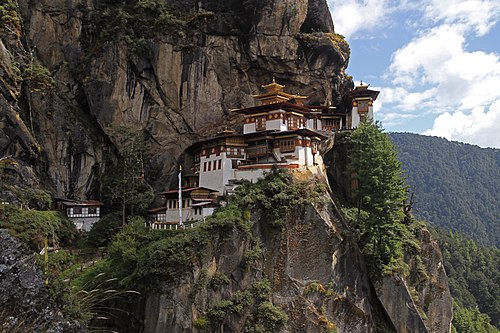
Clinging to a cliff high above the valley, Paro Taktsang is Bhutan’s most famous sight. The steep hike up and back usually takes four to six hours, with a café viewpoint about halfway.
Start early; it is a demanding climb at altitude.
Photo: Gerd Eichmann, CC BY-SA 4.0

This 17th-century fortress-monastery houses the district administration and monks. It hosts the Paro Tsechu masked-dance festival each spring.
Dress formally; long sleeves and trousers or skirt.
Photo: Bernard Gagnon, CC BY-SA 4.0

Above the dzong, the round watchtower known as Ta Dzong now houses the National Museum, covering Bhutanese art, history and culture.
Photo: Bernard Gagnon, CC BY-SA 4.0

One of Bhutan’s oldest temples, traditionally dated to the 7th century, sits among fields north of town.
Photo: Romarin07, CC BY-SA 3.0

At the head of the valley, this restored fortress once guarded the route to Tibet, with views of Mount Jomolhari on clear days.
Photo: Christopher J. Fynn, CC BY-SA 4.0
Bhutanese food is built around chillies and cheese: ema datshi (chillies in cheese sauce), red rice, momos and buckwheat dishes. Most tour packages include meals at hotels and local restaurants.
Butter tea (suja) and local beer are widely available.
Paro International Airport is served by Druk Air and Bhutan Airlines from cities including Delhi, Kathmandu and Bangkok; the mountain approach is one of the most dramatic in the world. Visitors can also enter overland from India.
Thimphu, the capital, is about an hour’s drive away.
Bhutan uses the ngultrum (BTN), pegged to the Indian rupee. Costs are dominated by the SDF and tour arrangements.
Children aged 6–11 pay half the SDF; under-6s are exempt.
Three days for the valley and Tiger’s Nest.
Visit Rinpung Dzong, the National Museum and Kyichu Lhakhang.
Hike to Paro Taktsang.
Visit Drukgyel Dzong, or drive to Chele La pass.
US$100 per person per night.
Take the Tiger’s Nest hike slowly.
Formal dress for dzongs and temples.
Paro Tsechu is in spring.
Quick answers for planning time in Paro.
US$100 per person per night for most visitors, confirmed until August 2027.
Usually four to six hours return.
Most visitors travel with a licensed guide; check current rules.
About an hour by road.
March to May and September to November.
Planning a wider trip? Our Bhutan travel guide covers getting there, costs, when to go and more.