AO
Angola
Giant sable antelope, Tundavala escarpment & Africa’s emerging frontier
Giant sable antelope, Tundavala escarpment & Africa’s emerging frontier
Angola is sub-Saharan Africa’s most underestimated destination — a vast, resource-rich country emerging from decades of civil war to reveal extraordinary natural and cultural riches largely unknown to the outside world. The Namib Desert reaches its northern edge at the Skeleton Coast; the Tundavala Escarpment in the Huíla Highlands drops vertically 1,000 metres to the plain below; the Kalandula Falls are Africa’s second-largest by volume; and the coastal capital Luanda has one of Africa’s most striking waterfront settings and a Portuguese colonial heritage of considerable beauty. The Kissama National Park is being carefully restocked; the Angolan giant sable antelope — one of the rarest and most magnificent animals on earth — survives only here.
Near Lubango in southern Angola, the Tundavala escarpment drops 1,000 metres in a near-vertical cliff to the hot plains of the Namib below — one of the most dramatic viewpoints in Africa. The cool highland city of Lubango (the “Little Lisbon” of Angola) with its Christ the King statue and colonial architecture is the gateway to the south’s extraordinary landscapes.
Africa’s second-largest waterfall by volume (after Murchison Falls) drops 105 metres in a wide horseshoe of multiple channels across the Lucala River in Malanje Province. The falls are set in thick tropical forest and see very few visitors — one of Africa’s great undiscovered natural spectacles.
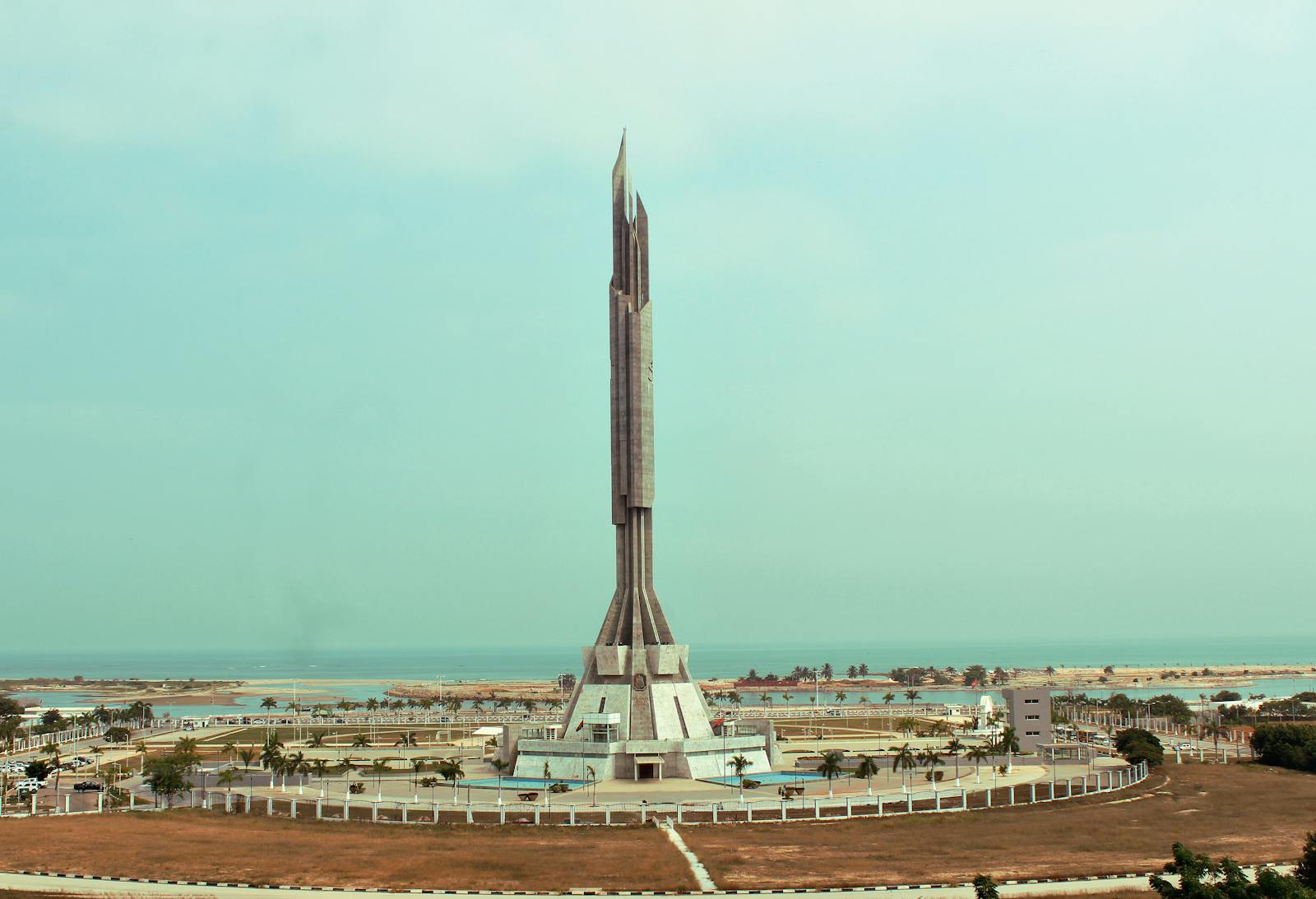
The Angolan capital’s Atlantic bay, lined with the Marginal waterfront boulevard, colonial fortresses (Fortaleza de São Miguel), the Ilha do Cabo beach peninsula and the Museu Nacional de Antropologia, is one of Africa’s most dramatically sited capitals. The city’s Portuguese colonial historic centre is being carefully restored.
Angola’s most accessible national park, 70 km south of Luanda, is being restocked with wildlife through Operation Noah’s Ark (elephants, zebra, wildebeest reintroduced from Botswana and South Africa). The critically endangered Angolan giant sable antelope (palanca negra gigante) — with horns reaching 1.7 metres — survives only in a sanctuary within this park.
Angola (Wikipedia) →Chicken braised in a thick palm oil sauce with okra, chilli and garlic — the national dish of Angola, derived from the traditional cooking of the Mbundu people. The palm oil gives the sauce a deep orange richness that is inseparable from Angolan cuisine.
Dried fish or smoked meat slow-cooked with okra, eggplant, palm oil and garlic — the everyday soul food of Angola, eaten across the country as a thick stew served with funge. The combination of dried protein with okra and palm oil is one of the oldest cooking traditions in the region.
Smooth cornmeal or cassava flour porridge — the Angolan equivalent of ugali or nshima, eaten at every meal by most Angolans as the starchy base alongside calulu, muamba or any other stew. The Portuguese colonial period added espresso culture and pasteis de nata alongside it.
The Portuguese colonial legacy produced genuine pasteis de nata in Luanda — crispy, caramelised custard tarts eaten for breakfast at Luanda’s cafés with an espresso. Angola has the most authentic custard tart culture outside Lisbon and Macau.
Roasted peanuts sold in small paper cones at every market, road junction and street corner in Angola — the universal snack and a crucial source of protein. Peanuts are also ground into a sauce used in countless Angolan dishes.
Angola’s most popular lager, brewed in Luanda since 1969 — a pale golden beer drunk cold across the country. After decades of war-era shortages, Cuca beer resuming full production was seen as a symbol of the country’s recovery.
The second major Angolan lager brand — a light, cold pale lager drunk alongside Cuca throughout the country. Imported Portuguese wines (especially Alentéjo reds) are widely available in Luanda’s restaurants, a remnant of the colonial relationship.
Quatro de Fevereiro International (LAD) in Luanda is the main hub. TAAG Angola Airlines, Ethiopian Airlines and South African Airways serve the main routes. Angola is well-connected regionally but limited from Europe. For trip planning, see the official Angola tourism portal.
💡 Lisbon is the most direct European gateway — TAAG Angola Airlines and TAP both fly Lisbon–Luanda in 7 hours, reflecting Angola’s strong Portuguese connections. Paris is the second option.
💡 Johannesburg and Nairobi are the African hub options. TAAG Angola Airlines connects Luanda to most major African capitals.
💡 Airport taxis in Luanda should be pre-booked through hotels — use reputable companies rather than informal taxis. Luanda traffic can extend the 30-minute airport journey to 2h+ at peak hours.
💡 TAAG Angola Airlines and Fly Angola cover all major domestic routes. Internal flights are strongly recommended over long road journeys; Angolan roads outside Luanda range from reasonable to very rough.
May to October is the dry season (cacimbo) — Luanda’s coast clear, the Namib desert in the south accessible, the Kissama National Park game viewing at its best. June and July are the coolest months with low humidity. November to April brings rains that make the highlands lush and the Tundavala Canyon spectacular.
Angola is the most expensive country in sub-Saharan Africa for travellers, with high costs for accommodation, food and transport reflecting oil-economy pricing. The Angolan Kwanza (AOA) is the currency; USD is widely accepted.
Muamba de galinha (chicken braised in red palm oil, garlic and okra — the national dish of Angola) costs AOA 3,000–8,000 (US$3–10) at a local restaurant.
Angola produces its own wine from the Namib and Huila highlands (small production, mostly drunk locally) and the Cuca and N’Gola beers are the national lagers, served ice-cold with fresh Atlantic seafood &mdash.
The Epic Sana and Talatona Convention Hotel are Luanda’s finest addresses — from US$250–500/night, with standards matching international 5-star hotels and the full security and infrastructure that oil-economy Luanda demands.
Luanda for two days, Kissama National Park for one, Benguela for one, Namibe and the Namib for one, the Tundavala Canyon for one, the Kalandula Falls for one. Angola is Africa’s most unexpected destination — a country of extraordinary landscapes, recovered wildlife and one of the most dramatic coastlines on the continent.
Luanda (population 9 million) — rebuilt with oil wealth since the end of the civil war in 2002, with the Marginal waterfront (the Bay of Luanda, one of the finest natural harbours in Africa), the Fortaleza de São Miguel (1576, the oldest Portuguese fort in sub-Saharan Africa, on the headland above the bay) and the Ilha do Cabo (a 10km sand spit with beach bars and seafood restaurants).
💡 Luanda was the most expensive city in the world for expatriates multiple years running (2014–2017 according to Mercer’s Cost of Living Survey) due to the oil boom and extreme import costs. A bottle of wine cost US$50 in a supermarket; a one-bedroom apartment US$10,000/month. The situation has moderated since oil prices fell but Angola remains expensive by African standards.
The Cidade Alta (the Portuguese colonial upper city — the Government Palace, the Cathedral of the Holy Saviour, the National Museum of Anthropology with the finest collection of Angolan masks and ritual objects outside Europe) and the Mercado Roque Santeiro (the largest informal market in Africa, a city-within-a-city of 150,000 traders).
💡 The Mercado Roque Santeiro was the largest informal market in Africa — a 50-hectare labyrinth of stalls, workshops and warehouses where everything from a car engine to a single cigarette was for sale. It was demolished in 2010 as part of Luanda’s redevelopment; the traders relocated to the Mercado Panguila. The name came from a Brazilian soap opera popular in Angola.
70km from Luanda. Kissama National Park (Quissama, 9,600km², the only wildlife park in Angola actively receiving tourists) was devastated by the civil war — by 2000, virtually all large mammals had been poached. Operation Noah’s Ark (2001) translocated 4 elephants and 34 buffalo from Botswana and South Africa; the populations have slowly recovered.
💡 Operation Noah’s Ark (2001) used three Boeing 747s to airlift 4 elephants from the Kruger Park and 34 buffalo and other animals from Botswana to Kissama — the largest airborne animal translocation in history. The Angolan government funded the operation as a symbol of post-war reconstruction. The park now has 200+ elephants; sable antelope, palanca negra (Angola’s national symbol) are the rarest.
1h flight from Luanda. Benguela — the finest surviving Portuguese colonial town in Angola, on the cold-current Benguela coast, with Art Nouveau and Manueline architecture around the main square, the best fish market on the Atlantic coast, and the terminus of the Benguela Railway (a 1,344km line connecting the Atlantic port to the DRC border, a British-built engineering wonder of 1931).
💡 The Benguela Railway (constructed 1898–1931 through 1,344km of Angolan terrain from Lobito to the Congo border) was the principal route for copper exports from the Katanga mining region of the DRC. The line was deliberately destroyed during the civil war and has been restored by Chinese contractors; the Lobito–Benguela section is now operating.
5h from Benguela. Namibe — the northern gateway to the Namib Desert (the oldest desert on earth, 55–80 million years old, extending from southern Angola through Namibia to South Africa). The Welwitschia plants at Iona National Park (Welwitschia mirabilis — a living fossil plant that produces only two leaves in its entire lifetime and can live 2,000+ years in the Namib).
💡 Welwitschia mirabilis grows only in the Namib Desert — it produces exactly two leaves throughout its entire lifespan (which can exceed 2,000 years) and those two leaves grow continuously, splitting and fraying at the ends. The oldest known individual (the “Great Welwitschia” near Swakopmund, Namibia) is estimated at 1,500–2,000 years old. It reproduces by cone.
2h inland from Lubango. The Tundavala Fissure (Fenda da Tundavala) — the Serra da Léba escarpment drops 1,000m sheer into the coastal plain, an 800m-wide canyon with a vertical east face visible for 100km from the sea, and the Serra da Léba pass (one of the most dramatically engineered roads in Africa, a series of hairpin bends descending 1,000m in 10km).
💡 The Serra da Léba road (“Estrada de Leba”) was constructed by Portuguese colonial engineers in the 1970s — 10km of tightly spaced hairpin bends descending the western escarpment of the Huila Plateau, one of the steepest sustained gradients on any paved road in Africa. The view from the top takes in the entire Namib coastal plain, the Atlantic horizon and the desert below.
1h flight from Luanda. Kalandula Falls (105m high, 400m wide — one of the largest waterfalls in Africa by volume and the second-largest in Africa by width after Murchison Falls) — the Lucala River plunges over a basalt escarpment in the Malanje highlands, surrounded by tropical forest. Fly from Luanda (LAD).
💡 Kalandula Falls (formerly Duque de Bragça Falls) receives approximately 350 cubic metres of water per second at peak flow — it is the largest waterfall in Africa by some volume measurements at peak. Unlike Victoria Falls, it is almost entirely free of tourist infrastructure and is accessible on a day trip from Luanda or Malanje.
Visa required for most nationalities — apply online via the Angolan e-visa portal before departure.
Direct from Lisbon (8h), Johannesburg (3h), Dubai and several African hubs.
Angola requires a visa applied for in advance from an Angolan embassy. E-visa available for some nationalities.
Luanda was the world’s most expensive city for several years due to its oil economy and import dependency. Hotel and restaurant costs remain extremely high by global standards.
The AOA is the currency. USD accepted in hotels and larger businesses. ATMs in Luanda.
Angola is expensive by African standards, reflecting oil-wealth pricing. Budget accordingly for accommodation and transport.
Hiring a driver is strongly recommended outside Luanda. Roads are improving but unpaved routes require 4WD in the rainy season.
Point your camera at menus, signs or street text for instant translation. Download the language pack offline before you arrive for full use without data.
FreeReal-time and offline exchange rates for all world currencies — converts prices instantly so you always know what you are paying in your home currency.
FreeFind and book hotels, guesthouses and apartments with free cancellation on most rates — one of the widest selections of accommodation worldwide.
FreeBrowse millions of traveller reviews for restaurants, attractions and hotels — helps identify the best local spots and avoid tourist traps.
FreeAngola sits within easy reach of several other destinations — each with a completely different character.