ZM
Zambia
Walking safaris, Devil's Pool & the untouched Luangwa Valley
Walking safaris, Devil's Pool & the untouched Luangwa Valley
Zambia is the quintessential off-the-beaten-track African safari destination — vast, unhurried and extraordinarily rich in wildlife, yet visited by only a fraction of the tourists who go to Kenya or Tanzania. The Zambian side of Victoria Falls is where travellers swim in Devil’s Pool at the very lip of the abyss in the dry season. South Luangwa National Park, accessible only by air or rough track, is considered one of Africa’s finest wildlife areas and the birthplace of the walking safari. The Lower Zambezi faces Zimbabwe across the river in a setting of baobab forests and sandbanks crawling with crocodiles. Zambia’s pride is its genuine wilderness character — no crowds, vast spaces, exceptional guiding.
Africa’s finest walking safari destination — the valley where Norman Carr pioneered the concept in the 1950s. South Luangwa’s concentration of leopards is among the highest in Africa; lion, elephant, buffalo, hippopotamus (the Luangwa River teems with them) and the endemic Thornicroft’s giraffe are year-round. The dry season (Jun–Oct) concentrates wildlife at waterholes; the green season (Dec–Apr) is spectacular for birds and newborn animals.
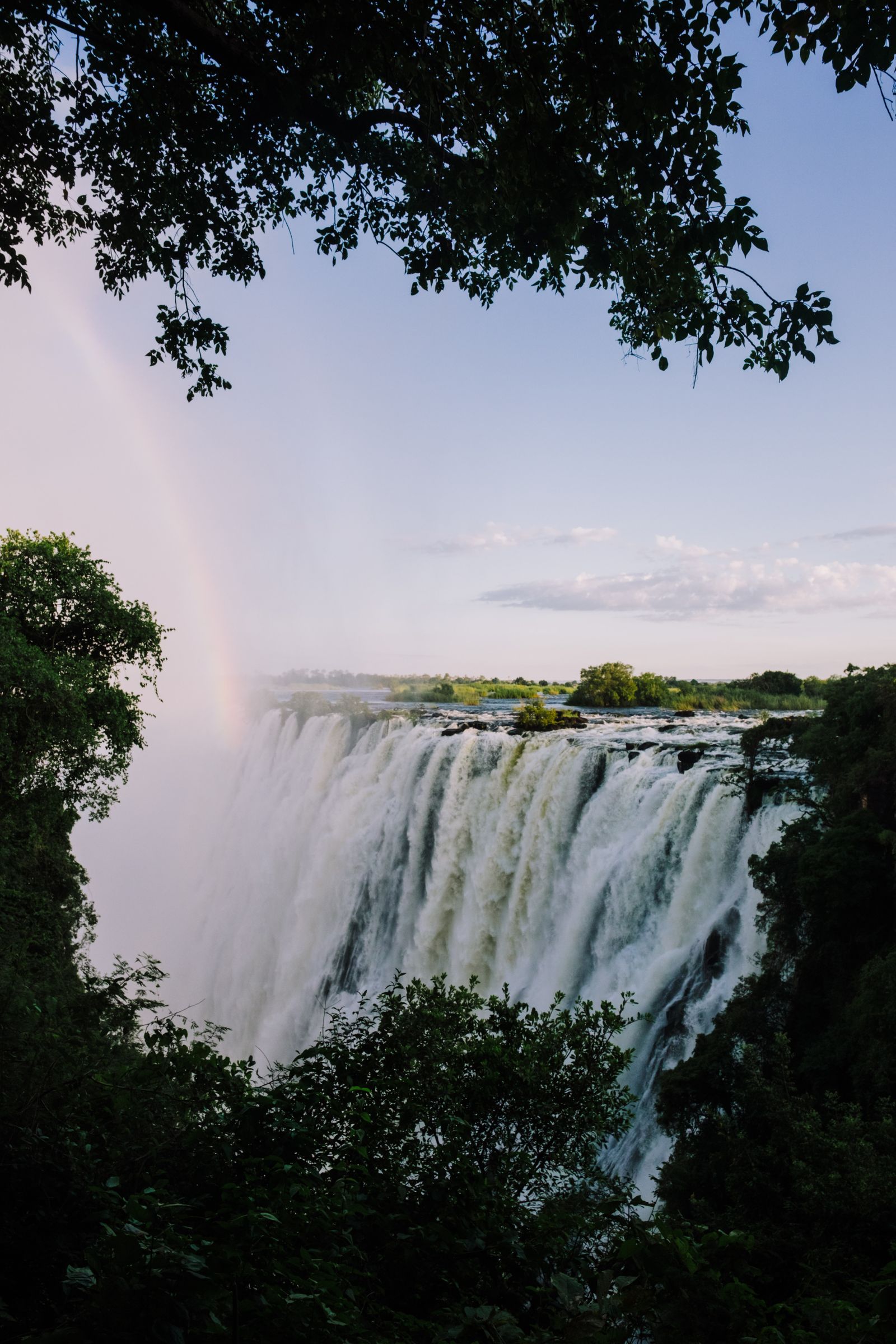
The Zambian side of Victoria Falls offers access to activities unavailable from Zimbabwe: Devil’s Pool (swimming at the falls’ very edge in the dry season), bungee jumping from the bridge and white-water rafting in the Batoka Gorge, one of the world’s most exhilarating commercial rafting experiences with Grade 5 rapids.
Where the Zambezi Valley widens below the Gwembe Trough, this remote national park offers canoe safaris, fishing for tiger fish (among the world’s great sport fish) and game drives in a wilderness of mopane woodland and riverine forest. Elephants swim the channels between Zambia and Zimbabwe; lions stalk the sandy riverbanks at night.
A thick, smooth porridge of finely ground white maize, rolled into a firm ball and eaten by dipping into relish — the foundation of every Zambian meal, consumed twice or three times daily and the cultural anchor of Zambian food identity.
Tiny sun-dried kapenta fish (a sardine-like species from Lake Kariba and Lake Tanganyika), fried crisp with onion and tomato or dried as a salt-rich condiment eaten alongside nshima — one of the most important proteins in the Zambian diet.
A stew of wild spinach, pumpkin leaves or cassava leaves cooked with tomato, onion and groundnut oil — the everyday vegetable relish eaten with nshima across Zambia and the broader Bantu-speaking region of southern Africa.
a remarkable ground orchid tuber and peanut cake, called African polony) — is the Zambian meal. Bush camps serve outstanding multi-course dinners under the stars; game meat (impala carpaccio, crocodile) appears on safari menus.
lager, named after Victoria Falls (Mosi-oa-Tunya — “The Smoke that Thunders”), is the national beer.
Kenneth Kaunda International (LUN) in Lusaka and Harry Mwaanga Nkumbula (LVI) in Livingstone are the main airports. Ethiopian Airlines, Kenya Airways and South African Airways serve the main routes. For trip planning, see the official Zambia tourism portal.
💡 Johannesburg is the most practical gateway for Lusaka — Airlink and South African Airways operate multiple daily JNB–LUN connections in 2h. Ethiopia and Nairobi are the East African gateway options.
💡 Victoria Falls (Zimbabwe side) is 10 minutes by road from Livingstone — the two airports are interchangeable for Falls visits. Combining Zambia with Zimbabwe, Botswana and Malawi makes a natural 2–3 week circuit.
💡 Proflight Zambia operates scheduled domestic services between Lusaka, Mfuwe (South Luangwa), Livingstone and Ndola. Charter flights to Lower Zambezi strips are arranged through lodges. Domestic air dramatically reduces overland travel time in a country the size of Texas.
💡 Zambia’s main highways are paved between major cities; the Great East Road (Lusaka–South Luangwa) is long but manageable in a standard vehicle. Kafue National Park (2h from Lusaka) is accessible without flying, making it a practical budget safari option.
May to October is the dry season — South Luangwa and Lower Zambezi game viewing at their peak, Victoria Falls accessible from the Zambian side, the walking safari season at its finest. July and August are the best months. The green season (November–April) brings lush landscapes, newborn animals and the full flow of Victoria Falls.
Zambia is a premium safari destination — comparable to Botswana and more expensive than Zimbabwe or Malawi. The experience justifies the cost: South Luangwa is the finest walking safari destination on earth.
Budget camping inside South Luangwa and Lower Zambezi.
The 2-day Lower Zambezi canoe safari (paddling from Chiawa to Gwabi, camping on a river island, with guides cooking dinner on the bank with hippos grunting 50m away) costs US&dollar.
Chinzombo Lodge (South Luangwa, the finest camp in the park, Norman Carr Safaris, US&dollar)
Lusaka for one day, South Luangwa National Park for three, Lower Zambezi for two, Victoria Falls (Livingstone) for one. Zambia invented the walking safari and remains its spiritual home — the best wildlife experience in Africa for those who want to meet it on foot.
Lusaka is a rapidly developing African capital — the Manda Hill and Arcades shopping centres for orientation, the Kabwata Cultural Village (traditional craft market and village reconstruction, the best place to buy Zambian textiles, carvings and copper work), and the excellent Latitude 15 hotel for the night.
💡 Zambia is one of Africa’s most stable democracies — it has had peaceful transfers of power between opposing parties (1991, 2011, 2021) in a continent where this remains exceptional. The 2021 election, in which incumbent Edgar Lungu conceded to Hakainde Hichilema, was praised internationally as a model democratic transition.
1h flight from Lusaka to Mfuwe (MFU). South Luangwa National Park (9,059km², the most densely populated wildlife area in Africa by some measures) — where Norman Carr invented the walking safari in 1950, a tradition that has made South Luangwa the gold standard for bush walking worldwide. The afternoon game drive: leopards in the fever trees (the highest density in Africa), hippos in every pool.
💡 Norman Carr (1912–1997) invented the commercial walking safari at South Luangwa in 1950, accompanied by his two tame lions — the first time visitors were guided on foot through wild Africa as a commercial experience. He also created the first community wildlife area in Africa (Kakumbi, 1983), pioneering the model that links conservation to community income.
A full day walking safari with an armed ranger and tracker — 4–6 hours through the miombo and mopane woodland following tracks of elephant, leopard and lion. The experience of approaching a bull elephant at 15m on foot, reading tracks, and understanding the bush at ground level is entirely different from vehicle-based safari.
💡 South Luangwa’s walking safaris operate in an exclusive concession area surrounding each lodge — no other vehicles or guides enter. The lodge tracker reads the ground (spoor, broken vegetation, dung freshness, the direction of animal movement) and leads the guide to a viewpoint. The skill is to position walkers downwind and at a safe angle for observation.
The Luangwa River boat safari (hippo, crocodile, African skimmer and the Zambia’s finest congregation of waterbirds visible from a flat-bottomed boat in the dry season) and the night game drive (leopards hunting, civets, honey badgers, aardvark, and the bush entirely transformed by darkness). South Luangwa has more leopard per square kilometre than any other park in Africa.
💡 South Luangwa’s leopard density has been attributed to the abundance of impala (the primary prey), the thick riverine forest (ideal ambush terrain) and a long tradition of non-interference. Individual leopards have been tracked and named for decades by resident guides who know their territories, cubs and family histories.
1h charter from Mfuwe to Jeki airstrip. Lower Zambezi National Park (4,092km², the Zambezi River valley between Zambia and Zimbabwe, with the finest canoe safari in Africa — paddling in Canadian canoes at water level past elephants drinking, buffalo grazing the river edge, and hippos resting in the deeper channels).
💡 The Lower Zambezi canoe safari (2–5 days, camping on river islands) was pioneered by Canoeing Safari operator Simon Espley in the 1980s. Paddling silently at water level gives a perspective on elephants and buffalo that no vehicle or motorboat can replicate — the wildlife ignores canoes.
Tiger fishing (Hydrocynus vittatus — the most aggressive freshwater predatory fish, with razor teeth, fighting like a tarpon, found in the Zambezi from the delta to the falls) and a full day canoe on the Zambezi with a guided fishing and wildlife stop at Chiawa and Gwabi pools.
💡 The tigerfish was named by 19th-century European explorers who encountered it on the Zambezi and Limpopo — it hunts in packs, is capable of leaping clear of the water to take aerial prey (including small birds), and fights with a ferocity far exceeding its size (typically 2–6kg). Trophy specimens reach 15–20kg on the Lower Zambezi.
4h drive or 45-min flight to Livingstone. Victoria Falls from the Zambian side — the Devil’s Pool (a natural rock pool at the lip of the Eastern Cataract, where in low-water season swimmers can lie at the edge looking straight down), the Livingstone Museum (the finest museum in Zambia, with David Livingstone’s notebooks and the original objects from his Africa expeditions) and the bridge bungee. Fly from Livingstone (LVI).
💡 David Livingstone reached Victoria Falls on 16 November 1855 — the first European to see them, guided by the Kololo people. He named them after Queen Victoria. His notebook description: “scenes so lovely must have been gazed upon by angels in their flight.” He was buried in Westminster Abbey; his heart was buried separately under a tree at Chitambo, in central Zambia.
KAZA Uni-Visa covers both Zambia and Zimbabwe and is excellent value if visiting both. E-visa or visa on arrival also available.
Livingstone Airport (LVI) serves Victoria Falls from the Zambian side. Lusaka (LUN) handles international routes.
Most visitors require a Zambia visa — available on arrival at Livingstone and Lusaka airports. KAZA Uni-Visa covers both Zambia and Zimbabwe for the Victoria Falls area.
Zambia has year-round malaria risk. Anti-malarials, long sleeves at dusk and mosquito repellent are strongly recommended.
Malaria is present throughout Zambia year-round. Anti-malarial prophylaxis is essential.
Most national parks are accessible by light aircraft from Lusaka or Livingstone. 4WD essential if self-driving in the parks.
— Mobile payment platforms widely used in Zambia.
Free— Wildlife identification for South Luangwa’s extraordinary mammal and bird diversity.
FreeDownload offline maps before you travel so navigation works without mobile data — essential for walking, driving and finding local spots.
FreePoint your camera at menus, signs or street text for instant translation. Download the language pack offline before you arrive for full use without data.
FreeReal-time and offline exchange rates for all world currencies — converts prices instantly so you always know what you are paying in your home currency.
FreeZambia sits within easy reach of several other destinations — each with a completely different character.
