BM
Bermuda
Pink sand beaches and the Atlantic's best golf
Pink sand beaches and the Atlantic's best golf

The world-famous pink sand beach — the pink tint comes from crushed coral, shells and the pink-red foraminifera Homotrema rubrum mixed into the white sand. Rated among the world’s top beaches; dramatic rock formations, calm pink-hued shallows, beach chair hire.
Photo: P. Hughes, CC BY-SA 4.0

Two extraordinary caverns filled with stalactites, stalagmites and crystal-clear underground lakes that reflect the formations perfectly — discovered by two boys chasing a cricket ball down a sinkhole in 1907. Guided tours descend floating pontoon bridges above the still water.
Photo: Andrew Currie, CC BY-SA 3.0

A UNESCO World Heritage Site — the oldest continuously inhabited English-speaking settlement in the New World (1612), with narrow lanes, stone buildings, the reconstructed Deliverance ship and the State House (1620, the oldest surviving non-residential British colonial building in the Western Hemisphere).
Photo: Seán Pòl Ó Creachmhaoil, CC BY-SA 4.0

One of the finest small aquaria in the Atlantic — Bermuda’s unique marine species, living coral reef tank and a large North Rock exhibit showcase the island’s ocean biodiversity. The natural history museum tells the story of the island’s geological formation.
Photo: Curtis & Renee, CC BY-SA 2.0

A vast 19th-century British naval fortress complex built by convict labour — now housing craft markets, the Bermuda Maritime Museum (including the Tucker’s Cross treasure), restaurants and the island ferry terminus. Beautiful stonework and ocean views throughout.
Photo: David Broad, CC BY 3.0

The former Bermuda Railway (decommissioned 1948) is now a 34km walking and cycling trail crossing the entire island — passing through subtropical vegetation, over railway bridges and along the coast, with no motorised vehicles allowed. The best way to see the island slowly.
Bermuda (Wikipedia) →Photo: Wikimedia Commons contributor, Public domain
The definitive Bermudian dish — a rich, dark, mahogany-coloured fish broth made with rockfish, onion, tomato, thyme and a dash of black rum and Sherry Pepper Sauce. Traditionally takes three days to prepare; every restaurant has a different secret recipe passed down through generations.
The fast, lean wahoo fish is Bermuda’s most prized eating fish — grilled, fried or served as sashimi at the island’s restaurants. Caught locally and extremely fresh, wahoo in Bermuda has a clean, sweet flavour that rivals the best Pacific fish.
Black-eyed peas cooked with rice and served alongside fish or meat — a Bermudian tradition for New Year’s Day and a common side dish throughout the year, reflecting the African-Atlantic culinary heritage of the island.
Bermuda’s own dark rum, produced by Gosling Brothers since 1806 — the base of the Dark ‘ n’ Stormy, the island’s official cocktail (dark rum with Barritt’s ginger beer). Gosling’s is one of the finest Caribbean-style rums produced outside the Caribbean.
Gosling’s Black Seal rum poured over Barritt’s Ginger Beer with a squeeze of lime — Bermuda’s official national cocktail, with a trademarked name. The combination of rich dark rum and fiery ginger beer is perfectly suited to the Atlantic breezes.
Gosling’s rum, fruit juices and falernum shaken over ice — the cocktail invented at the Swizzle Inn (est. 1932), the island’s oldest bar. The bar’s motto: “Swizzle Inn, Swagger Out”. Bermuda’s signature drinking experience.
L.F. Wade International (BDA) is the only airport. American Airlines, Delta, United, British Airways and Air Canada serve the main routes. Note: tourists cannot rent cars — scooters and taxis are the main transport. For trip planning, see the official Bermuda tourism portal.
New York (2h) and Boston (2h) are the closest US gateways — Bermuda is the closest tropical British territory to the US East Coast. Most Americans fly as a day flight.
British Airways operates the only direct London–Bermuda service (from Gatwick, ~8h). Most Europeans route via New York or Boston.
Bermuda’s bus and ferry network (combined pass: US$40/3 days) covers all major sights efficiently. Tourists cannot rent cars; scooters (US$50–70/day) are the standard independent transport.
Tourists are legally prohibited from renting cars in Bermuda (a law maintained since the 1940s to prevent traffic congestion on the narrow roads). Scooters are the practical solution; buses and ferries cover all major sights without one.
April to October is best — warm (22–29°C), the pink sand beaches swimmable, the water clear. May and October are the sweet spots: warm but less crowded and cheaper than July–August peak. November to March is mild (15–20°C) with occasional cold fronts and reduced hurricane risk.
📅 Bermuda is in its best season in May, June, July, August, September, October. See where else is good to go in those months, or browse where to go by month.
Bermuda uses the Bermuda dollar (BMD, pegged 1:1 to USD). It is one of the most expensive island destinations in the world — no sales tax, but very high import costs make everything expensive.
The Bermuda fish sandwich (rockfish (Pterois volitans — though more commonly snapper or grouper) on toasted raisin bread, with tartar sauce and coleslaw — the defining fast food of Bermuda, available at every takeaway from)
Bermuda lobster (Panulirus argus, the spiny lobster — in season September–March, caught by local fishermen under strict size and season regulations) is the finest seafood on the island, available at good restaurants.
The Mid Ocean Club (founded 1921, designed by Charles Blair Macdonald, ranked among the 50 finest golf courses in the world, with the 5th hole)
Hamilton for one day, Horseshoe Bay for one, Royal Naval Dockyard for one, St George’s for one, Crystal Caves for one, diving for one, Spittal Pond for one. Bermuda — the most isolated inhabited island group in the Atlantic — has pink sand, 300 shipwrecks and the oldest English town in the New World.
Hamilton — the capital of Bermuda (a British Overseas Territory in the North Atlantic, 1,070km east of North Carolina, 21 square kilometres of pink-sand island — the most isolated inhabited group of islands in the world, the only Atlantic islands without a natural source of fresh water, entirely dependent on rainwater collection) with the Bermuda National Museum at the Royal Naval Dockyard and the Hamilton waterfront.
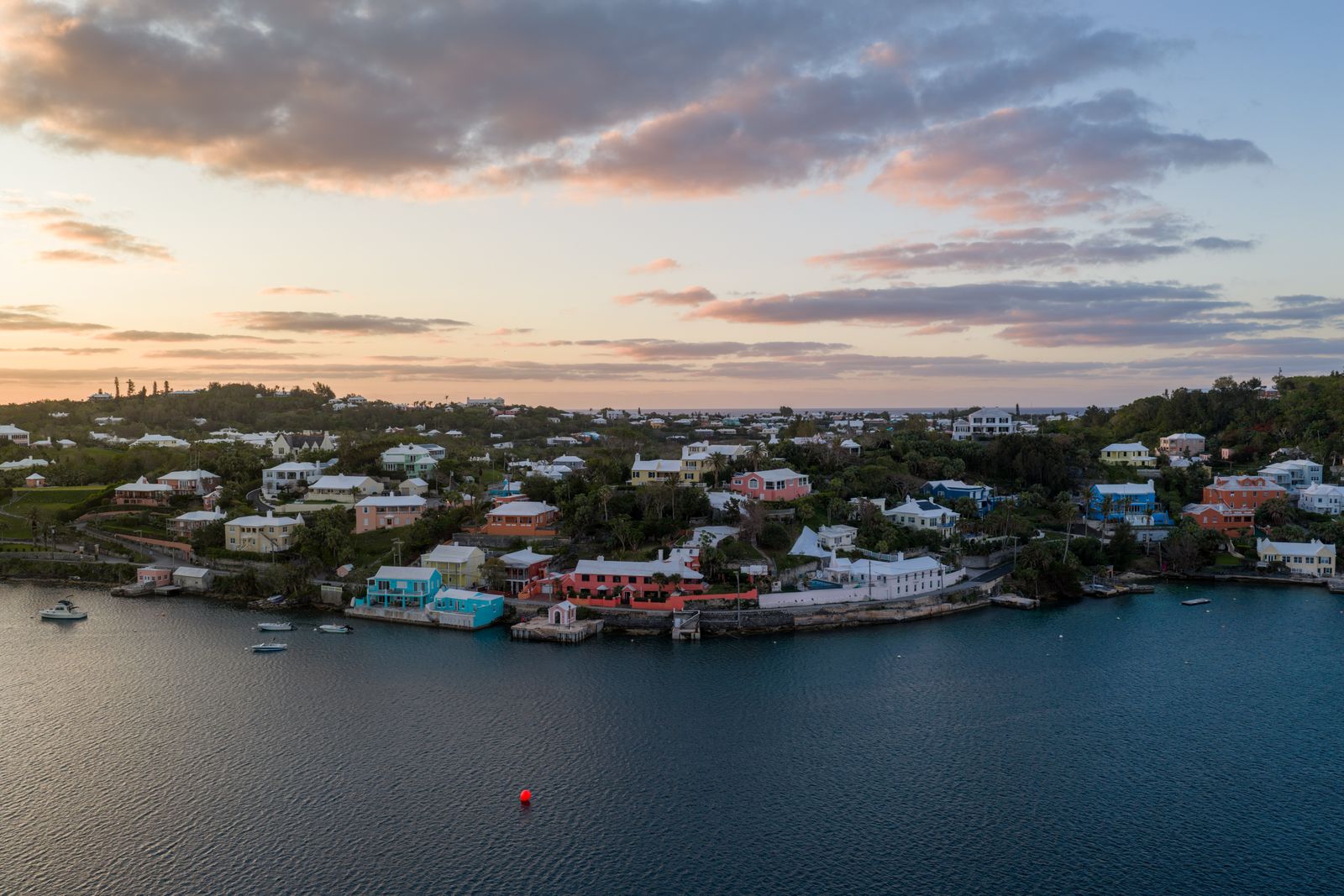
Bermuda has no natural fresh water sources — no rivers, no streams, no natural springs. All freshwater comes from rain collected from rooftops (the distinctive white stepped Bermudian roofs are designed to channel rainwater into underground tanks — each house is required by law to have a roof-catchment tank). The stepped white roof (coral limestone sealed with lime wash) is the defining architectural feature of the island.
Horseshoe Bay Beach (the most famous beach in Bermuda — a crescent of pink sand (the colour comes from fragments of Foraminifera — single-celled organisms with red shells that wash up with the sand — mixed with white coral sand, giving it the distinctive pink tint) with the natural sandstone arches at the western end) and the South Shore park walk connecting Horseshoe, Warwick Long Bay and Chaplin Bay.
Bermuda’s pink sand (the result of Foraminifera, single-celled marine organisms with calcium carbonate shells that break down into tiny red fragments and mix with the white coral sand) is found on the south shore beaches where the Atlantic swell deposits shell material. The concentration of Foraminifera varies; the pinkest sand is at Horseshoe Bay and Pink Beach.
The Royal Naval Dockyard (a massive fortified naval complex built by the British Navy from 1809 using convict and slave labour as the “Gibraltar of the West” — the main British Atlantic naval base between Canada and the Caribbean, now restored as a heritage complex with the National Museum of Bermuda, the world’s best collection of Bermuda history and the finest collection of Bermudian art) and the glass-bottom boat tour.
The Royal Naval Dockyard was built using convict labour from Britain — approximately 9,000 convicts transported from England between 1824 and 1863, housed on hulks (old warships converted to floating prisons) moored in the harbour. The conditions were brutal; an estimated 2,000 convicts died during the construction. The dockyard they built is the largest military fortification in the Western Hemisphere.
St George’s (UNESCO World Heritage — the first English settlement in Bermuda, founded 1612, the oldest continuously inhabited English town in the New World, with the original street grid, the unfinished cathedral begun in 1612 and never completed, the State House (the oldest remaining building in Bermuda, built 1620), the stocks and pillory in the town square still in place, and the Bermuda National Trust buildings).
St George’s (founded 1612 — 8 years before the Pilgrims landed at Plymouth Rock in Massachusetts) is the oldest continuously inhabited English-speaking town in the New World. It was the capital of Bermuda until 1815, when Hamilton became the new capital. The town’s historic core is almost entirely intact — it was built on coral limestone and the hot, dry climate has preserved the wooden structures.
Crystal Cave (a limestone cavern discovered in 1907 by two boys chasing a lost cricket ball, flooded with crystal-clear underground water at 20m — stalactites and stalagmites growing for 30,000 years reflected in the perfectly still water, with a floating pontoon bridge allowing visitors to walk above the water) and the adjacent Fantasy Cave — the finest cave complex in the Atlantic island chain.
Crystal Cave (discovered in 1907 by two schoolboys — Carl Gibbons and Edgar Hollis — who were chasing a ball that had fallen down a hole, lowered themselves on a rope and found a vast cavern) is an accidental discovery that became Bermuda’s most unusual attraction. The cave was formed by the dissolution of coral limestone over 30,000 years; the underground lake never drops below 20m depth.
Bermuda has more than 300 shipwrecks in its surrounding waters (the result of its position in the main shipping lane between Europe and the Americas, its fringing reef system and the pre-1800 navigational hazards of the island) — including the Sea Venture (the English flagship that wrecked on Bermuda in 1609, inspiring Shakespeare’s The Tempest) and easily accessible modern wrecks at 10–30m with excellent visibility.
The Sea Venture wreck (July 28, 1609 — the flagship of an English convoy heading to Virginia Colony, driven onto Bermuda’s reefs in a storm) is one of the most historically important shipwrecks in the Atlantic. The survivors spent 9 months building two replacement ships and then sailed to Virginia, saving the Jamestown Colony from collapse. The account written by William Strachey about the storm and the island is widely accepted as a primary source for Shakespeare’s The Tempest (1611).
Spittal Pond Nature Reserve (the largest nature reserve in Bermuda, 24 hectares on the south shore — a freshwater and saltwater pond system with the finest birdwatching in Bermuda: herons, egrets, kingfishers and 200+ species of migratory birds using the island as a stopover on the Atlantic flyway — the Portuguese Rock, a 16th-century inscription the only evidence of early Portuguese visits to Bermuda, is in the park). Fly from Bermuda (BDA).
Bermuda sits directly on the major Atlantic bird migration flyway — in autumn (September–November), millions of migratory birds pass through or stop over on the island on their way from North America to the Caribbean and South America. Bermuda is particularly famous among ornithologists for vagrant sightings: European species blown off course by Atlantic storms frequently arrive on the island.
Bermuda is easy to reach from the US East Coast — American Airlines, Delta, JetBlue and United fly direct from multiple US cities; British Airways from London Gatwick.
US dollars are accepted everywhere; no need to exchange. Credit cards are widely accepted at all hotels, restaurants and shops.
American two and three-pin plugs — UK visitors need a US adaptor. Voltage is 120V, so some UK appliances may need a transformer.
Bermuda does not allow visitors to rent cars. Scooters (mopeds) are the primary visitor transport; ferry and bus networks cover the main areas.
Bermuda has a higher density of golf courses per square mile than anywhere else in the world. Port Royal (government-owned) is considered the best value; Mid Ocean is the most prestigious.
Bermuda has over 300 shipwrecks in its waters — the combination of clear warm water (24°C+) and centuries of wrecks makes this one of the most accessible and rewarding wreck-diving destinations in the Atlantic.
Quick answers to the questions people most often ask before visiting Bermuda.
Fly into L.F. Wade International Airport (BDA). It's about 2 hours from New York and Boston, around 3 hours from Toronto, and about 7–8 hours direct from London Gatwick.
No. Visitors aren't allowed to rent cars. Most people get around by rented scooter or small electric vehicle, taxis, ferries and the island's buses.
April to October is warm (22–29°C) and best for the pink-sand beaches, with May and October the sweet spots before and after the summer peak. November to March is mild (15–20°C) and quieter.
The Bermudian dollar, pegged 1:1 to the US dollar. US dollars are accepted everywhere and cards are widely used. Plugs are US-style (Type A/B, 120V).
Yes — it is one of the world's most expensive island destinations. Expect around US$120–200 per day on a budget, US$300–500 mid-range and US$800 or more at the top end.
Bermuda sits alone in the North Atlantic but the wider Caribbean — Bahamas, Jamaica, Barbados, Trinidad and Tobago and the Dominican Republic — offers a rich variety of island experiences within the same Atlantic basin.
Bermuda is one of the world’s least-visited places. See all 90 in our guide to the world’s least-visited countries & territories.

