BS
Bahamas
Swimming pigs, pink beaches & the clearest water on earth
Swimming pigs, pink beaches & the clearest water on earth
The Bahamas is an archipelago of 700 islands and 2,400 cays scattered across 260,000 square kilometres of the western Atlantic — a nation built on turquoise water, white sand and the extraordinary clarity of the Bahamian Sea. Nassau, the capital on New Providence, combines a lively colonial heritage with excellent dining and late-running nightlife; the Family Islands beyond — Exuma, Eleuthera, the Abacos, Bimini, Andros — offer some of the most spectacular and varied natural environments in the Atlantic. Swimming with wild pigs on Big Major Cay in the Exumas has become one of the Caribbean’s most photographed experiences. The Andros Barrier Reef, third-largest in the world, and the blue holes scattered throughout the archipelago are world-class diving destinations.
The Bahamas is also one of the world’s great blue-water sport-fishing destinations, the birthplace of modern scuba diving lore, and home to the clearest water measurably recorded anywhere on earth in the Exuma Cays Land and Sea Park.
The Exumas are the most beautiful part of the Bahamas — a chain of 365 cays and islands with water that shades from pale turquoise to deep cobalt. Big Major Cay’s famous swimming pigs (feral pigs that wade out to greet boats), the swimming nurse sharks and sting rays of Compass Cay, and the Thunderball Grotto (a sea cave used in two James Bond films) make the Exumas one of the Caribbean’s great island-hopping destinations.
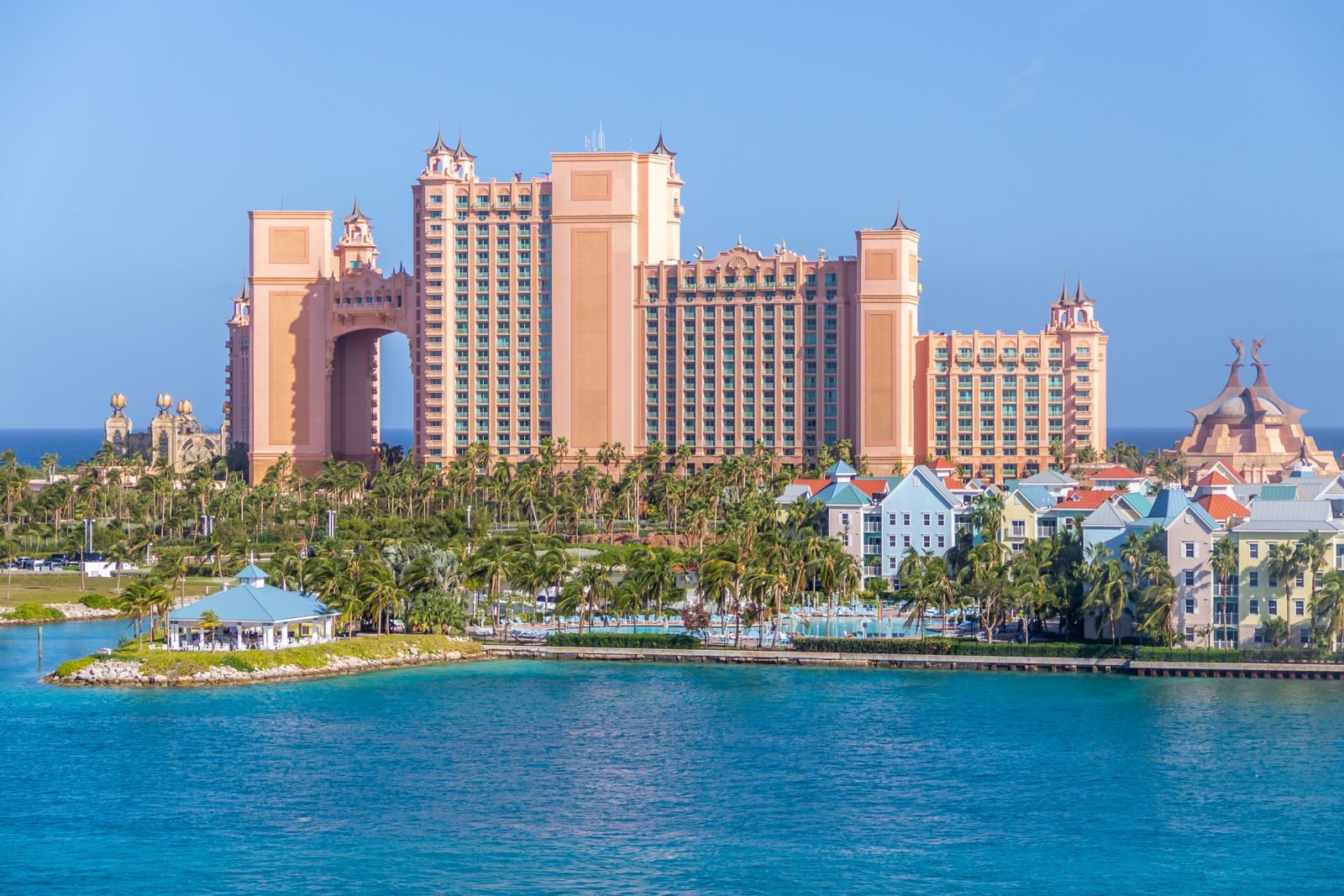
The colonial capital is the gateway to the Bahamas — its pastel-painted Bay Street, 18th-century forts (Fort Fincastle, Fort Charlotte), the historic straw market and the drum-and-whistle Junkanoo festival traditions coexist with the mega-resort infrastructure of Atlantis on adjacent Paradise Island. Cable Beach’s luxury hotels and the downtown fish fry at Arawak Cay offer a more local Nassau experience.
The largest Bahamian island is the least developed — a wilderness of mangroves, pine forests and the Andros Barrier Reef running 225 kilometres offshore. The island’s extraordinary blue holes — underwater sinkholes dropping hundreds of metres into ancient cave systems — are among the world’s premier technical diving sites and were explored by Jacques Cousteau himself.
Harbour Island (Briland to locals) has one of the world’s most distinctive beaches — three miles of pink sand, its colour derived from crushed coral and foraminifera shells mixed into the white. The clapboard pastel houses of Dunmore Town, dating to the 18th-century Loyalist era, and the island’s warm, quiet character make Harbour Island the Bahamas’ most exclusive retreat.
Bahamas (Wikipedia) →the large spiral-shelled mollusc — appears in every possible form: cracked conch (battered and fried), conch salad (raw, ceviche-style with lime and Scotch bonnet), conch fritters and conch chowder.
Strips of fresh Nassau grouper battered lightly and deep-fried — sold at fish fry events (Arawak Cay in Nassau is the best) and beachside stalls. The quality depends entirely on how fresh the grouper is; on a good day it is extraordinary.
Bahamian lobster, in season August–March) and grilled snapper are the fish staples.
pigeon peas with rice and thyme) is the national side dish.
coconut rum, pineapple juice and Goombay punch) is the defining cocktail.
The beer of the Bahamian south — a pale lager brewed in Nassau and the everyday cold drink at beach bars and local restaurants throughout the Out Islands.
The flagship Bahamian lager, brewed since 1988 — the most widely available beer in the Bahamas, named after the sound of Junkanoo cowbells. Served ice-cold with conch salad, grouper fingers and anything else at Arawak Cay.
Lynden Pindling International (NAS) in Nassau is the main hub. American, Delta and JetBlue serve the US routes; British Airways connects London. Domestic air taxis connect Nassau to the Out Islands. For trip planning, see the official Bahamas tourism portal.
💡 British Airways operates year-round direct flights from Heathrow to Nassau. Miami (30 min from Nassau) is the natural US transit hub with multiple daily connections.
💡 Miami and Fort Lauderdale are the closest US gateways — Nassau is 30–35 minutes by air, meaning same-day connections from Europe via Miami are straightforward. Bahamasair flies between Nassau and multiple Florida airports.
💡 The Bahamas has an excellent small-aircraft network connecting Nassau to all inhabited Out Islands — trips that would take 4–8h by ferry take 30–45 minutes. Bahamasair and Western Air cover the main routes at US$80–180 one-way.
💡 Nassau jitneys (public minibuses) are the cheapest city transport at US$1.25 per trip, covering most of New Providence. Taxis in Nassau use fixed zone rates — agree before getting in.
December to May is peak season — Nassau, the Exumas and the Out Islands at their best, clear skies, calm seas. March to May is ideal: dry, warm but not oppressive (27–29°C). June to November is hurricane season — the risk is real though the Bahamas lies north of most hurricane tracks.
The Bahamas is one of the most expensive Caribbean destinations — significantly more so than Jamaica or the Dominican Republic. Nassau is the most affordable island; the Out Islands (Exumas, Eleuthera, Harbour Island) are considerably pricier.
Cracked conch — queen conch (Strombus gigas, the national shell of the Bahamas) pounded flat, seasoned, breaded and deep-fried — is the defining Bahamian dish.
Kalik beer (“the beer of the Bahamas”, brewed since 1988 in Nassau, named for the cowbell sound of Junkanoo — clink-clink) is the island’s lager and costs US$3–5 at most bars.
The Pink Sands Hotel (Harbour Island, 1950s pink cottages in a tropical garden behind the famous beach, where Mick Jagger and Diane von Furstenberg have both stayed) and the Grand Isle Resort on the Exumas are the Bahamas’s best-known addresses.
Nassau for two days, Paradise Island for one, the Exumas by boat for two, Eleuthera for one, Harbour Island for one. The Bahamas — 700 islands and 2,400 cays, only 30 inhabited — has the clearest shallow water in the Atlantic.
Nassau (population 280,000, on New Providence Island) has the British colonial architecture of Downtown (Parliament Square, Government House, the pink Supreme Court building) and Cable Beach for the first evening. The Nassau Straw Market and the Fish Fry at Arawak Cay (the most authentic Bahamian food experience in New Providence — conch fritters, cracked conch, fish platters).
💡 Nassau was the base of operations for New Providence pirates — most famously Blackbeard (Edward Teach), Anne Bonny, Mary Read and Charles Vane — from the 1690s to 1718. The Royal Governor Woodes Rogers eliminated the pirate republic in 1718 by hanging 10 pirates on the Nassau waterfront; the motto he established for the Bahamas was “Expulsis Piratis, Restituta Commercia” (Pirates Expelled, Commerce Restored).
The Queen’s Staircase (66 steps hand-carved from solid limestone by enslaved people in the 1790s, cutting through a cliff to Fort Fincastle), Fort Charlotte (the largest fort in the Bahamas, 1788, 42 cannons, never fired in anger), the Atlantis marine exhibits on Paradise Island and the Junkanoo Museum (Junkanoo — the Bahamian Boxing Day street festival of sequined costumes, goatskin drums and cowbells — is the defining cultural expression of the Bahamas).
💡 Junkanoo (celebrated at dawn on 26 December and 1 January) is the most visually spectacular festival in the Caribbean — competing groups of hundreds spend 11 months preparing costumes made entirely of crepe paper glued over cardboard armatures, built in secret “shacks.” The secrecy is real; rival groups have spied on each other’s preparations for decades.
35-min flight from Nassau to Exuma (GGT) or ferry. The Exuma Cays — 365 islands and cays in 120km of ocean, with the most extraordinary shallow-water colour gradients in the world (turquoise over white sand, impossible azure over sea grass, deep blue in the channels) and Pig Beach (Big Major Cay) — where a colony of wild swimming pigs has lived for decades, meeting tourist boats in the water.
💡 The Pig Beach pigs on Big Major Cay arrived by unknown means — the most popular theory is that they were deposited by sailors who intended to return and cook them but never did. They have swum out to meet tourist boats for at least 40 years and are now one of the most photographed animals in the Caribbean. The origin remains genuinely unknown.
A full day by speedboat through the Exuma Cays — Compass Cay (where nurse sharks circle the dock in 1m of water and can be touched), Leaf Cay (a beach with a colony of 200+ Allen’s cays iguana — a species found only in the Exumas, resembling a miniature dinosaur), the Thunderball Grotto (the cave used in the James Bond films “Thunderball” and “Never Say Never Again”, swimmable at low tide).
💡 Thunderball Grotto at Staniel Cay is accessible by snorkelling through an underwater entrance at low tide, emerging in an air-filled chamber lit by shafts of sunlight through holes in the limestone roof. It was used in the 1965 Bond film “Thunderball” (as Palmyra) and the 1983 “Never Say Never Again.” The coral inside is entirely undamaged.
35-min flight from GGT to North Eleuthera (ELH). Eleuthera — 180km long and 1.5–3km wide, the thinnest island in the world — is the finest island for experiencing the difference between the calm turquoise west coast (Caribbean) and the dramatic dark-blue surf of the Atlantic east coast, separated in places by just 50m of rock.
💡 Glass Window Bridge on Eleuthera is the narrowest point of the island — a bridge over a rock cut where the dark blue Atlantic and the turquoise Bight of Eleuthera are separated by 9m of land. In a strong Atlantic swell, waves wash over both sides of the bridge simultaneously; the colour contrast between the two bodies of water is abrupt and genuinely striking.
20 min ferry from North Eleuthera. Harbour Island (“Briland”) — a 4.8km² island with 200-year-old clapboard houses in pastel colours, the finest pink sand beach in the world (Pink Sand Beach — 5km, the pink colour from crushed foraminifera shells, a microscopic organism with pink calcium carbonate shells) and golf carts as the only vehicle on the island.
💡 Pink Sand Beach gets its colour from Homotrema rubrum — a tiny red-pink marine organism that lives in large numbers in the reef surrounding the island. The shells are continually ground up by wave action and deposited on the beach, mixing with white coral sand to produce the pink hue. The colour is most intense in morning light.
A morning on Harbour Island by golf cart (the only vehicle allowed — the island has no cars) — the colonial Dunmore Town (named after Lord Dunmore, the Royal Governor who fled Revolutionary America and established himself here in 1787), the Methodist church (1843) and the pastel-painted shotgun houses. Fly from ELH or GGT back to Nassau, then international connections.
💡 Harbour Island was the original capital of the Bahamas before Nassau — Dunmore Town was the most important settlement in the northern Bahamas in the late 18th century. The Loyalists who fled American independence after 1783 established themselves here; their clapboard architecture with picket fences has barely changed since.
Nassau’s Lynden Pindling International Airport has direct flights from most US East Coast cities (2–3 hours from Miami, New York). Inter-island travel by Bahamasair or small charter planes.
Nassau (NAS) handles international flights. The Out Islands (Exumas, Harbour Island, Eleuthera) need a domestic connection — Bahamasair or small charters. Exumas is 45 min by air.
The BSD is pegged 1:1 to USD and both are used interchangeably everywhere. No need to exchange.
The famous pink sand beaches are on Harbour Island (Eleuthera) — not Nassau. The pink colour comes from foraminifera (tiny red organisms) mixed with white coral sand.
The famous swimming pigs are on Big Major Cay in the Exumas, 70km south of Nassau. Day tours from Staniel Cay Yacht Club are the most reliable way to visit.
The Family Islands (Out Islands) are far quieter and more beautiful than Nassau — rent a boat or hire water taxis to explore the Exumas from George Town or Staniel Cay.
June–November; Dec–April offers the safest and most pleasant weather.
Good in Nassau; limited on outer islands — download offline maps.
FreeEssential for boat and water activity planning across the island chain.
FreePoint your camera at menus, signs or street text for instant translation. Download the language pack offline before you arrive for full use without data.
FreeReal-time and offline exchange rates for all world currencies — converts prices instantly so you always know what you are paying in your home currency.
FreeFind and book hotels, guesthouses and apartments with free cancellation on most rates — one of the widest selections of accommodation worldwide.
FreeBahamas sits within easy reach of several other destinations — each with a completely different character.
