TD
Chad
Saharan landscapes and the last of Lake Chad
Saharan landscapes and the last of Lake Chad
⚠️ Travel advisory: most governments advise against travel
The US advises against all travel to Chad, and other governments advise against travel to large parts of the country, because of terrorism, crime and unrest near its borders. Check current advice carefully before any visit.
Latest official advice: UK FCDO · US State Department · Reviewed September 2026

A UNESCO World Heritage Site of beauty — orange sandstone towers, arches, gorges and rock shelters rise from the Sahara. Cave paintings inside the shelters date back 7,000 years; the Guelta d’Archei oasis harbours a relict population of Nile crocodiles.
Photo: Sven.oehm, CC BY-SA 4.0

One of Central Africa’s great wildlife recovery stories — managed by African Parks since 2010, elephant herds have rebounded from 450 to over 1,000. Also home to giraffes, lions, leopards, buffaloes, tiang hartebeest and African wild dogs.
Photo: Fatakaya, CC BY-SA 4.0

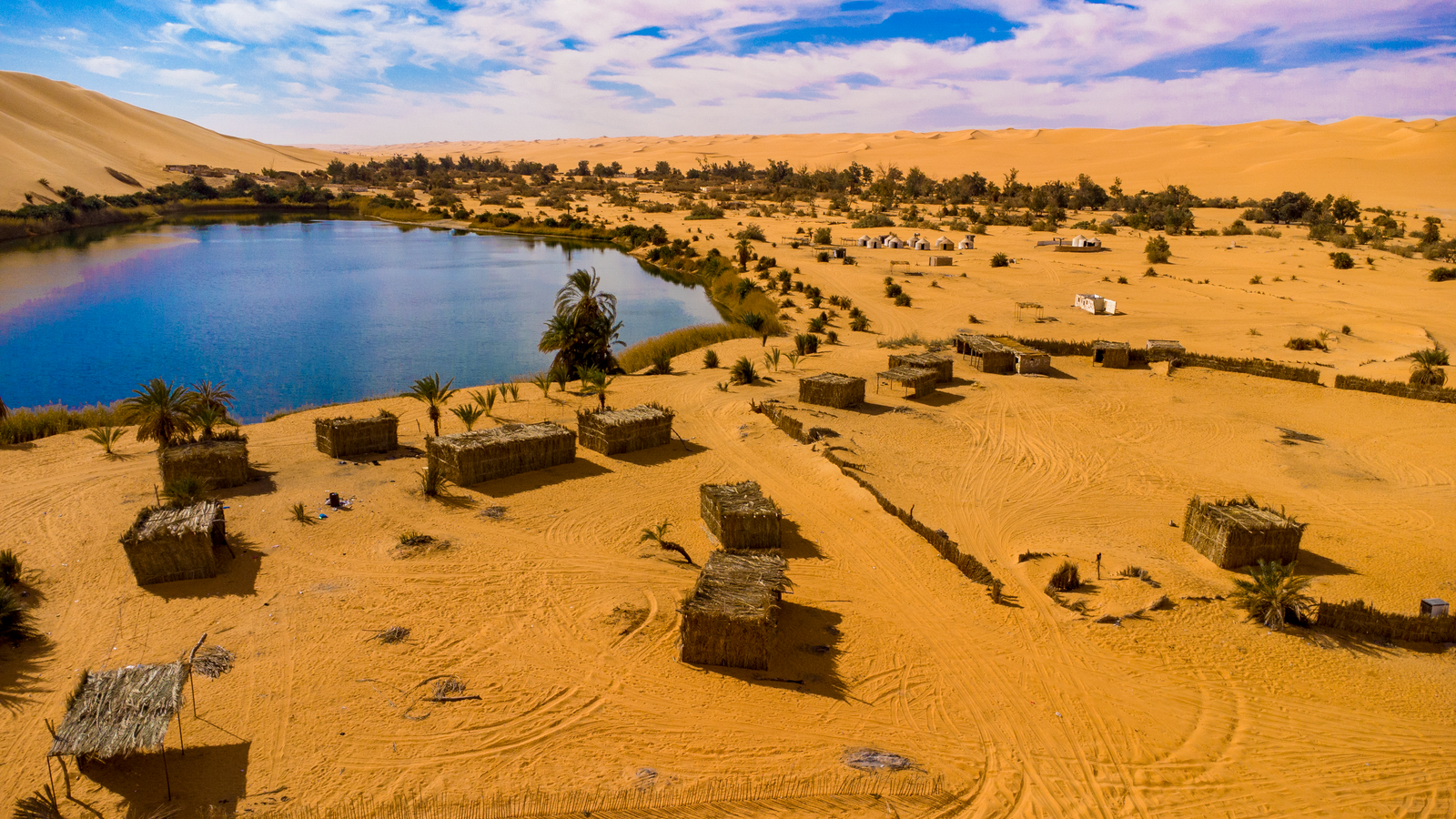
One of Africa’s most famous lakes — and one of its most dramatic recent tragedies. It has shrunk by 90% since the 1960s due to climate change and irrigation. What remains is a complex delta of wetlands, reed channels and fishing villages of great diversity.
Photo: Coolthoom1, CC BY-SA 4.0

The highest mountains in the Sahara — volcanic peaks reaching 3,415m (Emi Koussi), with hot springs, lava lakes and prehistoric rock art. Access is extremely difficult (permit and armed escort required) but the landscapes are unlike anywhere else on earth.
Photo: michael kerling, Public domain

The capital at the confluence of the Chari and Logone rivers — the Grand Marché, the National Museum of Chad and the lively riverside fish market are the city’s highlights. The city has improved significantly in safety and infrastructure.
Photo: Korom10, CC BY 4.0

A permanent waterhole in a dramatic canyon in the Ennedi Massif — home to crocodiles that have survived here isolated from the Nile for thousands of years, swimming in waters used by camel caravans. A surreal and ancient spectacle.
Photo: anmede, CC BY-SA 2.0
A thick okra stew cooked with dried fish or meat, tomato and palm oil — the defining everyday dish of southern Chad, eaten with aiysh (millet porridge). The okra gives it a distinctive texture; the dried fish adds a deep, savoury depth.
Mutton skewers grilled over charcoal — the universal street food of N’Djamena, eaten from roadside stands after Friday prayers or at evening markets. Served with sliced raw onion and chilli sauce.
Finely ground millet cooked to a thick, smooth porridge — the staple grain food of the Sahel, eaten at every meal in northern Chad, usually with dried fish sauce, milk or groundnut paste. More nutritious than maize and better adapted to the Saharan climate.
A refreshing juice made from the wild fruit of the Detarium microcarpum tree — tart, sweet and sold at every market stall in southern Chad as the defining non-alcoholic drink of the country.
Fava beans slow-cooked with garlic, cumin and olive oil — eaten for breakfast across Chad and the entire Sudan-Nile corridor, served with flatbread and a hard-boiled egg at roadside stalls throughout N’Djamena.
The local lager brewed in N’Djamena — named after the Chari River, available at bars in the capital and southern towns. In predominantly Muslim northern Chad, non-alcoholic drinks and tea are preferred.
Hassan Djamous International Airport (NDJ) in N’Djamena is the gateway. Ethiopian Airlines, Air France and Turkish Airlines serve the main routes.
Paris (6h, Air France) and Istanbul (5h30, Turkish Airlines) are the most direct European connections. Royal Air Maroc via Casablanca (4h) is a good alternative.
Addis Ababa (5h, Ethiopian) is the primary connection from East Africa. Lagos and Douala (both ~2h) are the main West/Central Africa connections.
Zakouma (the primary tourist destination) is reached by a chartered light aircraft from N’Djamena (1h30, arranged through African Parks). The Ennedi and Tibesti require full expedition planning.
Self-drive is not practical in Chad — roads outside the capital require a 4WD with an experienced driver, and the distances and security considerations demand local expertise. All major destinations require either a charter flight or a fully equipped 4WD expedition.
November to February is the only viable window for travel — cool, dry Saharan conditions in the north (15–28°C in N’Djamena; colder in the Tibesti). The Zakouma safari season is also November–May. June to October is the wet season; the southern savanna and roads flood completely.
📅 Chad is in its best season in January, February, November, December. See where else is good to go in those months, or browse where to go by month.
The Central African CFA franc (XAF) is the currency. Affordable but Zakouma and Ennedi require significant expedition budgets.
Brochettes de mouton (lamb skewers grilled over charcoal, seasoned with salt and spices)
Zakouma National Park (managed by African Parks since 2010 — accommodation at the Tinga Camp or Hyal Camp, from US$150–250 per person per night all-inclusive with game drives — is the most professionally managed)
The Ennedi Massif expedition (a 7–10 day 4WD + camel tour of the sandstone canyons, rock art sites and desert landscapes of northeastern Chad — US$2,000–4,000 per person including all logistics — is one of)
N’Djamena for one day, Zakouma National Park for two days, Lake Chad for one, Ennedi Massif (security permitting) for one, Tibesti overview for one, N’Djamena farewell for one. Chad — the geographical heart of Africa — has the oldest known human ancestor (Toumai, 7 million years old), the most dramatic elephant conservation recovery in Africa at Zakouma, and the largest rock art site in the central Sahara at Ennedi. Check current advisories for northern regions.
N’Djamena — the capital of Chad (1.28 million km² — the fifth-largest country in Africa, population 17 million, almost entirely landlocked, one of the poorest countries in the world, with the Tibesti Mountains in the north being among the most remote inhabited places in Africa) — with the National Museum of Chad (covering Chadian prehistory including the Sahelanthropus tchadensis skull — the oldest known hominin, 7 million years old, found in Chad in 2001 — the earliest known member of the human lineage) and the Grand Marché.
Sahelanthropus tchadensis (nicknamed “Toumai” — found in 2001 in the Djurab Desert of northern Chad by Michel Brunet’s team from the University of Poitiers, dated to 6–7 million years ago, making it the oldest known hominin — is the single most significant palaeontological discovery in Africa since Lucy (Australopithecus afarensis). The skull, a replica of which is in the N’Djamena museum, fundamentally changed understanding of early human evolution by demonstrating that hominins evolved much earlier and further from East Africa than previously believed.
Zakouma National Park (3,540km² of Sudano-Sahelian savanna in southeastern Chad — the finest safari destination in Central Africa and one of the great unsung wildlife areas on the continent, with an elephant conservation recovery: from 4,000 elephants in the 1970s to 400 after a decade of ivory poaching, then recovering to 700+ after African Parks began managing the park in 2010 — plus lions, leopards, giraffes, black-crowned cranes and bird diversity).
Zakouma’s elephant recovery (African Parks took over management of Zakouma from the Chadian government in 2010 — when the elephant population had crashed from 4,000 to 450 due to ivory poaching by the Janjaweed militias crossing from Sudan — and within 10 years had increased the population to 700+ through intensive anti-poaching operations, GPS collar monitoring and community engagement. Zakouma is now considered one of the most successful large mammal conservation turnarounds in African history.
Two days of Zakouma safari — the elephant herds concentrating at the Salamat River water holes in the dry season (December–May), the lions that follow the elephant herds, the aggregations of migratory birds (the park records 370+ bird species, including the black-crowned crane and the saddle-billed stork in the wet season marshes) and the roan antelope, tiang, kob and water buffalo of the savanna.
Zakouma’s black-crowned crane (Balearica pavonina — the national symbol of Chad, a large grey crane with a distinctive golden crown, one of the most elegant birds in Africa — breeds in the Salamat marshes of southeastern Chad in numbers not seen elsewhere in Central Africa. The Salamat floodplain — an inland delta of the Chari River — supports one of the largest remaining breeding populations of black-crowned cranes in Africa.
Lake Chad (once the sixth-largest lake in the world — covering 26,000km² in 1963, it has shrunk by 90% to approximately 2,500km² today due to a combination of reduced rainfall (linked to Sahel desertification), agricultural irrigation extraction and population growth — the most dramatic example of climate-driven freshwater loss in Africa, with 30 million people formerly dependent on the lake now facing food insecurity) accessible from N’Djamena, the remaining fishing communities of the lake’s western edge and the hippo pools.
Lake Chad’s shrinkage (from 26,000km² in 1963 to approximately 2,500km² today — a 90% reduction in 60 years — has displaced the farming and fishing communities of four countries (Chad, Niger, Nigeria and Cameroon), contributing to the conditions that allowed Boko Haram to recruit from the impoverished communities around the lake’s former shores. The lake’s restoration has been discussed at international levels for decades but requires coordinated action from four governments with divergent interests.
The Ennedi Massif (UNESCO World Heritage 2016 — a sandstone plateau in northeastern Chad, 60,000km² of eroded canyon landscapes with the finest pre-historic rock art in the central Sahara, including images of crocodiles, hippos and cattle dating from 8,000+ years ago when the Sahara was wet — requires dedicated expedition with security briefing and guide; one of the most striking desert landscapes in Africa, the “Grand Canyon of the Sahara”).
The Ennedi rock art (dating from 8,000–3,000 years ago — when the Sahara was substantially wetter than today (the African Humid Period or “Green Sahara” period, approximately 11,000–5,000 years ago, when the Sahara received sufficient rainfall to support grasslands, lakes, hippos and crocodiles) — includes naturalistic paintings of swimming hippopotami in a landscape now 100% hyperarid desert, one of the most striking illustrations of climate change in human history.
The Tibesti Mountains — currently closed to civilians; active conflict zone. In better conditions: the Tibesti (3,415m — the highest mountain in the Sahara, an active volcanic massif with the Emi Koussi crater (3,415m), the highest point in Chad and one of the greatest desert mountain landscapes on earth, with calderas, lava fields and isolated Toubou nomad communities — one of the most remote and dramatic places in Africa).
The Toubou people of the Tibesti (a Saharan nomadic group of approximately 50,000 people, inhabiting the Tibesti Mountains and the surrounding Saharan desert of Chad, Niger and Libya — the most adapted Saharan people in Africa, with a pastoral culture based on camels and goats, a fierce independence and a long history of resisting outside control) have maintained effective control of the Tibesti for most of Chadian history, including during the French colonial period.
A final morning in N’Djamena: the camel market on the outskirts (Chad has the largest camel population in Africa after Sudan) and the craft workshops of the Farcha quarter (traditional Toubou silver jewellery and Kanembu woven textiles) before flying from Hassan Djamous International Airport (NDJ).
Chad is the geographical heart of Africa — the exact centre of the African continent is in northwestern Chad near the Ahaggar Plateau — and the meeting point of the Arab world (Saharan north), the Sahelian cultures (central belt) and the sub-Saharan forest zone (south). This north-south cultural and ecological transect, combined with geological diversity (Sahara, Tibesti volcanoes, Ennedi sandstone, Lake Chad), makes Chad one of the most geographically and culturally diverse countries in Africa.
Ethiopian Airlines and Royal Air Maroc have the best connections to N’Djamena (NDJ). Fly-in safaris to Zakouma depart from N’Djamena on small charter aircraft.
Apply before travel; e-visas may be available. Tour operators visiting Ennedi and Zakouma typically arrange all permits and documentation as part of expedition packages.
The Ennedi Massif and Tibesti Mountains require travel permits and armed military escorts. These are arranged exclusively through licensed Chadian tour operators in N’Djamena.
Chad’s heat is extreme: N’Djamena reaches 45°C in April. The November to February window offers manageable temperatures and access to all key sites before the rainy season.
N’Djamena and all of southern Chad are malarial year-round. Prophylaxis, DEET repellent and treated bed nets are essential.
ATMs are unreliable in N’Djamena and non-existent outside it. Bring USD or EUR in cash to exchange at banks; tour operators generally accept payment in advance by bank transfer.
Quick answers to the questions people most often ask before visiting Chad.
Fly into Hassan Djamous International Airport (NDJ) in N'Djamena. Common routes run via Paris (about 6 hours), Istanbul (about 5h30) and Addis Ababa (about 5 hours). Trips to Zakouma or the Ennedi are usually arranged from N'Djamena by licensed tour operators, often with charter flights.
Yes, all nationalities need a visa and should arrange it before travelling. Visits to the Ennedi Massif and Tibesti also need special permits, which licensed Chadian tour operators organise as part of an expedition.
November to February is the most comfortable period, with cooler, dry conditions and access to the main sites. The Zakouma safari season runs roughly November to May. Heat builds sharply towards April, and the June–October rains make many southern roads impassable.
Parts of Chad are subject to government travel warnings, and the Ennedi and Tibesti regions require permits and escorts. Most visitors travel with licensed operators who handle security and logistics. Always check your government's current travel advice before booking.
Day-to-day costs are low — roughly US$35–60 per day on a budget and US$100–200 mid-range. Expeditions to Zakouma or the Ennedi are the main expense and can run to US$500 per day or more.
Camera translation of signs and menus. Download language pack offline.
FreeHotels, guesthouses and apartments with free cancellation on most rates.
FreeMillions of traveller reviews for restaurants, attractions and hotels.
FreeThe most widely used messaging app worldwide for bookings and local contact.
FreeChad borders Niger, Sudan, Nigeria, Cameroon and Libya, spanning the Sahara desert in the north and tropical savannah in the south — each neighbouring country offers a completely different face of Central and North Africa.
Chad is one of the world’s least-visited places. See all 90 in our guide to the world’s least-visited countries & territories.