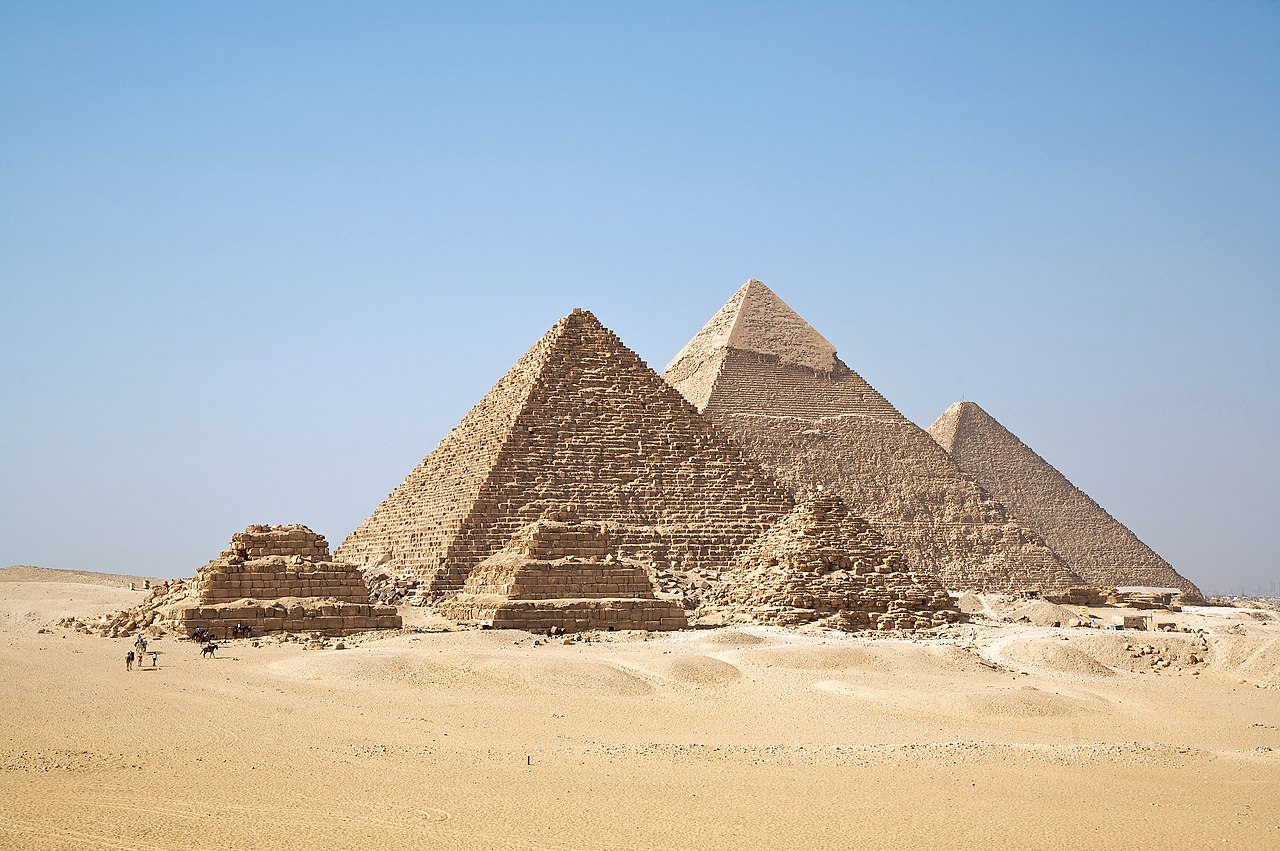
Where the Ancient World Survives

The Pyramids of Giza are the only surviving wonder of the ancient world — the Great Pyramid of Khufu (147m; built 2560 BC) stood as the tallest structure on earth for 3,800 years. The Sphinx (73m long; carved from a single limestone outcrop; 2500 BC) faces due east. The interior of Khufu’s pyramid (LE 600 additional) is a 60m ascending passage to the Grand Gallery and the King’s Chamber.
💡 The Giza Plateau opens at 7am — arrive at opening before the tour buses arrive at 9am. Buy entry (LE 450) in advance at egy.travel to avoid the gate queue.

The Egyptian Museum on Tahrir Square (founded 1902) holds 120,000 objects across 107 rooms — the Tutankhamun galleries, the Amarna room, and the Royal Mummy Room. The Grand Egyptian Museum (GEM; 2023; 490,000m²) on the Giza plateau is now the world’s largest archaeological museum, with the complete Tutankhamun collection of 5,398 objects.
💡 Khan el-Khalili at dusk (5–7pm) is the most atmospheric time — the evening light on al-Hussein Mosque, the spice stalls at full activity, and the negotiation energy at its most alive.

Islamic Cairo (al-Qahira; the medieval Fatimid city) has the finest concentration of Islamic architecture in the world — the 1km al-Mu’izz Street has 40 standing mosques, madrasas, and wikalahs built between 970 and 1800 AD. The Khan el-Khalili bazaar (founded 1382) is the largest traditional market in the Arab world.
💡 Al-Mu’izz Street at 8am (the medieval Islamic spine; Bab Zuweila to al-Hakim Mosque) has the finest morning light on the limestone madrasa facades before the tourist traffic starts.

Zamalek Island, in the middle of the Nile in central Cairo, is the finest neighbourhood in the city — the Art Deco villas, the foreign embassies, and the best restaurants in Cairo on its banks. The Cairo Tower (187m; LE 100) on Zamalek gives the finest 360° city panorama.
💡 The Grand Egyptian Museum (GEM; LE 450; 2km from the Sphinx) holds the complete Tutankhamun collection — far superior to the old Egyptian Museum arrangement and worth the separate trip.
Cairo has the most varied food scene in the Arab world and the finest Egyptian cuisine: the koshari (the national dish; the Egyptian street food; the combination of rice, lentils, macaroni, fried onion, and the garlicky tomato sauce; the chilli vinegar splash; E£ 20–40 from any of the Koshari Abu Tarek restaurants — the most celebrated koshari chain in Cairo; the Champollion Street restaurant is the most famous; the most democratic and most specifically Egyptian meal), the ful medames (the slow-cooked fava beans with the olive oil, the lemon and the cumin; the most important breakfast in Egypt; EGP 10–20 from any ful cart from 6am; the Egyptian breakfast; eaten by 90 million Egyptians every morning), the ta’amiya (the Egyptian falafel; made from fava beans rather than chickpeas; greener and more intensely flavoured than the Lebanese version; EGP 5–10 for a sandwich; the most ubiquitous Cairo street food), the fiteer (the layered puff pastry; the Egyptian pie; EGP 30–80 depending on the filling — the meat, the cheese, the honey and cream cheese — from the Farouk restaurant on Shubra Street; the most specific Cairene dessert), and the ahwa (the Egyptian coffee; cardamom-scented; very strong; served with the fine coffee grounds settling at the bottom; EGP 10–20 at any ahwa cafe; the Fishawi in the Khan el-Khalili; the social ritual of Cairo).
The Cairo Metro (3 lines; 65 stations; EGP 7–10/trip; the most reliable Cairo transport for the key tourist circuit: Line 1/2 to Sadat station for the Egyptian Museum and Tahrir Square; Line 2 to El-Geish station for Islamic Cairo; Line 2 to Giza station (then 20-min taxi or Careem to the Pyramids); runs 5:30am–midnight; the metro cars have separate women-only sections at the front) is the backbone of tourist transport in Cairo. Careem (the Uber-owned regional ride-hailing app; dominant in Egypt; EGP 30–200 for most Cairo journeys; always use the app for price transparency and driver accountability; the Giza Plateau from Downtown is EGP 80–120 by Careem; the airport to Zamalek is EGP 150–250; more reliable than the metered taxi and significantly more reliable than the unmetered white taxis) is the essential supplement. Walking within defined areas (the Khan el-Khalili bazaar; the al-Mu’izz Street; Zamalek; the Giza Plateau within the complex) is pleasant and necessary; walking between neighbourhoods in Cairo is not recommended due to traffic and distances.
The Giza Plateau opens at 7am — arrive in the first hour before the tour buses from central Cairo arrive at 9am.
The Khan el-Khalili bazaar is best at dusk (5–7pm) when the spice shops and gold merchants are at full activity and the evening light hits the al-Hussein Mosque.
Al-Mu’izz Street at 8am (the 1km medieval Islamic spine from Bab Zuweila to Bab al-Futuh; free to walk) has the morning light on the madrasa facades before the tourist traffic starts &mdash.
Fishawi’s Café (Khan el-Khalili; open continuously since 1773; narghile from EGP 80) is Cairo’s oldest café. Visit after midnight when the bazaar empties and the tea boys move between antique mirror tables.
A felucca chartered from the Zamalek Corniche at sunset (LE 150–200/hour for the whole boat; negotiate with the captain at the dock) is the finest LE 150 you spend in Cairo &mdash.
The Grand Egyptian Museum (GEM; LE 450; 2km from the Sphinx; Uber LE 15) opened in 2023 and holds the complete Tutankhamun collection (5,398 objects).
Oct–Apr is the comfortable season (15–28°C; clear sky; the best light on the Pyramids). Dec–Feb is the peak tourist season (the coolest; book hotels ahead). May–Sep is harsh (35–45°C; the khamsin sandstorm March–May) but the cheapest. Ramadan (dates vary by year) brings a unique evening atmosphere.
Three days: Pyramids at dawn, the Royal Mummies, the Khan el-Khalili, Islamic Cairo, the GEM, and a Nile felucca sunset.
Giza Plateau at 7am (the three pyramids; the Sphinx; pyramid interior LE 600 extra). Grand Egyptian Museum (GEM; the Tutankhamun hall). Khan el-Khalili at dusk.
💡 Cairo Uber is the most reliable and affordable in Africa — LE 25–60 covers almost any city trip. The airport to Downtown is LE 90–130.
Egyptian Museum on Tahrir (9am; Royal Mummies; Tutankhamun galleries). Al-Mu’izz Street walk. Citadel of Saladin at noon. Felucca at sunset from the Zamalek dock.
💡 The Giza sound and light show (nightly at 6:30pm and 7:30pm; LE 300–350; viewed from the plateau) narrates the history of the pyramids through projected light on the Sphinx and the pyramid faces.
Saqqara day trip (30km south; Uber LE 80–100; the step pyramid of Djoser; the Tomb of Ti; the Serapeum). Memphis open-air museum (5km north; the Ramesses II colossus).
💡 Al-Azhar University (970 AD; the oldest continuously operating university in the world; free outside prayer times) has the finest view of the medieval minaret collection from the inner courtyard.
Cairo is excellent value for Western visitors. The GEM (USD 7–12), the Pyramids (USD 4), and the koshari lunch (USD 0.60) make the essential Cairo experiences remarkably cheap. Per person per day.
The koshari at Abu Tarek (EGP 30 for the large bowl; USD 0.60; the most democratic meal in Cairo — the same dish eaten by 90 million Egyptians every day) is the finest 60-cent lunch in any major tourist city in the world.
The Royal Mummies Room supplement (EGP 180; USD 3.60) at the Egyptian Museum is the most extraordinary EGP 180 in this guide — the actual preserved bodies of Ramesses II, Seti I and 20 other pharaohs, in perfect condition after 3,200.
The Mena House Hotel (the 1869 royal hunting lodge converted to a hotel in 1885 on the Giza Plateau)
Uber Egypt — the safest and most reliable way to navigate Cairo from the pyramids to the Khan el-Khalili.
Free
Grand Egyptian Museum (GEM) official app with interactive gallery maps and Tutankhamun object guides.
Free
Arabic translation with camera OCR — essential for mosque inscriptions and market signs in Islamic Cairo.
Free
Cairo restaurant discovery with Zamalek, Downtown, and Islamic Cairo filtering.
Free
Cairo Metro app with real-time line status for the Tahrir–Downtown corridor.
Free
Download the Cairo offline map — essential for navigating Islamic Cairo’s medieval street grid without data.
Free
Explore more of Egypt’s extraordinary cities and landscapes.