FR
Bordeaux
An elegant 18th-century city on the Garonne and the gateway to some of the world’s most famous vineyards
An elegant 18th-century city on the Garonne and the gateway to some of the world’s most famous vineyards

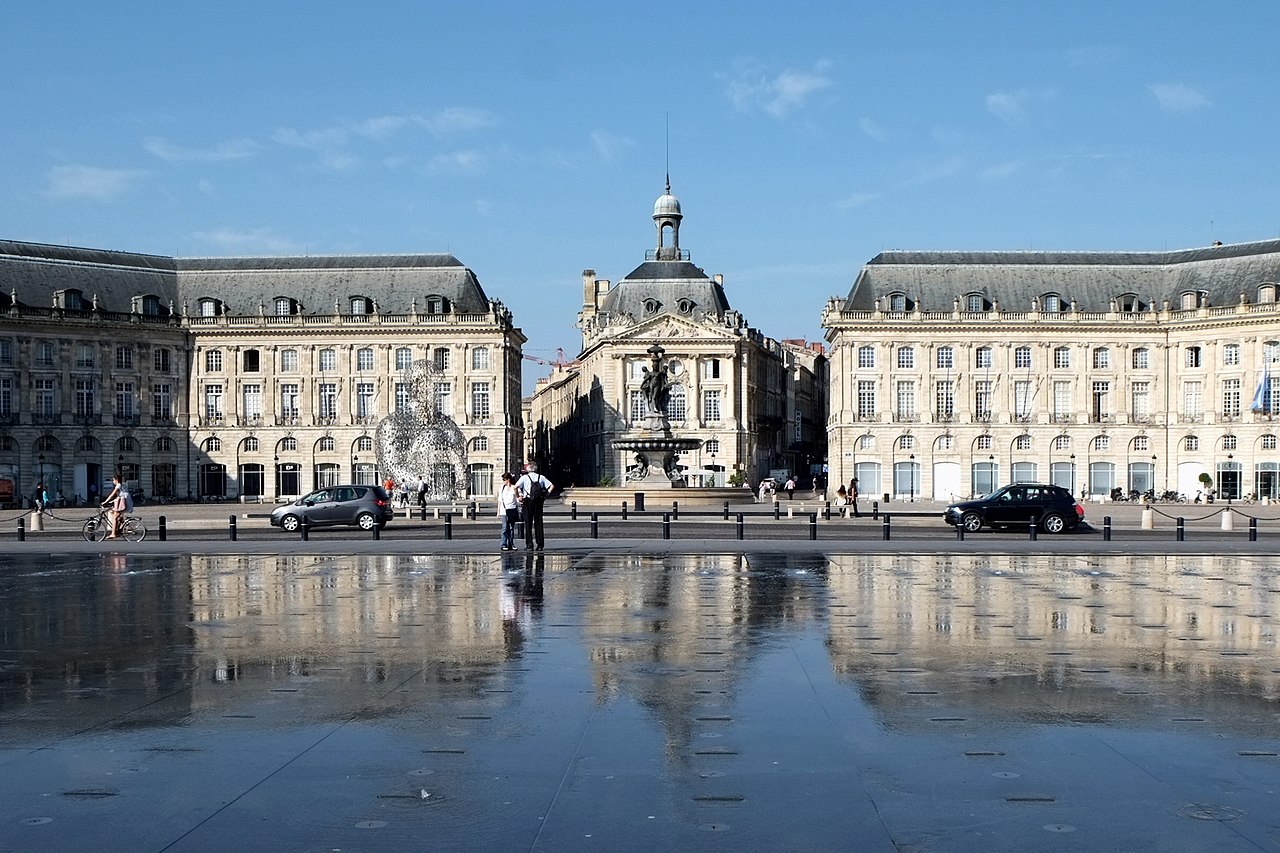
The grand riverside square of the 18th century faces the Miroir d’Eau, a vast shallow reflecting pool that alternates between a mirror and a mist.
Visit at dusk, when the square is lit up and reflected in the water.
Photo: Patrick Despoix, CC BY-SA 3.0

A museum of wine and its cultures, opened in 2016 in a swirling building on the river, with a tasting at the top-floor viewpoint.
Photo: FrDr, CC BY-SA 4.0

A medieval hilltop village surrounded by vineyards, about 40km from Bordeaux, with a church carved into the rock. The village and its vineyards are a UNESCO site.
Photo: Nataloche, CC BY-SA 4.0
Try entrecôte bordelaise, Arcachon oysters, duck and canelés, small caramelised cakes.
The Marché des Capucins and the Chartrons district are good for food; many wine bars serve local wines by the glass.
High-speed trains from Paris take a little over two hours. Bordeaux-Mérignac Airport is linked to the centre by shuttle bus and tram. Trams cover the city, and trains run to Saint-Émilion and Arcachon.
France is in the EU and the Schengen area and uses the euro. EU citizens need only an ID card; citizens of the UK, US, Canada, Australia and many other countries can visit visa-free for up to 90 days in any 180-day period, with biometric registration under the EU Entry/Exit System. An ETIAS travel authorisation is also due to be introduced. Check current rules before you travel.
Bordeaux is moderately priced; wine tours are the main extra.
City and vineyards.
Walk from Place de la Bourse through the old town to the Grosse Cloche and Saint-André Cathedral, and along the riverside.
Visit the Cité du Vin, then explore the Chartrons district and its wine bars.
Take the train or a tour to Saint-Émilion for vineyards, tastings and the monolithic church.
🛂 Entry rules: EES and ETIAS
France is in the Schengen area, which has two EU border systems for non-EU visitors.
EES (in force): since 10 April 2026 the EU’s Entry/Exit System registers non-EU visitors’ passport details, fingerprints and a photo the first time they enter the Schengen area, replacing passport stamps. Allow extra time at the border on your first trip; later crossings are quicker. EU, EEA and Swiss citizens are not registered.
ETIAS (not yet running): a €20 online travel authorisation for visitors who don’t need a visa, such as UK, US, Canadian and Australian citizens. It hasn’t started and no start date has been confirmed, so nobody can apply yet; ignore websites that offer to “pre-register” you for a fee.
Visa-free visitors can stay up to 90 days in any 180-day period across the whole Schengen area, not per country.
Official information: EU: Travel to Europe (EES & ETIAS) · Reviewed September 2026
Watch your belongings on public transport and at busy sights.
Many châteaux require appointments; book tours in advance.
The Bordeaux CityPass covers transport and many museums.
Set lunch menus (formules) are usually much cheaper than dinner.
Quick answers for planning time in Bordeaux.
Citizens of the UK, US, Canada, Australia and many other countries can visit visa-free for up to 90 days in 180, with registration under the EU Entry/Exit System.
A little over two hours by high-speed train.
By regional train or on an organised tour, about 30–40 minutes.
A huge shallow reflecting pool in front of Place de la Bourse.
May, June, September and October; the grape harvest is usually in September and October.
French is the language; a few words of French and a polite “bonjour” go a long way.
Free
Planning a wider trip? Our France travel guide covers getting there, costs, when to go and more.