FR
Nice
The French Riviera capital
The French Riviera capital
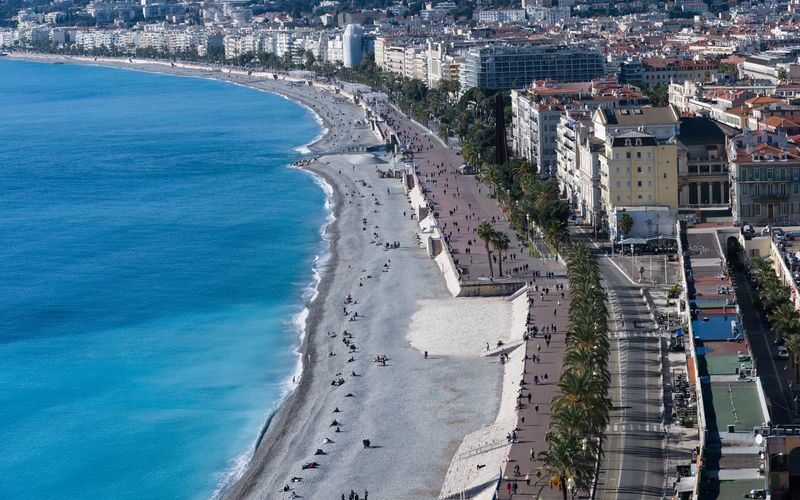
The 7km seafront walkway is the daily rhythm of the city — joggers at 6am, families by 10, tourists by noon. Walk it at dawn before anyone else arrives. The pebble beaches running alongside it are free (the sea is usually calm and warm from June through October).
💡 Rent a Vélobleu from any docking station to cycle the full 7km without fighting pedestrian traffic. The separated cycle lane is smooth and well-signed (€1.50/hour).

The morning market at Cours Saleya is the best food market on the Riviera, and that’s a competitive field. Flowers on one side, vegetables and local produce on the other. Arrive early for socca at Chez René. The surrounding lanes of Vieux-Nice — Baroque churches, shuttered windows, the occasional cat on a sill — are worth an hour of unplanned walking.
💡 The flower market at Cours Saleya runs Tue–Sun mornings (Mondays: flea market). Arrive by 8am for the freshest socca — buy from the stalls at the eastern end.
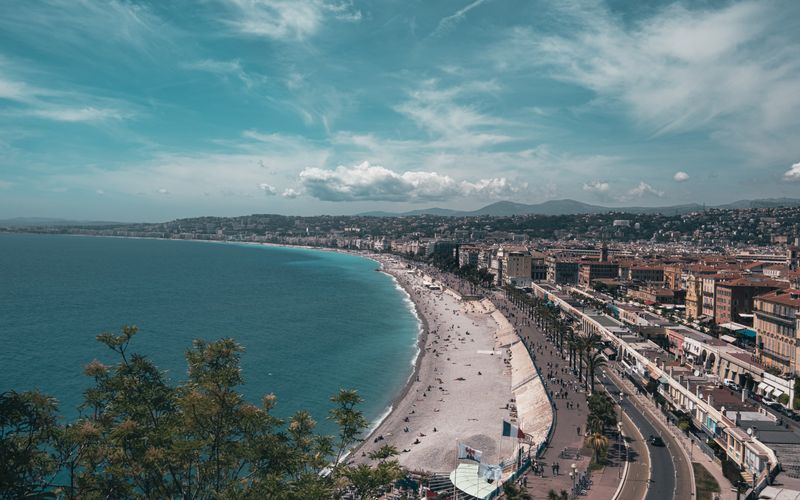
Take the lift (free going down) or walk up the steps. From the top: the Baie des Anges curving out to the west, the old port and its boats below, the Alps visible on a clear day behind the city. There’s a waterfall, a park and a small café. Entry is free. It closes at dusk. Get there an hour before sunset.
💡 Take the free lift from the base on Quai des États-Unis, or climb the 400 steps for the view en route. The waterfall at the top is artificial — the panorama over the Baie des Anges is the best view in Nice.
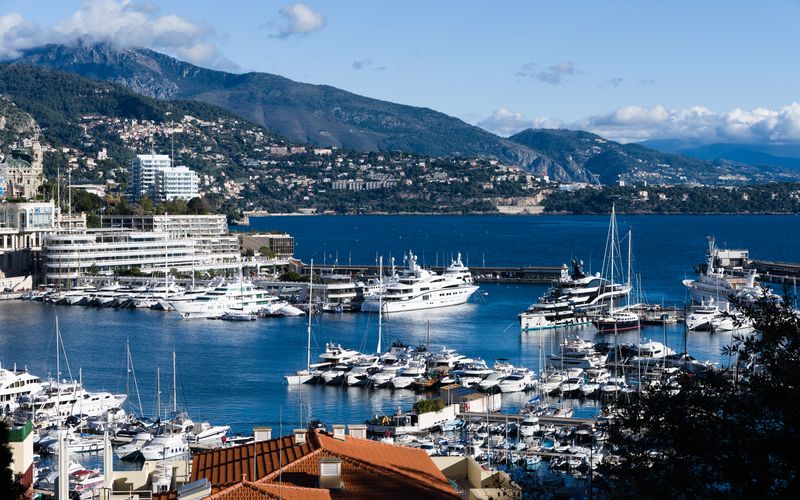
The train from Nice-Ville takes 22 minutes and costs €4.10 return. Walk to the Prince’s Palace (free to see the changing of the guard at 11:55am), the Oceanographic Museum (€18), and the casino square. Have lunch at the port. Return in the afternoon — two hours in Monaco is probably enough for most people.
💡 Train from Nice-Ville every 20 min (22 min; €4.10 return). Walk from Monaco-Monte-Carlo station through the old town to the Prince’s Palace and the Oceanographic Museum roof terrace.
The food in Nice is its own regional tradition, distinct from French and Italian but borrowing from both. Socca — a thick chickpea pancake from a wood-fired oven, eaten standing with a paper cone and a glass of rosé — costs about €3 and is the correct introduction. Chez René Socca in Vieux-Nice is the benchmark; arrive before noon or it’s gone. Pissaladière (caramelised onion tart with anchovies and olives) is in every bakery. The proper salade niçoise uses raw vegetables — no cooked green beans, no potatoes, no exceptions.
For dinner, the lanes around Rue de la Préfecture in Vieux-Nice have the best value. The restaurants facing the main squares charge for the view; the ones two streets back charge for the food. Rosé from Bandol or Bellet (the tiny local appellation in the hills above Nice) is what goes with everything. A good bottle at a good restaurant costs €25–35 and is well worth it.
Two tram lines handle most of it. Line 1 runs east–west through the city centre into Vieux-Nice; Line 2 connects the airport to the port. A Lignes d’Azur day pass (€5) covers both trams plus buses — you’ll rarely need it for more than the airport transfer since Old Town is a 20-minute walk from most hotels. Coastal trains to Monaco, Cannes and Antibes run every 30 minutes from Nice-Ville station; no advance booking, just buy at the platform. Taxis from the airport to the centre run €25–35 depending on traffic and whether you look like you know the city.
The best-positioned beach clubs — Ruhl, Hi Beach, Blue Beach — fill up fast. Book a sun-lounger online the evening before.
Socca at Chez René Socca is eaten at a plastic table or standing on the pavement.
The lift operates from the Promenade end and goes up for free (and down for free).
Trains to Monaco, Cannes and Antibes depart every 30 minutes from Nice-Ville station. No reservation needed, no apps.
Topless sunbathing is accepted on the beaches. Walking through the old town in swimwear and flip-flops is not. Restaurants and shops expect you to be dressed. Bring a shirt.
The Nice Carnival (two weeks in February) is one of Europe’s great street festivals. It also doubles hotel prices and fills every pavement.
The Côte d’Azur gets over 300 sunny days a year, which is either wonderful or overrated depending on whether you arrived in August. May, June and September are the months that earn the reputation: warm enough to swim, quiet enough to enjoy it, and half the price of peak summer.
Nice is a base, not just a destination. The coastal train unlocks Monaco, Cannes and Antibes in under an hour each way, so five days gives you the city itself plus two or three of the best day trips on the Mediterranean.
Check in, then walk straight into the old town. If the market at Cours Saleya is still running, go now. If not, walk the lanes — Rue Pairolière for street food, the Baroque cathedral, the late-afternoon light on the ochre houses. Dinner on Rue de la Préfecture.
💡 The Cours Saleya market closes at 1pm — buy lunch from the stalls before noon (baked tians, local cheese, olives) and eat at the outdoor tables.
Walk the Promenade at 7am before the sun-loungers go out. Matisse Museum in Cimiez (open 10am; free first Sunday of the month). Back to the old port by 4pm, then up to Castle Hill for sunset. It closes at dusk, so time it.
💡 The Matisse Museum is free on the first Sunday of each month. Walk up through the Roman Cimie¨z site (30 min) rather than taking the tram.
Train from Nice-Ville at 9am (22 min, €4.10 return). Prince’s Palace changing of the guard at 11:55am. Oceanographic Museum. Harbour lunch. Casino square walk. Return by 5pm. Monaco is small — two hours is usually enough; three is plenty.
💡 The Oceanographic Museum (€20) is the Monaco highlight — the rooftop terrace gives a free 360° view of the principality.
Morning bus to Èze village (Line 82, 25 min). Walk the Nietzsche Path down to Èze-Bord-de-Mer for a swim. Train to Antibes (25 min): the Picasso Museum inside the Château Grimaldi, the covered market, the old ramparts. Return via the seafront.
💡 Èze village is best before 10am before the coaches arrive. The Nietzsche Path descent to Èze-sur-Mer (45 min, steep) is the best way to leave.
Train to Cannes (40 min). Walk the Croisette. The old quarter (Le Suquet) has the best views of the bay. Ferries to the Îles de Lérins leave from the port (€18 return) — the smaller island (Saint-Honorat) has a Cistercian monastery and a vineyard.
💡 The Cannes old quarter (Le Suquet) above the port is far better than the Croisette — no crowds, the morning fish market, the castle hill view.
Nice is expensive in August and very reasonable in May. The numbers below are per person per day excluding flights, based on a couple travelling together. Staying five minutes’ walk from the beach costs roughly the same as five minutes from the Louvre in Paris.
Free public beaches are pebble. The sand is in Antibes — 25 minutes by train for €4 return.
The 3-star hotels on the Promenade des Anglais cost less than the equivalent hotel in Paris. The extra cost is for the sea view.
The best-value Michelin-level meal near Nice is not in Nice itself. Restaurants in Èze and Villefranche-sur-Mer charge less for equivalent quality.
Real-time tram and bus journey planner for Nice, with live disruption alerts. Works offline once loaded.
Free
Coastal train times and tickets for Monaco, Cannes, Antibes. Timetables also available on platform boards — the app is useful for checking in advance.
Free
Official Nice tram and bus app. Real-time tracking, day pass purchase and timetables. Line 2 is the airport connection.
Free
Restaurant reservations in Nice. Useful for securing a table at the better Vieux-Nice restaurants on weekends.
Free
Free entry and timed-entry booking for city museums including Matisse and Chéret. Worth checking before you arrive.
Free
Download the Nice offline map including Vieux-Nice. The old town’s lanes are easier to navigate with a phone map than on instinct.
Free
Discover more of France’s great destinations.