VA
Vatican City
The world's smallest country and spiritual heart of Catholicism
The world's smallest country and spiritual heart of Catholicism
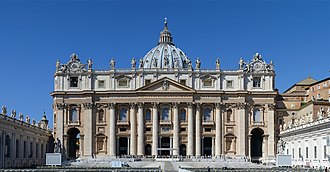
Michelangelo’s dome dominates the Roman skyline — the world’s largest church, built over the tomb of Saint Peter, took 120 years to construct. The interior overwhelms the senses with Bernini’s bronze baldachin, Michelangelo’s Pietà and the vast view from the dome.
Photo: Alvesgaspar, CC BY-SA 4.0

Michelangelo’s ceiling is among the most influential artworks ever created — painted in just four years (1508–1512) while the artist lay on scaffolding. The Last Judgment fresco fills the entire altar wall. The acoustics, the scale and the detail together create an experience beyond description.
Photo: Snowdog, CC BY-SA 3.0

One of the world’s great art collections, accumulated over 500 years by the papacy — 54 galleries including the Gallery of Maps, Raphael’s Rooms, the Pinacoteca and Egyptian antiquities, all leading to the Sistine Chapel. Book timed entry at least 2 weeks in advance.
Photo: Wilfredor, CC0
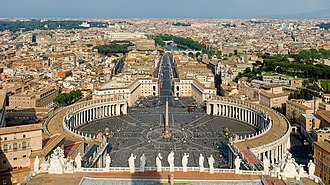
Bernini’s elliptical colonnade embraces the largest piazza in Rome — 284 columns forming two curved arms. Free to enter at any time; spectacular at sunrise before the crowds arrive and dramatically lit at night.
Photo: Diliff, CC BY-SA 3.0

A 1st-century Roman necropolis discovered in 1939 beneath the basilica floor — where the tomb of Saint Peter himself was identified. A scavi (excavation) tour through the ancient burial complex is one of the most intimate and eerie experiences in Rome.
Photo: Gary Todd from Xinzheng, China, Public domain

Approximately half of Vatican City is gardens — Italian, French and English landscape styles over 23 hectares of sculpted topiary, fountains, grottos and papal retreats. Accessible only on guided tours booked through the Vatican itself; extraordinary peace in the heart of Rome.
Photo: Staselnik, CC BY-SA 3.0
The Jewish-Roman artichoke — deep-fried whole until the outer leaves crisp like petals and the heart becomes tender. A speciality of Rome’s Jewish quarter, a 10-minute walk from the Vatican. The crunchy texture and nutty flavour make it one of Rome’s finest dishes.
The simplest and most demanding pasta in the Roman canon — spaghetti or tonnarelli with only Pecorino Romano, Parmigiano and coarsely ground black pepper, emulsified into a silky sauce without cream. Get it right and it is impressive; virtually every Roman trattoria within walking distance of the Vatican serves it.
The Vatican’s immediate neighbourhood in Prati has some of Rome’s finest artisan gelato shops — Fatamorgana, Gelarmony and Il Gelato di San Crispino. Look for small metal tubs covered with lids (not mountainous piles of bright-coloured ice cream).
The Lazio region produces Est! Est!! Est!!! and several good Frascati whites — served by the carafe at neighbourhood osterie near the Vatican at prices that are a fraction of tourist-facing restaurants.
Rome’s street-food icon — a fried rice croquette with a mozzarella centre that stretches into threads (like a telephone wire) when pulled apart. Available from street vendors and pizza al taglio shops throughout the Prati neighbourhood.
Vatican-adjacent Prati has excellent neighbourhood bars (cafes) — stand at the counter, drink espresso in one or two sips, pay about €1.20. The ritual is distinctly Roman and completely different from a touristy sit-down caffè.
Vatican City is within Rome — there are no direct flights. Rome Fiumicino (FCO) and Rome Ciampino (CIA) serve the city. The Vatican is 30–45 min from FCO by train or taxi. For trip planning, see the Vatican City official site.
Rome Fiumicino (FCO) is the main hub — virtually every European capital has direct daily services. Ciampino (CIA) is used mainly by Ryanair and budget carriers; it is slightly further from the city centre.
The Leonardo Express (FCO → Termini, €14, 32 min) then Metro A to Ottaviano-San Pietro (€1.50, 5 stops) is the most reliable route — total 55 min from plane to Vatican gates. A taxi from FCO to the Vatican costs €50–80 fixed rate.
The Via della Conciliazione (the grand avenue connecting Castel Sant’Angelo to St Peter’s Square, built for the 1950 Holy Year) is the finest approach on foot — the colonnade appears in full only in the final 100 metres as the avenue opens into the square.
Book Vatican Museums tickets online before arrival — walk-in queues of 3–4 hours are normal in July and August. The Sistine Chapel is always included in the general ticket; the Scavi and Gardens require separate booking.
April to June and September to October are the best months — warm (18–25°C), manageable crowds and the Papal Audiences in full swing. July and August are the hottest (30–35°C) and busiest. November to March is quieter and cooler (8–15°C) with shorter queues at the museums.
📅 Vatican City is in its best season in April, May, June, September, October. See where else is good to go in those months, or browse where to go by month.
Vatican City uses the euro. All entry fees are paid to the Vatican itself; accommodation is in Rome. Vatican Museum tickets should be booked online in advance to avoid queues of 2–4 hours.
The Sistine Chapel is included in the Vatican Museums ticket (€17 standard, €20 last Sunday of month — the free monthly day, for which queues start at 5am).
The early access Vatican Museums tours (entering before 7am, before the museum opens to the general public)
The Friday Night openings (Vatican Museums open on selected Friday evenings in summer, &euro)
St Peter’s Square for one day, the Basilica for one, the Vatican Museums for one, the Vatican Gardens for one, the Necropolis for one, Castel Sant’Angelo for one, Papal Audience for one. Vatican City — the world’s smallest country at 0.44km² — contains a greater density of artistic and spiritual significance than any other place on earth.
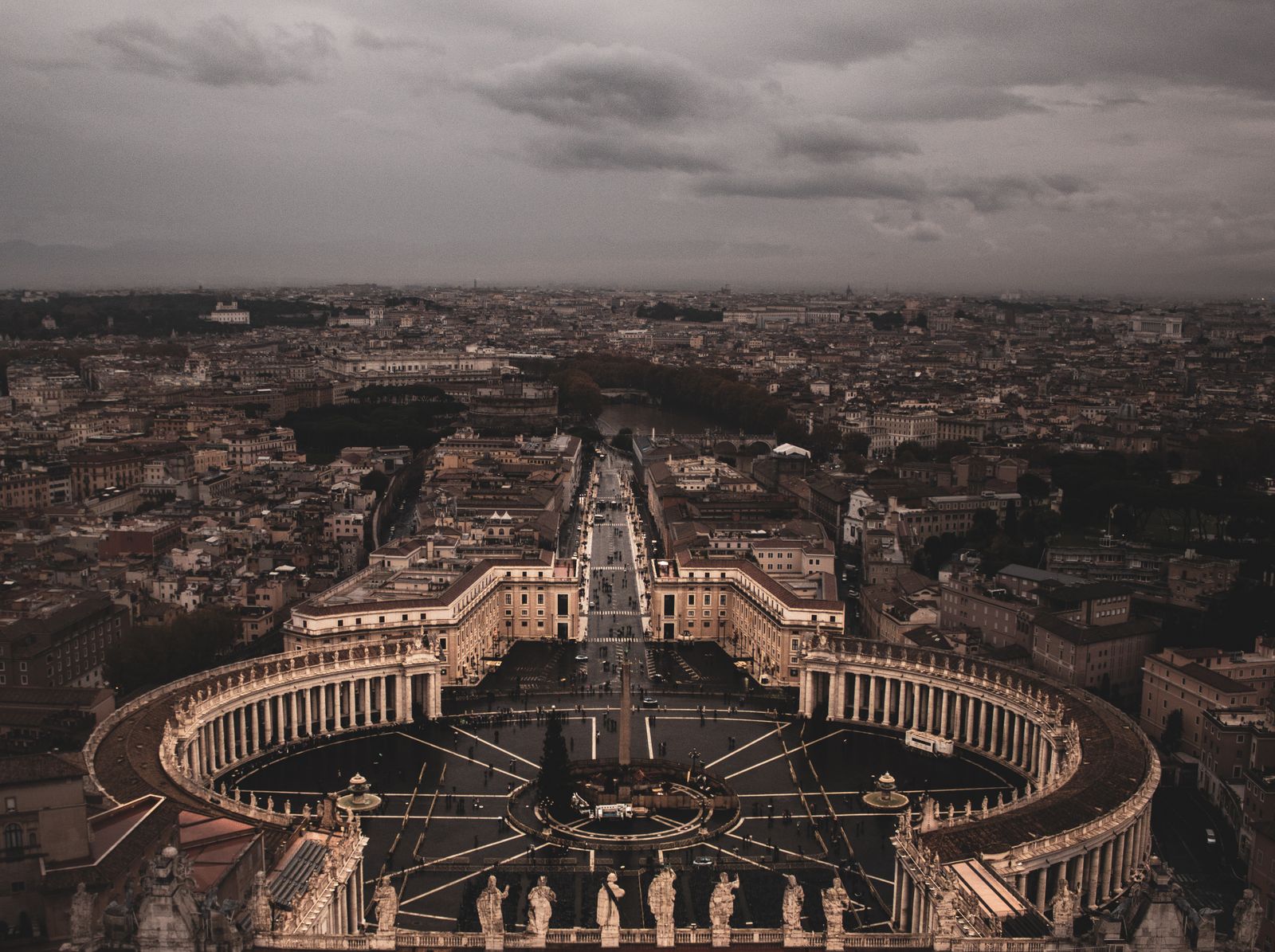
St Peter’s Square (Piazza San Pietro — the greatest urban space in the world, designed by Gian Lorenzo Bernini 1656–1667 as a symbolic embrace of the Catholic Church: two curved colonnades of 284 columns enclosing an ellipse of 240m, with the Egyptian obelisk brought from Heliopolis by Caligula in 37 AD in the centre, and the white line on the paving showing the shadow of each column at midday — a sundial on the grandest scale).
Bernini’s colonnade for St Peter’s Square took 11 years to build (1656–1667) and required 284 columns and 88 pilasters of travertine marble. The two curved arms were designed to represent the Church “embracing Catholics, welcoming heretics, and enlightening unbelievers” — Bernini’s own description. The Egyptian obelisk at the centre was brought from the Circus of Nero in 37 AD; it is the only obelisk in Rome that has never fallen since antiquity.
St Peter’s Basilica — the largest church in the world (20,000 standing capacity, 15,160m² floor area, the 136m dome by Michelangelo dominating the Rome skyline for 450 years) — with Michelangelo’s Pietà (carved at age 25 in 1499, the only signed work in his oeuvre — he carved his name on the strap across Mary’s chest after overhearing visitors attribute it to another sculptor) and the climb to the dome summit for the finest view of Rome.
The dome of St Peter’s (designed by Michelangelo from 1547, modified and completed by Giacomo della Porta in 1590) was the largest dome in the world when completed — surpassing the Pantheon at 43.3m internal diameter. It remains the largest dome constructed using traditional masonry. The gilded ball at the summit (2.3m in diameter, accessible through a trapdoor) has been climbed by Michelangelo himself and by numerous subsequent artists and architects.
The Vatican Museums (the largest art collection assembled by a single institution — 54 galleries, 20,000 works on display from 1.5 million in the collection, the product of 500 years of papal patronage and acquisition) — the Gallery of Maps (a 120m corridor with 40 topographical maps of Italy painted 1580–1583, the most ambitious cartographic painting project in history) and the Sistine Chapel (Michelangelo’s ceiling, painted 1508–1512 on 500m² of curved surface, lying on his back on scaffolding 20m above the floor).
Michelangelo painted the Sistine Chapel ceiling (500m², 300 figures, the Book of Genesis in nine scenes) between 1508 and 1512 — a total of approximately 4 years, largely alone. He did not paint lying on his back (a persistent myth) but standing with his neck bent sharply backward, a position that caused permanent damage to his eyesight and spinal posture. He was 33 when he began and 37 when he finished.
The Vatican Gardens (23 hectares of the western half of Vatican City, accessible only by guided tour and closed to the general public — including the Ethiopian College, the Vatican Radio Tower, a replica of the Lourdes Grotto and the Casino of Pius IV designed by Pirro Ligorio in 1560, considered one of the finest Mannerist buildings in existence) — the part of Vatican City that 99% of visitors never see.
The Vatican Radio transmission towers (built by Guglielmo Marconi himself in 1931, who personally designed the Vatican Radio system at Pope Pius XI’s request, making Vatican Radio the second radio broadcasting organisation in the world after the BBC) still stand in the Vatican Gardens. Vatican Radio broadcasts in 47 languages; the transmission towers are the oldest continuously operating broadcast towers in the world after the BBC transmitters.
The Scavi (Vatican Necropolis — a 1st–4th century AD Roman cemetery directly below the high altar of St Peter’s, excavated 1939–1950, containing the Aedicula of St Peter (the monument the Vatican asserts marks the actual burial site of the apostle Peter — bones found nearby in 1941, identified in 1965 by Pope Paul VI as probably belonging to a robust male of about 60–70, of the 1st century AD) — maximum 250 visitors per day; advance booking essential).
The Scavi excavation (1939–1950, authorised by Pius XII) confirmed that the high altar of St Peter’s Basilica stands directly above a 1st-century Roman cemetery — exactly where early Christian tradition placed the burial of Peter. The “Graffiti Wall” near the aedicula contains a 2nd-century Greek inscription that the Vatican’s epigraphers translate as “Peter is here”, the closest physical evidence for the apostle’s burial location.
Castel Sant’Angelo (originally built as the mausoleum of Emperor Hadrian in 139 AD, converted into a fortress and then a papal residence, connected to the Vatican by the Passetto di Borgo — a secret elevated corridor 800m long used by popes to escape during sieges, most famously by Clement VII during the Sack of Rome in 1527 — with the finest panoramic view of the Tiber and Rome from the Angel terrace at the top).
The Passetto di Borgo (the elevated walkway connecting the Vatican to Castel Sant’Angelo) was used in genuine emergency on 6 May 1527 during the Sack of Rome — when Charles V’s unpaid troops (partly Lutheran Swiss mercenaries) went on an uncontrolled rampage through Rome, killing 12,000 people. Pope Clement VII fled through the corridor in his nightgown while the attack was in progress, the last time the passetto was used for its intended purpose.
The Papal General Audience (held every Wednesday at 10am in St Peter’s Square when the Pope is in Rome — free to attend with a ticket from the Prefettura della Casa Pontificia, distributed free on Tuesdays or available online — the Pope addresses the 10,000–80,000 assembled faithful in multiple languages, blesses objects brought for the purpose, and is driven through the square in the Popemobile). Fly from Rome (FCO or CIA).
The Papal Audience tickets (free, distributed by the Prefettura della Casa Pontificia via their office at the Bronze Door of St Peter’s on Mondays and Tuesdays, or online at www.vatican.va) are one of the most striking free experiences in the world — sitting in Bernini’s colonnade while the Bishop of Rome addresses 30,000 people in seven languages simultaneously, from a platform 50 metres from the Apostolic Palace where every pope since 1903 has lived.
🛂 Entry rules: EES and ETIAS
Vatican City has no border controls of its own for most visitors; you arrive through the Schengen area, so its rules apply.
EES (in force): since 10 April 2026 the EU’s Entry/Exit System registers non-EU visitors’ passport details, fingerprints and a photo the first time they enter the Schengen area, replacing passport stamps. Allow extra time at the border on your first trip; later crossings are quicker. EU, EEA and Swiss citizens are not registered.
ETIAS (not yet running): a €20 online travel authorisation for visitors who don’t need a visa, such as UK, US, Canadian and Australian citizens. It hasn’t started and no start date has been confirmed, so nobody can apply yet; ignore websites that offer to “pre-register” you for a fee.
Visa-free visitors can stay up to 90 days in any 180-day period across the whole Schengen area, not per country.
Official information: EU: Travel to Europe (EES & ETIAS) · Reviewed September 2026
Queues without pre-booked timed entry can reach 4+ hours. Book official timed tickets at museivaticani.va as soon as dates open; unofficial resellers charge 2-3x the price.
Knees and shoulders must be covered for entry to St Peter’s Basilica and the museums. Disposable ponchos are sold outside; planning ahead saves time.
Only the dome climb and Vatican Museums require tickets — the basilica itself, Bernini’s square and Mass in St Peter’s are free and open to all.
The Prati neighbourhood immediately north of the Vatican has excellent hotels, neighbourhood restaurants away from tourist pricing, and a 5-minute walk to St Peter’s Square at any hour.
The square opens before 7am — arriving at sunrise gives you Bernini’s colonnade, Michelangelo’s dome and the obelisk completely to yourself before tour groups arrive.
Italian Type C and Type L plugs; 230V. Most modern devices auto-switch to 230V; check before plugging in.
Quick answers to the questions people most often ask before visiting Vatican City.
Vatican City sits inside Rome, so you fly into Rome Fiumicino (FCO) or Ciampino (CIA). From Fiumicino, take the Leonardo Express train to Roma Termini (about 32 minutes), then Metro line A to Ottaviano-San Pietro; a taxi from the airport takes 45–75 minutes.
No. There are no border checks between Rome and Vatican City — you simply walk into St Peter's Square. You only need the documents required to enter Italy.
Yes. St Peter's Square and St Peter's Basilica are free to enter. You only need tickets for the Vatican Museums (including the Sistine Chapel) and for climbing the dome.
Yes. Without a pre-booked timed ticket, queues can reach 2–4 hours or more in busy periods. Book on the official Vatican Museums website as early as you can and avoid unofficial resellers.
Yes. Knees and shoulders must be covered to enter St Peter's Basilica and the Vatican Museums, and staff do turn visitors away. Bring a light scarf or wear long trousers or a skirt.
Camera translation of signs and menus. Download language pack offline.
FreeHotels, guesthouses and apartments with free cancellation on most rates.
FreeMillions of traveller reviews for restaurants, attractions and hotels.
FreeThe most widely used messaging app worldwide for bookings and local contact.
FreeEncircled by Rome and surrounded by the Mediterranean world, Vatican City sits at the heart of Southern Europe — Italy, France, Spain, Greece and Portugal are all within easy reach, alongside the micro-states of Monaco and San Marino.
Vatican City is one of the world’s least-visited places. See all 90 in our guide to the world’s least-visited countries & territories.


