SM
San Marino
World's oldest republic on a limestone mountain
World's oldest republic on a limestone mountain
San Marino claims to be the world’s oldest republic, founded according to tradition by a Christian stonemason named Marinus in 301 AD — making it older than the Roman Empire’s fall and every other state in Europe. This tiny enclave entirely surrounded by Italy perches dramatically on the three limestone peaks of Monte Titano in the Emilia-Romagna region, its medieval fortresses and towers visible for miles across the Adriatic plain. The historic centre and Mount Titano are together a UNESCO World Heritage Site. San Marino issues its own stamps, currency (euro), passports and number plates, and maintains an army of fewer than 1,000 — the world’s smallest.
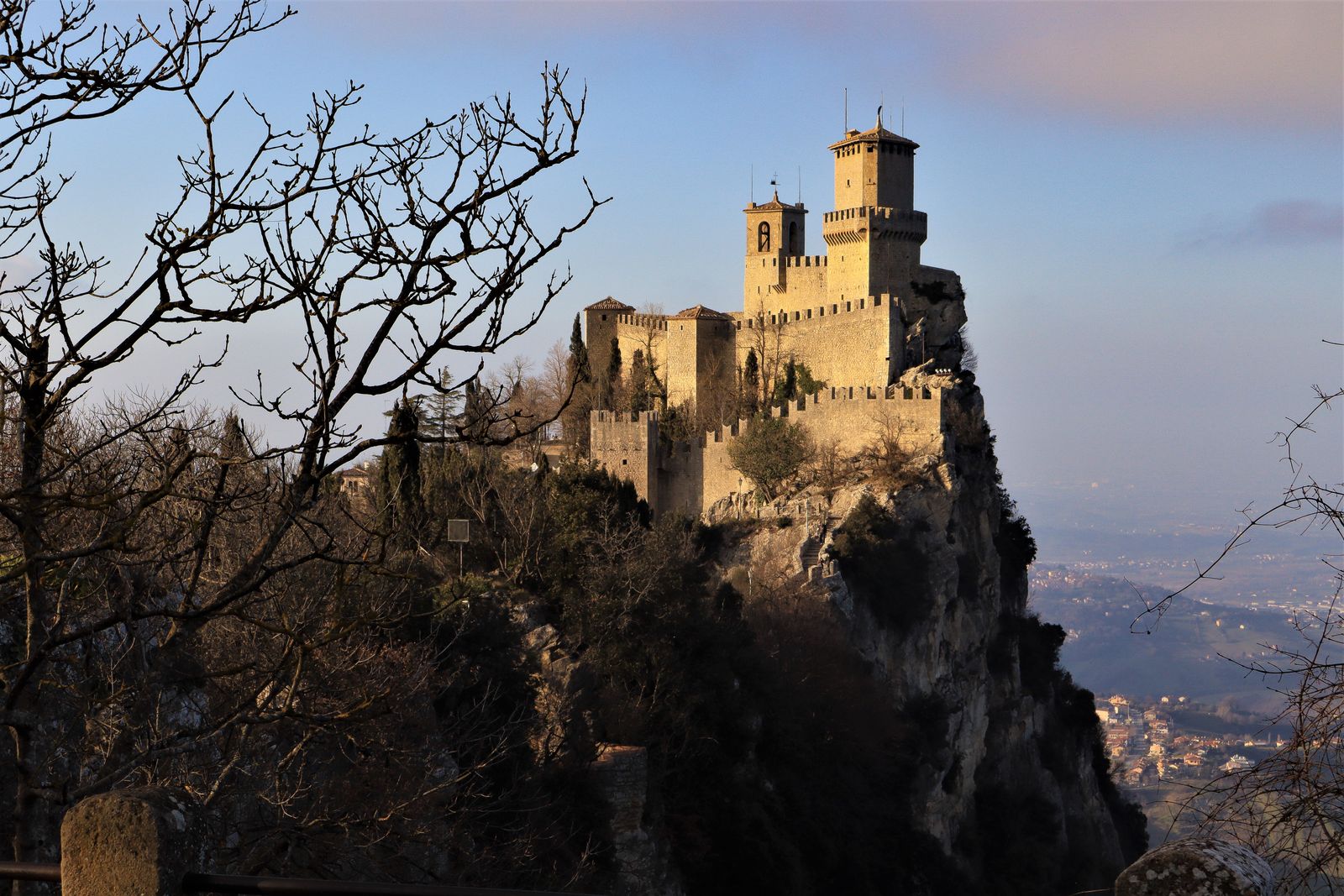
The three medieval towers of La Guaita (the oldest, 11th century), La Cesta and Montale crown Monte Titano’s limestone ridge and are San Marino’s defining image. A walkway connects La Guaita and La Cesta along the ridge, with immense views across the Adriatic plain towards the sea. La Guaita served as a prison until 1970 and is now a museum.
The cobblestoned City of San Marino with its Piazza della Libertà, the Government Palace (Palazzo Pubblico) and the Basilica di San Marino is compact and entirely walkable. The two Captains Regent — San Marino’s dual heads of state elected every six months since 1243 — still hold their changing-of-the-guard ceremonies in medieval costume.
San Marino’s Museo di Stato holds a rich collection of ancient coins, stamps, medieval art and Sammarinese historical artefacts that tell the story of this improbable republic’s survival through 1,700 years of Italian politics.
San Marino (Wikipedia) →Beans stewed with pork rind — a hearty local speciality.
A dense cake of polenta, dried figs, nuts and honey, baked in a wood oven — the traditional Christmas cake of San Marino.
A thin flatbread filled with prosciutto, squacquerone cheese and rocket — Romagnan street food that is the daily lunch staple of San Marino.
Fresh tagliatelle and strozzapreti with ragù or truffle. San Marino makes its own wines, such as Brugneto and Tessano.
San Marino has no airport. Rimini (RMI) is the nearest airport (30 min); Bologna (BLQ) is the best-connected hub (1h30 by car or bus). For trip planning, see the official San Marino tourism portal.
Rimini Airport has direct summer services from the UK (Ryanair, Jet2). The Bonelli Bus connects Rimini railway station to San Marino in 1 hour for €5.
Bologna (the best-connected Emilia-Romagna airport) is 1h30 from San Marino by car or 2h by train + bus. Most European long-haul travellers use Bologna as the gateway.
The Bonelli Bus (running year-round, multiple times daily from Rimini FS to San Marino City centre) is the most convenient public transport option — €10 return. The cable car from Borgo Maggiore to the city summit (€2.50) completes the journey in style.
San Marino City’s historic centre is pedestrianised; cars must park at the base and take the cable car or walk up. Parking at Borgo Maggiore (free) then the cable car (€4.50 return) is the recommended approach for drivers.
May to September is best — warm (18–28°C), the medieval towers clear, the hilltop views spectacular. July and August are peak but the altitude (750m) keeps it cooler than the Adriatic coast below. October to April is quieter and cheaper; November to February can be misty and cold but dramatically atmospheric.
📅 San Marino is in its best season in April, May, June, July, August, September, October. See where else is good to go in those months, or browse where to go by month.
San Marino uses the euro (as an EU associate member). Prices are similar to or slightly cheaper than neighbouring Italy, with duty-free on tobacco, fuel and electronics.
Piadina — the flatbread of Romagna (a thin, unleavened flour disc griddled on a terracotta testo and filled with prosciutto, squacquerone cheese and rocket; or Nutella for dessert) — is the street food of San Marino.
Biancale di Rimini (a rare white wine grape variety grown only in the hills around Rimini and San Marino, producing a crisp, mineral white with a slight almond finish) is the local wine to seek out in San Marino restaurants.
Il Righi (the finest restaurant in San Marino, on the city walls with panoramic terrace views over the Adriatic plain, serving Romagnola cuisine with local truffles and the finest local wines) is the definitive San Marino dining experience.
Capital for two days, towers and walls for one, Rimini for one, Borgo Maggiore for one, Serravalle for one, Monte Titano sunrise for one. San Marino — the world’s oldest republic, on a mountain top in central Italy — is a half-day visit or an immersive multi-day stay depending on how deep you go.
San Marino City — the capital of the world’s oldest republic (San Marino was founded in 301 AD by a Christian stonemason named Marinus fleeing Diocletian’s persecution, making it the oldest constitutional republic in the world) on the summit of Monte Titano (750m) — with the First Tower (Guaita — the oldest, 11th century, the symbol of San Marino, used as a prison until 1975) and the panorama across the Adriatic plain to Rimini and the sea.
San Marino is the world’s oldest republic — it has been a self-governing state continuously since 301 AD (1,724 years), making it the oldest surviving sovereign entity in the world. Its constitution dates from 1600, making it the world’s oldest written constitution still in effect. The country has never been successfully conquered despite multiple attempts; Napoleon in 1797 and Mussolini’s fascist government both respected its independence.
The Second Tower (Cesta or Fratta — the highest of the three towers at 756m, with the Museum of Ancient Weapons inside the tower rooms —300 weapons from the 13th to 19th centuries) and the Third Tower (Montale — a single round tower on the third summit, only visible from a distance, privately owned) connected by the medieval wall walk (the Passo delle Streghe — the Path of the Witches — a narrow wall-top path between the first and second towers with the best views over Italy).
The three towers of San Marino (the Three Peaks of Mount Titano — Guaita, Cesta and Montale) were built between the 11th and 14th centuries as the defensive strongpoints of the republic. They appear on San Marino’s coat of arms and flag, are inscribed as a UNESCO World Heritage Site (2008), and are visible from the Adriatic coast 20km below on clear days.
The Historic Centre of San Marino City (UNESCO World Heritage — the Palazzo Pubblico, the 19th-century neogothic town hall where the two Captains Regent of San Marino are sworn in every 6 months in an unbroken tradition since 1243, and the duty-free shopping area — San Marino has no VAT and is a significant destination for Italian shoppers buying tobacco, electronics and spirits at reduced prices).
San Marino has two Heads of State simultaneously — the two Captains Regent, elected every 6 months by the Grand and General Council, a tradition unbroken since 1243. The system ensures no individual can hold power for long; the Captains cannot be re-elected for 3 years after their term ends. It is the world’s only system of co-equal dual headship of state running continuously for 780+ years.
30 min drive to Rimini — the most popular seaside resort on the Adriatic (15km of sandy beach, the largest concentration of beach clubs in Italy, and the Rimini historic centre with the Tempio Malatestiano (one of the finest early Renaissance buildings in Italy, designed by Leon Battista Alberti in 1450) and the Ponte di Tiberio (a perfectly preserved 2,000-year-old Roman bridge still in use as a road bridge)).
The Rimini beach resort system (200+ beach clubs operating in season, each with its own umbrellas, sun loungers, bars and restaurants, packed 2m apart along 15km of coast) is the largest and most organised beach resort system in Europe. In August Rimini has 3 million visitors per month — the beach is so heavily managed that a square metre of sand costs €15–30/day to access.
The Borgo Maggiore (the lower town of San Marino, connected to the capital by a cable car running every 15 minutes — the most pleasant way to arrive — with a medieval centre, the main weekly market (Thursday mornings, the most authentic local market in San Marino) and the Philip Contarini Museum of Curiosities).
The San Marino cable car (Funivia di San Marino, opened 1959, rebuilt 1995, running 800m and rising 200m from Borgo Maggiore to the capital in 1 minute 30 seconds) is the most pleasant arrival in San Marino and provides the best overview of the fortifications from below.
Serravalle — San Marino’s largest settlement (population 10,000 — larger than the capital) at the foot of Monte Titano, with the Domagnano Treasure Room (replicas of the extraordinary Ostrogothic gold jewellery found in 1893 — one of the finest late-antique treasure finds in Italy, the originals now in Germanic museums) and the San Marino stamps museum (San Marino has issued postage stamps since 1877, collected worldwide, a significant revenue source for the republic).
San Marino’s postage stamp programme (begun 1877) has been one of the republic’s most significant revenue sources for 150 years — San Marino produces beautifully designed limited-edition stamps collected worldwide, generating millions of euros annually from international philatelists who will never visit. The stamp collection spans 147 years and is one of the finest in European philatelic history.
An early morning return to the First Tower for sunrise (Monte Titano at 750m is above the morning fog that frequently fills the Adriatic plain in autumn and spring — the towers emerge from the cloud like a medieval island, the most atmospheric and photographed view in San Marino, free of crowds before 9am) before departure via Rimini (RMI) or Bologna (BLQ).
Monte Titano’s position (750m above a flat coastal plain, facing the Adriatic) creates a temperature inversion in the morning in spring and autumn — the plain fills with fog to about 500m, leaving the three towers of San Marino isolated above a white sea of cloud. The effect lasts 1–3 hours after sunrise; visitors willing to arrive at 6am experience it.
🛂 Entry rules: EES and ETIAS
San Marino has no border controls of its own for most visitors; you arrive through the Schengen area, so its rules apply.
EES (in force): since 10 April 2026 the EU’s Entry/Exit System registers non-EU visitors’ passport details, fingerprints and a photo the first time they enter the Schengen area, replacing passport stamps. Allow extra time at the border on your first trip; later crossings are quicker. EU, EEA and Swiss citizens are not registered.
ETIAS (not yet running): a €20 online travel authorisation for visitors who don’t need a visa, such as UK, US, Canadian and Australian citizens. It hasn’t started and no start date has been confirmed, so nobody can apply yet; ignore websites that offer to “pre-register” you for a fee.
Visa-free visitors can stay up to 90 days in any 180-day period across the whole Schengen area, not per country.
Official information: EU: Travel to Europe (EES & ETIAS) · Reviewed September 2026
No airport, no railway. Hire a car or take a bus from Rimini (25 min by bus). Most visitors day-trip from Rimini on the Adriatic coast.
San Marino has open borders with Italy but offers a voluntary passport stamp at the Ufficio Filatelico e Numismatico — a popular souvenir.
San Marino uses the euro and issues its own euro coins, which are collector items. The San Marino-design euro coins are legal tender but worth keeping.
The First, Second and Third towers (La Rocca, La Cesta, Montale) are all walkable from the capital along the medieval walls — a 2-hour circuit with extraordinary Adriatic views.
San Marino will stamp your passport on request at the official border stamp offices — a popular souvenir even though there are no border controls.
San Marino is known for slightly cheaper electronics, crossbows (the national weapon) and a huge number of coin and stamp shops catering to collectors.
Quick answers to the questions people most often ask before visiting San Marino.
San Marino has no airport or railway. Fly to Rimini (seasonal flights from the UK) or Bologna, then take the bus from Rimini (under an hour) or drive. Most visitors come on a day trip from Rimini.
There are no border checks between Italy and San Marino, so you can drive straight in. The tourist office offers an optional passport stamp as a souvenir.
The euro. San Marino also issues its own euro coins, which are popular with collectors.
May to September is warm (18–28°C) with clear views from the hilltop; at about 750 m, it stays cooler than the coast below. October to April is quieter.
The three towers on Monte Titano, the medieval historic centre (a UNESCO World Heritage Site) and sweeping views over the Italian countryside to the Adriatic.
— Works well for navigation around Monte Titano and the surrounding area.
FreePoint your camera at menus, signs or street text for instant translation. Download the language pack offline before you arrive for full use without data.
FreeReal-time and offline exchange rates for all world currencies — converts prices instantly so you always know what you are paying in your home currency.
FreeFind and book hotels, guesthouses and apartments with free cancellation on most rates — one of the widest selections of accommodation worldwide.
FreeBrowse millions of traveller reviews for restaurants, attractions and hotels — helps identify the best local spots and avoid tourist traps.
FreeSan Marino sits within easy reach of several other destinations — each with a completely different character.

