MC
Monaco
Glamour, Grand Prix & Mediterranean cliffs
Glamour, Grand Prix & Mediterranean cliffs
Monaco is the world’s second-smallest country and its most densely populated — a glamorous city-state of 2.08 square kilometres clinging to limestone cliffs above the Mediterranean, where Formula 1 cars race through the streets, superyachts crowd the harbour and the casino of Monte-Carlo has symbolised wealth and elegance since 1863. Despite its reputation for exclusivity, Monaco is freely accessible — the train from Nice takes 20 minutes and there is no admission fee for any of its streets. The old town (Monaco-Ville) on the Rock contains the Prince’s Palace, the Oceanographic Museum founded by Prince Albert I and the Cathedral where Grace Kelly is buried.
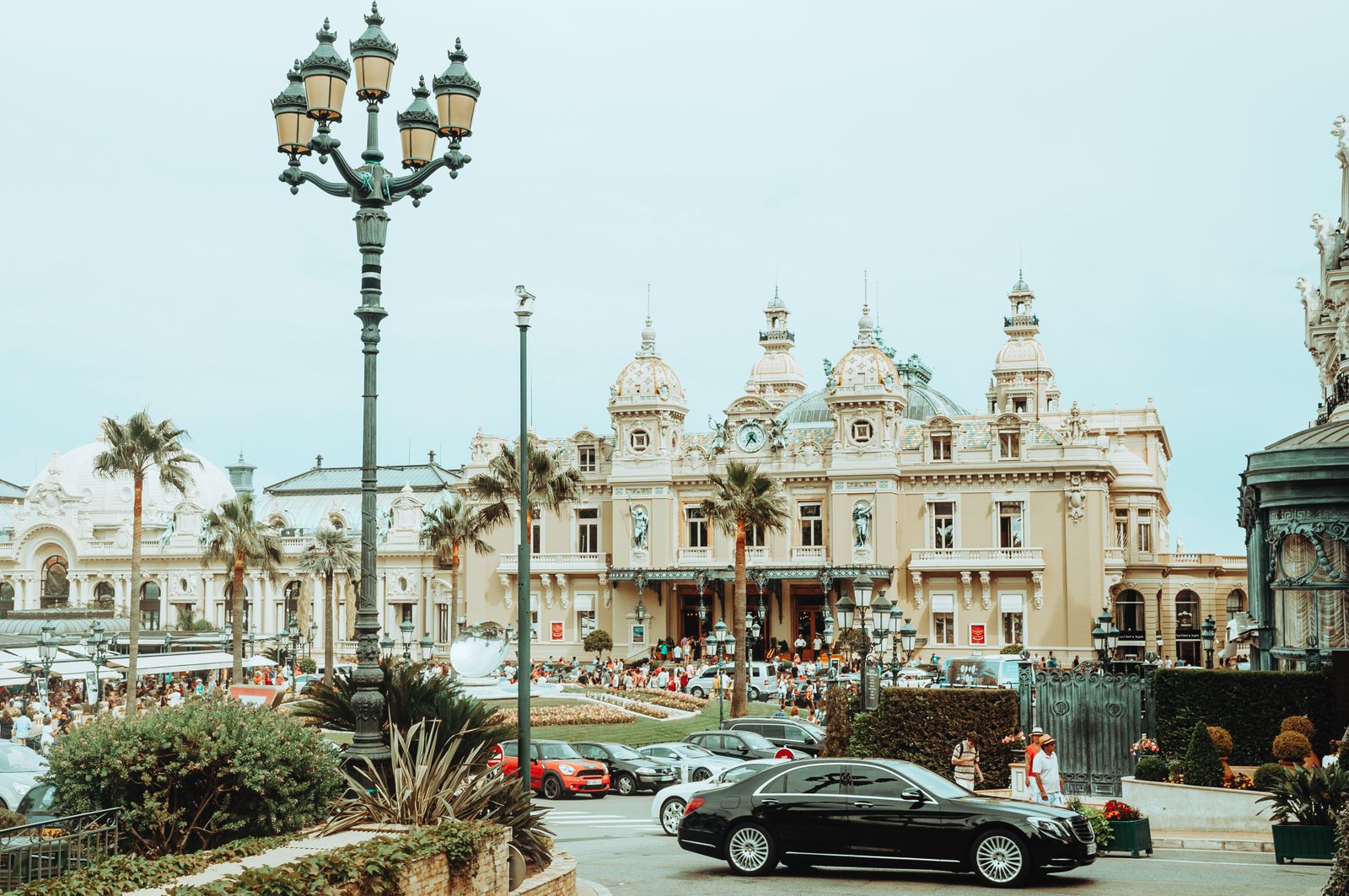
The legendary Casino de Monte-Carlo (1863) is the most famous casino in the world — a Belle Époque masterpiece of opera-house opulence where the dress code, the chandeliers and the stakes are all operatic. Entry to the gaming rooms requires a small fee and smart dress; the ornate atrium is accessible freely and spectacular in itself. The square outside, flanked by the Hôtel de Paris, is the heart of Monaco’s social theatre.
The medieval Grimaldi fortress-turned-palace on the Rock of Monaco has been the seat of the ruling family since 1297 — the longest-reigning royal family in Europe. The changing of the guard at 11:55 daily, the state apartments (open summer), and the panoramic views of the harbour from the palace square make this the essential stop in old Monaco.
Founded in 1910 by Prince Albert I, a pioneering oceanographer, this clifftop museum is one of the world’s finest aquariums and oceanographic collections — Jacques Cousteau was its director for 30 years. The rooftop terrace with its Mediterranean panorama is outstanding; the shark lagoon and living coral reef are the highlights inside.
The Monaco Grand Prix — the most famous race in Formula 1 — runs through the actual city streets each May. For the rest of the year you can drive, cycle or walk the entire circuit — the famous Tunnel, the Hairpin and the swimming pool chicane — in real life. The Automobile Club de Monaco has a small museum.
Monaco (Wikipedia) →Fried pastry filled with Swiss chard, ricotta and Parmesan — the national dish of Monaco, sold at bakeries and the September National Day festivities.
Salt cod cooked with tomatoes, olives, onion, garlic and herbs — the traditional Monegasque fisherman’s dish, rarely found in tourist restaurants but authentic.
A flat bread flavoured with orange zest, anise and olive oil, baked for Christmas and the Feast of Sainte Dévote (patron saint of Monaco).
Small pastries flavoured with orange-flower water, baked for Easter.
A chickpea-flour pancake, shared with nearby Nice. For an affordable meal, try the Marché de la Condamine.
Monaco has no airport or train station in the conventional sense. Nice Côte d'Azur (NCE) is the gateway — 22km west, 30 min by train or taxi. For trip planning, see the official Monaco tourism portal.
The regional train (Gare de Nice Ville → Monaco-Monte-Carlo) runs 4–6 times per hour and costs €4.20 — the best option by far. The helicopter (7 min, €150–200) is the most striking arrival.
Nice Airport is extremely well connected — virtually every European capital has multiple daily direct flights. London (2h), Paris (1h30) and all Swiss cities are within 2 hours.
Monaco’s train station (tunnelled entirely underground into the cliff, opened in its current form in 1964) is one of the most unusual stations in Europe. All trains on the Marseille–Ventimiglia Riviera line stop here.
Monaco’s free public lifts and escalators (connecting the harbour level to the Rock and the hillside districts) are an essential tool — the principality rises 160m from sea level to the Jardin Exotique in under 1km. Everything is walkable if you don’t mind the climb.
May to October is best — warm Mediterranean sun (20–28°C), the Grand Prix in May, the sea swimmable from June to October. July and August are peak season. November to April is mild (10–17°C) and much quieter — excellent for the Casino and museums without the summer crowds.
📅 Monaco is in its best season in April, May, June, July, August, September, October. See where else is good to go in those months, or browse where to go by month.
Monaco uses the euro. It is one of the most expensive destinations in the world for accommodation and dining, but entry to all public spaces (Casino Square, the Rock, the harbour) is free.
Staying in Nice (€60–120/night) and taking the 30-min train to Monaco daily is the most practical budget strategy — Monaco’s cheapest hotels start at €200/night. The train runs every 15–30 minutes and costs €4.20 each way.
The Café de Paris (opposite the Casino, the most famous brasserie on the Riviera, serving bouillabaisse, grilled sea bass and the tarte au citron) is the archetypal Monaco experience — a three-course lunch costs.
Le Louis XV — Alain Ducasse à l’Hôtel de Paris (3 Michelin stars, the flagship of Ducasse’s empire, serving a tasting menu of the finest Provençal and Mediterranean cuisine) is consistently ranked among.
Monaco-Ville for one day, Monte-Carlo for one, Fontvieille for one, Grand Prix circuit for one, Jardin Exotique for one, Larvotto and Menton for one, Nice for one. Monaco — the world’s second-smallest country — packs extraordinary density of experience into 2km² of Mediterranean cliff and reclaimed sea.
Monaco-Ville (the Old Town on the Rock — the original medieval settlement 60m above the Mediterranean, the Rocher de Monaco) with the Palais Princier (the official residence of the Grimaldi family, who have ruled Monaco since 1297, open to the public when the Prince is absent — the changing of the guard at 11:55 daily) and the Cathédrale de Monaco (the Saint Nicholas Cathedral where Grace Kelly is buried in a simple tomb behind the high altar).
The Grimaldi family has ruled Monaco continuously since 1297 — the longest-reigning royal dynasty in the world currently in power. François Grimaldi captured the fortress disguised as a Franciscan monk. The dynasty has ruled for over 725 years, surviving the French Revolution (Napoleon briefly annexed Monaco) and two World Wars.
Monte-Carlo — the district of Monaco built in the 1860s on reclaimed land by Charles III to raise revenue (the Casino de Monte-Carlo, opened 1863, the single building that transformed Monaco from a bankrupt principality into one of the wealthiest territories in the world, designed by Charles Garnier of Paris Opéra fame) and the Café de Paris (the legendary brasserie opposite the Casino with the most photographed terrace in Monaco).
Charles III of Monaco opened the Casino in 1863 in a deliberate effort to raise revenue without taxing his subjects — the gamble worked spectacularly. Within 5 years the Casino revenues were so large that Charles abolished all direct taxation in Monaco entirely (it has never been reintroduced). Monaco has had no income tax since 1869, making it a magnet for ultra-wealthy European residents.
Fontvieille — the industrial and cultural district built on reclaimed land in the 1960s, with the Collection de Voitures Anciennes (Prince Rainier III’s private collection of over 100 historic automobiles including a 1929 Bugatti Royale, a 1952 Hudson Hornet and a 1963 Lincoln Continental) and the Port de Fontvieille (a working harbour of fishing boats and small yachts — the authentic counterpoint to the superyacht parade of Port Hercules).
Prince Rainier III’s car collection (100+ vehicles ranging from the 1903 De Dion-Bouton to a 1986 Ferrari Testarossa) is one of the finest private automobile collections in the world. Rainier was a passionate car collector and occasional racing driver; the collection includes cars raced by Stirling Moss and Jacques Villeneuve, as well as the cars used by the Monegasque royal family for state occasions.
The Monaco Grand Prix circuit (a 3.337km circuit through the streets of Monte-Carlo, La Condamine and the tunnel — the most famous motor racing circuit in the world, run since 1929, with the Casino Square, the hairpin at the Fairmont Hotel, the tunnel section and the swimming pool chicane all walkable when not racing) and the Yacht Club de Monaco (the most exclusive yacht club in the world).
The Monaco Grand Prix (first run in 1929) is unique among Formula 1 races — it uses the same streets that are open to normal traffic 51 weeks per year. The circuit is considered the most technically demanding in F1 (the barriers are a metre from the cars; overtaking is almost impossible) and the most prestigious to win. A car lapping Monaco at race speed has an average corner speed of 104km/h with zero room for error.
The Jardin Exotique (a cliff-face garden of 7,000 succulent plants from five continents, clinging to the vertical limestone face of Monaco’s western cliff at 100m, with the finest view of Monaco from above) and the Grotte de l’Observatoire (a prehistoric cave beneath the garden with stalactites and the bones of cave bears and woolly rhinoceroses found during excavation — Monaco was inhabited 300,000 years ago).
The Grotte de l’Observatoire beneath the Jardin Exotique contains evidence of human habitation dating from 300,000 years ago — making the Rock of Monaco one of the longest continuously habitable sites in Europe. The cave’s constant temperature (14°C year-round) and protected entrance were ideal for Palaeolithic occupation; the same qualities now make it a tourist site 50m below a city of extreme modernity.
Larvotto Beach (Monaco’s only public beach, a strip of fine shingle on the eastern coast with a marine reserve protecting the Posidonia seagrass meadows) and a day trip to Menton (4km east — the lemon capital of France, on the French-Italian border, with the finest Art Nouveau architecture on the Riviera and the Jean Cocteau Museum).
Monaco’s Larvotto Marine Reserve (established 1999) protects a Posidonia oceanica seagrass meadow — one of the slowest-growing organisms on earth (1cm per year), these ancient seagrass meadows take thousands of years to develop and provide nursery habitat for 25% of all Mediterranean fish species. The meadow off Larvotto is estimated to be over 1,000 years old.
Nice (22km west, 30 min by train or bus — the capital of the French Riviera, with the Cours Saleya flower market, the Promenade des Anglais and the Vieux-Nice old town) for a final day before flying from Nice Côte d’Azur (NCE) or returning by train. Monaco has no airport; all air access is via Nice.
The Monaco-Nice train (4–6 trains per hour, 20–30 min, €4.20 single) is the cheapest and most frequent way to reach Monaco from Nice Airport — far faster than a taxi (45–90 min in traffic) and dramatically cheaper than the helicopter (NCE–Monaco, 7 minutes, €150–200 per person).
🛂 Entry rules: EES and ETIAS
Monaco has no border controls of its own for most visitors; you arrive through the Schengen area, so its rules apply.
EES (in force): since 10 April 2026 the EU’s Entry/Exit System registers non-EU visitors’ passport details, fingerprints and a photo the first time they enter the Schengen area, replacing passport stamps. Allow extra time at the border on your first trip; later crossings are quicker. EU, EEA and Swiss citizens are not registered.
ETIAS (not yet running): a €20 online travel authorisation for visitors who don’t need a visa, such as UK, US, Canadian and Australian citizens. It hasn’t started and no start date has been confirmed, so nobody can apply yet; ignore websites that offer to “pre-register” you for a fee.
Visa-free visitors can stay up to 90 days in any 180-day period across the whole Schengen area, not per country.
Official information: EU: Travel to Europe (EES & ETIAS) · Reviewed September 2026
Train from Nice (20 min) is the easiest option. Driving and parking in Monaco is expensive and traffic-heavy. Helicopter transfer from Nice airport takes 7 minutes.
The entire principality can be walked in an afternoon. The Old Town (Monaco-Ville) and Casino Square are 1.5km apart. No taxis needed.
Budget accordingly. A coffee at a café near the Casino costs EUR 7-10. A restaurant meal EUR 50-100 per person.
The nearest airport is Nice (NCE) — 30 min by road or 7 minutes by Héli Air Monaco helicopter. The helicopter is famous but costs around EUR 160 each way.
Monaco is expensive — budget accordingly for food and drinks. Day-tripping from Nice or Menton is the economical approach.
Smart casual dress required for the gaming rooms. Bring your passport for ID; under-18s are not admitted.
Quick answers to the questions people most often ask before visiting Monaco.
May to October is best — warm Mediterranean sun (20–28°C), the Grand Prix in May, the sea swimmable from June to October. July and August are peak season.
Monaco has no airport or train station in the conventional sense. Nice Côte d'Azur (NCE) is the gateway — 22km west, 30 min by train or taxi.
Expect roughly €150–280 a day on a budget and €500–900 mid-range, or €2,000+ for a more luxurious trip, per person and excluding flights.
Monaco uses the euro (€).
Plug types: Type C / E (two-pin, 230V).
— Works perfectly; Monaco is small enough to navigate on foot in an afternoon.
FreePoint your camera at menus, signs or street text for instant translation. Download the language pack offline before you arrive for full use without data.
FreeReal-time and offline exchange rates for all world currencies — converts prices instantly so you always know what you are paying in your home currency.
FreeFind and book hotels, guesthouses and apartments with free cancellation on most rates — one of the widest selections of accommodation worldwide.
FreeMonaco sits within easy reach of several other destinations — each with a completely different character.

