GS
South Georgia
The wildlife capital of the Southern Ocean
The wildlife capital of the Southern Ocean
The world’s largest elephant seal population — hundreds of southern elephant seals haul out on the beaches of South Georgia, with enormous bulls (up to 4 tonnes) battling for harems. The noise, smell and sheer scale of a crowded South Georgia beach during October-November breeding season is one of nature’s most extraordinary spectacles.
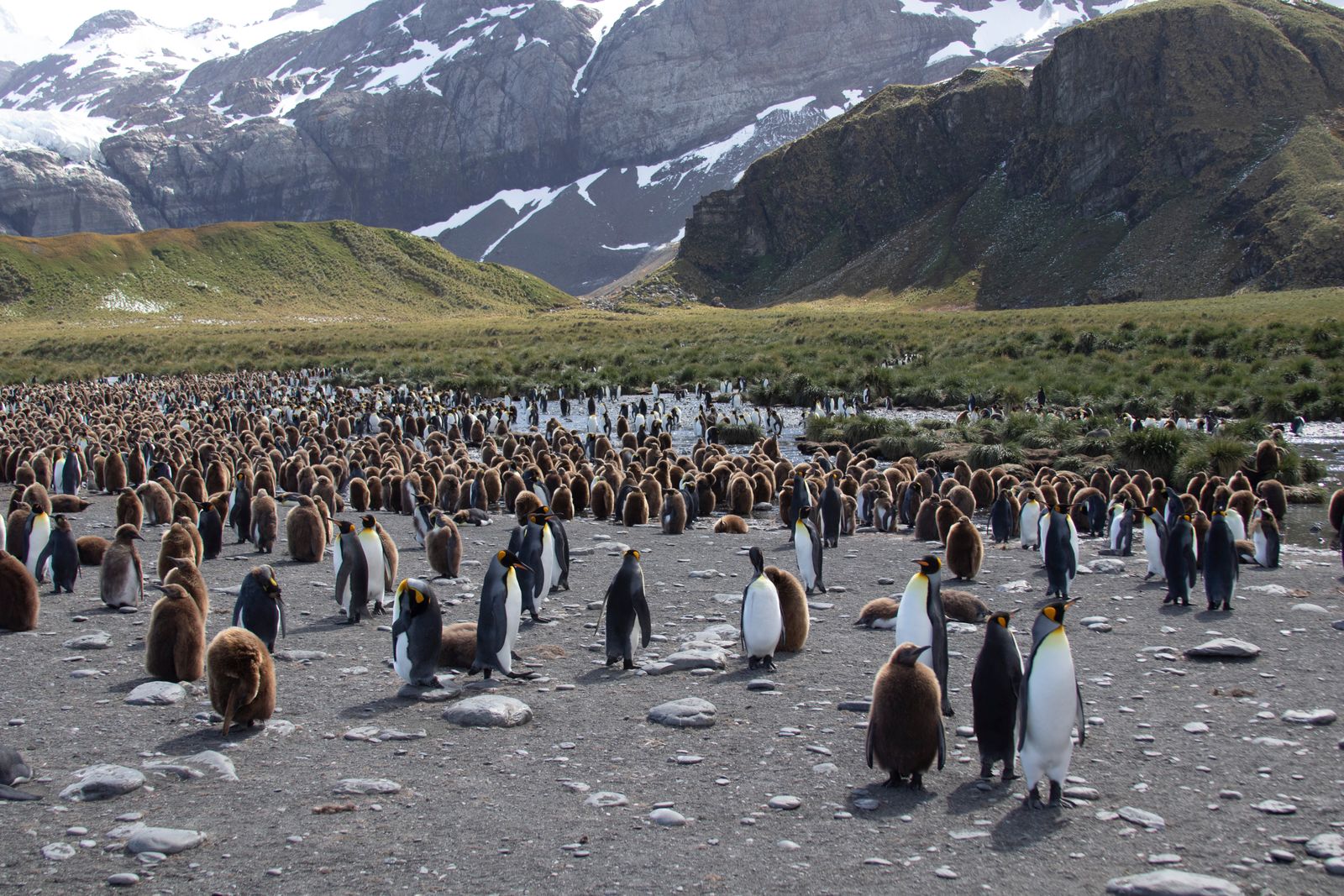
Hundreds of thousands of king penguins — South Georgia is home to over 400,000 breeding pairs of king penguins, concentrated in huge colonies at St Andrews Bay (the world’s largest) and Salisbury Plain. Standing among 100,000 penguins is an overwhelming sensory experience that few places on earth can match.
Ernest Shackleton is buried at the old whalers’ cemetery in Grytviken — the man who twice survived impossible Antarctic ordeals died here in 1922, returning for a fourth expedition. The simple white marble grave among the abandoned whaling station is one of the most moving pilgrimage sites in the world of exploration.
An abandoned early 20th-century Norwegian whaling station — now a hauntingly beautiful industrial ruin of rusted machinery, oil tanks, whale bone yards and the church where Shackleton’s funeral was held. The South Georgia Museum in the manager’s villa tells the complete story.
South Georgia is home to the largest wandering albatross breeding colony in the world — the albatross with the greatest wingspan of any living bird (up to 3.5m) nests here in large numbers on the northwestern headlands. Seeing a wandering albatross soaring in the Drake Passage approaches to South Georgia is one of the greatest wildlife experiences on earth.
The island’s mountainous spine — a dramatic chain of glaciated peaks reaching 2,934m (Mount Paget) rising from sea level in just a few kilometres. Glaciers calving directly into the ocean create a constantly changing icescape; Shackleton crossed the entire island’s mountains in 1916 without ropes, ice axes or maps.
South Georgia and the South Sandwich Islands (Wikipedia) →All South Georgia visitors arrive on expedition cruise ships — the finest of which (Quark Expeditions, Ponant, Heritage Expeditions) serve exceptional food informed by the remote setting: fresh bread baked daily, locally caught Patagonian toothfish when available, and celebratory dinners at anchor in historic bays.
The deep-water Patagonian toothfish (marketed as Chilean sea bass) is caught in tightly regulated, sustainable fisheries around South Georgia — its white, buttery, flaking flesh is considered one of the world’s finest white fish. Served at Grytviken’s small cafe and on expedition vessels.
A hearty lamb stew in the Falkland Islands tradition — the closest inhabited territory to South Georgia — served at the small staff station at King Edward Point. The Falklands produce some of the finest free-range lamb in the Southern Hemisphere.
A shot of Scotch whisky poured over Shackleton’s grave — an Endurance expedition tradition. Tour operators provide the whisky; the ritual of leaving some for “the Boss” is one of the most atmospheric moments of any South Georgia voyage.
The Zodiac landings that deliver visitors to South Georgia beaches are followed by hot chocolate and biscuits served from thermos flasks — the standard cold-weather refreshment of polar expedition travel. Simple, warming and completely appropriate.
The Falkland Islands Brewery produces ales and lagers from South America-influenced recipes — available at Grytviken and on expedition ships. A craft beer with extraordinary context: brewed in the Falklands, drunk in the Southern Ocean.
No airport or harbour. All access is by expedition cruise ship. The South Georgia Government requires a landing permit (£85/person) for all visitors. For trip planning, see the official South Georgia tourism portal.
💡 Ushuaia (54°S — the world’s southernmost city) is the departure point for most South Georgia expeditions. The crossing takes 4–7 days depending on whether the Falklands are included.
💡 Stanley (Falklands) is 3 days at sea from South Georgia and is included in most itineraries. The combination of Falklands + South Georgia forms the classic sub-Antarctic circuit.
💡 All operators use small expedition vessels (50–200 passengers) with zodiac inflatable boats for shore landings. The £85 landing permit is included in all cruise prices; operators pay on behalf of passengers.
💡 There are no roads, vehicles, hotels or permanent visitor facilities on South Georgia. All movement is on foot; conditions change rapidly. The expedition team manages all shore visits.
November to March is the only viable window — the austral summer, when wildlife peaks and the island is accessible (0–8°C). December and January are warmest with the most daylight. The island is effectively inaccessible April–October.
All visits are by expedition cruise ship — no independent access exists. The South Georgia Government charges a landing permit (£85 per person) included in all cruise prices.
The expedition cruise model — small ships of 50–200 passengers with zodiac inflatable landings at every site — is the only way to visit South Georgia.
Dedicated South Georgia itineraries (14–18 day voyages with the Falklands and South Georgia as primary focus) provide 4–6 full landing days. Adding Antarctica extends the voyage to 18–22 days.
The National Geographic/Lindblad photography voyages to South Georgia — with professional wildlife photographers on board, dedicated zodiac time and the Lindblad equipment library — are the gold standard of wildlife photography expedition travel.
Drake Passage crossing, Salisbury Plain king penguins, St Andrews Bay, Grytviken and Shackleton, Prion Island albatrosses, Gold Harbour, return crossing. South Georgia — the greatest wildlife destination on earth — has 500,000 king penguins on a single beach, wandering albatrosses and the ruins of the world’s largest whaling station with Shackleton’s grave.
The Drake Passage crossing (48 hours from Ushuaia, or 5–7 days from the Falklands — the roughest stretch of ocean in the world, where the full circumpolar current of the Southern Ocean meets no landmass — albatrosses, petrels and prions trailing the ship across storm-grey water).
💡 The Drake Passage is the world’s most powerful ocean passage — the Antarctic Circumpolar Current carries 100–150 times the combined flow of all the world’s rivers through this 800km gap between Cape Horn and the Antarctic Peninsula.
Salisbury Plain — 60,000+ breeding pairs of king penguins, 150,000+ total birds, the most immersive wildlife experience in the polar region: the penguins approach within arm’s length, the colony audible 2km at sea, with southern elephant seals hauling out on the beach among the penguins.
💡 King penguins have a 14-month breeding cycle, meaning chicks from the previous year (the brown woolly “oakum boys”) are still present alongside eggs and new chicks — two-thirds of the colony contains chicks at any given time.
St Andrews Bay — 150,000+ king penguins nesting on the glacier outwash plain, 5,000+ southern elephant seals on the beach, hundreds of giant petrels overhead — a scene of overwhelming biological abundance on volcanic grey sand backed by the Heaney Glacier.
💡 The combined biomass of penguins and elephant seals on this single 2km beach exceeds the total mammal and bird biomass of many African national parks. The colony covers the entire beach from glacier snout to tideline.
Grytviken (the Norwegian whaling station 1904–1965, processing 54,000 whales over 61 years — the rusting factory, fuel tanks and flensing deck preserved by cold air as an industrial relic) and the grave of Ernest Shackleton, the Antarctic explorer buried here in 1922.
💡 Shackleton’s Endurance expedition (1914–1917 — ship crushed by ice, crew surviving 5 months on the floe, the open-boat voyage to South Georgia in a 6.7m lifeboat, the unmapped mountain traverse to Grytviken) is the greatest polar survival story. All visitors toast Shackleton with a measure of whisky at the grave.
Prion Island — the largest accessible colony of wandering albatrosses (Diomedea exulans) in the world, birds incubating eggs on pedestal nests of matted grass, the 9-month chicks preparing for first flight, the 3.4m wingspan of the adults the largest of any living bird.
💡 The wandering albatross breeds on a 2-year cycle: chicks spend 9 months on the nest before flying north for 5–10 years of continuous oceanic wandering before returning to breed. South Georgia holds approximately 1,000 breeding pairs — the most accessible colony in the world.
Gold Harbour — black sand backed by the Bertrab Glacier, 25,000+ king penguins, elephant seal harems with 2,200kg males fighting at the waterline, gentoo penguins on the slopes, light-mantled sooty albatrosses on the cliff ledges, iceberg fragments in the cove.
💡 Gold Harbour in late-afternoon light — low-angle Antarctic sun illuminating the king penguin crests and the blue ice of the Bertrab Glacier — produces some of the most striking wildlife photography available anywhere on earth.
The return Drake Passage crossing or the transit north to the Falklands — watching the last icebergs diminish astern, fin whales and humpbacks in the nutrient-rich waters, the albatrosses following the ship to the horizon.
💡 South Georgia’s whale recovery (the waters were emptied of 175,000 whales between 1904 and 1965, reducing blue, fin and humpback populations by 95–99%) is now well underway; humpbacks have returned in large numbers and populations are approaching pre-whaling levels around the island.
All South Georgia visits are on expedition cruise vessels. Most itineraries depart from Ushuaia, Argentina (36-48 hours south) and combine South Georgia with the Falkland Islands and/or Antarctic Peninsula. Leading operators include Quark Expeditions, Heritage Expeditions and Ponant.
All visitors must obtain a prior visitor permit from the Government of South Georgia and the South Sandwich Islands (GSGSSI). Tour operators handle this as part of expedition booking.
There are no hotels, restaurants, ATMs or services for independent visitors. All needs are provided by the expedition ship.
The austral summer (November-March) is the only practical visit window — sea ice and darkness make access impossible in winter. Late November brings penguin hatching; December-January is peak breeding season; March has the finest weather.
All shore landings are by inflatable Zodiac through surf and swell — expedition operators brief visitors carefully. Physical fitness and the ability to step from a boat into shallow water in waterproof boots is required.
South Georgia’s biosecurity regime prevents introduction of new species — clothing and equipment is vacuumed and cleaned before every landing. The system protects the fragile ecosystem that has taken decades to recover.
South Georgia sits in the sub-Antarctic South Atlantic, with the Falkland Islands to the northwest and Argentina and Chile forming the closest continental landmasses — Uruguay and Brazil complete the wider South Atlantic neighbourhood.