UY
Uruguay
The most progressive country in South America
The most progressive country in South America

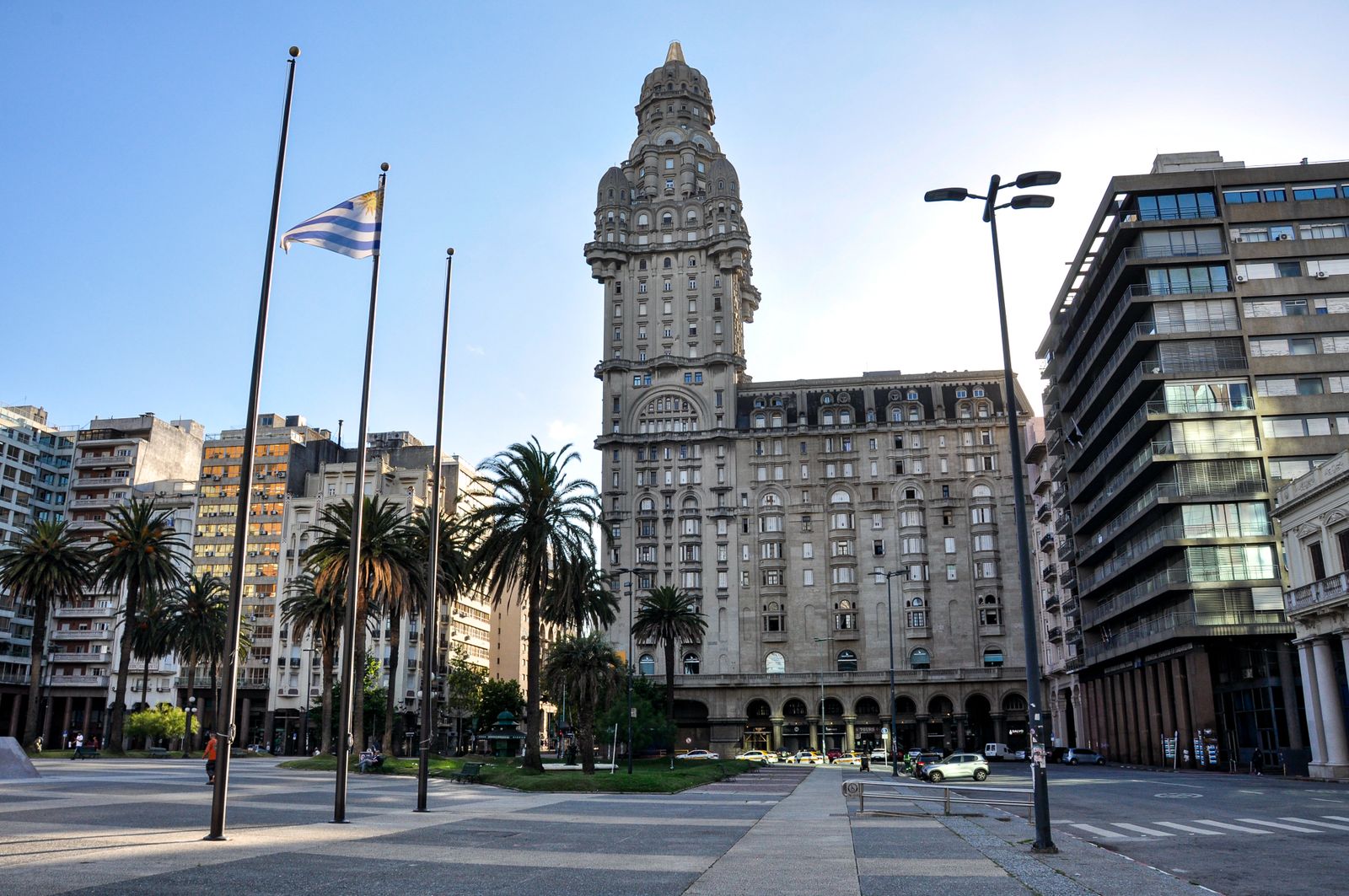
The Ciudad Vieja (Old City) of Neoclassical and Art Deco buildings, the Mercado del Puerto’s Saturday asado grills and the 22km Rambla promenade along the Rio de la Plata.
Photo: Área multimedia del Museo Hisórico Cabildo, CC BY-SA 4.0

UNESCO-listed: Uruguay’s oldest town, founded by the Portuguese in 1680, with cobblestone streets, a lighthouse and a mix of Portuguese and Spanish building styles; around 1h15 by fast ferry from Buenos Aires.
Photo: JGHowes, photographer (Canon AE-1 camera)., Attribution

The hand sculpture on Playa Brava beach (the Mano de Punta del Este), the Enjoy (former Conrad) casino and Casapueblo (Carlos Páez Vilaró’s whitewashed hotel-museum above the sea).
Photo: Марсело Кампи, CC BY-SA 3.0

A fishing village turned luxury destination: a lighthouse, sandy streets and long Atlantic beaches popular with surfers.
Photo: Richard Masoner / Cyclelicious, CC BY-SA 2.0

A village reached only by 4×4 trucks across the dunes: no electricity grid, sea lion and fur seal colonies and one of the most remote beaches in Uruguay.
Photo: Florh22, CC BY-SA 3.0

Traditional cattle-ranching estancias: horseback riding across the rolling pampas with gauchos, the asado (slow-grilled beef) and the mate culture.
Photo: Bruna da Silva Rodrigues, CC BY-SA 4.0

Often called the world’s longest carnival (around 40 days): the Afro-Uruguayan candombe drumming parades of the Desfile de Llamadas (February) and the satirical murga choirs.
Photo: Tano4595, CC BY-SA 2.5

A wooded canyon in Uruguay’s little-visited interior, with marked trails and rich birdlife.
Photo: Pablo S. Sotelo, Public domain
A 3-hour ritual of beef cuts (tira de asado, vacio, entraña) on a parrilla grill over quebracho wood: the centre of Uruguayan social life.
A Uruguayan sandwich of sirloin steak, ham, bacon, egg, cheese, olives, lettuce and tomato: the national sandwich, said to have been invented in Punta del Este in the 1940s.
Thin beef (or chicken) breaded and fried: eaten with lemon and chips, a legacy of Italian immigration.
A deep-fried sweet dough circle: eaten on rainy days throughout Uruguay with mate. The most Uruguayan of comfort foods.
The Tannat grape (originally from Madiran, France) is Uruguay’s signature red: full-bodied and tannic, sometimes blended with Merlot or Cabernet Franc. Bouza and Garzón are well-known estates.
Hot water poured over dried yerba mate leaves in a gourd, drunk through a metal straw (bombilla): the universal Uruguayan social ritual, carried everywhere all day.
A blend of sparkling and still Uruguayan white wine: a Mercado del Puerto classic, associated with Café Roldós since the late 19th century.
Two shortbread discs sandwiched with dulce de leche and dipped in chocolate: a favourite Uruguayan sweet.
Montevideo Carrasco (MVD) is the main hub. LATAM and Aerolíneas Argentinas serve the largest volume of traffic; Air Europa connects directly to Madrid. Buquebus high-speed ferry connects Montevideo and Colonia to Buenos Aires. For trip planning, see the official Uruguay tourism portal.
Madrid is the best European gateway — Air Europa operates direct Madrid–Montevideo. Buenos Aires is a common transit point; Buenos Aires to Montevideo is under 1h by air or 2–3h by direct Buquebus ferry.
Buenos Aires is the most frequent connection point for Uruguay — multiple daily flights, and the Buquebus high-speed catamaran from Buenos Aires Puerto Madero to Montevideo takes roughly 2–3h.
Montevideo’s STM bus network covers the entire city — the STM app shows routes and real-time arrivals. The Uber app works reliably for city travel.
Uruguay’s main roads are generally in good condition — Ruta 1 and the Interbalnearia are fast and well-surfaced. Car hire from MVD is the best option for the wine route and the remote coast.
December to March is summer — Punta del Este and the beaches at their best, Montevideo warm and lively, the wineries of Canelones in harvest. April to November is the shoulder and cooler season — Montevideo is enjoyable year-round and less crowded outside summer. June to August is cool (10–14°C) but mild by Southern Cone standards.
📅 Uruguay is in its best season in January, February, March, December. See where else is good to go in those months, or browse where to go by month.
Uruguay is one of the more expensive countries in South America — many prices are closer to southern Europe than to its neighbours, especially in Punta del Este in summer.
The chivito — Uruguay’s national sandwich, a beef steak (churrasco) with ham, mozzarella, fried egg, bacon, tomato, lettuce, mayonnaise and pickles in a round bread roll — is the most substantial and satisfying single item.
Uruguayan Tannat from the Canelones wine valley — Bouza, Bodegas Garzón, Deicas — is Uruguay’s flagship wine.
Bodegas Garzón (opened 2016 in the hills of Maldonado department, inland from Punta del Este) offers tastings and a restaurant; Francis Mallmann's small hotel is in nearby Pueblo Garzón.
Montevideo for three days, Colonia del Sacramento for one, Punta del Este for two, the Uruguayan wine country for one. Uruguay is small, stable and easy to travel, and it is often overlooked next to its bigger neighbours.
Montevideo — often ranked among the most liveable cities in Latin America — has the Rambla (a coastal promenade of around 22km) and the Ciudad Vieja (old city) with its mix of Art Deco, neoclassical and colonial architecture. The Mercado del Puerto for the traditional parilla (grill) lunch.
The Rambla runs for around 22km along the Río de la Plata, east from the old city to Carrasco. On weekends much of the city walks, cycles and drinks mate along it.
The Mercado Agrícola (a 1913 iron-and-glass market building, restored as a food hall with Uruguayan craft beers, cheese, charcuterie and grills). The Teatro Solís (1856, Uruguay's main theatre, on the Plaza de la Independencia) for an evening performance or a guided tour of the neoclassical interior.
Uruguay and Argentina trade places as the world's biggest beef eaters per head — roughly 45–50kg per person a year. Most cattle are grass-fed, mainly Hereford and Angus.
The Feria de Tristan Narvaja (Montevideo's best-known Sunday street market — second-hand books, vinyl records, old coins, fresh produce and street music). The Museo Histórico Nacional for the story of José Artigas (Uruguay's national hero, less known abroad than Bolívar or San Martín).
José Artigas (1764–1850) is less known outside the region than other independence leaders. He advocated land reform, equal rights for indigenous peoples and federal self-government, all radical in 1815. He died in exile in Paraguay aged 86, never returning to Uruguay.
About 2h45 by bus from Montevideo. Colonia del Sacramento (UNESCO World Heritage Site) — founded by the Portuguese in 1680 on a peninsula opposite Buenos Aires, with a barrio histórico of cobblestone streets, 17th-century ruins and the lighthouse above the Río de la Plata — is entirely walkable in half a day.
Colonia changed hands repeatedly between Portugal and Spain until 1777, and both left their mark on the old town. The lighthouse (1857) stands beside the ruins of the Convent of San Francisco.
2h from Montevideo. Punta del Este — one of South America’s best-known beach resorts, with beaches on both the Atlantic and the calmer bay side of the peninsula, and La Mano (Mario Irarrázabal's hand sculpture, 1982) — is at its busiest in January and February.
Punta del Este's high season (January–February) draws crowds from Argentina, Brazil and Uruguay, and prices peak. From March the beaches are much quieter and prices drop.
Casapueblo (the white, sculpted building on the cliffs, built by Uruguayan artist Carlos Páez Villáro, now a hotel and museum, on a cliff above the Portezuelo beach). Drive west to the Canelones wine region (about 1h30) for Tannat wine tastings at Bouza or Bodegas Carrau.
Tannat — a thick-skinned, deeply coloured red grape from Madiran in France — is Uruguay's national variety, brought by Basque immigrants in the 1870s, and makes dark, firm, tannic reds.
3h from Punta del Este. Cabo Polonio — a remote cape on the Atlantic coast with no grid electricity or road access (visitors park at the entrance on Ruta 10 and take 4×4 trucks across the dunes), a lighthouse, a small year-round population and colonies of sea lions and fur seals on the rocks — is one of the wildest points on the Uruguayan coast. Return to Montevideo.
Cabo Polonio has no grid power and no private cars; homes use solar panels and generators. The sea lion and fur seal colonies are visible from the lighthouse and the rocks below. The area is a protected national park.
Cabify also works.
An asado restaurant meal: UYU 500-1,000 (EUR 12-24). Punta del Este in summer: expensive.
Expect unhurried service and late dinners.
Buquebus, Colonia Express and Seacat run Buenos Aires–Colonia in about 1h15–1h30. Book ahead in summer.
January in Punta del Este: Argentinian summer migration. Go in November or March.
Antel has the best coverage in the interior.
Declining mate is polite (“gracias” with hand over the gourd). Accepting and drinking is warmer.
The country’s progressive legislation and stability are sources of quiet national pride.
Quick answers to the questions people most often ask before visiting Uruguay.
December to March is summer — Punta del Este and the beaches at their best, Montevideo warm and lively, the wineries of Canelones in harvest. April to November is the shoulder and cooler season — Montevideo is enjoyable year-round and less crowded outside summer.
Montevideo Carrasco (MVD) is the main hub. LATAM and Aerolíneas Argentinas serve the largest volume of traffic; Air Europa connects directly to Madrid. Buquebus high-speed ferry connects Montevideo and Colonia to Buenos Aires.
Expect roughly UYU 900–1,600 a day on a budget and UYU 2,800–5,000 mid-range, or UYU 10,000+ for a more luxurious trip, per person and excluding flights.
Uruguay uses the UYU.
Plug types: Type C / F / I / L (mixed, 220V – bring universal adaptor).
Ride-hailing in Montevideo and Punta del Este — widely used and reliable across Uruguay.
FreeAlternative ride-hailing in Montevideo — popular alongside Uber in the capital.
FreeUruguay’s dominant food delivery app — covers Montevideo, Punta del Este and major cities.
FreeBook Montevideo Old City tours, Colonia del Sacramento day trips and Uruguayan cultural experiences.
FreeUruguay’s primary messaging platform — contact hotels, guides and local transport.
FreeBook hotels in Montevideo and beachfront accommodation in Punta del Este.
FreeA mate-and-murals capital, a glitzy beach resort, a cobbled river town, an off-grid dune village and a belle-époque seaside gem — five sides of Uruguay.
Uruguay sits within easy reach of several other destinations — each with a completely different character.


