CP
Clipperton Island
The loneliest atoll in the Pacific — a French possession no one lives on
The loneliest atoll in the Pacific — a French possession no one lives on
The only above-sea-level landmark on Clipperton — a 29-metre basalt pinnacle on the eastern reef edge, the remnant of an ancient volcanic vent. The rest of the island is an almost perfectly flat coral ring. Climbed by the few visitors who reach it; the view from the top reveals the entire atoll and surrounding Pacific in every direction.
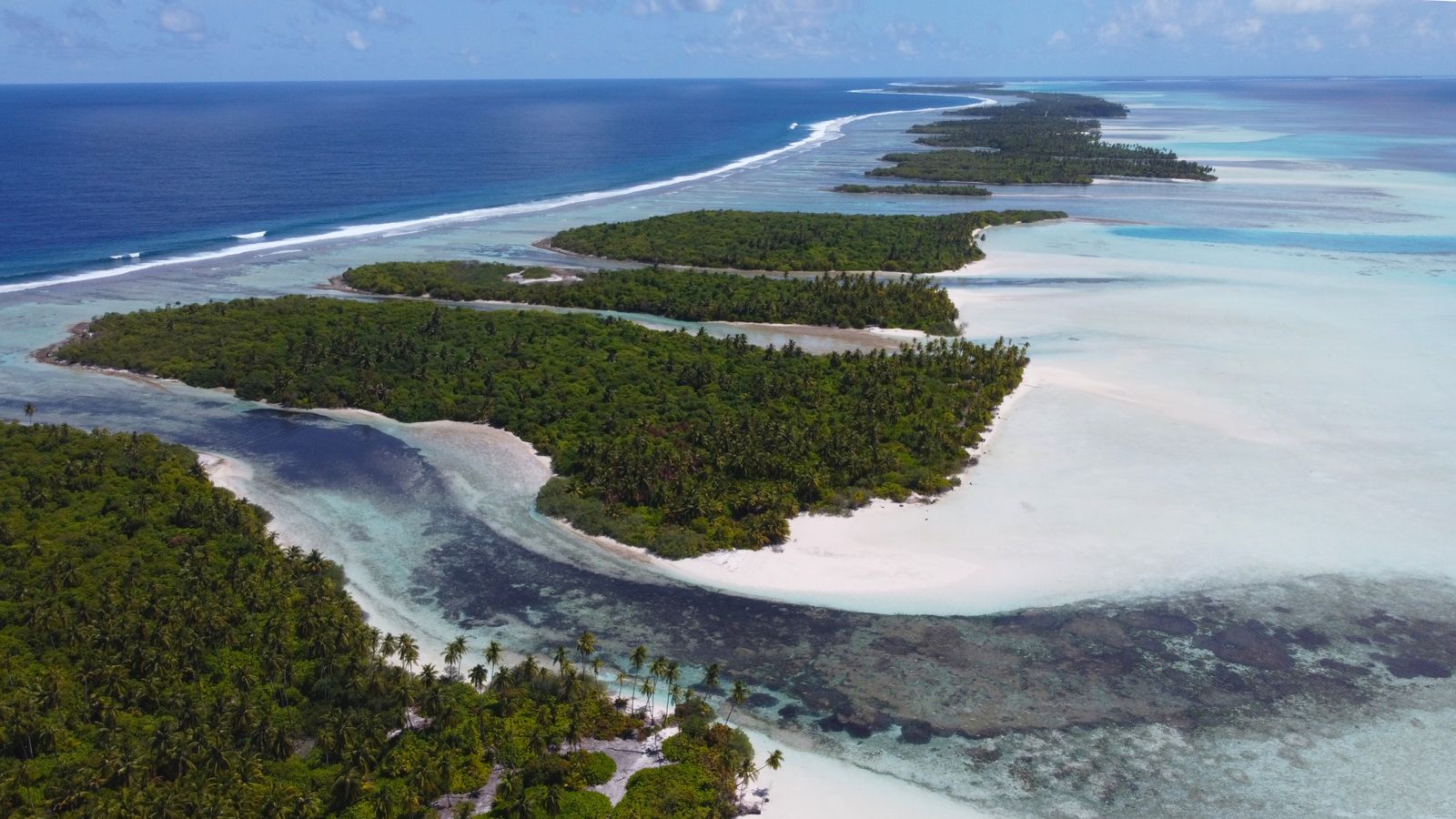
A large central lagoon completely enclosed by the coral reef — uniquely, the lagoon has no passage to the open sea and no tidal exchange. The water is a colour from this isolation, and the lagoon harbours species not found in open ocean reefs. A unique ecological laboratory.
One of the largest masked booby colonies in the Eastern Pacific — over 112,000 birds nest on the ground across the island, filling the coral flat with their calls and the air with flight. Also home to thousands of brown boobies, frigatebirds and red-footed boobies.
Millions of Gecarcinus planatus land crabs dominate the island — a species found only on Clipperton and a few Eastern Pacific islands. They have no natural predators on the island (since the last introduced pig was shot in 1958) and now cover virtually every surface of the island’s interior.
Some of the least-disturbed, unexploited coral reef diving in the Eastern Pacific — the reef wall drops to extreme depths and is patrolled by schooling hammerhead sharks, Galapagos sharks, silvertip sharks, vast schools of jacks and yellowfin tuna. One of the few Eastern Pacific reefs with virtually no fishing pressure.
Crumbling concrete foundations are all that remain of a Mexican guano-mining settlement occupied from 1897 to 1917 — scene of one of the Pacific’s most tragic episodes, when the last survivors of the abandoned garrison were rescued in 1917 after years of isolation, starvation and violence. The ruins are sparse but deeply poignant.
Clipperton Island (Wikipedia) →All visits to Clipperton are by private charter vessel — food is entirely what the expedition brings. Most serious dive charter vessels operating in the Eastern Pacific prepare excellent meals at sea; the culinary experience is that of the ship, not the island.
The waters around Clipperton are rich in pelagic fish — yellowfin tuna, wahoo and mahi-mahi are caught easily from the vessel during the crossing or at anchor. Seared tuna sashimi within minutes of catching it in the middle of the Pacific is a meal you will describe for years.
Reflecting the Mexican culinary connection from the nearest mainland — fresh-caught fish cured in lime juice with cilantro, chilli and cucumber. Prepared on board with the day’s catch in the tradition of Acapulco’s coastal fishing culture.
Provisioned from Mexico before departure — cold Mexican lager (Modelo, Pacifico) drunk at anchor in the most remote atoll in the Eastern Pacific. The combination of icy beer, shark-patrolled reef and zero other humans is unparalleled.
Feral coconut palms grow in patches on the island — descendants of trees planted by the failed mining colony. The coconuts are available in small numbers; cracking one open on the most remote atoll in the Eastern Pacific is one of those small moments that outlast the trip.
Sundowners mixed from expedition provisions, drunk at anchor while 100,000 boobies return to their nests in the evening — the specific experience of watching the sun set over a completely uninhabited atoll in the empty Pacific ocean is one that very few people in history have had.
No airstrip, no harbour, no facilities. Access is by private yacht or vessel with a French Ministry permit only. Departing from Manzanillo or Puerto Vallarta, Mexico (1,200km away). For trip planning, see the WWF Clipperton Island marine ecology.
The NW side of the atoll provides the only partial shelter for anchoring, but it is exposed to all swell from the NW and W. Landing on the reef is by dinghy through the surf; conditions must be carefully assessed.
Puerto Vallarta (PVR) and Manzanillo (ZLO) are the nearest Mexican ports with offshore yacht charters. Mexico City (MEX) is the main international gateway.
France won sovereignty over Clipperton in a 1931 international arbitration with Mexico and the island has been French territory since. The French government issues very few non-scientific permits; amateur radio (DX) expeditions and scientific research have the best approval records.
Clipperton is one of the most challenging landings in the Pacific — the surf over the reef can make dinghy landings extremely difficult, the coral rubble beach is rough and covered with aggressive nesting birds, and there is no shelter from the tropical sun. Safety equipment and situational awareness are essential.
There is no season for visitors — Clipperton is an uninhabited French atoll with no facilities. Any visit requires a French military or scientific permit and a private vessel. November to March is the wet season with higher seas; April to October is calmer.
📅 Clipperton Island is in its best season in January, February, March, April, November, December. See where else is good to go in those months, or browse where to go by month.
No currency, no facilities, no accommodation. All costs are the vessel charter and permit fees.
There is no infrastructure on Clipperton — no pier, no anchorage, no shelter, no fresh water, no fuel.
Clipperton is one of the rarest DX entities in amateur radio (consistently ranked in the top 10 most-wanted rare entities worldwide).
The Eastern Pacific circuit.
Pacific passage, atoll arrival, seabird colonies, yellow crazy ant survey, lagoon sharks, outer reef diving, garrison history, return passage. Clipperton — the most remote French territory in the Americas — has 80,000 masked boobies, the world’s only freshwater reef sharks, one of the greatest survival tragedies in Pacific history and some of the least disturbed coral reef in the Eastern Pacific.
The 1,200km ocean passage from the Mexican Pacific coast to Clipperton (approximately 3–4 days by yacht from Manzanillo or Puerto Vallarta — through the open Eastern Pacific, the least-traversed stretch of ocean in the Americas — with frigatebirds, red-footed boobies and brown boobies following the vessel from 600km out, the first indication of the island) and the first view of the island’s rock (Clipperton Rock, a 29m basalt pinnacle — the only vertical feature on the atoll, visible from 15km).
Clipperton Island (also Ile de la Passion — named for the French pirate John Clipperton who reputedly used the atoll as a base in the early 18th century, and subsequently a site of one of the most striking and tragic human stories in Pacific history: the Mexican military garrison of 1906–1917, which was abandoned by supply ships during the Mexican Revolution and in which all but one adult male and all remaining women and children survived extraordinary hardship until rescued by an American gunboat in 1917).
Clipperton atoll (a coral atoll of 6km² at 10°N, 109°W in the Eastern Pacific — the most remote French territory in the Americas, 1,120km from the nearest Mexican coast — with a brackish lagoon in the interior (the atoll’s ring of reef enclosing a stagnant lake, not the typical clear-water lagoon, but a dark brackish body of water that smells of sulphur and is home to millions of land crabs) and the nesting colonies of 80,000+ masked boobies — the largest masked booby colony in the world.
The masked booby colony at Clipperton (80,000+ individuals — the largest breeding colony of masked boobies (Sula dactylatra) in the world, nesting on the atoll’s coral rubble beaches in such density that the birds cover the entire sand surface — alongside 10,000+ red-footed boobies, 40,000+ brown boobies and the nesting colonies of frigatebirds make Clipperton the most numerically significant seabird nesting site in the Eastern Pacific.
The yellow crazy ant invasion (Anoplolepis gracilipes — introduced accidentally to Clipperton sometime in the late 20th century, the yellow crazy ant has spread to cover most of the island at densities of 10,000+ ants per square metre, killing the crabs, seabird chicks and any animal unable to escape — creating one of the most extreme invasive species disasters on a coral atoll, reducing the land crab population from millions to near-zero and fundamentally altering the ecosystem) and the ongoing French eradication programme.
The yellow crazy ant invasion at Clipperton (discovered approximately 2001 — the ant had apparently established from a single introduction, possibly from a visiting fishing vessel, and spread to cover nearly the entire atoll within 10–15 years, killing the Gecarcinus and Johngarthia land crabs that previously cleaned the beach, removing dead seabirds, and fertilising the soil) represents one of the most dramatic invertebrate invasions in the Pacific and is the primary conservation challenge facing the island.
The Clipperton brackish lagoon (the interior of the atoll, a brackish lake fed by seawater over the reef crest during storm events, with no outlet and high evaporation creating variable salinity — in this unusual environment, blacktip reef sharks have adapted to live in almost entirely fresh water, the only known freshwater-adapted reef sharks in the world, along with eagle rays that entered the lagoon as juveniles and cannot exit — one of the most unusual enclosed marine ecosystems on earth).
The freshwater-adapted blacktip reef sharks of the Clipperton lagoon (Carcharhinus melanopterus — living in water of 0.5–15 ppt salinity, compared to the normal 35 ppt oceanic salinity, surviving in conditions that would be lethal to most marine cartilaginous fish) have been studied as an extreme example of euryhaline adaptation in sharks. The sharks cannot exit the lagoon (the reef crest is too shallow even at high tide); they are effectively trapped in a freshwater environment for their entire lives.
The outer reef wall (the coral reef encircling the atoll — virtually undived, healthy, with no fishing pressure since 1979 when Mexico abandoned its fishing claim, with the finest fish biomass in the Eastern Pacific: schooling hammerhead sharks, tiger sharks, Galapagos sharks, enormous schools of tuna and jacks, manta rays, whale sharks and the great density of reef fish that accumulates at an isolated mid-ocean atoll far from any fishing ground).
The Eastern Pacific Isolated Islands (Clipperton, Cocos, Malpelo and the Revillagigedo Archipelago) form a chain of marine biodiversity hotspots in the otherwise relatively fish-poor Eastern Pacific, connected by oceanic currents that transport larvae between sites. Clipperton is the most isolated and least-visited of these islands, and has consequently the most undisturbed marine ecosystem.
The ruins of the Mexican garrison (the island was garrisoned by the Mexican military 1906–1917 as a territorial claim against US ambitions in the Eastern Pacific — the 1910 Mexican Revolution cut off all supply ships, leaving the garrison of 100 men, women and children stranded for 7 years, during which all adult men died of scurvy, the remaining women and children were subjected to the rule of a brutal lighthouse keeper, and the 15 survivors were finally rescued by an American gunboat in July 1917).
The Clipperton Island tragedy (1910–1917 — the Mexican garrison abandoned by the Revolution, suffering scurvy, all adult men dying, the survivors subjected to the rule of Victor Manuel Alvarez the lighthouse keeper who declared himself king and ruled through violence until he was killed by the women survivors three days before the rescue ship arrived) is one of the most striking survival stories in Pacific history and is the subject of Laura Restrepo’s novel “Isle of Passion.”
The return passage to Mexico (3–4 days at sea — watching the atoll disappear below the horizon, knowing that Clipperton will see perhaps 5–10 visiting vessels per year and will be empty of human beings for most of the year ahead) and the privilege of having been one of the handful of humans to visit one of the most remote places on earth. All departures are by private vessel.
Clipperton receives approximately 2–5 permitted scientific or military expeditions per year, plus a similar number of permitted yacht visits. Total human footfall is fewer than 100 people per year, making it one of the least-visited land masses on earth. The French government issues permits very selectively; most applications from amateur visitors are declined.
Clipperton is administered by France but practically reached only from Mexico. Charter dive vessels from Acapulco or Manzanillo make the 36-48 hour crossing; a handful of specialist operators run Clipperton expeditions each year. The French Navy periodically transits; scientists occasionally receive research permits.
All visits require advance authorisation from the French High Commission in French Polynesia (Papeete). The process is bureaucratic and time-consuming; specialist expedition operators handle this as part of their service.
There is absolutely no infrastructure on Clipperton. All communication is via the expedition vessel’s satellite systems. Mobile phones are useless.
The density and variety of shark species around Clipperton is impressive. Expedition dive masters provide mandatory briefings; solo swimming from the vessel is not permitted. Spearfishing is prohibited.
The masked booby and frigatebird colonies are fragile despite their size; French authorisation includes strict conditions on not disturbing nesting birds. Walking routes to the interior are designated by expedition leaders.
The crossing from Mexico and conditions at anchor can be rough. Serious seasickness precautions (medication, wristbands) are recommended; the island offers no natural shelter from large swells on some approach angles.
Quick answers to the questions people most often ask about visiting Clipperton Island.
Yes, but only as a private expedition. Clipperton is an uninhabited French atoll with no airstrip, harbour, accommodation or facilities of any kind. Every visit needs advance authorisation from the French authorities and a capable offshore vessel, usually a dive charter or private yacht.
By sea from Mexico. Expeditions typically depart from Manzanillo or Puerto Vallarta, around 1,200 km to the northeast, and the crossing takes several days depending on the vessel. You reach those ports by flying into Mexico City, Puerto Vallarta (PVR) or Manzanillo (ZLO). Landings on the atoll are by dinghy through the surf, and the only anchorage is exposed.
Yes. Clipperton is French territory and all visits require prior authorisation from the French administration. The process is slow and bureaucratic, so specialist expedition operators usually handle it as part of the trip. Apply well before your planned departure.
There is no tourist season. Expedition operators favour the calmer-sea months; seas are generally rougher during the November–March wet season, and sea conditions on the day decide whether a landing is possible at all.
Clipperton is one of the most expensive places on Earth to reach. With no facilities, the cost is almost entirely the vessel charter and permits: expedition trips typically run from about US$15,000–30,000 per person, and a private charter can exceed US$50,000.
Clipperton sits in the Eastern Pacific off the coast of Mexico, with Ecuador, Colombia, Costa Rica and Mexico forming the nearest mainland shore — French Polynesia and American Samoa represent the wider French Pacific world.
Clipperton Island is one of the world’s least-visited places. See all 90 in our guide to the world’s least-visited countries & territories.