KH
Cambodia
Ancient Angkor Wat and jungle temple magic
Ancient Angkor Wat and jungle temple magic

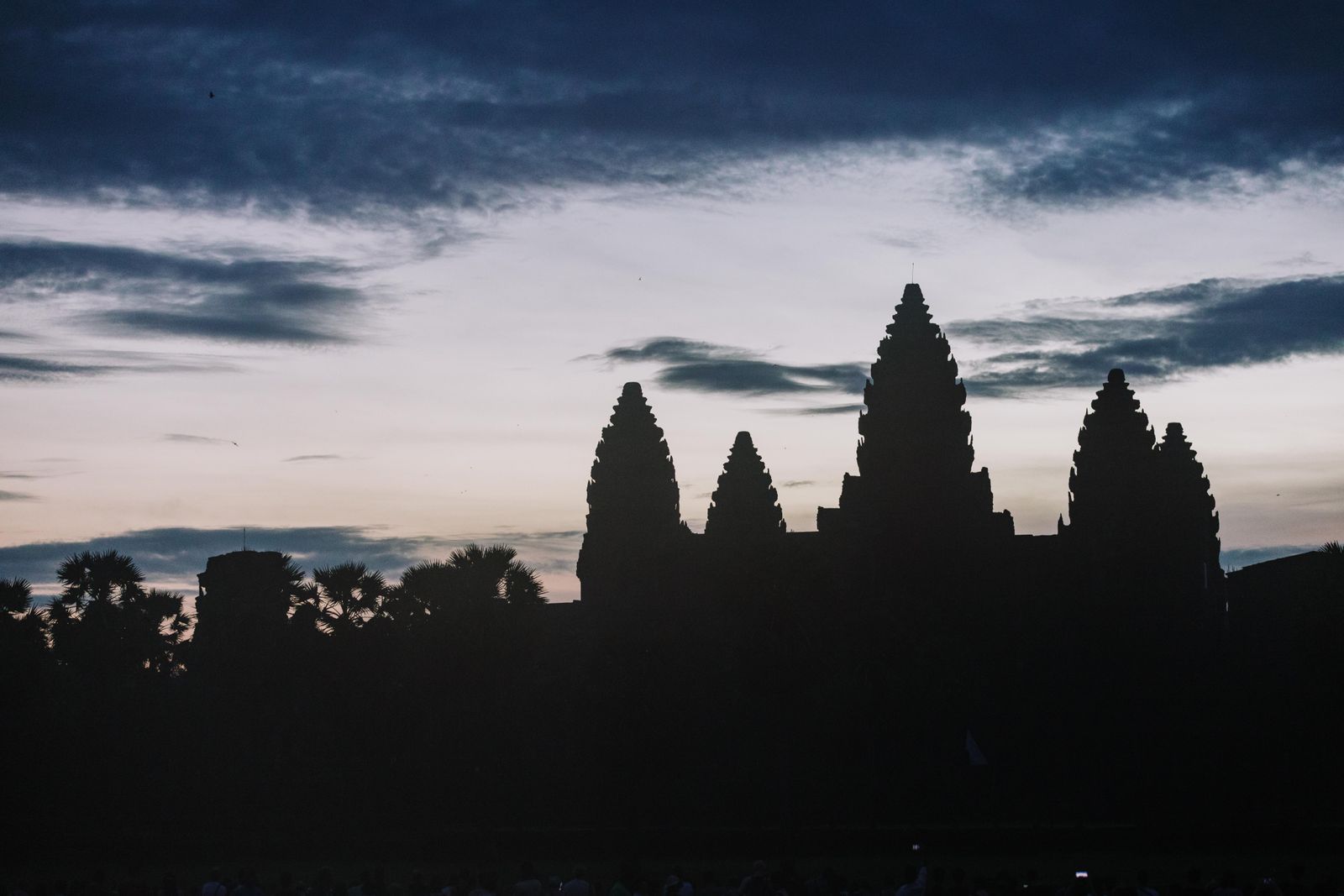
The largest religious monument on earth: a 12th-century Hindu temple with the world’s longest continuous bas-relief. The sunrise reflection in the moat is one of the world’s great travel images.

Angkor Thom’s Bayon temple has 216 giant faces carved into 54 towers. Ta Prohm was left unrestored: giant strangler fig trees grow through the galleries.

The Royal Palace (with the Silver Pagoda floored with 5,329 silver tiles), the National Museum and the riverside promenade.

S-21 torture prison and the Killing Fields: essential and profoundly moving historical sites from the Khmer Rouge period (1975-1979).

Southeast Asia’s largest freshwater lake, expanding fivefold in monsoon season. Floating villages accessible by boat from Siem Reap.

A French colonial city with the bamboo train (bamboo platforms on railway bogies), the bat caves and the excellent Phare Circus.

Kampot: a riverside colonial town surrounded by the world’s finest black pepper. Kep: fresh crab grilled with Kampot pepper at the quayside market.

A 9th-12th century Khmer temple perched on a 525m cliff with views into Thailand. Less visited than Angkor and deeply atmospheric.
Fish in a steamed coconut milk and lemongrass curry cooked in a banana leaf cup. The national dish of Cambodia.
Thin pork slices marinated in coconut milk, grilled over charcoal and served over rice at dawn. The definitive Cambodian breakfast.
Fresh rice noodles in green fish curry sauce with herbs and bean sprouts. Served from street carts early morning throughout Cambodia.
Stir-fried cubed beef with oyster sauce, served on lettuce with a lime and black pepper dipping sauce.
Dark Robusta coffee through a sock filter into sweetened condensed milk over ice. Stronger and sweeter than Vietnamese iced coffee.
Fresh mud crab stir-fried with fresh green or black Kampot pepper. One of the finest seafood dishes in Southeast Asia.
Cambodia’s national lager. Cold, light and inseparable from the temple at sunset.
A thick vegetable and fish soup considered the most ancient Cambodian soup, predating French colonial influence.
Siem Reap International (REP) serves Angkor; Phnom Penh (PNH) is the main hub. Cambodia Angkor Air and AirAsia serve domestic routes. Bus connections across Southeast Asia are excellent. For trip planning, see the official Cambodia tourism portal.
💡 Singapore Airlines via Singapore and Cathay Pacific via Hong Kong offer the smoothest connections to Siem Reap and Phnom Penh from Europe. Bangkok is also a convenient hub with multiple onward options.
💡 Bangkok is the primary hub for Cambodia — Bangkok Airways’ Bangkok–Siem Reap route is the most frequently used international connection.
💡 Giant Ibis Transport is Southeast Asia’s best-reviewed long-distance bus service — air-conditioned, on-time, with USB charging and on-board entertainment. Book at giantibis.com.
💡 Grab operates in Phnom Penh and Siem Reap — the easiest and most transparent pricing for city travel. PassApp is the local alternative with slightly lower fares.
November to April is the dry season — the best time to visit. December and January are ideal: cool, dry and clear. The wet season (May–October) brings daily rain but also the flooded Tonle Sap lake and lush green landscapes. Angkor is photogenic in rain.
Cambodia is one of the cheapest countries in Southeast Asia — exceptionally affordable food, guesthouses and local transport, with US dollars accepted everywhere.
Bai sach chrouk — thin slices of pork grilled over charcoal, served over broken rice with pickled cucumber and ginger broth — is the most common Cambodian breakfast dish and costs US$1–2. Served from 6am at market stalls.
A private tuk-tuk driver for a full day at Angkor (6am–6pm, including waiting) costs US$15–25 — the best value in Southeast Asia for a personal guide who knows when the crowds thin.
Amansara in Siem Reap (a former royal guest villa with 24 suites around a pool) is one of Southeast Asia’s finest small hotels — from US$1,200/night, it includes private Angkor tours before the site opens to the public.
Siem Reap and Angkor for three days, the Tonle Sap lake for one, Phnom Penh for two, the south coast for one. Cambodia is compact and the connections between its main sites are straightforward.
Arrive in Siem Reap (REP). Angkor Thom and the Bayon at late afternoon — the Bayon’s 216 giant stone faces (each one of the bodhisattva Avalokitesvara, or possibly of King Jayavarman VII himself) are most atmospheric in low golden light. The Old Market (Psar Chas) for dinner and the Pub Street area for the Cambodian street food scene.
💡 The Angkor Archaeological Park 3-day pass costs US$62 and covers all temples in the complex. Single-day (US$37) and 7-day (US$72) passes are also available at the official ticket office, 5km from Siem Reap centre.
Angkor Wat (built 1113–1150 CE under Suryavarman II, the largest religious monument ever built — 402 acres) at dawn, when the reflection of the five towers appears in the moat. The bas-relief galleries (600m of continuous narrative carving: the Churning of the Sea of Milk, the Battle of Kurukshetra) take 2 hours at minimum.
💡 The dawn crowd at Angkor Wat’s main reflection pool has grown to several hundred people. For a quieter dawn experience, position at the northern reflection pool — fewer visitors, equally good reflection.
Ta Prohm — the jungle temple deliberately left with trees growing through the stonework (famous from the Tomb Raider film) — is the most atmospheric of the minor temples. Banteay Srei (30km north, 10th century) is the finest pink sandstone carving in the Angkor complex — smaller and more detailed than the main temples.
💡 Banteay Srei means “Citadel of Women” and its pink sandstone bas-reliefs are considered the finest carving in the Khmer Empire. The 10th-century detail is exceptional. The round trip from Siem Reap takes 3 hours.
The Tonle Sap is Southeast Asia’s largest freshwater lake — it reverses its flow direction seasonally, filling from the Mekong in wet season and draining back in dry season. The floating villages (Kompong Khleang, Mecrey Island) are entire communities built on the water: schools, churches, pig farms, all floating.
💡 Kompong Khleang is the most authentic floating village near Siem Reap — a 1.5h drive from town, largely un-touristed, with a resident population of 10,000. Most of the village is on stilts or floating pontoons.
1h flight or 5h bus from Siem Reap. The Tuol Sleng Genocide Museum (S-21 prison) — the high school converted by the Khmer Rouge into a torture and interrogation centre where 17,000 people were killed — is one of the most important and harrowing historical sites in Asia. The Royal Palace and Silver Pagoda in the afternoon.
💡 Tuol Sleng is deeply difficult and entirely essential for understanding modern Cambodia. Allow 2 hours and read about the Khmer Rouge period beforehand. The combination of Tuol Sleng and the Choeung Ek killing fields (15km south) in one day is very heavy.
Choeung Ek (the Killing Fields): where 17,000 victims of S-21 were executed and buried in mass graves. The memorial stupa filled with 8,000 skulls. The Central Market (Art Deco dome, 1937) for Cambodian silk and silverwork. Riverside promenade at sunset.
💡 The Choeung Ek audio guide (US$3) is voiced by survivors and former Khmer Rouge members — it transforms what would otherwise be a confusing field of grass and signs into something genuinely comprehensible.
3h from Phnom Penh. Kep — a former French colonial resort on the Gulf of Thailand, famous for the crab market (fresh mud crabs with Kampot pepper sauce) and the quiet beaches. Kampot town: crumbling French colonial architecture, pepper plantations, the Bokor Hill Station above the fog.
💡 Kep crab with Kampot pepper (black pepper grown in the hills 25km away) is one of Southeast Asia’s finest regional dishes — the pepper is the finest in the world by most specialist accounts. Costs US$8–12 at the Crab Market.
Apply at evisa.gov.kh. 30-day tourist visa within 3 business days for USD 36.
Cambodia prices are in USD; riel given as change under USD 1.
A 3-day pass is USD 62. Book at the official counter, not from touts.
Both work in Phnom Penh and Siem Reap for metered, safe transport.
Angkor Wat faces west so sunrise reflects from the east entrance.
The Khmer people carry the trauma of the Khmer Rouge with grace and a forward-looking energy.
A full-day tuk-tuk for Angkor costs USD 15-20. Drivers know the sites and timing.
Drink bottled water. Eat at busy restaurants throughout Cambodia.
Cambodia’s leading local ride-hailing app — widely used in Phnom Penh; supports Khmer and English.
FreeBook Angkor Wat sunrise tours, Tonle Sap lake trips, Phnom Penh killing fields tours and Cambodian experiences.
FreeWidely used for traveller-to-local communication — contact guesthouses and tuk-tuk drivers.
FreeBook guesthouses, boutique hotels and Angkor-area accommodation.
FreeBook bus tickets between Phnom Penh, Siem Reap, Ho Chi Minh City and Bangkok in English.
FreeFrom the ancient temples of Angkor to the islands of the Gulf of Thailand — explore Cambodia’s extraordinary destinations.
Cambodia sits within easy reach of several other destinations — each with a completely different character.