KR
South Korea
Seoul nights and slow palace mornings
Seoul nights and slow palace mornings

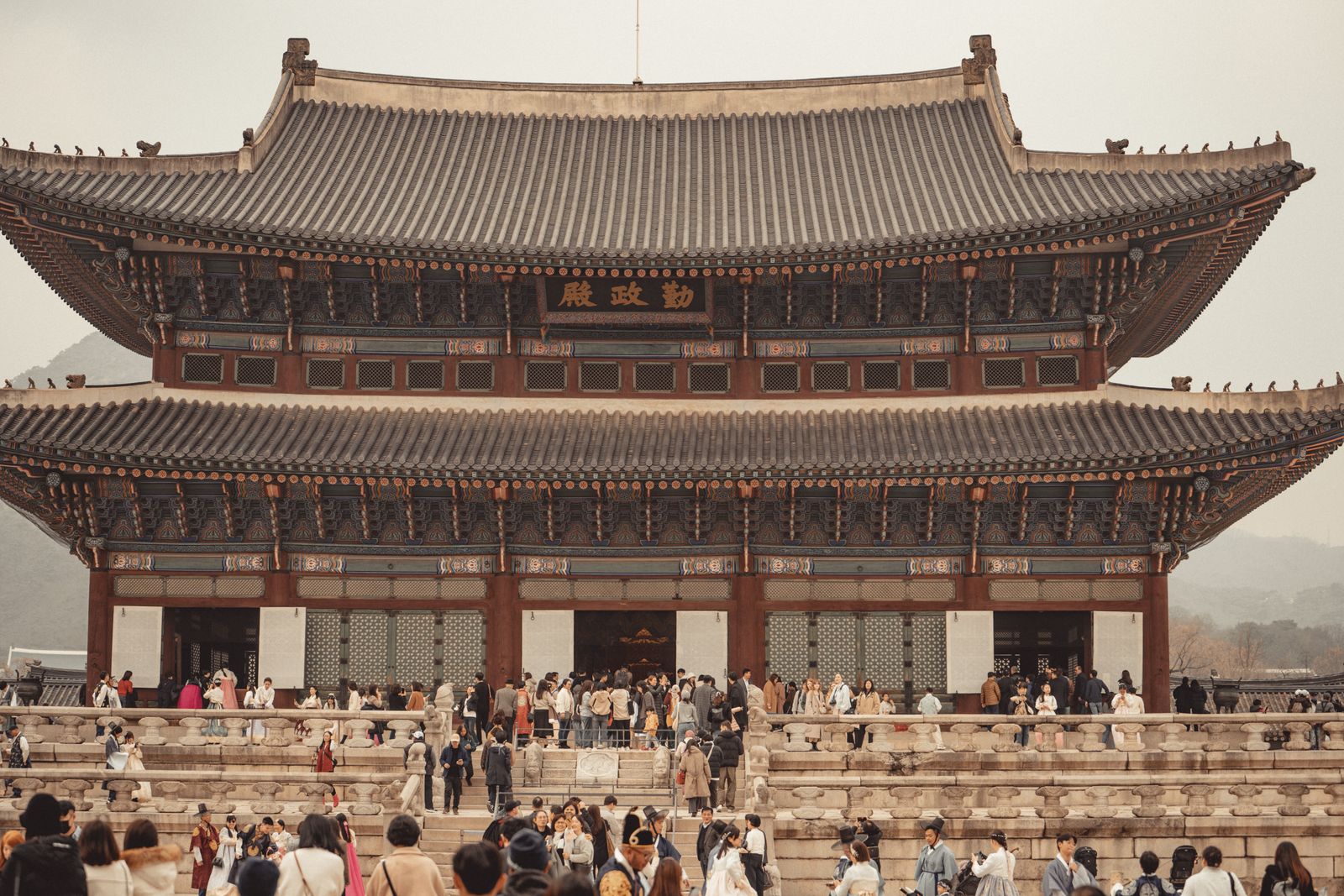
The 1395 Joseon Dynasty palace and the Bukchon Hanok Village of 600-year-old tile-roofed houses. The royal guard-changing ceremony at the Heungnyemun gate, the Inwangsan shamanist mountain trails.
Photo: Syced, CC0

The Silla Kingdom capital (57 BC – 935 AD): royal tumuli grass mounds in suburban parks, the Bulguksa Temple (UNESCO, 528 AD) and the Seokguram Grotto (UNESCO, a Tang-dynasty granite Buddha).
Photo: Basile Morin, CC BY-SA 4.0

Gamcheon Culture Village (a favela-style hillside of painted houses), Jagalchi Fish Market (the largest in Korea) and Haeundae Beach.
Photo: Basile Morin, CC BY-SA 4.0

A volcanic island formed by Hallasan (1,950m): lava tubes, basalt sea cliffs, Haenyeo women free-divers and the Seongsan Ilchulbong sunrise peak.
Photo: Wikimedia Commons contributor, Public domain

The finest hiking in Korea: granite peaks (1,708m) with cable cars, autumn maple forests and the Ulsanbawi Rock’s six granite outcrops.
Photo: kallerna, CC BY-SA 4.0

600 traditional hanok houses, the finest bibimbap in Korea (birthplace of the dish) and a paper-making (hanji) tradition dating to the Joseon period.
Photo: Bernard Gagnon, CC0

The 4km-wide buffer zone between North and South Korea: the JSA (Joint Security Area) where North Korean soldiers are visible across the border; the Third Tunnel dug by the North.
Photo: Lance Vanlewen, CC BY-SA 4.0

Seoul’s oldest permanent market (1905): raw yukhoe (beef tartare), bindaetteok (mung bean pancakes) and silk vendors in a covered market hall.
Photo: kallerna, CC BY-SA 4.0
Mixed rice: steamed rice with vegetables, gochujang (red pepper paste), sesame oil and a fried egg. Mix everything before eating. Jeonju’s version is considered the original and finest.
Fermented napa cabbage with gochugaru, garlic, ginger and salted shrimp. The national food: 80+ types, served at every Korean meal as a banchan (side dish).
Thick-cut pork belly grilled on a table-top charcoal grill, wrapped in lettuce with garlic, ssamjang (fermented chilli paste) and pickled vegetables. The definitive Korean social meal.
Chewy rice cakes in a sweet-spicy gochujang sauce with fish cakes. The definitive Korean street food, eaten after school by every Korean child since the 1950s.
Fried chicken (two ways: crispy and sweet-spicy glazed) with iced beer (maekju). Korea’s greatest contribution to international drinking culture.
Unfiltered rice wine, milky white and slightly effervescent: 6-8% alcohol, served in a brass bowl. The oldest alcoholic drink in Korea.
A clear spirit (20-25% alcohol) distilled from sweet potato or rice: the world’s best-selling spirit by volume. Drunk in shots with Korean BBQ.
A thick savoury seafood and spring onion pancake, pan-fried in oil until crispy. The classic drinking food, eaten with makgeolli on a rainy day.
Seoul Incheon (ICN) is one of the best airports in the world — efficient, connected and easy to navigate. Gimpo (GMP) serves domestic and some regional routes. Korean Air and Asiana are the main carriers; Jeju Air and Jin Air for budget routes. For trip planning, see the official South Korea tourism portal.
Korean Air and Asiana both fly direct from Heathrow to Incheon in ~11 hours. The Polar route over the Arctic makes Seoul one of the shorter long-haul flights from Europe.
Korean Air and Asiana offer the most non-stop services from North American cities. Los Angeles has the highest frequency.
The KTX bullet train (Korea Train eXpress) is the standard way to travel between Seoul and Busan — faster than flying once you include airport time. Book at korail.com.
The AREX Express runs directly from Incheon Terminal 1 and 2 to Seoul Station in 43 minutes. The most efficient airport rail connection in Northeast Asia.
Spring (April–May) and autumn (September–November) are the best seasons — cherry blossoms in April, foliage in October are two of the most celebrated natural events in East Asia. Summer (June–August) is hot and humid with a monsoon period. Winter (December–February) is cold and dry — Pyeongchang ski season.
📅 South Korea is in its best season in April, May, June. See where else is good to go in those months, or browse where to go by month.
South Korea is mid-range for Asia — more expensive than Southeast Asia but significantly cheaper than Japan. Seoul is the priciest city; regional towns and Busan are notably more affordable.
A jimjilbang (Korean bathhouse and sauna) is also budget accommodation — KRW 10,000–15,000 for a night sleeping on the heated floor in communal areas. Completely safe, extremely local.
Korean BBQ at a proper restaurant — samgyeopsal (pork belly), galbi (short ribs), with endless banchan side dishes and soju — costs KRW 25,000–50,000pp. It’s the definitive Korean social meal.
Mingles, Jungsik and La Yeon (in The Shilla Hotel) are Seoul’s leading tasting menu restaurants — KRW 200,000–350,000pp, internationally ranked, and showcasing Korean ingredients with serious technique.
Seoul for four days, Gyeongju for the ancient capital, Busan to finish on the southern coast. The KTX bullet train makes moving around straightforward.
Gyeongbokgung Palace — the main Joseon-dynasty royal palace (1395), with the hourly Changing of the Guard in traditional armour. Bukchon Hanok Village nearby: a preserved neighbourhood of traditional Korean wooden houses on a hillside between palaces.
Rent a hanbok (traditional Korean dress) near Gyeongbokgung for INR 10,000–15,000 (≈$8–12) — entrance to the palace is free when wearing one.
Insadong: the arts and crafts district, tea houses, antiques and traditional snacks. Afternoon: N Seoul Tower on Namsan Mountain (cable car or 20-min hike) for the panoramic city view. Evening: Hongdae, the university district, for the bar and live music scene.
The T-money card (transit card) works on Seoul’s metro, buses and taxis — and is the most convenient way to pay. Available at every convenience store.
Myeongdong: Seoul’s main shopping district, K-beauty stores, street food stalls (tornado potatoes, tteokbokki, hotteok). The Han River parks — Yeouido in spring for cherry blossoms, cycling year-round. The COEX Starfield Library (a floor-to-ceiling bookshelf installation in a mall — extraordinary).
Korean street food in Myeongdong costs KRW 1,500–5,000 per item (≈$1–4). Try: tteokbokki (spicy rice cakes), gimbap (seaweed rice rolls), hotteok (sweet stuffed pancakes).
The Demilitarized Zone between North and South Korea is 40km from Seoul. Joint Security Area (JSA) tours visit Panmunjom where the armistice was signed in 1953 and the border building where you can stand simultaneously in both countries.
JSA tours must be booked in advance through authorised operators — usually 2 weeks minimum. Dress code applies: no ripped jeans, no shorts. Bring your passport.
2h by KTX from Seoul Suseo station. Gyeongju was the capital of the Silla Kingdom for 1,000 years (57 BCE – 935 CE) — the entire city is a UNESCO World Heritage Site. The royal burial tumuli (enormous grass-covered mounds) in the centre of town, Bulguksa Temple (774 CE) in the hills above.
Bulguksa Temple (774 CE) is one of the finest Buddhist temple complexes in East Asia. The Seokguram Grotto behind it — an 8th-century granite rotunda enclosing a 3.5m seated Buddha — is worth the extra walk.
1h from Gyeongju by regional train. Busan is Korea’s great port city — Haeundae Beach (2km of white sand in a city bowl), the Gamcheon Culture Village (a hillside neighbourhood painted in every colour), Jagalchi fish market (the largest in Korea).
The Busan International Film Festival (BIFF) in October is one of Asia’s most important film events — the BIFF Square in Nampo-dong has handprints of Korean cinema stars in the pavement year-round.
Gwangalli Beach with its view of the Gwangan Bridge is Busan’s most photogenic spot — best at dusk when the bridge lights up. Return to Seoul (2h30 by KTX from Busan station) or fly direct from Gimhae (PUS) for international departures.
Busan–Seoul by KTX takes 2h30 — a comfortable trip. The KTX also connects Busan to Incheon Airport in one connection, making it easy to fly out without returning to Seoul first.
A rechargeable card that works on all Seoul subway, bus and intercity bus.
Seoul to Busan: 2h15. Seoul to Gyeongju: 2h. Book at korail.com.
Korea’s dominant taxi app, equivalent to Uber but with licensed taxis.
The respect hierarchy (hoobae to sunbae) governs most social interactions. Accepting food from an elder with two hands is correct.
A Korean sauna hall costs KRW 10,000-15,000 for 24-hour access.
A Korean BBQ dinner: KRW 15,000-25,000 per person. Seoul accommodation is comparable to Tokyo.
Thank you in Korean. Accompanied by a small bow.
July-August: 32C+ and 80%+ humidity. The monsoon (jangma) brings heavy rain July-August.
Quick answers to the questions people most often ask before visiting South Korea.
Spring (April–May) and autumn (September–November) are the best seasons — cherry blossoms in April, foliage in October are two of the most celebrated natural events in East Asia. Summer (June–August) is hot and humid with a monsoon period.
Seoul Incheon (ICN) is one of the best airports in the world — efficient, connected and easy to navigate. Gimpo (GMP) serves domestic and some regional routes. Korean Air and Asiana are the main carriers; Jeju Air and Jin Air for budget routes.
Expect roughly KRW 50–80k (about $36–58) a day on a budget and KRW 150–250k (about $109–181) mid-range, or KRW 400k+ (about $290+) for a more luxurious trip, per person and excluding flights.
South Korea uses the KRW.
Plug types: Type C / F (two-pin, 220V).
South Korea’s dominant ride-hailing and taxi app — set up before arriving; payment by card in-app.
FreeKorean National Railway’s app — buy KTX high-speed and intercity train tickets; requires Korean phone verification.
FreeSouth Korea’s most accurate navigation app — Google Maps has poor data in Korea; Naver is far more reliable.
FreeSouth Korea’s dominant messaging app — used by nearly everyone; essential for communicating locally.
FreeSouth Korea’s leading food delivery app — huge selection of Korean restaurants with fast delivery.
FreeBook DMZ tours, K-pop experiences, Everland tickets and Korean activities.
FreeExplore South Korea’s top city destinations — from Busan to Seoul, each with its own distinct character.
South Korea sits within easy reach of several other destinations — each with a completely different character.


