AZ
Azerbaijan
Flames, Silk Road & the Caspian coast
Flames, Silk Road & the Caspian coast
Azerbaijan sits at the crossroads of Europe and Asia, a country of geographic and cultural contrasts: the flame-shaped skyscrapers of ultra-modern Baku rise alongside a perfectly preserved UNESCO-listed medieval old city; fire temples and Zoroastrian mud volcanoes recall the era when Azerbaijan’s natural gas seeps made it the sacred land of eternal flames; and the high Caucasus mountains in the north shelter ancient villages that have barely changed in centuries.
Baku, the Caspian capital, has reinvented itself since oil wealth arrived — the Heydar Aliyev Centre (designed by Zaha Hadid) and the Flame Towers are architectural landmarks of global significance. But the country beyond Baku — the mud volcanoes of Gobustan, the ancient petroglyphs, the mountain towns of Sheki and Lahic — rewards exploration immensely.
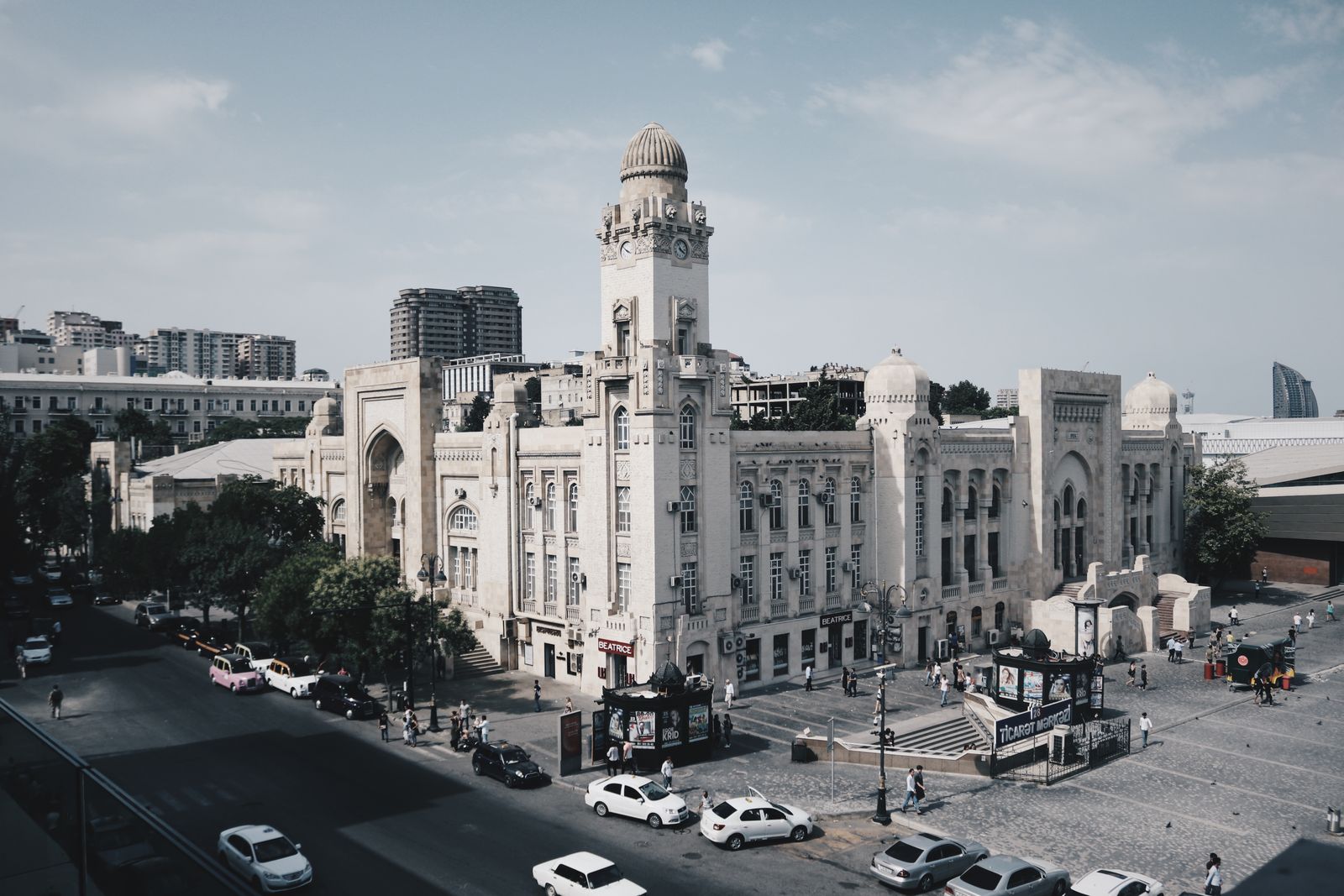
The UNESCO-listed medieval core of Baku is a warren of winding lanes, caravanserais, mosques and the enigmatic Maiden Tower — a 12th-century cylindrical fortress of uncertain purpose that overlooks the Caspian. The Palace of the Shirvanshahs, a 15th-century royal complex, is the finest architectural ensemble in the old city. Step outside its walls and the contrast with the flame-lit modernity beyond is startling.
An hour south of Baku, Gobustan is an otherworldly landscape of grey mud volcanoes (the world’s largest concentration), ancient petroglyphs carved by Bronze Age inhabitants and eroded rock formations. The petroglyphs depict hunters, boats and rituals dating back 12,000 years; the mud volcanoes emit cold grey sludge in slow volcanic eruptions of viscous, surreal beauty.
In the northern foothills of the Caucasus, Sheki is arguably Azerbaijan’s most beautiful town — a former Silk Road caravanserai hub with the extraordinary Sheki Khans’ Palace, its interior walls covered in intricate stained-glass and fresco work of delicacy. The town’s craft workshops, walnut-studded piti stew and mountain setting make it a highlight of the Caucasus.
Three flame-shaped skyscrapers light up the Baku skyline by night with a LED display that mimics fire — a nod to Azerbaijan’s ancient Zoroastrian fire-worship heritage. The Heydar Aliyev Centre, Zaha Hadid’s undulating white building, is a masterwork of contemporary architecture. Baku’s waterfront Bulvar (promenade) stretches 3 kilometres along the Caspian with parks, restaurants and fairground rides.
Saffron rice served with lamb, dried fruit and chestnuts — the centrepiece of weddings and holidays.
Vine leaves or vegetables stuffed with spiced minced lamb, rice and herbs, served with garlic yogurt — dolma-making is on UNESCO’s intangible heritage list.
Tiny lamb dumplings served in a clear broth with dried mint and vinegar.
Lamb, chicken and sturgeon kebabs grilled over charcoal are staples in Baku, followed by black tea in pear-shaped armudu glasses.
Rice, lamb and dried fruit baked inside a crisp lavash crust and cut open at the table.
Heydar Aliyev International (GYD) is 25km from Baku. AZAL (Azerbaijan Airlines) and Buta Airways serve European and regional routes. Turkey and the Gulf are primary transit hubs. For trip planning, see the official Azerbaijan tourism portal.
AZAL flies direct from Heathrow to Baku in 5h30. Turkish Airlines via Istanbul is the most frequency-connected routing for UK travellers.
Georgia and Azerbaijan combine naturally as a Caucasus circuit. Note: no direct Baku–Yerevan route (political situation); travel requires routing via Georgia.
Baku Metro costs AZN 0.30 per trip and covers the city centre efficiently. The Bolt app is the most reliable ride-hailing option, significantly cheaper than flag taxis.
The Baku–Sheki route passes through the foothills of the Greater Caucasus — one of Azerbaijan’s most scenic drives. Car hire in Baku costs AZN 40–80/day from Europcar and local agencies at GYD.
April to June and September to November are ideal — Baku pleasant, the Caucasus mountains accessible, the mud volcanoes and fire country at their most atmospheric. July and August are hot in Baku (35–40°C). January to March is cold but Baku has good indoor culture and the Shahdag ski resort.
📅 Azerbaijan is in its best season in April, May, June, September, October. See where else is good to go in those months, or browse where to go by month.
Azerbaijan is mid-range — Baku is significantly cheaper than Istanbul or Tbilisi for accommodation and food, with excellent local cuisine at affordable prices. The Azerbaijani manat is pegged to the USD.
Plov (the Azerbaijani pilaf — saffron-scented rice steamed in a cauldron with dried fruits, lamb, chestnuts or herbs, served with kazmag — a crisped rice crust) is the most important dish in the country.
Azerbaijani wine (from the Ganja and Quba regions, relatively unknown) has been produced for 4,000 years — the indigenous Madrasa grape variety produces a full-bodied red unique to Azerbaijan.
The Four Seasons Baku and the Fairmont Baku (inside the Flame Towers) are the city’s finest addresses — from AZN 250–600/night, with views over the Caspian from the upper floors that are difficult to match.
Baku for three days, Gobustan for one, Sheki for two, the Caucasus mountain villages for one. Azerbaijan is the most confident of the South Caucasus countries — oil money meets ancient Silk Road history.
Baku — “City of Fire”, built on oil revenues, a skyline of glass towers including the three Flame Towers (1 × 182m, the centrepiece of the modern city) rising above the Caspian Sea. The Icherisheher (Inner City, UNESCO World Heritage Site): the 12th-century Maiden Tower and the 15th-century Palace of the Shirvanshahs.
The Flame Towers are clad in LED screens that display digital flames at night — visible from 20km out to sea. Built 2007–2013, they contain apartments, a hotel and offices. The design references Azerbaijan’s ancient identity as “Land of Fire.”
The Icherisheher Old City (1.5km of medieval streets entirely enclosed within 12th-century defensive walls) contains the Maiden Tower (12th century, purpose still debated — lighthouse, Zoroastrian fire temple, or defensive tower), the Juma Mosque and the Carpet Museum. The Heydar Aliyev Centre (Zaha Hadid, 2012) — one of the most discussed buildings of the 21st century.
The Heydar Aliyev Centre is a wave-form building of undulating white reinforced concrete without any right angles — Zaha Hadid’s most complete built statement of her design philosophy. It won the Design of the Year Award in 2014.
Yanar Dag (Burning Mountain) — a natural gas seep that has been burning continuously since at least the 13th century, when Marco Polo described it. The Ateshgah Fire Temple (18th century, built by Hindu traders from India who worshipped the eternal fire) and the oil derricks of the Absheron Peninsula — the first oil wells in the world, drilled in 1846.
The first commercial oil well in the world was drilled in Baku in 1846 — 13 years before Drake’s well in Pennsylvania (1859), which is usually credited as the first. The Absheron boom of the 1870s–1890s produced more than half of the world’s oil and built much of Baku’s ornate eclectic architecture.
1h30 from Baku. Gobustan (UNESCO World Heritage Site) — a rocky plateau with 6,000 petroglyphs dating from 5,000–40,000 BCE, the largest concentration of prehistoric rock art in the Caucasus, and 300 mud volcanoes — the largest concentration of mud volcanoes on earth (Azerbaijan has 350 of the world’s estimated 700).
The Gobustan mud volcanoes (at Gobustan, Salakhly and Qobustan) erupted with oil instead of mud in 2001 — the resulting fire was visible from Baku 50km away. Mud volcanoes are caused by pressurised gas and water escaping from deep petroleum deposits, not geothermal activity.
4h drive into the Caucasus foothills. Sheki (UNESCO World Heritage City) is the finest historic city in Azerbaijan — the 18th-century Khan’s Palace with its stained glass sha-rabam windows (no lead, the coloured glass held together by carved wood), the covered caravanserai, the old town of two-storey merchants’ houses.
The Khan’s Summer Palace at Sheki has walls covered in miniature paintings of hunting scenes, battles and the story of Bahram Gur — approximately 5,000 individual panels, applied by a single master painter. The sha-rabam windows contain coloured glass pieces no larger than 4cm held together without lead.
The villages of the Sheki district — Kish (the oldest church in the Caucasus, Albanian, 1st century CE), Lahij (a village of 1,800 people where every family is engaged in copperwork — the main street is lined with workshops still using 200-year-old techniques).
Lahij is a UNESCO-listed copperworking village where traditional hammered copper vessels, trays and samovars are made using techniques unchanged since the 17th century. The village has no cars on its main street and the sound of hammering carries through the entire settlement.
4h drive back to Baku. Last evening in the Old City. Heydar Aliyev International Airport (GYD) for international flights. Azerbaijan Airlines and Azal serve European and regional routes from GYD.
Baku’s restaurant scene has improved significantly since 2010 — the Oil Club, Sumakh and Dolma are the finest contemporary Azerbaijani cuisine restaurants, serving dishes from the southern Talysh region, northern Sheki tradition and the Absheron coast in tasting menu format.
Most nationalities can obtain an e-visa online in advance — simple and straightforward. Visa on arrival also available at Baku airport.
Heydar Aliyev International Airport (GYD) handles all international flights. The city is the most developed destination; the Caucasus regions (Sheki, Gabala) are 5-6 hours by road.
The Azerbaijani manat (AZN) is the currency. Cards accepted in Baku hotels and restaurants; carry cash for bazaars, regional towns and taxis.
Azerbaijan is a secular Muslim country. Dress conservatively outside Baku. Alcohol is available widely. Ramadan affects some services.
The Armenian and Azerbaijani borders are closed to each other. If you have Armenian stamps in your passport, entry may be refused; check current rules.
Baku has an excellent metro and cheap taxis. For the regions, hiring a driver is the most practical option. Roads to mountain villages can be challenging.
Azerbaijani (Turkic) is the official language; Russian is widely understood among older residents. English is increasingly spoken in Baku.
Azerbaijan is excellent value — accommodation, food and transport are significantly cheaper than Western Europe.
Quick answers to the questions people most often ask before visiting Azerbaijan.
April to June and September to November are ideal — Baku pleasant, the Caucasus mountains accessible, the mud volcanoes and fire country at their most atmospheric. July and August are hot in Baku (35–40°C).
Heydar Aliyev International (GYD) is 25km from Baku. AZAL (Azerbaijan Airlines) and Buta Airways serve European and regional routes. Turkey and the Gulf are primary transit hubs.
Expect roughly AZN 40–70 a day on a budget and AZN 120–200 mid-range, or AZN 400+ for a more luxurious trip, per person and excluding flights.
Azerbaijan uses the Azerbaijani Manat (AZN).
Plug types: Type C / F (two-pin, 220V).
— Generally good in Baku; less reliable in remote mountain regions.
FreePoint your camera at menus, signs or street text for instant translation. Download the language pack offline before you arrive for full use without data.
FreeReal-time and offline exchange rates for all world currencies — converts prices instantly so you always know what you are paying in your home currency.
FreeFlame-Tower Baku, the rock art of Gobustan, Silk Road Sheki, mountain-resort Gabala and the high Caucasus of Quba — five sides of Azerbaijan.
Azerbaijan sits within easy reach of several other destinations — each with a completely different character.


