TM
Turkmenistan
Door to Hell crater, white marble capital & Silk Road Merv
Door to Hell crater, white marble capital & Silk Road Merv
Turkmenistan is Central Asia’s most bizarre and fascinating country — a hermit state of 6 million people sitting atop one of the world’s largest natural gas reserves, ruled by an eccentric authoritarian dynasty that has built a capital of white marble, gold statues and revolving buildings that defies rational description. Ashgabat, the capital, holds the world record for the most white marble buildings in a city and features a giant gold-plated rotating statue of the founding president (Turkmenbashi) that tracks the sun. But Turkmenistan’s great natural wonder transcends politics: the Darvaza gas crater — a 69-metre wide natural gas field that has been burning since 1971 after a Soviet drilling accident set it alight — is one of the world’s most surreal and sights, nicknamed the “Door to Hell”. The ancient Silk Road city of Merv, a UNESCO World Heritage Site and once the largest city on earth, adds cultural depth of enormous significance.
In the middle of the Karakum Desert, a 69-metre wide, 30-metre deep crater has been burning with natural gas since a Soviet geological survey accident in 1971. Camping at the crater’s edge at night — watching the flames reflect off the desert sky and feeling the heat on your face while standing in total wilderness silence — is one of travel’s most otherworldly experiences. Accessible by 4WD from Ashgabat (3–4 hours).
The ruins of Merv — capital of the Seljuk Empire, once the world’s largest city in the 12th century and home to one million people — spread across the Murghab River plain in a complex of mudbrick fortresses, palaces, mausoleums and the intact 12th-century Sultan Sanjar Mausoleum. The site’s scale — spanning 5,000 years of continuous settlement — and its barely-explored quality make it one of the world’s great archaeological destinations.
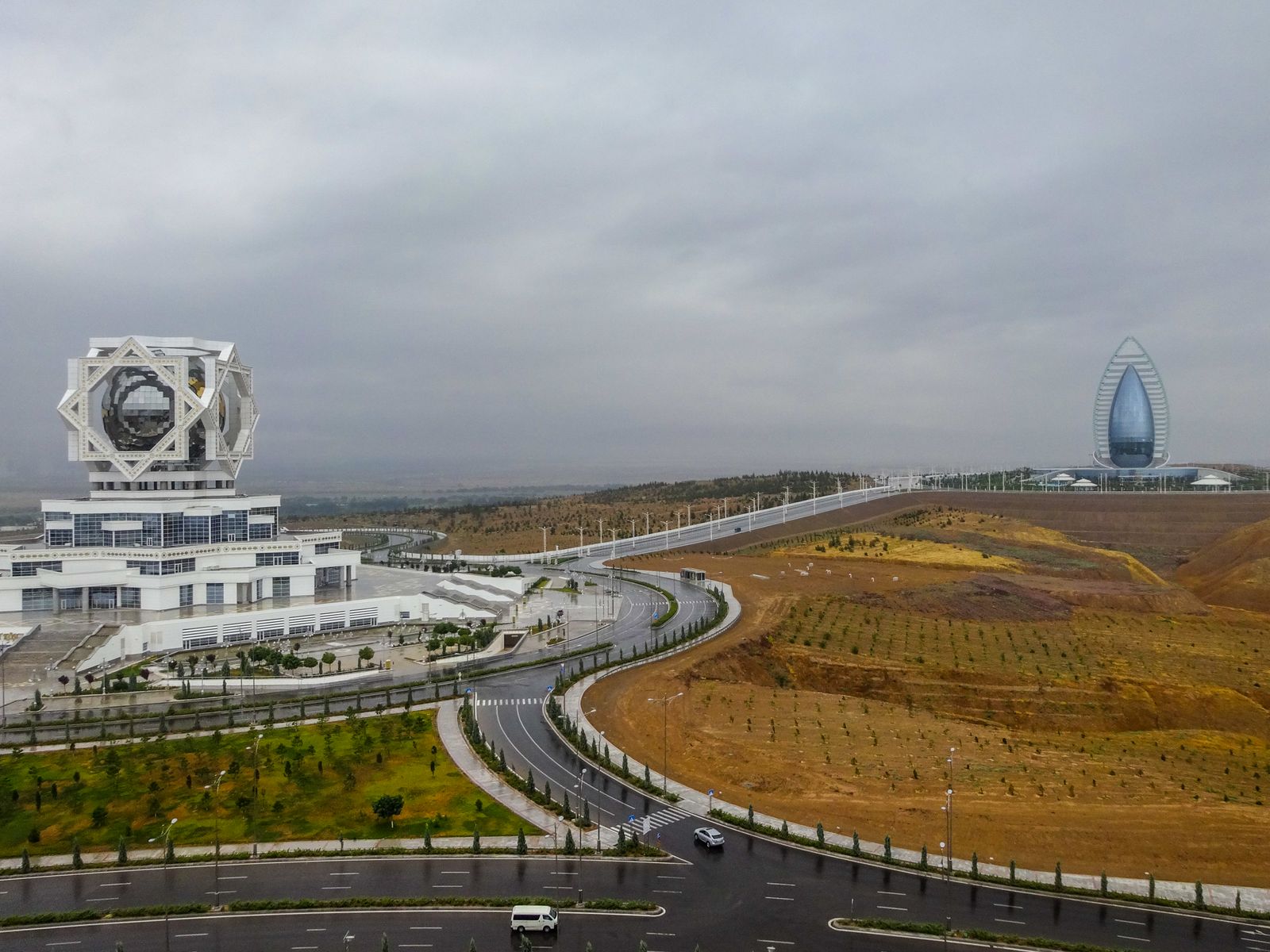
The world’s strangest capital — every surface is white Carrara marble, every roundabout has a gold statue, and the monuments to the personality cult of the late President Niyazov (Turkmenbashi) include a revolving golden statue, the Arch of Neutrality (a tripod tower with a rotating star) and an eight-pointed star-shaped structure housing the country’s political administration. Surreal, bizarre and utterly unique.
A canyon of pink, red and white sandstone layers carved into the flat Ustyurt Plateau in western Turkmenistan — one of Central Asia’s most dramatic landscapes, almost entirely unknown to visitors outside the region. The canyon walls glow orange and pink at sunset in a display of geological colour that rivals the American Southwest.
The Central Asian pilaf — long-grain rice slow-cooked with lamb, rendered fat (dumba), carrots, onion and cumin in a heavy iron kazan (cauldron). The cornerstone of every Turkmen celebration, wedding and funeral meal; a master plov cook is a figure of social prestige.
Marinated lamb skewers grilled over saxaul wood charcoal — the most beloved street food of Turkmenistan and Central Asia, sold at every bazaar and roadside chaikana. Saxaul is a desert scrub wood that burns at very high heat with minimal smoke, giving the meat a uniquely clean char.
Steamed dumplings filled with minced lamb, onion and pumpkin — the Central Asian cousin of Chinese baozi and Turkish manti. Served at teahouses (chaikana) and street stalls throughout Turkmenistan with sour cream or yogurt; a simple, satisfying staple.
Thin flatbread stuffed with green herbs (spring onion, dill, spinach) or spiced minced lamb, folded and fried on a dry griddle — the Turkmen speciality sold at every bazaar. Crispy outside, fragrant inside; eaten hot as a snack or light lunch.
Slightly fermented camel or mare’s milk — a traditional nomadic drink of the Turkmen pastoralists. Green tea (chai) is the universal daily drink throughout Turkmenistan; and Chardjou melons, grown in the Murgab oasis, are considered the world’s finest table melons — fragrant and sweet.
Ashgabat International (ASB) is the main hub. Turkish Airlines and Turkmenistan Airlines serve the main routes. A visa is required for all nationalities — obtain in advance; a tour operator or sponsor letter is typically required.
Istanbul (4h30, Turkish Airlines — daily) is the most practical European gateway. Moscow (3h30) is the most frequent connection overall.
Dubai (3h) and the Central Asian capitals are all within 3 hours. Combining Turkmenistan with Uzbekistan and Kazakhstan in a single Central Asia circuit is the most efficient itinerary.
Most visitors obtain their Turkmen visa through an approved tour operator who provides the mandatory Letter of Invitation (LOI). Independent travel without a government-approved guide is technically illegal; in practice, a guide must accompany all foreign visitors.
All travel outside Ashgabat effectively requires a guide and vehicle — both Darvaza and Yangykala need 4WD and navigation that is extremely difficult independently. Domestic flights to Mary (for Merv) and Turkmenbashi are affordable.
April to June and September to October are the best months — mild (18–28°C), the Karakum Desert bearable, the Darvaza gas crater most atmospheric. July and August are extreme (40–45°C in the desert). November to March is cold in the desert (can freeze at night) but the Gate of Hell fires burn brightest.
📅 Turkmenistan is in its best season in March, April, May, September, October. See where else is good to go in those months, or browse where to go by month.
Turkmenistan uses the Turkmenistani Manat (TMT, approx 3.5 TMT = 1 USD official rate; black market rates differ). Relatively affordable for basic costs but a visa and guide are mandatory expenses.
Plov (Turkmen-style pilaf — lamb, carrots, onion and rice cooked in cottonseed oil in a large kazan, the defining dish of all Central Asia, each country with its own variation — Turkmen plov is typically cooked with lamb fat)
The Darvaza Gas Crater overnight (camping in the desert next to the 70m burning crater, watching the flames reflect off the Karakum sand in silence)
The Ashgabat Carpet Museum (housing the world’s largest collection of Turkmen handwoven carpets, including the world’s largest handmade carpet at 301m²)
Ashgabat for two days, Merv for one, Darvaza Gas Crater for one, Konye-Urgench for one, Yangykala Canyon for one, Nohur for one. Turkmenistan — one of the world’s most closed countries — has the surreal white marble capital of Ashgabat, three UNESCO World Heritage Sites and the most famous burning gas crater on earth.
Ashgabat — the capital of Turkmenistan (a closed Central Asian republic of 488,000km², 6 million people, one of the world’s last remaining totalitarian states — ranking alongside North Korea in press freedom and political openness) — the most striking urban environment in post-Soviet Asia: a city of white marble skyscrapers, gold-domed mosques, a giant golden rotating statue of the first president Turkmenbashi, and one of the lowest population densities of any world capital city, all built from natural gas revenues.
Ashgabat holds the Guinness World Record for the highest density of white marble-clad buildings in the world — the entire city centre was rebuilt from scratch between 1991 and 2010 using Makrana marble imported from India, following the megalomaniac instructions of President Saparmurat Niyazov (Turkmenbashi — Father of all Turkmen, 1991–2006), who renamed months of the year after himself and his mother, banned beards and opera, and commissioned a golden rotating statue of himself that always faced the sun.
The Neutrality Monument (a 75m tripod structure topped by a gold rotating statue of Turkmenbashi — Turkmenistan declared permanent neutrality in 1995, the only country with such a UN-recognised status — originally in the city centre, moved to the suburbs when it obstructed a new building project) and the Earthquake Monument (dedicated to the 1948 Ashgabat earthquake that killed 10,000–176,000 people and destroyed virtually the entire city — the scale of death is disputed because Stalin suppressed the true figure).
The 1948 Ashgabat earthquake (October 6, 1948 — a 7.3 magnitude earthquake that struck at 1:12am while most people were asleep) killed between 10,000 and 176,000 people depending on source — the Soviet authorities suppressed the true figure for decades and the census data was falsified. Most modern estimates put the death toll at 110,000–130,000 — approximately two-thirds of Ashgabat’s entire population at the time. The earthquake is the single deadliest event in Turkmen history.
Merv (UNESCO World Heritage — 30km east of Mary, the ruins of one of the greatest cities of the Silk Road — a succession of ancient cities of the Achaemenid, Seleucid, Parthian, Sasanian, Arab, Seljuk and Mongol periods spread across 60km², including the Sultan Sanjar Mausoleum (1157 AD — the finest surviving Seljuk building in Central Asia, with the original turquoise-tiled dome still intact after 870 years) and the round city of Gyaur Kala (3rd century BC — a perfectly circular Hellenistic city plan visible from the air).
Merv (ancient Margiana, later Marw — one of the five largest cities in the medieval world at its height under the Seljuk Turks in the 11th century, with a population of approximately 200,000) was destroyed by the Mongol armies of Tolui Khan in 1221 in one of the worst urban massacres of the medieval period — contemporary sources (possibly exaggerated) claim 700,000–1.3 million inhabitants killed. The city never fully recovered; the ruins now cover 60km² of desert steppe.
The Darvaza Gas Crater (“The Door to Hell” — a 70m-wide by 20m-deep crater in the Karakum Desert that has been burning continuously since 1971, when Soviet geologists accidentally drilled into a natural gas cavern, causing the ground to collapse and the gas to ignite — the decision to burn it off to prevent methane poisoning was expected to extinguish in a few weeks; it has been burning for over 50 years, the most surreal geological spectacle in Central Asia).
The Darvaza Gas Crater has been burning continuously since 1971 — 50+ years. The decision to set the gas alight (to prevent the deadly methane from spreading to surrounding villages) was expected to extinguish within a few days as the pocket burned out. The gas pocket has proved to be much larger than expected; geologists estimate the reserve could continue burning for decades or even centuries. President Berdymukhammedov ordered the crater extinguished in 2022; the order was not implemented.
Konye-Urgench (UNESCO World Heritage — the ruins of the capital of the Khorezm Empire (11th–13th century) on the Amu Darya delta — with the Kutlug-Timur Minaret (60m — the tallest minaret in Central Asia, built in the 11th century, still standing to its full height after 900 years) and the Turabek-Khanum Mausoleum (1370 AD — a geometric muqarnas ceiling, one of the finest examples of medieval Islamic architectural mathematics in existence).
The Kutlug-Timur Minaret (60m, built in the 11th century, the tallest remaining medieval minaret in Central Asia) is the most striking surviving monument of the Khorezm Empire — a state that at its height in 1215 AD controlled all of Central Asia and parts of modern Iran, before being completely destroyed by Genghis Khan in 1220. The Mongol destruction of Khorezm was so complete that the Amu Darya permanently changed its course, cutting off the city from its water supply.
Yangykala Canyon (a remote canyon in the Balkan Region of western Turkmenistan — layers of red, ochre, white and pink Cretaceous limestone carved by ancient river erosion into a 60m-deep canyon system extending for 25km, the finest desert canyon scenery in Central Asia, accessible only by 4WD and rarely visited — the colours intensify dramatically at sunset, the canyon glowing red and gold against the Karakum sky).
The Yangykala Canyon (a Cretaceous limestone formation in western Turkmenistan deposited when the Karakum Desert was the floor of the ancient Tethys Sea — the geological predecessor of the Caspian Sea, Aral Sea and Mediterranean — approximately 80 million years ago) contains visible marine fossils in the canyon walls: ammonites, belemnites and sea urchins deposited on the seafloor and now exposed at 100m elevation in the middle of one of the world’s most arid deserts.
Nohur (a mountain village in the Kopet Dag Mountains on the Iranian border — an isolated community of approximately 5,000 people who maintain a highly distinct culture including the traditional practice of decorating house gates with wolf and goat skulls, a custom believed to ward off evil spirits, pre-Islamic in origin, and the distinctive Nohur embroidery style with its blue and red geometric patterns on white cotton — one of the most authentic traditional villages in Turkmenistan). Fly from Ashgabat (ASB).
The Nohur people (an isolated ethnic group in the Kopet Dag mountains of Turkmenistan, believed by some ethnographers to descend from a pre-Turkic Parthian population) maintain wolf skull rituals (attaching wolf heads to gateposts as protective talismans — a practice documented since at least the 18th century) that have no parallel elsewhere in Central Asia. Their embroidery tradition is distinct from mainstream Turkmen carpet and textile work.
Tourist visa required and obtained through a licensed Turkmen tour operator — independent travel without a state-approved guide is effectively impossible. Letter of invitation from a licensed operator is needed.
Turkmenistan is one of the most restrictive countries for tourism. A letter of invitation (LOI) and visa must be arranged through an authorised tour operator weeks before arrival.
Independent tourism is not permitted. A registered guide must accompany visitors at all times. Your operator arranges this.
The TMT is the currency. The official exchange rate is controlled; exchange only at authorised points. USD notes in perfect condition (no tears, marks or older dates) are preferred.
Photography of government buildings, military installations and police is prohibited. Ashgabat has many such restrictions — ask your guide before photographing.
Severely restricted. Many Western sites and apps are blocked. Download a VPN before arriving.
Quick answers to the questions people most often ask before visiting Turkmenistan.
Yes, but it's one of the world's most restrictive countries for tourism. A tourist visa requires a letter of invitation through a licensed Turkmen tour operator, and a registered guide must accompany you for most of your trip.
Book with a licensed tour operator, which applies for your letter of invitation; you then collect the visa on arrival or at an embassy. Start the process several weeks in advance.
Fly into Ashgabat International Airport (ASB). Istanbul (about 4h30) is the most practical European connection, with flights also from Dubai (about 3 hours) and Almaty.
April to June and September to October are best (18–28°C), including for the Darvaza gas crater. July and August are extremely hot in the desert, and winter nights can be freezing.
Yes — internet access is heavily restricted and many sites and apps are blocked. Photography of government buildings, military sites and police is also prohibited.
Download Turkmenistan offline maps before arriving — internet access is too restricted for live navigation.
FreeDownload offline maps before you travel so navigation works without mobile data — essential for walking, driving and finding local spots.
FreePoint your camera at menus, signs or street text for instant translation. Download the language pack offline before you arrive for full use without data.
FreeReal-time and offline exchange rates for all world currencies — converts prices instantly so you always know what you are paying in your home currency.
FreeFind and book hotels, guesthouses and apartments with free cancellation on most rates — one of the widest selections of accommodation worldwide.
FreeTurkmenistan sits within easy reach of several other destinations — each with a completely different character.
Turkmenistan is one of the world’s least-visited places. See all 90 in our guide to the world’s least-visited countries & territories.


