GE
Georgia
Ancient wine, Caucasus mountains and old churches
Ancient wine, Caucasus mountains and old churches

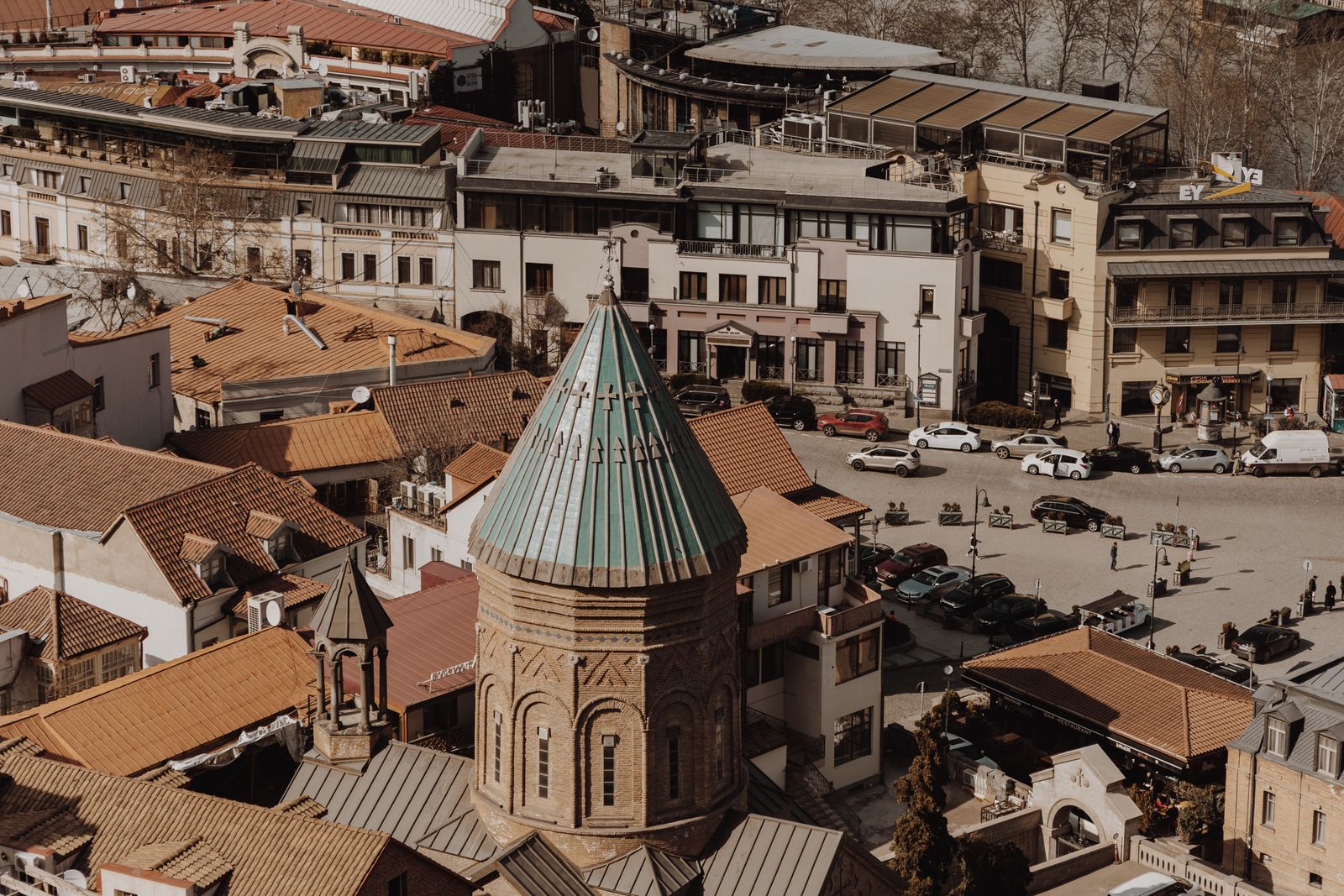
The Old Town’s carved wooden balconies above the Mtkvari River gorge, the Abanotubani sulphur bath district (hot spring baths in domed bathhouses), the Narikala fortress and the Sameba Cathedral.
Photo: Vladimer Shioshvili, CC BY-SA 2.0

Gergeti Trinity Church (14th century) on a cliff at 2,170m with Mount Kazbegi (5,047m) behind it: the most dramatic church setting in the Caucasus. Accessible on foot from Stepantsminda.
Photo: Andrzej Wójtowicz from Poznań, Poland, CC BY-SA 2.0

The ancient capital 20km from Tbilisi: the Svetitskhoveli Cathedral (1029 AD, the holiest church in Georgia) and Jvari Monastery on the cliff at the confluence of the Aragvi and Mtkvari rivers.
Photo: Jacques Dupakiers, CC BY 2.0

A UNESCO landscape of 200 medieval defensive towers built between the 9th and 12th centuries: Ushguli (one of Europe’s highest inhabited settlements, 2,200m) and Mestia as the gateway.
Photo: deguonis from Lithuania, CC BY 2.0

The Georgian wine heartland: Telavi as the base, Alaverdi Monastery’s 11th-century wine cellar and the Sighnaghi walled city above the Alazani Valley. Qvevri amber wine is the original Georgian style.
Photo: Arian Zwegers from Brussels, Belgium, CC BY 2.0

A 6th-century cave monastery carved into a volcanic cliff: 6,000 inhabitants and 13 storeys of cave churches, cells and tunnels visible from the valley below.
Photo: Image by falco from Pixabay, CC0

A subtropical Black Sea resort city with European architecture, a palm-lined boulevard and the Botanical Garden above the coast.
Photo: Andrew Milligan sumo, CC BY 2.0

A 6th-century monastery complex in a semi-desert landscape on the Azerbaijan border: medieval frescoes in cave cells and a landscape unlike anywhere else in Georgia.
Photo: Vyacheslav Argenberg, CC BY 4.0
Large soup dumplings of minced meat, onion and spices: hold by the knot, bite a hole and drink the broth before eating. The knot is left on the plate (counted at the end to gauge consumption).
Cheese-filled bread in three styles: Adjaruli (boat-shaped with egg yolk and butter on top), Imeruli (round, cheese inside) and Megruli (cheese inside and on top). The national food of Georgia.
Small vegetable appetisers compressed into balls: spinach with walnut, red bean with walnut, beet with walnut – walnut is the dominant flavour of Georgian cold starters.
Chicken in a thick walnut and garlic sauce flavoured with coriander, cinnamon and cloves: the definitive Georgian winter dish.
Amber wine (white grapes fermented with skins in clay amphorae for 6 months): orange in colour, tannic and complex. The world’s oldest winemaking method (8,000 years).
Georgian grape marc brandy (the equivalent of Italian grappa): 60-70% alcohol, drunk at every Georgian feast (supra).
Borjomi mineral water (from a volcanic spring, distinctive bitterness) is Georgia’s most exported product. Coffee culture has arrived in Tbilisi’s Old Town cafe scene.
A flatbread filled with spiced kidney beans: the Svaneti highlands’ version of khachapuri and the correct fuel for mountain trekking.
Tbilisi International (TBS) is the main hub; Kutaisi (KUT) serves budget European routes. Georgian Airways and Wizz Air serve European cities; Turkish Airlines via Istanbul is the most frequent connection. For trip planning, see the official Georgia tourism portal.
Wizz Air operates multiple weekly London–Tbilisi flights from Luton in 5 hours. Turkish Airlines via Istanbul is the most frequent option with highest seat availability.
Georgia sits at the heart of the South Caucasus — Armenia (5h bus) and Azerbaijan (1h30 flight) combine naturally for a Caucasus circuit. Tbilisi is the most cosmopolitan entry point.
Tbilisi’s metro costs GEL 1 per trip and connects the airport directly to the city centre — the best value airport transfer in the Caucasus. The Bolt app works reliably in all Georgian cities.
Georgia’s road network has improved significantly since 2010 — the E60 Tbilisi–Kutaisi–Batumi highway is fast and modern. Mountain roads (Kazbegi, Svaneti) are winding but sealed and manageable in a standard car in summer; 4WD recommended in autumn.
April to June and September to November are ideal — Tbilisi in full swing, the Greater Caucasus accessible, Kakheti wine country at its most beautiful (and grape harvest in October). July and August are hot in Tbilisi (32–38°C) but the mountain resorts of Svaneti and Kazbegi are perfect. Winter brings skiing in Gudauri.
📅 Georgia is in its best season in April, May, June. See where else is good to go in those months, or browse where to go by month.
Georgia is excellent value — one of Europe’s and the Caucasus’s best-priced destinations, with outstanding wine, food and mountain scenery at affordable prices. The Georgian Lari (GEL) is relatively stable.
Khachapuri — the national bread, a bread boat filled with melted sulguni cheese and topped with a raw egg and butter — is the most addictive thing to eat in Georgia.
Georgian wine from Kakheti — Rkatsiteli (amber, tannic, complex from 6-month skin contact in qvevri) and Saperavi (the inky red that makes what may be the most distinctive varietal in the world) — costs GEL 15–50 a bottle at restaurants.
Bambi Hotel Mestia and Rooms Hotels (a Georgian luxury chain with properties in Tbilisi, Kazbegi and Batumi) are Georgia’s finest addresses.
Tbilisi for two days, Kazbegi for one, Kakheti wine region for one, Mtskheta for one, Kutaisi for one, the Caucasus mountains of Svaneti for one. Georgia is the Caucasus at its most accessible and most welcoming.
Tbilisi (named for the warm sulphur springs that have been used since the 5th century) has one of the most romantically dilapidated old towns in the Caucasus — carved wooden balconies overhanging cobblestone streets, the Narikala fortress above, the Metekhi Church on the cliff. The Abanotubani (Sulphur Bath District) for a traditional Georgian bath.
The Tbilisi sulphur baths (domed brick buildings above natural hot springs, 35–43°C, distinct smell of hydrogen sulphide) have been continuously operating since the 5th century. The baths inspired Pushkin, Dumas and Lermontov. A private room for two costs GEL 10–40/hour.
The Simon Janashia National Museum (archaeological collection from 8,000 BCE, including the 1.8 million-year-old Dmanisi hominid skulls — the oldest human remains found outside Africa) and the Ethnographic Museum (open-air, 70 traditional buildings relocated from across Georgia). The evening in Rustaveli Avenue wine bars — Georgia is the birthplace of wine.
The Dmanisi skulls (found 1.8 million years ago in the Caucasus foothills) pushed back the accepted date for human migration out of Africa by 600,000 years. The discovery is among the most significant in palaeoanthropology — the skulls are on display at the Tbilisi National Museum.
2h30 from Tbilisi via the Georgian Military Highway (the most striking drive in the country, through gorges and over the Jvari Pass at 2,379m). Kazbegi (Stepantsminda) — the Gergeti Trinity Church (14th century, perched on a 2,170m cliff directly below Mount Kazbegi at 5,047m) is the defining image of the Georgian Caucasus.
The Gergeti Trinity Church hike (1h30 each way from Kazbegi village, 600m vertical) is the single most rewarding walk in Georgia — the path rises through pine forest and emerges above the cloud layer with the church below and Kazbegi’s glaciers above. Accessible by 4WD on the road or on foot.
2h from Tbilisi. Kakheti is Georgia’s wine region — the Alazani Valley, the Telavi wine town, and the qvevri (clay jar buried in the earth) winemaking tradition that has been practised here for 8,000 years. UNESCO included Georgian qvevri winemaking on the Intangible Cultural Heritage list in 2013.
Georgia is the birthplace of wine — archaeological evidence of grape cultivation and wine production from the Neolithic period (6000 BCE) has been found in the Caucasus. The qvevri method (fermenting with grape skins in sealed clay jars buried in the earth for 6 months) produces the distinctive amber wines now celebrated internationally.
25 min from Tbilisi. Mtskheta (UNESCO World Heritage Site) was the capital of the Georgian Kingdom from the 3rd century BCE — the Svetitskhoveli Cathedral (11th century, the most important religious building in Georgia, built over the burial site of Christ’s robe according to tradition) and the Jvari Monastery (6th century, the prototype for all subsequent Georgian ecclesiastical architecture, directly above the confluence of the Mtkvari and Aragvi rivers).
Jvari Monastery (“Holy Cross”, 590 CE) gave its name to the opening stanza of Lermontov’s narrative poem “The Demon” (1841): “Where Aragva merges with the Kura, there stands the ancient monastery.” The view from the monastery over the confluence and Mtskheta below is unchanged since the 6th century.
3h from Tbilisi. Kutaisi (Georgia’s second city) and the Gelati Monastery (12th century, UNESCO World Heritage Site, built by King David the Builder — the finest medieval Georgian royal monastery, with the mosaic of the Virgin in the apse and the tomb of the king himself beneath the main entrance portal).
King David IV (David the Builder, 1073–1125) unified and enlarged the Georgian Kingdom to its greatest historical extent. He asked to be buried beneath the main entrance to Gelati so that every visitor would walk over his grave — an act of humility entirely at odds with his considerable military achievements.
1h flight from Kutaisi to Mestia, or 6h drive. Svaneti — a high Caucasian valley (1,400–2,500m) with medieval defensive towers (the Svan towers, built from the 9th–13th centuries as family fortresses), preserved pre-Christian and Christian religious artefacts and the finest trekking in the Caucasus. Fly back to Tbilisi.
The Svan towers (230 in Mestia alone) were built as defensive family compounds — the Svans retreated inside and sealed the ground floor when threatened. The towers are 20–28m tall, built from unmortared stone, and have stood for 800–1,000 years without maintenance.
Both work in Tbilisi. Marshrutka (minibuses) connect all Georgian cities.
A khinkali: GEL 1-2 each (EUR 0.35-0.70). Restaurant meal: GEL 30-60 (EUR 10-20).
The supra (feast) culture: a Georgian host will feed you until you are physically unable to eat more. The tamada (toastmaster) leads toasts all evening.
Being invited into a Georgian home for wine, food and conversation is common, genuine and not to be refused.
The Svaneti and Kazbegi weather is unpredictable year-round. Always carry rain gear.
Minibuses leave from Didube terminal in Tbilisi to all regional cities: cheap, frequent and occasionally very crowded.
Both give good 4G coverage including the major mountain regions.
The Georgian toast (gau-mar-jos): to victory/to life. Said at every raised glass.
Quick answers to the questions people most often ask before visiting Georgia.
Fly into Tbilisi (TBS) or Kutaisi (KUT), which has many budget flights from Europe. Direct flights from London take about 5 hours; Istanbul is a frequent connecting hub.
Many nationalities, including EU, UK and US citizens, can visit Georgia visa-free for up to a year. Check the rules for your passport.
April to June and September to November, when Tbilisi is pleasant and the Caucasus mountains are accessible. October is grape-harvest season in Kakheti's wine country. July and August are hot in Tbilisi.
A traditional feast with many dishes, wine and a series of toasts led by a toastmaster (tamada). Georgian hospitality is famous, and visitors are often invited to join one.
Yes — it's excellent value. Expect around GEL 60–100 per day on a budget and GEL 200–380 mid-range. The currency is the Georgian lari (GEL).
The dominant ride-hailing app in Tbilisi and Batumi — very affordable by European standards.
FreeAlternative ride-hailing popular in Tbilisi — also covers intercity routes to Kutaisi and Batumi.
FreeBook Kazbegi mountain tours, Uplistsikhe cave city visits, Kakheti wine region days and Georgian experiences.
FreeGeorgia’s widely used messaging app — many businesses and tour operators prefer Telegram over WhatsApp.
FreeBook guesthouses and hotels across Tbilisi, Kazbegi and the wine country.
FreeExplore Georgia’s top city destinations — from Kazbegi to Tbilisi, each with its own distinct character.
Georgia sits within easy reach of several other destinations — each with a completely different character.


