CL
Atacama
The World's Driest Desert and Finest Stargazing
The World's Driest Desert and Finest Stargazing

El Tatio (4,500m above sea level; 95km north of San Pedro by jeep; depart 4am; arrive 6am for the peak eruption; free access at the geyser field; the largest geyser field in the Southern Hemisphere and third-largest in the world) erupts at dawn when the air temperature at 4,500m creates the maximum steam contrast. 80+ geysers and fumaroles are active simultaneously in the dawn light, with columns of steam rising 10m in the −10 to −5°C morning air.
💡 Tours depart San Pedro at 4am (CLP 20,000–35,000; all tour agencies in town; the guides and route are all similar; choose for price and company size). Dress for −10°C at the geyser field — significantly colder than San Pedro (2,400m vs 4,500m). Bring a thermos of coca tea (provided by most tour operators). The hot spring bathing pool (CLP 5,000 extra; adjacent to the geysers; 30°C) is available from 8am after the main eruption.
Valle de la Luna (Moon Valley; 15km west of San Pedro; CLP 4,000 entry; open daily until 1h after sunset; the most visited site in the Atacama) is a landscape of eroded salt and gypsum rock formations created by the evaporation of a prehistoric ocean, producing formations of such extraordinary resemblance to the lunar surface that NASA tested Mars rover equipment here. The salt cave (a 50-metre cavern carved by the wind in a salt cliff; free access inside the park), the Three Maries rock formations, and the Duna Mayor (the highest sand dune; 1h climb; finest Atacama panorama) are the three main features.
💡 Visit Valle de la Luna for sunset (the tour departs San Pedro at 4:30pm; CLP 15,000–25,000; or drive yourself if renting a car; the golden light on the white salt formations and orange rock walls turns the landscape extraordinary for 30 minutes before the sun dips behind the Andes). Many tours combine the sunset with a stargazing session in the valley (9pm; the Milky Way core visible to the naked eye in summer).
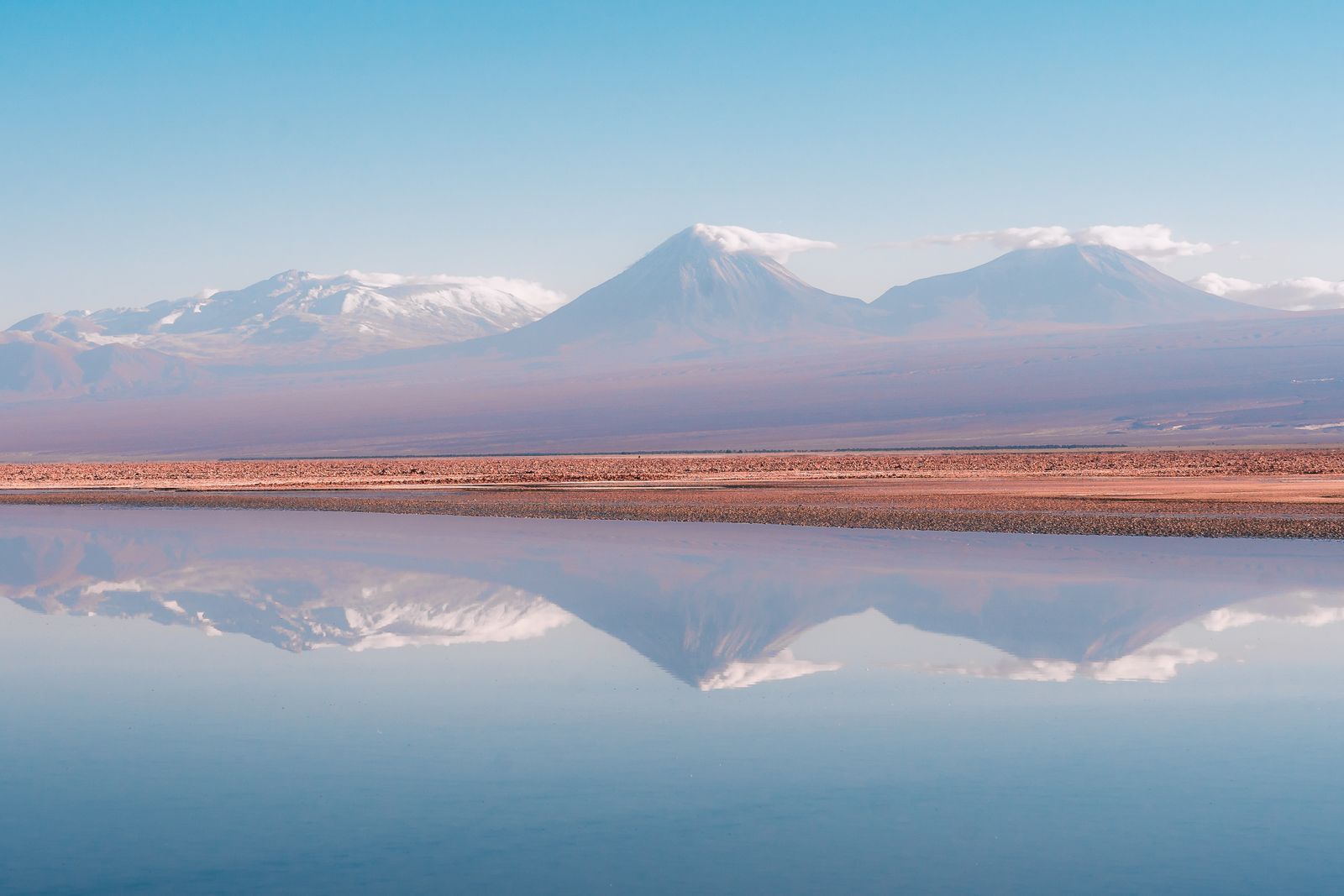
The Salar de Atacama (100km south of San Pedro; the third-largest salt flat in the world; 3,000 km²; altitude 2,300m; the Chaxa Lagoon CONAF sanctuary CLP 6,500 entry) hosts three species of flamingo (Chilean, Andean, and James’s — the only place in the world where all three South American flamingo species are resident simultaneously). The flamingos feed in the mineral-rich brine lakes on algae; the surrounding white salt flat reflects the Andean peaks.
💡 The best flamingo viewing is in the morning (8–10am; before the wind builds over the salt flat; the flamingos feed most actively in the cooler morning). The combined Atacama Salt Flat + Lagoon tour (CLP 18,000–30,000; departs 8am; includes Chaxa Lagoon entry) is the standard half-day excursion. Binoculars significantly improve the experience.
Atacama Desert stargazing tours (CLP 20,000–35,000/person; nightly departures from San Pedro at 9pm; all tour operators offer similar programs; Space Observatory and ALMA Visitor Center are the most professional venues) provide access to powerful telescopes (30–40cm Celestron or Meade; computer-guided) in the world’s finest darkness conditions. On a clear Atacama night, the unaided eye sees 2,000–3,000 stars; the Milky Way core is visible as a coloured cloud; the Magellanic Clouds (satellite galaxies of the Milky Way; visible only from the Southern Hemisphere) are prominent naked-eye objects.
💡 The ALMA Visitor Center (open Saturdays and Sundays; 9am–2pm; free; 40 minutes from San Pedro; the most advanced radio telescope array on earth) is worth combining with a Saturday afternoon Salt Flat tour for the most complete Atacama science experience. The evening stargazing tour (CLP 25,000–35,000; the Space Observatory or Mamalluca near Vicuna are the most professional; book online the day before).
San Pedro de Atacama is a small town (population 5,000) with a surprisingly good restaurant scene for its size. Adobe (Caracoles street; the longest-operating restaurant in town; quinoa stew, llama steak, and the finest pisco sour in San Pedro; CLP 12,000–22,000 for a main course) is the non-negotiable dinner. Tierra Todo Natural (fresh organic juices, empanadas, and quinoa bowls; CLP 5,000–8,000; the best lunch option for dietary restrictions) and the Mercado Municipal (covered market; cheap empanadas and local food from CLP 2,000–4,000; 8am–4pm) complete the food circuit. Altitude affects alcohol — at 2,400m, one pisco sour has the impact of two at sea level; drink water continuously throughout your Atacama stay.
At 2,400m in the world’s driest desert, dehydration is the primary health risk. Drink a minimum of 3 litres per day.
El Tatio (4,500m; −10°C at dawn; peak eruption 6–7am) requires booking through any San Pedro tour agency the previous evening (CLP 20,000–35,000; all depart simultaneously; no significant quality difference between operators).
The Space Observatory and Alfredo Broggi’s private observatory (the most personal and highest-quality experience; CLP 30,000–35,000; maximum 6 people per session; book via San Pedro tour agencies) sell out 2–3 days in advance in the peak season (November–March).
LATAM and JetSmart operate multiple daily flights between Santiago (SCL) and Calama (CJC; the airport for San Pedro de Atacama; 1h 40 mins; from CLP 30,000–80,000 one-way booked in advance).
San Pedro de Atacama (2,400m) and El Tatio (4,500m) require acclimatisation.
Despite daytime temperatures reaching 25–30°C, San Pedro temperatures drop to 5–10°C at night year-round.
Fly Santiago–Calama (1h 40 mins; LATAM). Transfer van Calama–San Pedro (1h; CLP 10,000; prebook). Arrive noon. Rest and hydrate (first 24h at 2,400m). 2pm: Salt Flat and Chaxa Lagoon flamingo tour (CLP 20,000; 3h; three flamingo species + white salt flat). Return 6pm. Adobe restaurant dinner (llama steak; CLP 18,000). 9pm: Space Observatory stargazing (book previous day; CLP 30,000; 2h; Milky Way core + Magellanic Clouds + Saturn rings in telescope).
4am: El Tatio geyser tour departs (CLP 30,000; −10°C; peak eruption 6am; hot spring bath 8am). Return San Pedro 11am. Rest and lunch (2,400m recovery after 4,500m morning). 4:30pm: Valle de la Luna sunset tour (CLP 20,000; sand dunes + salt caves + sunset + optional night stargazing in valley). Return 11pm.
8am: Altiplanic Lagoons tour (CLP 25,000; Lagunas Altiplánicas Miscanti and Miñiques at 4,200m; Andean flamingos and vicunas; 5h). Lunch in San Pedro. Transfer to Calama airport 3pm (1h). Flight to Santiago or Punta Arenas for Patagonia leg.
Free star map and sky guide. Download offline constellation packs for the Southern Hemisphere. Use during the stargazing tour to identify objects being pointed at in the telescope.
Free
Download offline maps for the San Pedro area and the routes to El Tatio and Valle de la Luna.
Free
Detailed local weather for San Pedro de Atacama. Check for any Altiplanic Winter (Invierno Altiplanie) storms in January–February before planning geyser or lake excursions.
Free
Multi-currency CLP card. Some Atacama tour operators are cash-only; carry CLP 80,000–100,000 cash for a 3-day tour program.
Free
From the Atacama Desert to Patagonia’s granite towers and Easter Island’s moai.