CL
Easter Island
Moai, Mystery and the Most Remote Place on Earth
Moai, Mystery and the Most Remote Place on Earth
Ahu Tongariki (the east coast; 17km from Hanga Roa; CONAF permit required; open all hours; the largest ceremonial platform in Polynesia) has 15 standing moai re-erected between 1992 and 1996 using a Japanese crane (the platform had been destroyed by a 1960 tsunami and the moai scattered inland). The 15 figures (the tallest 9m; the heaviest weighing 86 tonnes) face inland at sunrise; the sun rises directly behind the platform in mid-winter, making this one of the most significant archaeoastronomical sites in the Pacific.
💡 Arrive at Ahu Tongariki for sunrise (currently 6:30–7:30am depending on the season; check the sunrise time for your visit date on timeanddate.com). The moai are silhouetted against the rising sun — the most distinctive image on Easter Island — for approximately 20 minutes before the sun rises high enough to light the front faces. Bring a tripod for the long-exposure dawn shots.
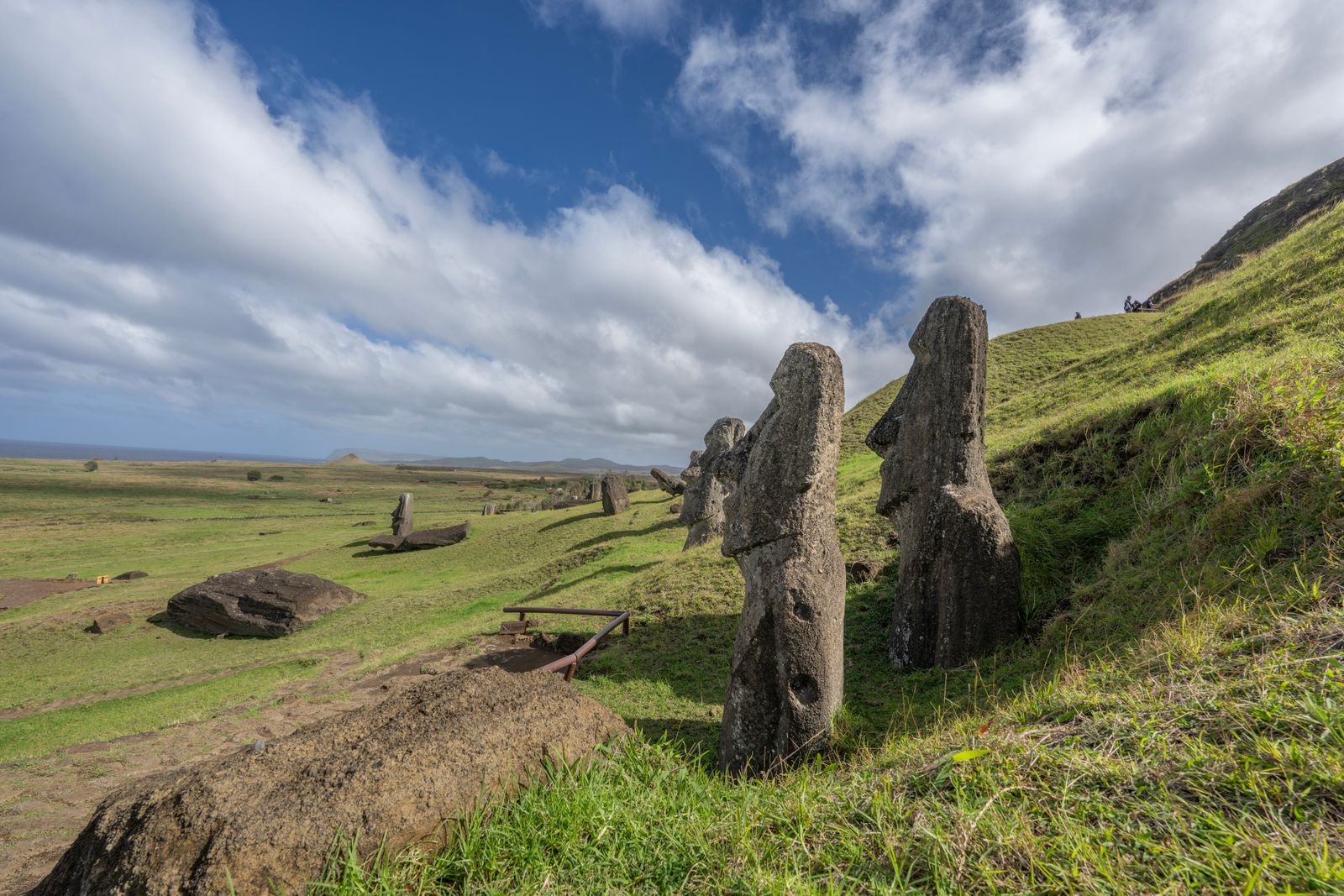
Rano Raraku (the volcanic crater on the east coast; 1km from Ahu Tongariki; CONAF permit; open 9am–5:30pm) is the quarry where all but a handful of Easter Island’s moai were carved from the volcanic tuff of the crater walls. Approximately 400 unfinished or abandoned moai remain at various stages of completion in the quarry floor and crater rim — some buried to the chest in accumulated sediment (the famous “moai heads” that actually have full bodies underground), some in mid-carving on the crater wall, one still attached to the rock face.
💡 Walk the inner crater rim trail (45 mins; 1.5km loop; well-marked; access included in CONAF permit). The inner crater has a small lake (the only naturally occurring freshwater lake on Easter Island outside Rano Kau) and the most dramatic concentration of partially buried moai on the island. The moai still attached to the crater wall (partially completed; 21m long if it had been erected; the largest moai ever attempted) is on the outer slope.
Orongo (the ceremonial village on the crater rim of Rano Kau volcano; 4km south of Hanga Roa; CONAF permit; open 9am–5:30pm; only 30 visitors allowed at any one time) is a restored stone village of 53 corbelled stone houses on a knife-edge ridge overlooking both the 300-metre-deep Rano Kau crater lake (the largest lake on Easter Island; permanently vegetated with totora reeds) and the Pacific cliff face and the three offshore islets (Motu Nui; Motu Iti; Motu Kao Kao) where the birdman ceremony took place annually.
💡 Visit Orongo as early as possible after 9am opening to secure access before the daily visitor limit is reached (30 people at a time; the wait can be 30–60 minutes at peak season). The Rano Kau crater from the Orongo rim is one of the most dramatic single viewpoints on Easter Island — a 300m-deep volcanic crater filled with a lake on the south, and the Pacific cliff falling 200m to the sea on the north.
Anakena (the north coast; 23km from Hanga Roa; CONAF permit for the ahu; the only white sand beach on Easter Island) is both the finest beach on the island and the location of Ahu Nau Nau (7 re-erected moai with coral eye reconstructions — the only moai with their original coral and red scoria eyes reconstructed; the most visually complete moai group on the island). Anakena is the landing site attributed to the legendary first king Hotu Matu’a in the Rapa Nui oral tradition.
💡 Anakena beach (free to enter; CLP 96,000 CONAF permit to approach Ahu Nau Nau) is the finest afternoon spot on Easter Island: swim in the turquoise Pacific, picnic in the shade of the palm trees, and watch the re-erected moai with their reconstructed coral eyes in the late afternoon light. The beach kiosk (fresh fish empanadas; CLP 3,000–5,000) is the only food on the north coast.
Hanga Roa has a small but excellent restaurant scene for its size. The essential experiences: fresh tuna ceviche with local sweet potato (the Rapa Nui traditional preparation; available at any seafront restaurant; CLP 8,000–15,000; the tuna is line-caught local Pacific yellowfin). La Kaleta (the most celebrated restaurant on the island; fresh catch seafood; CLP 15,000–30,000; reserve ahead; the langosta — Pacific lobster — is the signature dish when in season). Te Moana (the best value restaurant on the main street; local Rapa Nui menu; CLP 8,000–12,000). The Sunday morning Hanga Roa market (fresh produce, local honey, and Rapa Nui handicrafts; CLP 500–3,000; the most authentic island shopping). The island grows sweet potato (kum ara; the staple food of the original Rapa Nui — and of Polynesia generally), banana, and sugar cane; the local sweet potato roasted in a hangi earth oven (CLP 2,000–4,000) is the most distinctively Rapa Nui food experience.
LATAM operates the only scheduled air service between Santiago (SCL) and Mataveri International Airport (IPC) in Hanga Roa (5h; from CLP 150,000–400,000 return depending on booking lead time; daily in summer; less frequent in winter).
Car rental in Hanga Roa (CLP 40,000–60,000/day; all-terrain recommended for unpaved roads to Anakena and Ahu Tongariki; available at the airport rental desks from 8am) gives full independent Easter Island access.
The Tongariki sunrise (drive from Hanga Roa at 5:30am; 20 minutes; the 15 moai silhouetted against the rising Pacific sun; the site is free to approach before dawn; the best light quality is 6–7am) is the finest Easter Island moment.
The CONAF Rapa Nui permit (CLP 96,000; valid for the entire stay; required at Ahu Tongariki, Rano Raraku, Orongo, and Anakena) can be purchased at the airport arrivals hall or at the CONAF office in Hanga Roa (Atamu Tekena; open 8:30am–5:30pm).
Easter Island has one ATM (Banco Estado; Hanga Roa; frequently out of cash during peak season and after major payment card batches).
The four main CONAF sites (Ahu Tongariki, Rano Raraku, Orongo, Anakena) take 2 full days.
Fly Santiago–IPC (5h; land noon). Buy CONAF permit at airport (CLP 96,000). Rent car at airport (CLP 50,000/day). Check into guesthouse. Afternoon: Hanga Roa town and Museo Antropológico Sebastián Englert (free–CLP 3,000; the best introduction to Rapa Nui history and culture; 1.5h). Sunset at Ahu Tahai (5 minutes from town; the 3 restored moai at sunset facing the Pacific; the most atmospheric evening on the island; free). Dinner at La Kaleta (reserve ahead; fresh tuna + langosta; CLP 20,000).
5:30am: drive to Ahu Tongariki (20 mins; arrive 6am for sunrise; 15 moai silhouettes at dawn; 1.5h). Drive to Rano Raraku quarry (1km; 9am; inner crater trail; partially buried moai; the unfinished giant; 1.5h). Drive to Anakena beach (north coast; 40 mins). Swim + Ahu Nau Nau (7 moai with coral eyes; the most complete moai group; free beach entry; CLP 96,000 permit for the ahu). Fish empanada at the beach kiosk. Return to Hanga Roa via the southern coastal road (more moai clusters visible).
9am: Orongo (4km south; open from 9am; 30-person limit; the birdman village and Rano Kau crater; 1.5h). Drive north: Ahu Akivi (the 7 inland-carved moai that uniquely face the sea; 1h). Puna Pau (the red scoria quarry where the topknot pukao were made; 30 mins). Afternoon: Te Pito Kura (the “navel of the world” sacred stone + the heaviest transported moai; north coast road; 30 mins). Return to Hanga Roa. Sunday market if applicable. Sunset aperitivo at Hanga Roa waterfront.
Morning: snorkelling at Hanga Roa harbour (the clearest Pacific water at the harbour mouth; free) or a PADI intro dive (Mike Rapu Diving; CLP 50,000; the most pristine and least-explored coral in Polynesia). Afternoon: souvenir shopping (moai carvings in local miro wood; CLP 10,000–50,000; the Mercado Artesanal on Atamu Tekena). Return flight to Santiago (5pm or 10pm; land midnight or 3am Santiago time).
Download Chile offline. Easter Island is included. Shows all ahu and archaeological sites with GPS coordinates.
Free
Download offline for Hanga Roa and the island perimeter road. Most site GPS points are accurately marked.
Free
Download David Hatcher Childress or Jo Anne van Tilburg’s Easter Island moai studies before arrival. Context transforms every site visit from “interesting rocks” to extraordinary archaeology.
Free
Bring pre-loaded CLP from Santiago. The single island ATM frequently runs out of cash in peak season.
Free
Quick answers to the questions travellers most often ask before visiting Easter Island.
The island is a year-round subtropical destination, warmest and driest from December to March (when the Tapati cultural festival is held in February). Rain is possible in any month.
Three to four days to see the moai sites — the Rano Raraku quarry, Ahu Tongariki and Anakena beach — plus the Rano Kau crater and the Orongo ceremonial village.
Flights from Santiago (about 5.5 hours) are the only way to arrive. On the island, rent a car, bike or scooter, or join tours to reach the scattered moai; the town of Hanga Roa is walkable.
Its mysterious giant moai statues, carved by the Rapa Nui people — one of the most remote inhabited islands on earth, with the Rano Raraku quarry, the row of statues at Ahu Tongariki, and a national park protecting it all.
From the Atacama Desert to Patagonia’s granite towers and Easter Island’s moai.