KP
North Korea
The most closed society on earth — Mass Games, Juche Tower & the DMZ
The most closed society on earth — Mass Games, Juche Tower & the DMZ
⚠️ Travel advisory: most governments advise against travel
US citizens cannot use their passports to travel to North Korea without special approval, and other governments advise against travel there because of the risk of arrest and long-term detention. This guide is kept for background only.
Latest official advice: UK FCDO · US State Department · Reviewed September 2026
North Korea is the world’s most closed and controlled society — the Democratic People’s Republic of Korea, where every aspect of the visitor experience is tightly managed by state-approved guides, and where the contrast between the monumental architecture of Pyongyang (built to project ideological power on a Soviet scale), the genuine warmth of individual North Koreans encountered in permitted contexts, and the system that governs their lives creates one of travel’s most complex and morally charged experiences. Tourism to North Korea is currently suspended for most international visitors; when tours do operate (historically through Chinese-based specialist operators from Beijing), they offer a glimpse of a society unlike any other on earth: the Mass Games, the Kumsusan mausoleum, the Mangyongdae funfair, the DMZ at Panmunjom and the ancient capital of Kaesong. Check current access conditions carefully before planning any visit.
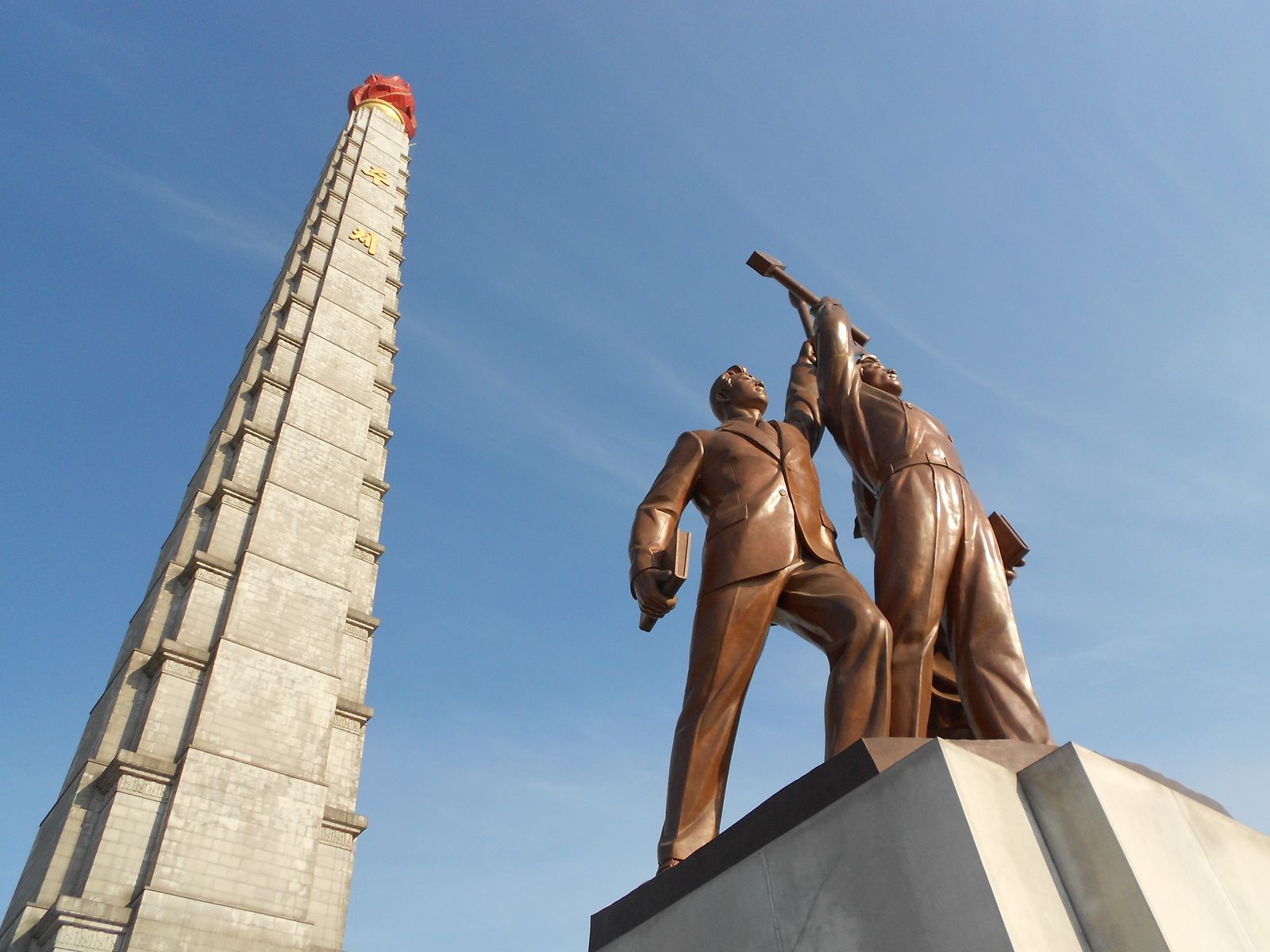
The hermit kingdom’s capital is unlike any other city on earth — a monumental socialist showcase of triumphalist architecture built from scratch after the Korean War levelled the original city. The Juche Tower (170m, lit at night), the Grand People’s Study House, Kim Il-sung Square (larger than Tiananmen), the Kumsusan Palace of the Sun (mausoleum of Kim Il-sung and Kim Jong-il) and the Mangyongdae funfair create a city of theatrical ideological spectacle.
When performed, the DPRK Mass Games (Arirang Festival or Pyongyang International Circus) assemble up to 100,000 performers in Kim Il-sung Stadium in a display of synchronised gymnastics, dance and human mosaic-making using coloured cards — the world’s largest performing arts event and a spectacle of collective discipline with no equivalent anywhere.
The most tense border on earth — the Joint Security Area at Panmunjom, where North Korean and South Korean (and formerly US) soldiers stand metres apart in the blue negotiation buildings on the Armistice Line, is visited from both sides. The North Korean side offers a perspective on the Korean War’s unresolved end.
North Korea (Wikipedia) →Naengmyeon — thin buckwheat noodles in cold broth with mustard and vinegar; Okryu-gwan in Pyongyang is the famous place to eat them.
Fermented cabbage and other vegetables are served with every meal. Tourists eat at designated restaurants.
Brewed in Pyongyang on equipment bought from a closed British brewery.
Pyongyang Sunan International Airport (FNJ) is the only international gateway. Air Koryo (the national carrier) and Air China serve Beijing. All arrivals require a state-approved tour. For trip planning, see the Koryo Tours (authorised DPRK tour operator).
Beijing is the only practical gateway for most nationalities. Air Koryo (the North Korean national carrier, one of the most unusual airlines to fly — a Soviet-era fleet with mandatory patriotic video content) operates the Beijing–Pyongyang route several times per week when relations allow.
All nationalities (except South Korea and most US citizens under the current travel ban) can visit North Korea, but ONLY through a licensed tour operator. No independent travel is permitted; all visitors are accompanied by two Korean guides at all times.
The Beijing–Pyongyang international train (26 hours, crossing the Yalu River border bridge at Dandong) is one of the world’s most unusual train journeys — the border crossing itself, with its extensive formalities, landscape change and gradual emergence into the DPRK countryside, is considered by many travellers the most memorable part of the entire North Korea experience.
The Pyongyang Metro (one of the deepest metro systems in the world, with stations at 100m+ depth designed as nuclear shelters, with socialist-realist mosaics and chandeliers — US$0.05 per ride, the cheapest metro on earth) is open to visitors at certain stations; the ride is among the most surreal transport experiences available anywhere.
April to October is the period when state-approved tours operate. May–June and September–October are the best months: mild, green landscapes and manageable crowds at key sites. July–August is the Mass Games season — the primary draw for most visitors. All visits are through state-authorised tour operators only.
📅 North Korea is in its best season in April, May, June, September, October. See where else is good to go in those months, or browse where to go by month.
Tours are sold in USD or EUR. All prices are determined by the state tour operator; independent spending is not possible.
Koryo beer (the North Korean state lager, brewed in Pyongyang and widely considered the finest beer in Asia by visitors with enough composure to notice)
The Mass Games supplement (US$150–300 above the standard tour price — for a seat in the premier section of the Rungrado Stadium, closest to the card section performers — is considered essential by most visitors:)
The Pyongyang Marathon (held every April on Kim Il-sung’s birthday — one of only two countries in the world where foreigners can run a full marathon alongside local citizens through the streets of the capital)
Pyongyang for two days, Kumsusan mausoleum for one, monuments for one, Mass Games (when performed) for one, Kaesong and DMZ for one, Mount Myohyang for one. North Korea — the most isolated country on earth — has the largest stadium in the world, the most striking mass performance spectacle on earth, the only walking distance with Kim dynasty mummies and the world’s most heavily militarised border at the DMZ. All visits are through authorised tour operators only.
Pyongyang — the capital of the Democratic People’s Republic of Korea (population 25 million, one of the most isolated and controlled societies on earth — all visitors must travel in guided groups organised through state-approved tour operators, accompanied by two government-assigned guides at all times, with no independent movement permitted — a city of extraordinary Soviet-era monumental architecture, the Kim Il-sung Square, the Arch of Triumph (the largest triumphal arch in the world at 60m) and the Juche Tower with its eternal flame).
North Korea (the DPRK — established 1948 under Kim Il-sung after the division of the Korean Peninsula, the world’s most controlled and isolated state — has been governed by the Kim dynasty for three generations: Kim Il-sung (1948–1994), Kim Jong-il (1994–2011) and Kim Jong-un (2011–present). The country maintains the world’s fourth-largest military, has nuclear weapons, and provides essentially no economic, social or political data to outside researchers, making it the least studied inhabited place on earth.
The Kumsusan Palace of the Sun (the mausoleum of Kim Il-sung and Kim Jong-il — their embalmed bodies lie in state in glass sarcophagi in the former presidential palace, visited on Thursdays and Sundays only, with strict formal attire required, extensive security screening, and the longest processional walk through institutional North Korean architecture in the country — the most strikingly unusual visitor experience in the world, combining solemnity, institutional control and the uncanny in equal measure).
The embalming of Kim Il-sung (who died 8 July 1994) and Kim Jong-il (who died 17 December 2011) was performed by Russian specialists (the same institute that embalmed Lenin, Stalin and Ho Chi Minh), at estimated costs of US$800 million for the palace renovation and ongoing annual embalming maintenance. The practice of “eternal” leadership (the two leaders retain their official titles as “Eternal President” and “Eternal General Secretary” in the North Korean constitution) gives the mausoleum a unique political significance.
Mangyongdae (the birthplace of Kim Il-sung, a modest farmhouse complex 12km west of Pyongyang, the most important historical pilgrimage site in North Korea, visited by all North Korean citizens) and the Pyongyang monuments: the Chollima Statue (the mythological winged horse of national progress), the Korean Workers’ Party Monument (three hands holding a hammer, a sickle and a writing brush — the most photographed monument in Pyongyang and the most direct visual expression of North Korean ideology in stone).
The Juche ideology (introduced by Kim Il-sung as the philosophical foundation of the North Korean state — a synthesis of Marxism-Leninism, Korean nationalism and the concept of self-reliance (“juche”) — is expressed architecturally throughout Pyongyang in the Juche Tower, the monumental murals, the Workers’ Party Monument and the Arch of Triumph. Every physical element of Pyongyang has been designed as a total work of political art, making the city the most completely ideologically designed urban environment in the world.
The Mass Games (Arirang or Paektusan Hero Youth Games — held at the 150,000-capacity Rungrado May Day Stadium, the largest stadium in the world, with 100,000–150,000 performers including schoolchildren holding coloured cards to create vast mosaic images, gymnasts, soldiers and acrobats performing in perfect synchronisation — the most striking and technically extraordinary mass performance event in the world, held approximately July–September in years the government chooses to perform it).
The Arirang Mass Games (when performed — not every year — represent the largest choreographed human performance event on earth, requiring 6+ months of rehearsal by 100,000+ participants (mostly schoolchildren and soldiers) who train the card mosaic and gymnastics elements for hours every day. The images created — historical battles, revolutionary achievements, natural landscapes — change with every movement of the cards, producing a “live animated mural” effect that has no parallel anywhere in the world.
Kaesong (the ancient Koryo Kingdom capital — now a North Korean city with the finest pre-Joseon architecture accessible to tourists, including the Koryo Museum in the restored Songgyungwan Confucian Academy, the royal tombs of the Koryo Dynasty and the traditional stone village of Kaesong) and the DMZ observation point (the 248km demilitarised zone dividing North and South Korea, the most heavily militarised border on earth, with the joint security area at Panmunjom where the 1953 armistice was signed).
The Korean Demilitarised Zone (DMZ — the 250km buffer zone created by the 1953 armistice, 4km wide and running the width of the peninsula — is the most militarised border in the world, with an estimated 1 million landmines, thousands of artillery pieces on both sides and the standing armed forces of the world’s fourth-largest military facing the world’s sixth-largest across a line where no peace treaty has ever been signed. The Korean War technically never ended; the 1953 armistice is a ceasefire, not a peace agreement.
Mount Myohyang (a UNESCO-listed mountain 160km north of Pyongyang, with Buddhist temples dating from the Koryo period including the Pohyon Temple (built 1042 CE), the Tongil Tower (the “Reunification” landmark) and the International Friendship Exhibition — a vast underground complex containing the gifts presented to the Kim dynasty by world leaders, a repository of 20th-century political gift culture ranging from a personal crocodile briefcase from Robert Mugabe to a limousine from Stalin).
The International Friendship Exhibition at Mount Myohyang (a series of underground climate-controlled halls containing 220,000+ gifts presented to Kim Il-sung and Kim Jong-il by world leaders, organisations and foreign communist parties from 180+ countries — a comprehensive archive of 20th-century political gift-giving that includes objects from Stalin, Mao Zedong, Fidel Castro, Ho Chi Minh, Yasser Arafat and hundreds of other political figures, providing a unique window into the diplomatic relationships of the Cold War era).
The final morning debrief at the Pyongyang hotel before the transfer to Pyongyang Sunan International Airport (FNJ) — the end of a journey that has been entirely planned, guided and controlled from the moment of entry — an experience unlike any other in the world: a country that presents a version of itself to carefully managed outside observers while its 25 million citizens live under a system of pervasive surveillance and ideological control that has no parallel in the modern world.
North Korea’s famine (the Arduous March — 1994–1998, when the collapse of Soviet subsidies, floods and drought combined to cause a famine in which between 240,000 and 3.5 million people died — the widest range of any 20th-century famine estimate, reflecting the total absence of reliable data from the DPRK — was not acknowledged by the government for several years and remains contested in its causes and scale. The famine fundamentally changed North Korean society, creating a black market economy and loosening central control in ways that have persisted despite government efforts to reverse them.
Tourism to North Korea has been largely suspended since COVID-19. When tours operate, access is exclusively through approved operators (typically from Beijing via Air Koryo). US citizens have been prohibited from travelling independently.
North Korea has been closed to foreign tourists since January 2020. As of March 2026 it had still not reopened to Western tourists: Rason opened briefly in February 2025 before closing again, and the 2026 Pyongyang Marathon was cancelled. Monitor operator updates; Koryo Tours and Young Pioneer Tours are the main Western operators.
When tourism resumes, all itineraries are set by the Korean International Travel Company. Your guides accompany you everywhere; unaccompanied movement is not permitted.
Guides direct what you may and may not photograph. Military installations, poverty, construction sites and unflattering scenes are off-limits. Cameras and phones may be inspected on departure.
Euros are the main tourist currency. North Korean Won cannot be obtained outside the country. Most tourist transactions are in hard currency.
Your guides will direct what you can photograph. Always ask; always defer. Your camera may be checked on exit.
Tourism dollars go directly to the North Korean state. This is a contested ethical question that each visitor must consider for themselves.
Quick answers to the questions people most often ask about visiting North Korea.
Only on a state-approved tour booked through a licensed operator — independent travel is not possible. North Korea has been largely closed to foreign tourists since 2020, so check with specialist operators for the current situation before planning anything.
When tours operate, visitors usually travel from Beijing, either by flight to Pyongyang Sunan International Airport (about 2 hours) or on the international train (about a day). Your tour operator arranges the route.
Yes. The visa (a tourist card) is arranged by your licensed tour operator as part of the tour booking.
Photography is restricted. Your guides tell you what you may and may not photograph, military sites are strictly off-limits, and cameras may be checked when you leave. Always ask before taking pictures.
Tours are all-inclusive and priced in US dollars or euros — typically around US$100–250 per day, with specialist tours costing more. Local currency can't be obtained outside the country.
Download offline maps before you travel so navigation works without mobile data — essential for walking, driving and finding local spots.
FreePoint your camera at menus, signs or street text for instant translation. Download the language pack offline before you arrive for full use without data.
FreeReal-time and offline exchange rates for all world currencies — converts prices instantly so you always know what you are paying in your home currency.
FreeFind and book hotels, guesthouses and apartments with free cancellation on most rates — one of the widest selections of accommodation worldwide.
FreeBrowse millions of traveller reviews for restaurants, attractions and hotels — helps identify the best local spots and avoid tourist traps.
FreeNorth Korea sits within easy reach of several other destinations — each with a completely different character.
North Korea is one of the world’s least-visited places. See all 90 in our guide to the world’s least-visited countries & territories.


