BL
Saint Barthélemy
France's most glamorous Caribbean jewel
France's most glamorous Caribbean jewel

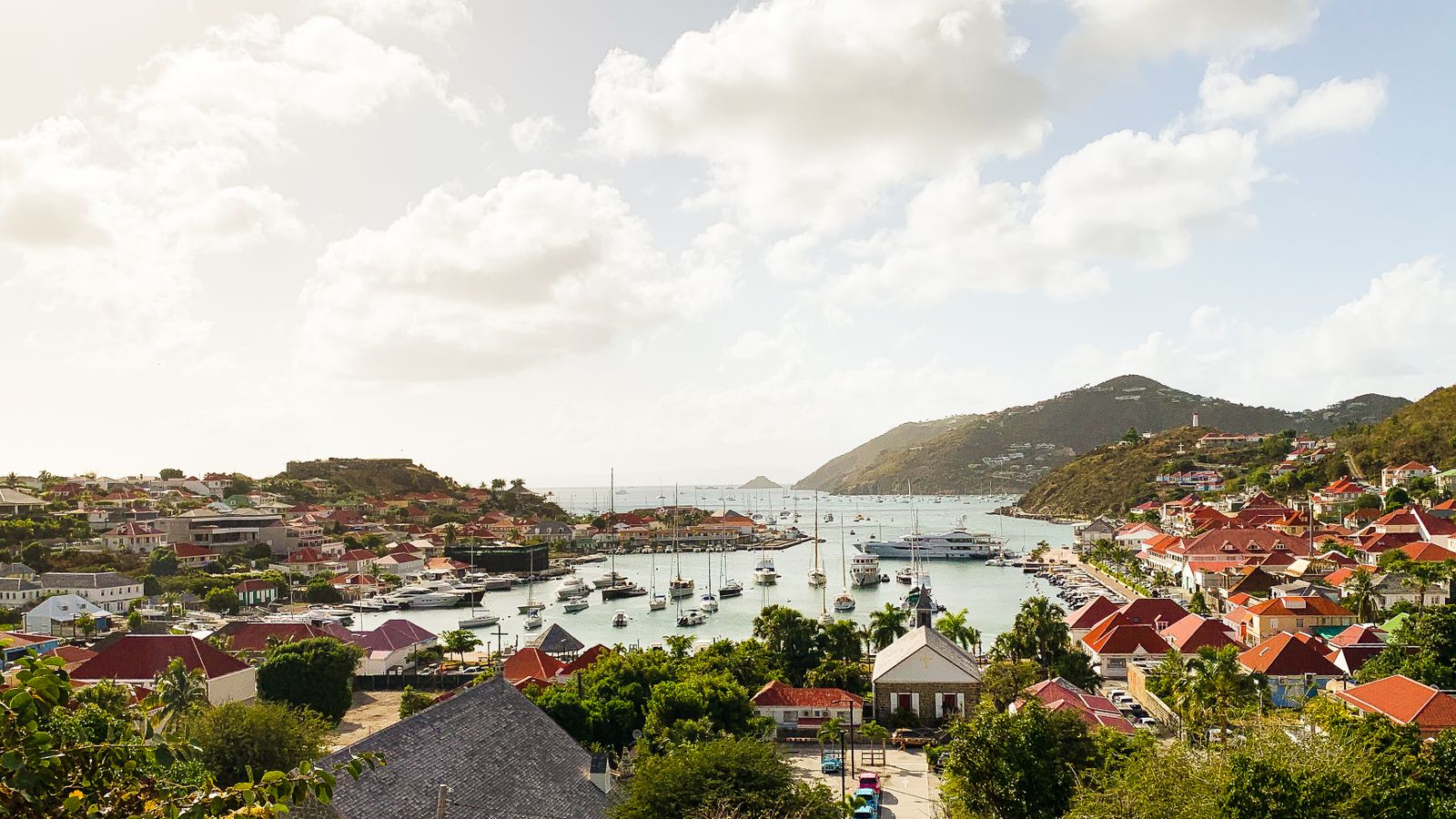
The only Caribbean capital named after a Swedish king (Gustav III of Sweden, who owned the island 1784–1878) — a picture-perfect harbour lined with super-yachts, high-end boutiques, excellent restaurants and the 18th-century Fort Gustav overlooking the bay.
Photo: David Broad, CC BY 3.0

A unique beach entirely covered in shells rather than sand — just 5 minutes from Gustavia harbour, this sheltered cove has remarkable calm water and the great experience of a beach made entirely of millions of bleached white shells and coral fragments.
Photo: David Stanley from Nanaimo, Canada, CC BY 2.0

The most remote and arguably the most beautiful beach on Saint Barthélemy — accessible only by boat or a 30-minute cliff hike from Flamands. The bay was once a favourite anchorage of David Rockefeller; completely undeveloped with healthy coral reef.
Photo: SV Zanshin, CC BY-SA 3.0

The island’s most famous and lively beach — a broad bay divided by a small rock into two sections, with beach clubs, restaurants, watersports and planes landing at the famously tiny St Barths Airport directly over the beach, at just a few metres altitude.
Photo: alljengi from Edinburgh, CC BY-SA 2.0

The most “local” beach on Saint Barths — where Barthésians themselves surf, bodyboard and swim. The village has a bakery, the island’s oldest cemetery and the 18th-century Lorient Anglican church; the beach itself has powerful waves excellent for surfing.
Photo: William Ellison, CC BY-SA 3.0

Two 18th-century French and Swedish fortifications on the headlands above Gustavia harbour — Fort Karl (French, 1763) and Fort Oscar (Swedish, 1787) preserve the island’s unique dual colonial history. Sweeping views of the harbour, Gustavia and the offshore islands.
Saint_Barth%C3%A9lemy (Wikipedia) →Photo: CareAhLine, CC0
Salt cod fritters — seasoned with fresh chives, parsley, scotch bonnet pepper and garlic then deep-fried in a light batter until golden. The defining appetiser of both Saint Barths and Guadeloupe; found on every bistro menu from Gustavia’s fine dining terraces to the bakeries of Lorient.
Grilled Caribbean spiny lobster — the centrepiece of Saint Barths’ restaurant scene, cooked over charcoal with garlic butter, lemon and fresh herbs. The quality of langouste in the clear waters around Saint Barths is impressive; ordered at beach restaurants and brought to the table directly from the tank.
Creole black pudding — highly spiced pork blood sausage with chilli, allspice, cloves and chives; grilled or pan-fried and served as an appetiser. The Saint Barths and Guadeloupean version is more intensely spiced than any European equivalent.
The quintessential French Caribbean aperitif — white agricole rum, fresh lime wedge and cane sugar syrup stirred together, served without ice in a small glass. Tradition demands you mix your own; “Ti’Punch” means “little punch” in Creole and is the social ritual that opens every Caribbean meal.
A fragrant curry from the French Caribbean — named after the Sri Lankan capital and reflecting the Martiniquean Indian heritage in the region. Made with chicken, pork or goat with a spice blend including cumin, coriander, turmeric, mustard seeds and curry leaf. Completely distinct from Indian or Thai curry.
Saint Barths’ French identity extends to its wine culture — the island imports directly from French suppliers at prices lower than mainland France due to its tax status. Restaurants serve serious Bordeaux, Burgundy and champagne at every table.
Gustaf III Airport (SBH) has the second-shortest commercial runway in the world (650m). Only small aircraft land; Sint Maarten (SXM, 10 min) is the primary hub. For trip planning, see the official Saint-Barthelemy tourism portal.
Sint Maarten (SXM) is the gateway for all Saint-Barth visits — fly into SXM on any major carrier and connect by 10-minute flight or 45-minute ferry. The SBH runway approach is one of the world’s most dramatic — aircraft skim the hilltop before dropping steeply onto the 650m runway.
All routes to Saint-Barth involve a connection through Sint Maarten (SXM). The Winair Island hopper (ATR or Britten-Norman Islander, ~10 seats) lands at SBH with a steep final approach that many visitors find simultaneously terrifying and exhilarating.
SBH airport is unique in that the terminal exit leads directly onto St Jean Beach — guests landing at SBH step off the plane and can be on the sand in 5 minutes. The terminal itself is a simple open-air shelter.
The Mini Moke (an open-sided beach car, the signature vehicle of Saint-Barth — rented widely, open-top, perfect for the island’s narrow roads and constant sunshine) is the classic way to explore Saint-Barth. The island has no large vehicles; all roads are single-lane in places.
December to April is peak season — dry, clear (24–28°C), the island at maximum activity. New Year’s Eve is the most famous party in the Caribbean. May to November is the quieter wet season; prices drop 30–50% and the island is far more relaxed.
📅 Saint Barthélemy is in its best season in January, February, March, April, December. See where else is good to go in those months, or browse where to go by month.
Saint-Barth uses the euro. It is among the most expensive destinations in the Caribbean — comparable to Monaco for luxury services, with a mid-range gap that barely exists.
Saint-Barth on a budget means self-catering from the excellent Match supermarket in Lorient (the best-stocked supermarket in the Leeward Islands, with French cheeses, cured meats, baguettes and local produce at reasonable prices) and picnicking on the free beaches. The beaches themselves are entirely free.
Saint-Barth’s rosé wine (the island is the largest per-capita consumer of Provence rosé in the world)
Saint-Barth’s New Year’s Eve.
Gustavia for one day, Shell Beach for one, St Jean for one, Colombier for one, Grand Cul de Sac for one, Saline for one, Flamands for one. Saint-Barth — the most exclusive island in the Caribbean — has 22 beaches on 25km², the finest French cuisine in the Leeward Islands, a Swedish colonial heritage and the most striking superyacht anchorage in the Atlantic.
Gustavia — the capital of Saint-Barthélemy (a French overseas collectivity of 25km², population 10,000, formerly owned by Sweden 1784–1878 — hence the Swedish names: Gustavia after King Gustav III, and the Swedish flag on the coat of arms) — with the Wall House Museum (the Swedish colonial heritage in a restored warehouse), the duty-free shopping strip of boutiques (Saint-Barth has the densest concentration of luxury fashion brands outside Monaco and Paris) and the Fort Oscar panoramic viewpoint.
Saint-Barthélemy was sold back to France by Sweden in 1878 for 320,000 gold francs after a referendum of the 3,000 inhabitants — the only Caribbean island ever voluntarily relinquished by a colonial power through a popular vote. Sweden’s 94-year rule left the Swedish names (Gustavia, Lorient, Colombier), the Swedish flag on the coat of arms, and a curious cultural memory of Scandinavian heritage in a deeply French island.
Shell Beach (the only beach directly accessible from Gustavia — a small cove covered entirely with shell fragments rather than sand, within 5 minutes walk of the port, with the Do Brasil restaurant and bar directly on the sand — the most social beach on the island, used by both locals and visiting yacht crews) and the Gustavia Harbour (the finest natural port in the Leeward Islands, with 80+ superyachts anchored during the December–April season — the greatest concentration of superyacht wealth in the Caribbean).
The superyacht fleet at Gustavia during the New Year’s Eve week (25 December–2 January) has been estimated to anchor US$10+ billion worth of vessels in a single harbour — yachts belonging to the wealthiest individuals in the world, attracted by Saint-Barth’s tax-free status (retained from the Swedish era), its French cuisine and its unparalleled party scene.
St Jean Beach (the busiest and most social beach on Saint-Barth — a 600m arc of pale sand on the north coast, divided by the Eden Rock promontory into two halves, with the Eden Rock hotel (the most photographed hotel room in the Caribbean — a suite built into the top of a rock pinnacle overlooking the beach, with a runway directly behind the beach where aircraft land so close the jet blast blows sand onto the loungers — the Saint-Barth equivalent of Maho Beach in Sint Maarten) and the Beach Bar.
The Eden Rock hotel (built by a British art collector on a natural rock outcrop at St Jean, with the hotel’s main suite accessible only by ladder from the terrace below, decorated with David LaChapelle photography and bespoke artworks, from US$800–2,500/night) and the adjacent runway that aircraft use to land at Gustaf III Airport (the second-shortest commercial runway in the world at 650m — aircraft approach directly over the beach and land between the beach and the hill) combine to create the most dramatic airport beach scene in the Caribbean after Maho.
Colombier Beach (the finest and most remote beach on Saint-Barth — accessible only by a 30-minute hike over a rocky hilltop or by boat, a crescent of white sand in a protected bay with clear water for snorkelling, ringed by wild cactus hills, with no road, no bar, no development — the complete antithesis of the island’s typical luxury scene) and the Colombier nature reserve (sea turtles nest on the beach June–October).
The 30-minute hike to Colombier Beach (from the car park at the end of the Colombier road, over a ridge of dry cactus scrub with views of Saint-Martin and Anguilla, down to the isolated cove below) is the most physically demanding beach access on Saint-Barth and entirely free. The contrast between the walk (rough, hot, cacti and goats) and the arrival (white sand, crystal water, silence) is one of the best beach reveals in the Lesser Antilles.
Grand Cul de Sac (the calm lagoon beach on the northeast coast — a shallow protected bay behind a barrier reef, ideal for children, snorkelling and kitesurfing, with the Béatrice restaurant on the sand and the most consistent kitesurf wind in Saint-Barth — and the dive site at the lagoon’s fringing reef with sea turtles, eagle rays and nurse sharks visible from the surface at high tide) and the Salines salt pond (the flamingo habitat in the island’s interior).
The lagoon at Grand Cul de Sac is protected from the Atlantic swell by a shallow coral reef; the combination of flat water, consistent 20-knot Trade Winds and warm temperature makes it one of the best beginner kitesurfing venues in the Leeward Islands. The reef provides some of the best accessible snorkelling on the island, accessible from shore without a boat.
Saline Beach (the most beautiful beach on the Atlantic side of Saint-Barth — a wide arc of pale sand accessible via a 10-minute walk from the road, separated from the road by a salt pond that filters out casual visitors, with the most dramatic waves on the island — strong enough for body-surfing, calm enough for swimming in the right conditions — traditionally clothing-optional at the far end, the most natural and undeveloped beach atmosphere on the island).
Saline Beach’s isolation (no road access, no bar, no facilities — just sand, surf and the surrounding dry hill vegetation) is the reason it is consistently rated the most beautiful beach on Saint-Barth by the island’s residents themselves, who tend toward Saline when they want to escape the tourist beaches. The salt pond behind the beach is a wetland habitat for herons and egrets.
Flamands Beach (the most intimate and least-crowded main beach on Saint-Barth — a north-coast crescent of fine white sand with the Hôtel Baie des Anges and the Anse des Flamands village, the most community-oriented beach on the island, popular with Gustavian families on Sunday) and a final dinner at L’Isoletta or the Bonito restaurant in Gustavia before flying from Saint-Barth (SBH) via Sint Maarten (SXM).
Saint-Barth cuisine (the finest French-Caribbean food in the Lesser Antilles — French techniques applied to Caribbean ingredients: freshly caught mahi-mahi with a beurre blanc, Caribbean spiny lobster in a Noilly Prat bisque, foie gras with local guava jam — at restaurants like L’Isoletta, La Gloriette and Do Brasil) is the defining reason why food-oriented travellers choose Saint-Barth over more scenic Caribbean alternatives.
The world’s most thrillingly terrifying short runway landing (650m, Type STOL certificate required) means only small Twin Otter aircraft land at SBH. Most visitors fly to Sint Maarten (SXM) and take a 45-minute ferry or an air taxi.
As a French collectivity, Saint Barths uses the euro. American Express, Visa and Mastercard are accepted at all hotels, restaurants and boutiques.
High season accommodation fills from November onwards for December/January. New Year’s Eve accommodation is typically reserved a full year in advance.
There are no all-inclusive resorts, no large chain hotels, no casinos and no fast food chains. The island’s identity is built around small, independently owned luxury; this is what keeps it exceptional.
French law requires all beaches to be publicly accessible. Many of Saint Barths’ most famous beaches adjoin luxury hotel properties but the beach itself is public to all.
Pain au chocolat, croissants and accras from the Lorient and St Jean bakeries eaten on the beach at sunrise is arguably the finest breakfast experience in the Caribbean.
Quick answers to the questions people most often ask before visiting Saint-Barthélemy.
Fly into Sint Maarten (SXM), then take a 10-minute hop on a small plane to St Barth's Gustaf III Airport (SBH) or a 45-minute fast ferry. Long-haul jets can't land on St Barth — its 650 m runway is one of the shortest commercial runways in the world.
December to April is peak season: dry, sunny and 24–28°C, with New Year's Eve the island's most famous (and most booked-up) night. May to November is quieter and wetter, and prices can fall by 30–50%.
Yes — it is one of the most expensive destinations in the Caribbean. Careful budget travellers spend around €100–180 per day, mid-range stays run €350–600, and luxury trips €1,500 or more.
The euro. St Barth is a French collectivity, and major credit cards are accepted at hotels, restaurants and boutiques across the island.
Yes. Under French law, all beaches are public — including those in front of luxury hotels — so you can visit any of the island's beaches.
Saint Barthelemy sits at the northern tip of the Leeward Islands chain, with Anguilla, Saint Kitts and Nevis, Antigua and Barbuda, Martinique, Montserrat and Dominica forming the wider Eastern Caribbean neighbourhood.
Saint Barthélemy is one of the world’s least-visited places. See all 90 in our guide to the world’s least-visited countries & territories.
