MQ
Martinique
Mount Pelée, rhum agricole and Creole France
Mount Pelée, rhum agricole and Creole France
Martinique is France in the Caribbean — a French overseas department where the baguettes are fresh, the wine is excellent, the volcanic landscapes are dramatic and the beaches range from the black volcanic sands of the northern Atlantic coast to the white and gold of the Sainte-Anne in the south. The island is dominated by Mount Pelée — an active stratovolcano that in 1902 erupted with catastrophic force, destroying the city of Saint-Pierre (the former “Paris of the Caribbean”) in under two minutes and killing 30,000 people. The ruins of Saint-Pierre, now partially excavated and with wreck diving on 18 ships sunk in the harbour, make it one of the most haunting destinations in the Caribbean. Martinique’s rum distilleries produce some of the world’s finest agricole rum, made from fresh-pressed sugar cane juice.
The ruins of the city destroyed in the 1902 eruption — the former theatre, cathedral, rum distillery and jail (whose sole survivor, a prisoner protected by his thick cell walls) are visible above ground; 18 ships sunk in the harbour are diveable at 5–50 metres, covered in coral and fish. Mount Pelée (1,397m) can be hiked in 3–4 hours from the le Prechéur trailhead through tropical forest to the still-fuming crater.
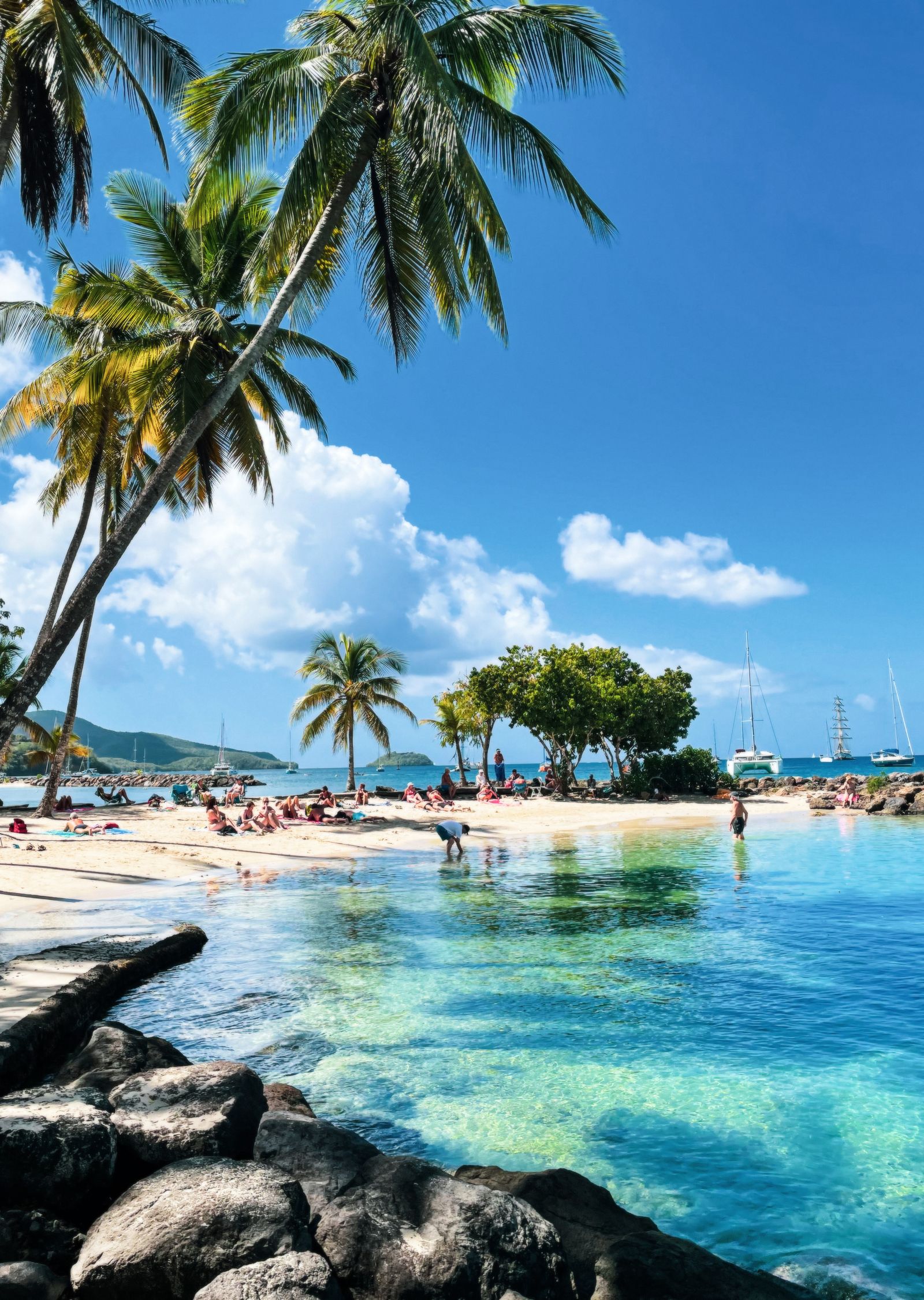
The finest beach in the French Caribbean — a kilometre of fine white sand fringed by sea grape and almond trees at the southern tip of the island, with calm turquoise water. Consistently rated among the Caribbean’s top beaches and the island’s social centre on weekends.
Martinique’s AOC-protected rhum agricole — distilled directly from fresh-pressed sugar cane juice rather than molasses, producing a more complex, vegetal spirit — is produced at a dozen distilleries open for visits. Rhum Clément, Trois-Rivières, Depaz and the extraordinary J.M from the slopes of Mount Pelée are the highlights of a rum trail of excellent quality.
Martinique (Wikipedia) →Salt cod fritters — the standard aperitif snack.
Chicken curry with Martinique’s distinctive colombo spice blend (cumin, turmeric, coriander, fenugreek, mustard) — brought by indentured labourers from South Asia in the 19th century and now entirely Martinican. Cooked with coconut milk and local vegetables.
Spicy Creole blood sausage, often served as a starter.
Caribbean spiny lobster grilled in garlic butter with a squeeze of local citrus — the premium restaurant dish of Martinique, caught fresh by the island’s fishermen and served at beachside restaurants in Le Marin and Sainte-Anne.
Gilt-head sea bream caught in the warm waters around Martinique, grilled whole over charcoal with local herbs and lime — a simple, elegant fish dish that represents the best of Martinican coastal cooking.
Freshwater crayfish, usually cooked in a Creole sauce.
Agricole rum, cane syrup and lime — the classic aperitif. Martinique rum has its own AOC.
Aimé Césaire International (FDF) near Fort-de-France is a busy hub. Air France operates direct flights from Paris; Air Caraïbes connects throughout the French Antilles. No direct UK flights — Paris is the gateway. For trip planning, see the official Martinique tourism portal.
Paris is the only European hub with direct connections to Martinique — Air France, Corsair and Air Caraïbes operate multiple daily CDG/ORY–FDF flights. From the UK, route via Paris.
American Airlines via Miami (3h30) is the most convenient US connection. Guadeloupe (45 min) and Saint Lucia (30 min) are the closest inter-island connections.
Martinique’s TCSP bus network covers the main destinations but frequency is limited. Car hire (€40–70/day) is by far the most practical option for exploring the distilleries, beaches and the north.
Martinique drives on the right (French system); roads are excellent throughout. The island is 80km long and the main tourist circuit is manageable in a day from any base.
December to April is peak dry season — the French Caribbean at its finest, the beaches of Sainte-Anne calm, the northern rainforest accessible. January to March are the best months (24–28°C). June to November is hurricane season; Martinique was directly hit by Hurricane Dean in 2007.
📅 Martinique is in its best season in January, February, March, April, May, December. See where else is good to go in those months, or browse where to go by month.
Martinique is a French département and uses the euro — the most expensive island in the Eastern Caribbean. Prices match metropolitan France for accommodation and dining; local Creole restaurants are significantly cheaper.
Accras de morue — light, crispy salt cod fritters flavoured with chives, piment antillais (Martinique’s aromatic scotch bonnet) and lime — are the essential Martinique apero food, eaten standing at a beach bar with a Ti-Punch.
Colombo de poulet — chicken braised in Martinique’s signature colombo spice blend (a curry-adjacent mix of turmeric, cumin, coriander, mustard seed and allspice, brought by Indian indentured workers in the 19th century and adapted)
Cap Est Lagoon Resort & Spa (the finest hotel in Martinique, 50 suites directly on the Atlantic lagoon, the best spa in the French Caribbean, from €350–800/night) and Habitation Saint-Aubin.
Fort-de-France for one day, Saint-Pierre for one, Mount Pelée for one, Sainte-Anne for two, the rum distilleries for one, Les Salines beach for one. Martinique — the most French island in the Caribbean — combines Creole culture with Michelin-quality food and the most dramatic volcanic scenery in the Lesser Antilles.
Fort-de-France — the capital of Martinique, a département of France — with the Bibliothèque Schœlcher (1889, a striking iron-and-glass library designed in Paris by Henri Picq, transported to Martinique in pieces and reassembled, named after abolitionist Victor Schœlcher who freed the slaves of the French Caribbean in 1848), the Grand Marché (the finest market in the French Caribbean — madras fabrics, piment antillais, soursop, plantain, colombo spices) and rum cocktails on the savane.
Martinique is a département and région of France (since 1946, confirmed by referendum) — not a colony or territory but a full part of France and the European Union, with the same legal system, currency and representation in the Assemblée Nationale. Martiniquais are French citizens. The island uses the euro, drives on the right and educates its children in the French national curriculum.
40 min from Fort-de-France. Saint-Pierre — once the cultural capital of the Caribbean (the “Paris of the West Indies” — a city of 30,000 with theatres, a botanical garden, the finest rum distilleries) was destroyed in 8 minutes on 8 May 1902 when Mount Pelée erupted with a nuage ardent (pyroclastic flow) that killed all 30,000 inhabitants. The ruins, never rebuilt, are still visible beneath the modern village.
The 1902 eruption of Mount Pelée killed 29,000–30,000 people — the deadliest volcanic disaster of the 20th century — in a pyroclastic surge that flowed at 670km/h and reached 700°C. One survivor, a prisoner named Louis-Auguste Cypàris, was protected by his stone cell and lived (though badly burned); he was later pardoned and joined Barnum & Bailey’s circus as “the lone survivor.”
The Mount Pelée hike (1,397m, 4–5h return, a marked trail through the cloud forest of northern Martinique to the rim of the crater — steaming, with views over the island and Saint-Pierre below) and the Jardin de Balata (a tropical botanical garden at 450m altitude, with a suspended forest canopy walkway above the jungle floor, 30 min from Fort-de-France).
Mount Pelée is classified as a decade volcano — one of 16 volcanoes worldwide identified by the International Association of Volcanology as deserving particular study due to their history of large, destructive eruptions and their proximity to populated areas. The 1902 eruption was the worst volcanic disaster since Tambora (1815). A smaller eruption in 1929–1932 evacuated northern Martinique.
1h from Fort-de-France. Sainte-Anne — the prettiest village in southern Martinique, with the Plage des Salines (the finest beach in Martinique — a 1.5km arc of white sand backed by coconut palms, with calm, shallow turquoise water and the offshore reefs of the Diamond Rock visible) and the Friday evening fish market in the village square with accras de morue (salt cod fritters) and Ti-Punch.
Ti-Punch (petit punch — a cocktail of rhum agricole, cane syrup and a squeeze of lime, named for its small size but significant strength) is the defining drink of Martinique. The rhum agricole (distilled directly from fresh sugarcane juice rather than molasses) is a fundamentally different product from other Caribbean rums, with a fresh, grassy flavour that is incomparable. Making a Ti-Punch is a deeply personal act: you adjust your own sugar and lime.
2h fast ferry from Martinique. Les Saintes (Terre-de-Haut, a tiny French island, 6km², perfectly maintained white-and-blue village, sandy beach at Anse Mire and a hilltop fort above the bay) is a day trip from Martinique — the most photographed village in the French Antilles, where everyone speaks French, the boulangerie opens at 6am and the bourg resembles Brittany in the tropics.
Les Saintes was the site of the Battle of the Saintes (12 April 1782) — the decisive naval battle in which British Admiral Rodney defeated the French fleet of de Grasse in the most important naval engagement of the American Revolutionary War’s Caribbean theatre, preventing France from threatening Jamaica. The cannon balls fired in the battle still occasionally surface on the seabed.
The distillery circuit of northern Martinique — Habitation Clément (18th-century rum estate, National Historic Monument, with one of the finest collections of Caribbean art and rum-making history in the French Antilles), Habitation Saint-James (the oldest distillery in Martinique, museum of the cane harvest) and the AOC Martinique rhum agricole appellation (the only Caribbean rum with a French Appellation d’Origine Contrôlée, like Champagne or Cognac).
Martinique’s rhum agricole has had an Appellation d’Origine Contrôlée (AOC) since 1996 — the first and only Caribbean spirit to receive this distinction. The AOC specifies the varieties of sugarcane permitted, the area of production, the minimum distillation proof and the aging requirements for the vieux (aged) expressions. The result is the most tightly regulated rum in the world.
A full day at Les Salines — early morning before the day-trippers arrive, the beach empty under the palms, the Diamond Rock (a 176m volcanic plug 2km offshore that was commissioned as HMS Diamond Rock by the British Navy in 1804 — the only rock ever given the official designation of a warship in British naval history) visible from the shore. Fly from Aimé Césaire (FDF).
HMS Diamond Rock (1804–1805) was a volcanic basalt plug used as a British military outpost and munitions store, armed with cannon that controlled the channel between Martinique and Saint Lucia. It was provisioned by ropes from the summit and held by 107 sailors. The French considered its capture sufficiently important that Napoleon sent 2,000 troops and Admiral Villeneuve to take it in 1805.
French/EU territory — EU citizens enter freely; Schengen visa rules apply. UK, US, Australian citizens enter visa-free up to 90 days.
Direct from Paris (8h), Miami, Montreal and regional Caribbean islands.
The 1902 eruption of Mont Pelée destroyed Saint-Pierre (then the largest city in the French Caribbean) and killed 30,000 people. The mountain is still active and can be hiked with guides.
Martinique is a French overseas department. Euro used everywhere.
Car hire is the best way to explore the island. The Martinique Bus network (TC) connects main towns but is infrequent outside Fort-de-France.
Quick answers to the questions people most often ask before visiting Martinique.
Fly into Aimé Césaire International Airport (FDF) near Fort-de-France. Direct flights from Paris take about 8h30, and there are direct flights from Miami (about 3h30). From the UK, connect via Paris.
Martinique is part of France and the EU. EU citizens enter freely, and UK, US and Australian citizens can visit visa-free for short stays under French rules.
December to April is the dry peak season, with January to March the best months (24–28°C). June to November is hurricane season.
In 1902, the eruption of Mont Pelée destroyed Saint-Pierre, then the largest city in the French Caribbean, killing almost all its inhabitants. Its ruins and museum are among the island's most moving sights.
It is among the pricier Eastern Caribbean islands, with prices close to mainland France — around €70–120 per day on a budget and €180–300 mid-range. A hire car is the best way to get around.
Point your camera at menus, signs or street text for instant translation. Download the language pack offline before you arrive for full use without data.
FreeReal-time and offline exchange rates for all world currencies — converts prices instantly so you always know what you are paying in your home currency.
FreeFind and book hotels, guesthouses and apartments with free cancellation on most rates — one of the widest selections of accommodation worldwide.
FreeBrowse millions of traveller reviews for restaurants, attractions and hotels — helps identify the best local spots and avoid tourist traps.
FreeMartinique sits within easy reach of several other destinations — each with a completely different character.
Martinique is one of the world’s least-visited places. See all 90 in our guide to the world’s least-visited countries & territories.


