KW
Kuwait
Pearl-diving heritage & Gulf hospitality
Pearl-diving heritage & Gulf hospitality
⚠️ Travel advisory: check before you go
In September 2026 the US raised its advice to “reconsider travel” for this region because of tensions involving Iran. Flights and tourism are operating normally, but airspace closures and cancellations can happen at short notice, so keep plans flexible and travel insurance in place.
Latest official advice: UK FCDO · US State Department · Reviewed September 2026
Kuwait is a small but prosperous Gulf emirate where the ancient traditions of pearl-diving and desert Bedouin life coexist with oil-funded modernity and one of the world’s highest per-capita incomes. Kuwait City’s landmark water towers and Liberation Tower punctuate a skyline built almost entirely since the discovery of oil in 1938. Though compact and often overlooked on the tourist trail, Kuwait rewards visitors with its outstanding souks, seafood, a major Islamic arts museum and the warm hospitality of a society that retains strong Bedouin roots. The desert south and the Green Island offshore offer escapes from the city.
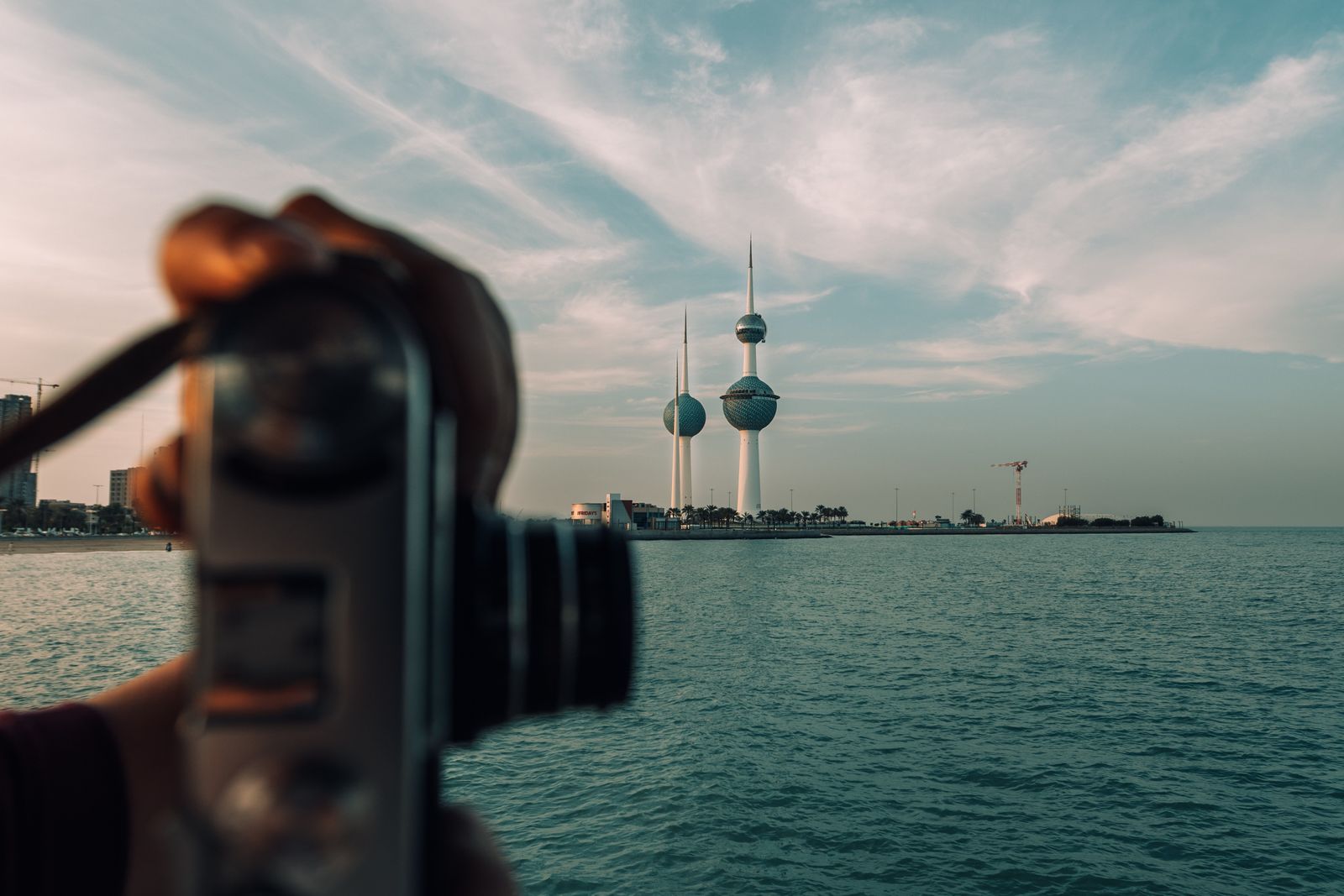
Kuwait’s most recognisable landmarks — three slender towers topped with painted globes designed by Swedish architects — house a revolving restaurant, a water reservoir and a viewing platform 123 metres above the Gulf. The towers, built in 1979, remain a potent symbol of Kuwait’s post-oil prosperity and resilience after the Iraqi invasion of 1990.
Kuwait’s largest mosque, completed in 1986 and capable of holding 10,000 worshippers, is a masterpiece of Islamic architecture with an 43-metre main dome and 74-metre minaret. Non-Muslim visitors are welcome on guided tours — the interior — vast prayer halls, intricate marble floors, calligraphy on every surface — earns the visit alone.
Kuwait City’s oldest and most atmospheric market dates to the early 20th century and still trades in spices, gold, fabric, fish and traditional Gulf crafts beneath its wooden-roofed arcades. The fish market, held in the early morning hours, is a scene of Gulf maritime culture.
The Dar al-Athar al-Islamiyyah, housed in a former residence of Kuwait’s first oil minister, holds one of the finest private collections of Islamic art in the world — 20,000 objects spanning 14 centuries from across the Muslim world.
Kuwait (Wikipedia) →Spiced rice with chicken, lamb or fish and dried limes (loomi) — the national dish.
A rose-water and cardamom milk pudding topped with pistachios and almonds — the classic Gulf dessert, chilled and delicate.
Slow-cooked wheat and meat porridge, served especially during Ramadan. Local seafood such as hammour (grouper) is worth trying.
Arabic coffee with cardamom, served with dates. Kuwait is dry; juice bars and coffee shops are where people meet.
Kuwait International (KWI) is a well-connected Gulf hub. Kuwait Airways, Jazeera Airways and all major Middle Eastern carriers serve the main routes. For trip planning, see the official Kuwait tourism portal.
Kuwait Airways operates direct Heathrow–Kuwait services; most Europeans fly with a Gulf hub connection via Dubai (Emirates), Abu Dhabi (Etihad) or Doha (Qatar Airways).
Kuwait sits at the heart of the Gulf — Dubai (1h30), Doha (1h15) and Abu Dhabi (1h30) are all very close. It makes an easy add-on to any Gulf itinerary.
Kuwait has no metro; taxis and Careem (the Gulf’s main rideshare app) are the best transport. Rental cars are available for excursions but the city is spread out and driving is aggressive.
Car hire (KWD 8–20/day) or a private driver is the most practical way to see Kuwait beyond the city. Roads are excellent; distances are short. The Failaka Island ferry departs from the Marina Crescent pier in Salmiya.
November to March is the only viable window — cooler temperatures (12–24°C), the Kuwait Towers and desert accessible. December and January are peak season. April and October are transitional. May to September is extreme — temperatures reach 45–50°C with humidity on the coast, making outdoor sightseeing impractical.
📅 Kuwait is in its best season in January, February, March, November, December. See where else is good to go in those months, or browse where to go by month.
Kuwait uses the Kuwaiti Dinar (KWD — one of the world’s most valuable currency units). It is expensive for accommodation and dining, but with no alcohol and no tourist traps it is straightforward to budget.
Machboos — Kuwait’s national dish (basmati rice cooked with a whole chicken or lamb, dried limes (loomi), baharat spice blend, onion and tomato — a slow-cooked one-pot dish present at every Kuwaiti family table) — costs.
Kuwait City’s restaurant scene reflects the city’s cosmopolitan population — Kuwaiti, Lebanese, Egyptian, South Asian and American restaurants all operate to a high standard.
The Four Seasons Kuwait (the finest hotel in Kuwait City, on the waterfront, from KWD 80–200/night) and the Jumeirah Messilah Beach Hotel are the most prestigious addresses in the country.
Kuwait City for three days, Failaka Island for one, Al Ahmadi for one. Kuwait — one of the wealthiest countries in the world per capita — is a short, rewarding Gulf destination with genuine historical depth behind the modern skyline.
Kuwait City — the capital of the State of Kuwait on the northwestern shore of the Persian Gulf — with the Kuwait Towers (three water-supply towers built 1971–1979 on a promontory into the Gulf, the defining architectural symbol of Kuwait and the finest modern landmark in the Arabian Gulf, with a revolving observation deck at 123m and the blue-tiled spheres visible from across the bay) and the Kuwait National Museum.
The Kuwait Towers (designed by Swedish architect Malene Bjørn and opened in 1979) are the most recognisable modern structure in Kuwait — the three towers hold a total of 4,500 cubic metres of fresh water for the city, the sphere restaurant rotates once per hour, and the towers are considered by many architectural critics to be the finest 20th-century structure in the Arabian Peninsula.
The Mubarakiya Souk (the oldest market in Kuwait City, a labyrinth of spice stalls, gold traders, tailors and sweet shops selling halwa and dates around a central covered hall — in continuous operation since the late 19th century and one of the few traditional souks in the Gulf to have survived without heavy modern renovation) and the corniche waterfront walk with views of the Kuwait skyline.
Kuwait City has been continuously inhabited as a trading port since approximately 1613, when Bani Khalid tribal leaders established a fort (kut) at the head of the bay — the name Kuwait is a diminutive of the Arabic kut (small fort). By the 18th century it was one of the most important dhow-building centres and pearl-diving ports in the Gulf; oil was discovered in commercial quantities in 1938.
The Al Qurain Martyrs’House (a Kuwaiti house in the Al Qurain suburb, the site of a battle on 24 February 1991 during the Iraqi occupation of Kuwait — a group of Kuwaiti resistance fighters held off Iraqi forces for 5 hours before the house was destroyed by tank fire, killing all the defenders — preserved exactly as it was after the battle, with bullet holes and shell damage intact, one of the most moving war memorials in the Middle East) and the Liberation Tower.
The Iraqi occupation of Kuwait (2 August 1990–28 February 1991) lasted 7 months. An estimated 1,000 Kuwaiti civilians were killed, thousands imprisoned, and the Iraqi army ignited 700 Kuwaiti oil wells on withdrawal — producing the largest man-made environmental disaster in history. The oil fires burned for 9 months and were visible from space; the resulting oil lakes in the desert still partially cover parts of southern Kuwait.
The Kuwait National Museum (the finest museum of Gulf heritage, with collections covering the pearl-diving history of Kuwait before oil — divers who descended to 12m without equipment to collect oysters, the economic foundation of Kuwait for 300 years — the dhow-building tradition and the Failaka Island archaeological finds: a Greek Hellenistic settlement from the 4th century BC, established by Alexander the Great during his Persian campaign, with a temple, agora and pottery).
Kuwait’s pearl-diving industry (at its peak in the early 20th century, involving over 800 dhows and 10,000 divers who produced the finest pearls in the world) collapsed virtually overnight in the 1930s when Japanese cultured pearls flooded the global market. Oil was discovered in 1938; by 1946 oil revenue had replaced pearl-diving entirely. The speed of this economic transformation — from pearl diving to oil wealth in 10 years — is one of the most dramatic transitions in modern economic history.
1h ferry from Kuwait City. Failaka Island — an island 20km offshore in Kuwait Bay with the Tell al-Khazna archaeological site (a Hellenistic Greek settlement dating from approximately 325 BC — established during the campaigns of Nearchus, Alexander’s admiral, with the ruins of a temple, a defensive wall and quantities of Greek pottery) and the abandoned Kuwaiti holiday town (evacuated during the Iraqi occupation and never reoccupied, now a ghost town of empty 1970s villas preserved by the desert).
Failaka Island’s Greek connection — the settlement founded by Alexander the Great’s forces around 325 BC — makes it one of the easternmost confirmed Greek colonial settlements in the ancient world. The Greeks called it Ikaros (after the mythological island). The ruins coexist with pre-Greek Bronze Age settlements dating from 2000 BC, making Failaka one of the most archaeologically layered sites in the Gulf.
Drive south. Al Ahmadi — the oil company town built by the Kuwait Oil Company from 1946 (a complete planned British colonial suburb of bungalows, cricket pitches and a golf course in the middle of the Kuwaiti desert, now preserved as a heritage site, the most complete example of mid-20th-century British oil-company town planning in the Gulf) and the Burgan Oil Field (the world’s second-largest oil field, producing approximately 1.7 million barrels per day, visible as a forest of pump jacks on the desert horizon).
The Burgan Oil Field (discovered 1938, second only to the Ghawar Field in Saudi Arabia in proven reserves, with approximately 66 billion barrels) has been the economic engine of Kuwait for 85 years. The oil fires set by Iraqi forces in February 1991 burned at Burgan for 9 months; the fire-fighting effort (largely by American and Canadian teams) was the largest and most difficult oil-fire suppression operation in history.
A final day — the Kuwait City waterfront at dusk (the Kuwait Towers illuminated at sunset, the dhow harbour with traditional wooden vessels — Kuwait still has the largest surviving fleet of wooden dhows in the Gulf — and dinner on a traditional dhow dinner cruise in the bay, with grilled hammour (grouper), madfoon (slow-cooked lamb in spiced rice buried underground) and the famous Kuwaiti sweet luqaimat (fried dough balls with date syrup). Fly from Kuwait (KWI).
Madfoon — Kuwait’s most celebrated festive dish (a whole lamb or large cut, marinated in spices including black lime, turmeric, cardamom and loomi, buried in an underground clay oven with a bed of basmati rice, cooked for 6–8 hours and served on a communal platter at weddings and celebrations) — is the Kuwaiti equivalent of the Moroccan mechoui: the supreme occasion meat.
Visa on arrival or e-visa available for many nationalities. GCC citizens enter freely. Check requirements at the Kuwait embassy website before travelling.
Kuwait is more conservative than Dubai. Dress modestly in public — cover shoulders and knees. Beachwear is for private beach clubs only.
The KWD is the world’s highest-valued currency unit. Cards are widely accepted. Taxis should be metered or agreed in advance.
June-September temperatures exceed 45°C. Most activity is indoors in air conditioning. October-March is ideal travel season with temperatures 15-25°C.
Kuwait International Airport (KWI) is the sole entry point. Budget airlines (Jazeera, Fly Kuwait) connect to regional hubs.
Strictly prohibited throughout Kuwait. Non-alcoholic alternatives are widely available.
Summer (Jun–Sep) temperatures regularly exceed 45°C. Visit Nov–Mar for comfortable weather.
Dress modestly outside tourist areas and malls — shoulders and knees covered in traditional and religious settings.
Quick answers to the questions people most often ask before visiting Kuwait.
November to March is the only viable window — cooler temperatures (12–24°C), the Kuwait Towers and desert accessible. December and January are peak season.
Kuwait International (KWI) is a well-connected Gulf hub. Kuwait Airways, Jazeera Airways and all major Middle Eastern carriers serve the main routes.
Expect roughly KWD 15–30 a day on a budget and KWD 50–90 mid-range, or KWD 150+ for a more luxurious trip, per person and excluding flights.
Kuwait uses the Kuwaiti Dinar (KWD).
In September 2026 the US raised its advice to “reconsider travel” for this region because of tensions involving Iran. Flights and tourism are operating normally, but airspace closures and cancellations can happen at short notice, so keep plans flexible and travel insurance in place. Always check current official travel advice before booking.
— One of the main ride-hailing apps in Kuwait, alongside Uber and inDrive.
Free— The dominant food delivery platform across the Gulf; outstanding range in Kuwait.
FreePoint your camera at menus, signs or street text for instant translation. Download the language pack offline before you arrive for full use without data.
FreeReal-time and offline exchange rates for all world currencies — converts prices instantly so you always know what you are paying in your home currency.
FreeSkyline Kuwait City, historic Failaka Island, the garden city of Al Ahmadi, seafront Fahaheel and the canals of Khiran — five faces of Kuwait.
Kuwait sits within easy reach of several other destinations — each with a completely different character.


