AE
UAE
Desert glamour meets futuristic skylines
Desert glamour meets futuristic skylines
⚠️ Travel advisory: check before you go
In September 2026 the US raised its advice to “reconsider travel” for this region because of tensions involving Iran. Flights and tourism are operating normally, but airspace closures and cancellations can happen at short notice, so keep plans flexible and travel insurance in place.
Latest official advice: UK FCDO · US State Department · Reviewed September 2026

The world’s tallest building (828m): the At the Top observation deck at 124th floor, the At the Top Sky at 148th floor and the Dubai Fountain’s water-and-light show at the base.
Photo: imran shahabuddin, CC BY 2.0
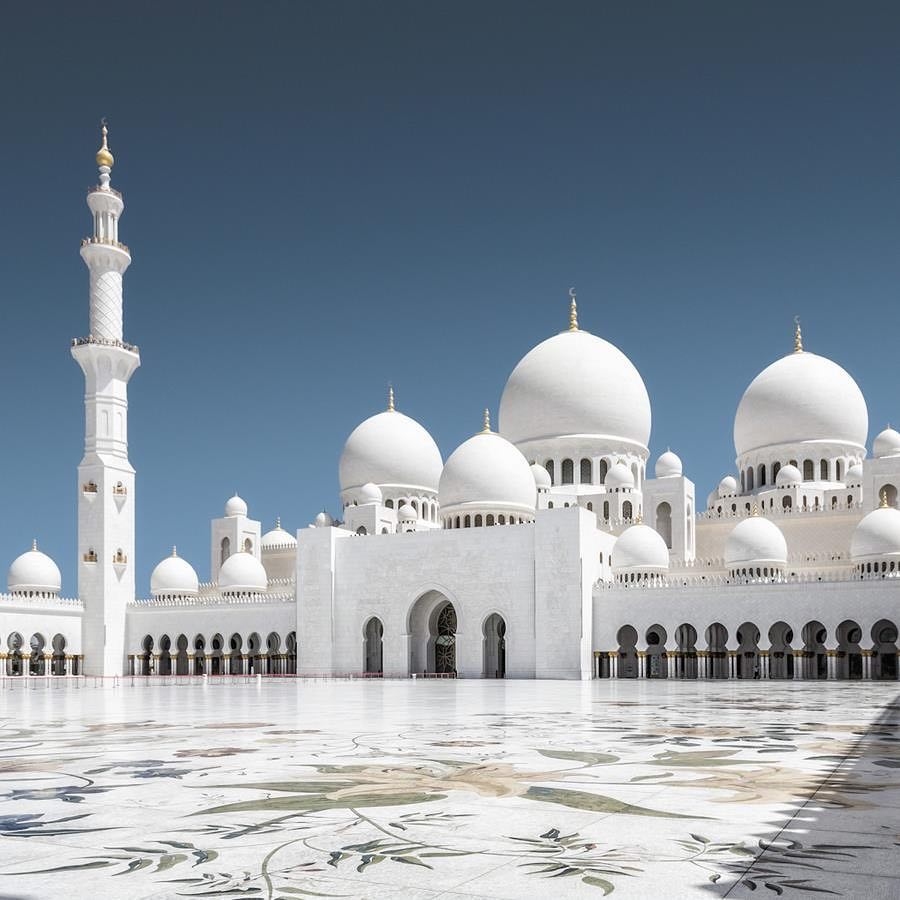
82 white domes, 1,000 columns, the world’s largest hand-knotted carpet (5,600m²) and 24-carat gold-plated chandeliers: one of the world’s most beautiful mosques, open to non-Muslims.

The Al Fahidi Historic District’s wind-tower architecture (the original air conditioning), the Gold Souk and Spice Souk on the opposite creek bank and the abra (water taxi) crossing between them.
Photo: Phil6007, CC BY-SA 4.0

An evening desert safari: 4WD dune bashing on the red sand dunes, camel riding, sandboarding at sunset and a Bedouin camp dinner of mezze and shisha under the stars.
Photo: Desertsafarideals, CC BY-SA 4.0

Jean Nouvel’s 2017 museum: a 180m dome perforated to create a rain of light (the museum of light effect). Ancient to contemporary art across civilisations in the world’s most architecturally ambitious new museum.
Photo: Boubloub, CC BY-SA 4.0

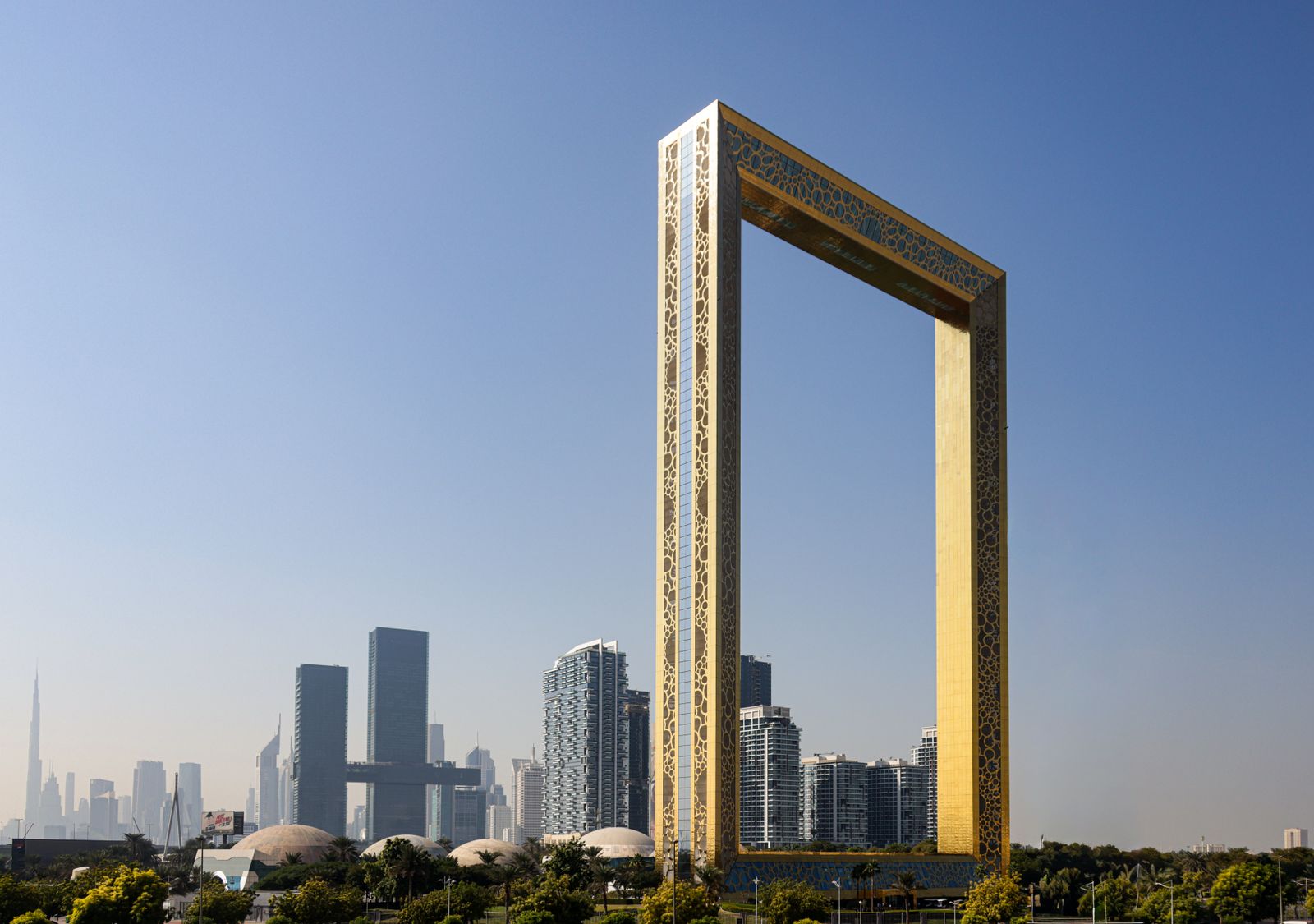
The Dubai Frame (150m, a picture frame between old and new Dubai) and the Museum of the Future (a torus-shaped building with Arabic calligraphy – the most beautiful building in the world according to many architecture critics).
Photo: Saaremees, CC BY-SA 4.0

The Palm Jumeirah from above (helicopter or the Atlantis’s rooftop): 17 fronds of reclaimed land with 4,000 villas, the Atlantis’s Aquaventure waterpark and the beach clubs.
Photo: Mohammad Azahar, CC BY-SA 4.0

The Sharjah Islamic Arts Museum (the finest Islamic art collection in the Gulf), the Heritage Area’s restored traditional architecture and the Sharjah Art Foundation’s biennial.
Photo: Noor Ali Rashid, Public domain
Rotating lamb or chicken carved into flatbread with garlic sauce, pickles and fries: the street food of the entire Gulf, eaten at roadside shawarma stands at any hour.
Wheat and chicken (or lamb) slow-cooked to a porridge consistency in a sealed clay pot: the oldest Emirati dish, eaten at Ramadan and celebrations.
Camel meat biryani or slow-stewed camel: the most traditional Emirati protein. Luqaimat: deep-fried dough balls in date syrup and sesame – the definitive Emirati sweet snack.
Spiced rice cooked with saffron, loomi (dried lime), black pepper and slow-braised meat or fish: the Gulf’s answer to biryani and the most frequently eaten Emirati home-cooked dish.
Very strong black tea with evaporated milk, sugar, cardamom and saffron: the Gulf equivalent of Indian chai, drunk multiple times daily.
The UAE has the world’s finest Lebanese restaurant culture outside Beirut: hummus, kibbeh, fattoush and grilled meats from Zaroob to Logma.
The UAE is Muslim; public drinking is prohibited. Licensed hotel bars and restaurants serve alcohol.
The UAE produces Medjool, Barhi and Khalas dates: eaten at every meeting, every coffee, every arrival and departure. The finest dates are from the Al Ain oasis plantations.
Dubai International (DXB) is one of the world’s busiest airports and a major global hub. Zayed International Airport (AUH), Abu Dhabi is Etihad’s hub. Al Maktoum (DWC, Dubai South) handles some flights. Emirates and Etihad are both based here. For trip planning, see the official Dubai & UAE tourism portal.
Emirates operates up to 7 daily Heathrow–Dubai flights, including double-decker A380s. flydubai and Air Arabia serve UK regional airports at lower price points.
Emirates operates the longest A380 services in the world from Los Angeles and Dallas. The Business Class and First Class products are the benchmark for long-haul luxury.
The Dubai Metro (Red and Green lines) is clean, fast, air-conditioned and cheap — covers the main tourist corridor from the airport to the Marina. Buy a Nol card (AED 6) at any station.
The Etihad Express bus service between Abu Dhabi Airport and Dubai (multiple stops including Ibn Battuta Mall and the Marina) is the cheapest city-to-city link at AED 35.
November to March is the ideal window: 20–28°C, clear skies, low humidity. April and October are transitional — warm but manageable. May to September is hot and extremely humid (40–48°C, with 80%+ humidity in August) — the city functions but outdoor exploration is impractical.
📅 UAE is in its best season in January, February, March, November, December. See where else is good to go in those months, or browse where to go by month.
The UAE is expensive for accommodation and dining — comparable to London or Singapore for hotels and restaurants. However, transport and some food is affordable, and the duty-free shopping is competitive.
A shawarma from a street-side stand in Deira or Satwa costs AED 8–15 (≈US$2–4) and is excellent — the best cheap eat in Dubai. The best shawarma places have a queue of local workers at lunchtime.
Dubai’s Friday brunch culture — an all-you-can-eat-and-drink affair at hotel restaurants, usually AED 300–500pp — is a genuine social institution. Free-flowing drinks included at most venues.
The Burj Al Arab Jumeirah (the sail-shaped hotel on its own island, often cited as the world’s most luxurious hotel) starts at AED 7,000/night.
Dubai for four days, Abu Dhabi for two, a desert safari to close. The UAE rewards exploration beyond the towers — the old creek, the souks, the desert and the cultural institutions of Abu Dhabi are the real substance.
Al Fahidi Historical Neighbourhood — Dubai as it was before the oil money, a warren of wind-tower houses from the 1800s, now home to galleries and the Dubai Museum. The Gold Souk and Spice Souk across the Creek. Cross by abra (wooden water taxi, AED 1) — the best single ride in Dubai.
The abra water taxi across Dubai Creek costs AED 1 (≈US$0.27) and is the most authentic experience in Dubai. The Gold Souk contains 10% of the world’s gold trade.
The Burj Khalifa (828m, the world’s tallest building) — observation decks at 124th and 148th floors. The Dubai Fountain show (the world’s largest choreographed fountain) at 6pm and 8pm, free from the waterfront. Dubai Mall (the world’s largest by total area).
The Burj Khalifa’s At the Top SKY observation deck (floor 148, AED 379) gives the full view above the clouds. Book online for a significant discount over walk-up prices.
The Palm Jumeirah monorail to the Atlantis Hotel at the tip. JBR (Jumeirah Beach Residence): a 1.7km beach promenade with restaurants and cafes, free public beach. The Dubai Marina at sunset for the superyacht-and-skyscraper combination.
Dubai’s beaches are free and excellent — the water is warm, the sand is fine, and there’s always a sun lounger. Jumeirah Beach Park (AED 5 entry) is the best public option.
A half-day or full-day desert safari from Dubai: dune bashing (4×4 over the red dunes), camel riding, sandboarding, and a Bedouin camp dinner under the stars. The Hajar Mountains (1h from Dubai, Hatta) for a contrast of dramatic rocky landscape.
The best desert experience near Dubai is actually in Ras al-Khaimah — the Hajjar Mountains meet the dunes there, and it’s less packaged than the standard Dubai safari. Worth the extra drive.
1h30 drive from Dubai. Abu Dhabi is a more considered city than Dubai — the Louvre Abu Dhabi (a Jean Nouvel-designed museum with a 180m perforated dome and a universal civilisations collection), the Qasr al-Watan presidential palace (open to visitors), the Corniche waterfront.
The Louvre Abu Dhabi is one of the finest new museums in the world — the collection spans 5,000 years and all major world civilisations in a single narrative. The dome’s filtered light at midday is impressive.
The Sheikh Zayed Grand Mosque is the third-largest mosque in the world and the most architecturally striking in the region — 82 domes, 1,000 columns, the world’s largest hand-knotted carpet (5,627m²) and the world’s largest chandelier. Entry is free, dress code applies.
The mosque at sunset, when the white marble and gold turn amber and the fountains glow, is the finest view in Abu Dhabi. The prayer call at the same time is an additional dimension.
Yas Island (30 min from Abu Dhabi): Ferrari World (world’s fastest rollercoaster — Formula Rossa, 240km/h), Yas Waterworld, the Yas Marina Formula 1 circuit. Or: fly home from Abu Dhabi (AUH) or Dubai (DXB).
Emirates and Etihad are two of the world’s best airlines — the Business Class products (especially Emirates’ A380 shower suite and Etihad’s A380 Residence) are benchmarks for luxury air travel.
Both work throughout the UAE. Taxis are metered and reliable.
A shawarma: AED 10-15 (EUR 2.50-4). A hotel meal: AED 150-500+. Budget food is excellent.
During Ramadan, eating or drinking in public (daylight hours) is an offence for non-Muslims too. Restaurant hours change significantly.
Modest dress (covered shoulders and knees) is required in malls and public areas. Swimwear only at pools and beaches.
The UAE’s permanent resident foreign population exceeds 88%. The resulting cultural mix is cosmopolitan.
The UAE is the most connected aviation hub in the world: nonstop to 200+ destinations from Dubai.
Both give excellent nationwide 5G coverage. Available at the airport.
A dawn desert drive (no tour, just driving south of Dubai on E44) gives silence, pink dunes and occasionally oryx.
Quick answers to the questions people most often ask before visiting the UAE.
Fly into Dubai International (DXB) or Abu Dhabi (AUH), both major global hubs. Direct flights from London take about 7 hours, and there are nonstop services from most of Europe, Asia and North America.
November to March is ideal: 20–28°C, clear skies and low humidity. May to September is extremely hot and humid (40–48°C), which makes outdoor sightseeing impractical.
Modest dress — covered shoulders and knees — is expected in malls, souks and public areas. Swimwear is fine at pools and beaches, and mosques require more conservative clothing.
During Ramadan, eating, drinking and smoking in public during daylight hours should be avoided by everyone, and opening hours change. Many restaurants still serve visitors discreetly.
Hotels and dining can be as expensive as London, but street food and taxis are affordable. Expect around AED 250–400 (US$68–109) per day on a budget and AED 800–1,400 mid-range. The currency is the dirham (AED).
The dominant ride-hailing app across UAE — now owned by Uber but operates separately with wider coverage.
FreeDubai’s official transit app — plan Metro, bus, tram and water bus journeys; top up your Nol card.
FreeBook Burj Khalifa At the Top tickets, Dubai Frame entry, desert safaris and Abu Dhabi experiences.
FreeUAE’s leading food delivery app — covers thousands of restaurants across Dubai and Abu Dhabi.
FreeUAE’s primary messaging platform — VoIP calls may be restricted; messaging works freely.
FreeExplore UAE’s top city destinations — from Abu Dhabi to Dubai, each with its own distinct character.
UAE sits within easy reach of several other destinations — each with a completely different character.


