QA
Qatar
Futuristic skylines rise from the Arabian desert
Futuristic skylines rise from the Arabian desert
⚠️ Travel advisory: check before you go
In September 2026 the US raised its advice to “reconsider travel” for this region because of tensions involving Iran. Flights and tourism are operating normally, but airspace closures and cancellations can happen at short notice, so keep plans flexible and travel insurance in place.
Latest official advice: UK FCDO · US State Department · Reviewed September 2026

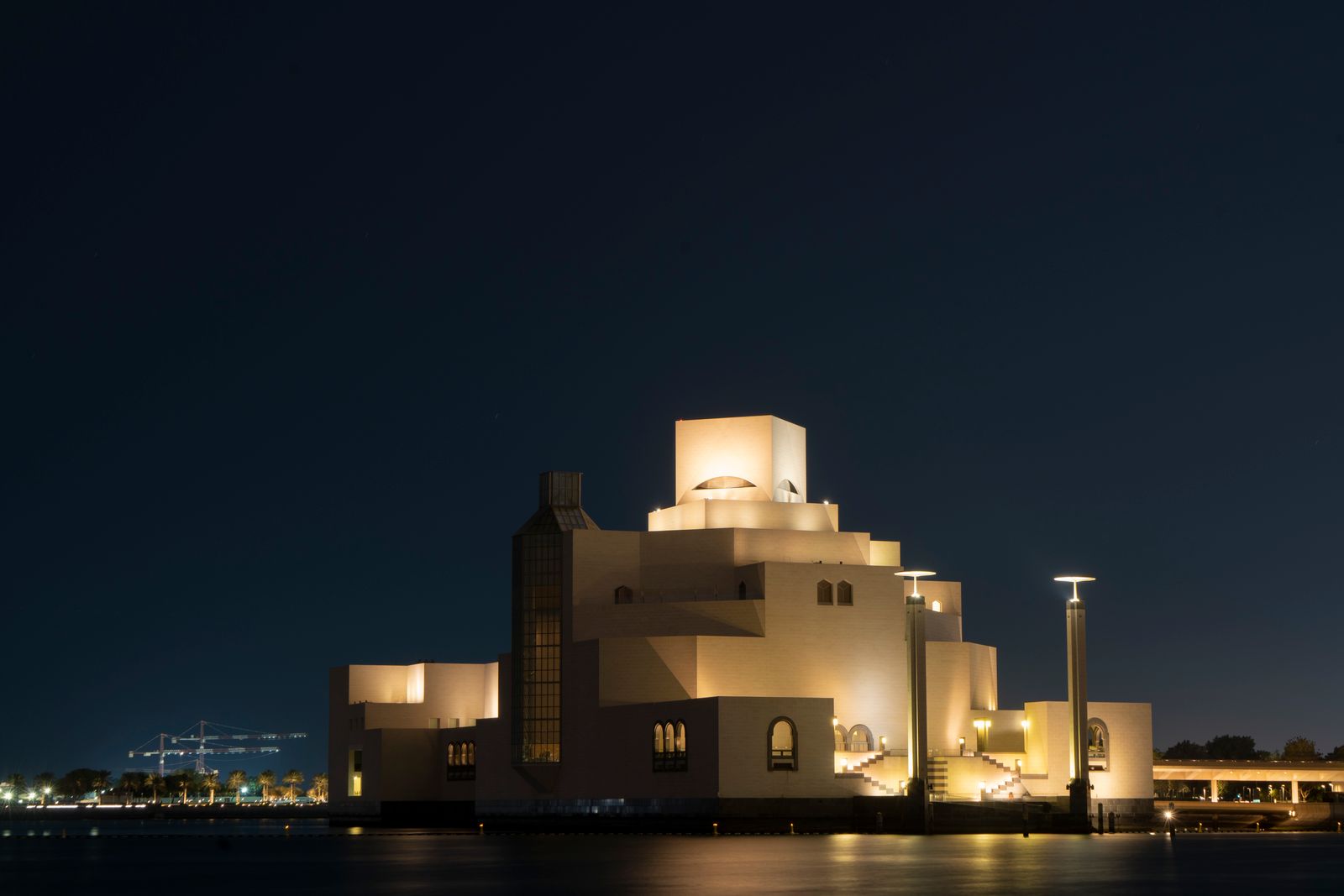
I.M. Pei’s 2008 masterpiece on an artificial island: the world’s most comprehensive collection of Islamic art from the 7th to 19th centuries in a building that references Islamic geometric patterns.
Photo: Chainwit., CC BY-SA 4.0

The most authentic traditional souq in the Gulf: spice traders, falconry equipment stalls, Arabic coffee houses and the restored mud-and-plaster architecture of old Doha.
Photo: Diego Delso, CC BY-SA 3.0

A man-made island of 32km of coastline: the Marina District restaurants and the West Bay glass tower skyline visible from the Corniche promenade.
Photo: Planet Labs, Inc, CC BY-SA 4.0

UNESCO Al Zubarah: an 18th-19th century pearl-fishing and trading town abandoned in the 1930s, with the finest surviving fort in Qatar.
Photo: Davide Mauro, CC BY-SA 4.0

A sea inlet completely surrounded by sand dunes on the Saudi Arabian border: accessible by 4WD, one of the most dramatic desert-meets-sea landscapes in Arabia.
Photo: HH58, CC BY-SA 4.0

Jean Nouvel’s desert-rose-shaped museum (2019): interlocking disc forms inspired by a gypsum sand rose crystal, housing Qatar’s story from ancient to present.
Photo: Amrit Sufi, CC BY 3.0

A cultural hub on the beach: galleries, a 5,000-seat amphitheatre, a mosque with a striking blue-tiled dome and the most accessible beach in central Doha.
Photo: km2bp @ Mapillary.com, CC BY-SA 4.0

Qatar’s only significant mangrove area: pink flamingos and wading birds at the Al Thakira mangroves, best explored by kayak at dawn.
Photo: Antony satheesh, CC BY-SA 4.0
Saffron rice with dried lime (loomi), cardamom and slow-braised lamb, chicken or shrimp: the national dish of Qatar, layered with aromatics.
Wheat and lamb slow-cooked to a smooth porridge: the traditional Gulf Ramadan dish, eaten at iftar.
Deep-fried dough balls drizzled with honey and sesame seeds: the Gulf’s most universal sweet snack, sold from street carts.
A whole slow-roasted lamb over fragrant saffron rice with nuts and spices: the ceremonial feast food of Qatar.
Lightly roasted cardamom coffee in small handleless cups from a long-spouted dallah pot: the universal symbol of Qatari hospitality.
Sweet vermicelli noodles with cardamom, rose water and saffron, topped with a fried egg: the distinctive Qatari breakfast, sweet and savoury together.
Medjool and Khalas dates presented with every coffee: the Gulf welcome ritual.
Alcohol available only in licensed hotels. The mocktail and fresh juice culture is excellent.
Hamad International (DOH) is one of the world’s finest airports and Qatar Airways’ hub — connecting 160+ destinations with premium service. Transit through DOH is pleasant, with free hotel stays for longer layovers. For trip planning, see the official Qatar tourism portal.
Qatar Airways operates from 30+ European cities to Doha with some of the finest aircraft (A380, 787, A350) and cabins in commercial aviation. Business class on the Qsuite is the most awarded in the industry.
Qatar Airways’ network makes DOH the most useful single hub for round-the-world travel — a free stopover program (up to 96 hours) turns a Doha transit into a 4-day Qatar visit at no extra airfare cost.
The Doha Metro (Gold and Red Lines) covers all major tourist areas from the airport — modern, air-conditioned, QAR 3 per trip. The airport station is directly connected to the terminal building.
Qatar is small enough to drive from north to south in 2 hours — car hire is the best option for Al Zubarah and the Inland Sea. Roads are excellent and signposted in English.
November to March is the only comfortable window — temperatures 18–25°C, the desert accessible, the new museums and waterfront at their most pleasant. April and October are transitional. May to September is extremely hot (38–45°C) and outdoors activities are largely impossible.
📅 Qatar is in its best season in January, February, March, April, November, December. See where else is good to go in those months, or browse where to go by month.
Qatar is expensive — among the priciest Middle Eastern destinations for accommodation, with alcohol available only in licensed hotel bars at significant premium. Food and transport are more affordable than expected.
Almost all major museums in Qatar are free — the MIA, the National Museum, the Islamic Art Museum — funded by Qatar Museums, the state cultural authority.
Machboos — spiced rice with slow-cooked meat (chicken, lamb or fish), flavoured with loomi (dried lime), cardamom, saffron and rose water — is Qatar’s national dish and the default answer to “what should I eat.
The St. Regis Doha and the Four Seasons Doha are the finest hotels — from QAR 1,500–3,000/night, with the Four Seasons having the most celebrated restaurant scene and the most accessible beach on Doha Bay.
Doha for three days, the inland sea and desert for one, the Al Zubarah fort for one, Katara Cultural Village and a pearl diving trip for two. Qatar is compact enough to be covered in three days but rewards a longer stay.
The Museum of Islamic Art (I.M. Pei’s last major building, 2008, on an artificial island in Doha Bay) holds the finest collection of Islamic art in the world — 14 centuries, three continents, 13,000 objects. The Doha Corniche (7km waterfront promenade with the Manhattan-like West Bay skyline behind) at sunset.
The MIA’s collection includes pages from the world’s oldest Quran (9th century, written on parchment), 14th-century Cairo bronze doors, and a collection of Islamic manuscripts rivalled only by Istanbul. The I.M. Pei building itself — pure white Mughal-Byzantine geometry — is one of the finest museums architecturally built this century.
Souq Waqif (the “standing market” — restored 19th-century trading quarter, mud-plastered facades, spice sellers, falconry equipment, Arabic coffee shops with shisha) is the most atmospheric traditional space in Qatar. The National Museum of Qatar (Jean Nouvel, 2019, shaped like interlocking desert rose crystals) for the comprehensive history of Qatar from pearls to petroleum.
The National Museum of Qatar building consists of 539 interlocking discs of steel and glass forming the shape of a desert rose (the gypsum crystal formation found in Qatar’s desert) — a 52,000m² structure covering 430,000 square feet. Jean Nouvel described it as “a building that is part of the landscape.”
1h30 north of Doha. Al Zubarah (UNESCO World Heritage Site) — the ruins of an 18th-century pearling and trading town abandoned in the 1900s, the most complete pre-oil Qatari settlement surviving — with the restored Al Zubarah Fort above it. The drive north through the flat Qatar peninsula past camel farms.
Al Zubarah was Qatar’s wealthiest city in the late 18th century, a major pearling and trading centre with a population of thousands. It was destroyed by a Bahraini attack in 1811 and never recovered. The ruins cover 60 hectares and include streets, mosques, houses and the harbour basin.
1h30 south of Doha. Khor Al Adaid (the Inland Sea) is a UNESCO-recognised natural reserve — a body of sea water surrounded entirely by sand dunes (the only such formation in the world), reached by a challenging desert drive through dunes up to 40m high. Dune bashing, sandboarding, and the spectacle of sea water ringed by desert.
Khor Al Adaid is accessible only by 4WD — the final 30km involves driving on loose sand dunes without roads. Tour operators in Doha operate half-day trips (QAR 150–300pp) with experienced drivers. The sight of open sea water surrounded entirely by sand dunes is improbable.
The Pearl Qatar (an artificial island covering 4km², modelled on the Mediterranean, 12 distinct districts, 12,000 apartments — built where pearl diving was once practised) for the marina restaurants and the juxtaposition of old and new Qatar. Lusail City (built from scratch for the 2022 FIFA World Cup, 200,000 residents planned).
Qatar was awarded the 2022 FIFA World Cup in 2010 in a decision later mired in controversy. The 8 stadiums built for the tournament cost an estimated US$6.8 billion — including the Al Bayt Stadium (shaped like a traditional Bedouin tent) and the Lusail Stadium where the final was held.
Katara Cultural Village (a purpose-built cultural district with an amphitheatre, mosques, galleries, the only traditional Qatari dhow harbour still active in Doha) for a pearl-diving simulation dhow trip — Qatar’s traditional economy before oil, entirely abandoned by the 1950s.
Qatar’s pearl diving economy employed 80% of the male population until the 1920s, when Japanese cultured pearls collapsed the market. The entire economic and social structure — captains (nakhoda), divers, ropesmen, singers — ceased within a decade. Oil was discovered in 1939.
Early morning desert drive to catch the light on the sand dunes before the day’s heat arrives. Hamad International Airport (DOH) for connections — one of the finest transit airports in the world, with free sleeping pods and a full-size tropical garden inside. Qatar Airways serves 160+ destinations from DOH.
Hamad International Airport was rated the world’s best airport by Skytrax in 2021, 2022 and 2024. The indoor tropical garden (Orchard) in the transit area contains 300 trees and 25,000 plants, covering an area the size of three football pitches.
Both apps are reliable. The Doha Metro connects airport, downtown and the Pearl.
A souq meal: QAR 40-80 (EUR 10-20). Hotel: EUR 100-350.
Consumption outside licensed venues is illegal.
Covered shoulders and knees in malls, souqs and public areas.
Coffee, dates and incense: being offered these is a sincere welcome.
Available at Hamad International Airport.
Metro to the Museum of Islamic Art, City Center, the Pearl and the airport.
Lusail, Al Bayt and Al Janoub stadiums now offer tours and events.
Quick answers to the questions people most often ask before visiting Qatar.
November to March is the only comfortable window — temperatures 18–25°C, the desert accessible, the new museums and waterfront at their most pleasant. April and October are transitional.
Hamad International (DOH) is one of the world's finest airports and Qatar Airways' hub — connecting 160+ destinations with premium service. Transit through DOH is pleasant, with free hotel stays for longer layovers.
Expect roughly QAR 200–350 a day on a budget and QAR 600–1,000 mid-range, or QAR 2,500+ for a more luxurious trip, per person and excluding flights.
Qatar uses the QAR.
In September 2026 the US raised its advice to “reconsider travel” for this region because of tensions involving Iran. Flights and tourism are operating normally, but airspace closures and cancellations can happen at short notice, so keep plans flexible and travel insurance in place. Always check current official travel advice before booking.
The dominant ride-hailing app in Doha — metered taxis are also good but Uber is more transparent.
FreeAlternative ride-hailing in Doha — often has more drivers available than Uber in Qatar.
FreeBook Museum of Islamic Art tours, desert safari drives, dhow cruises and Qatari cultural experiences.
FreeQatar’s dominant food delivery app — covers restaurants across Doha with fast delivery.
FreeDoha’s official metro app — plan journeys, check fares and access the Gold, Red and Green lines.
FreeQatar’s primary messaging platform — contact hotels, tour operators and local services.
FreeSkyline-and-souq Doha, futuristic Lusail, old-town Al Wakrah, mangrove-lined Al Khor and the desert Inland Sea of Khor Al Adaid — five faces of Qatar.
Qatar sits within easy reach of several other destinations — each with a completely different character.


