DJ
Djibouti
Salt lake lowest in Africa, whale sharks & alien volcanic moonscape
Salt lake lowest in Africa, whale sharks & alien volcanic moonscape
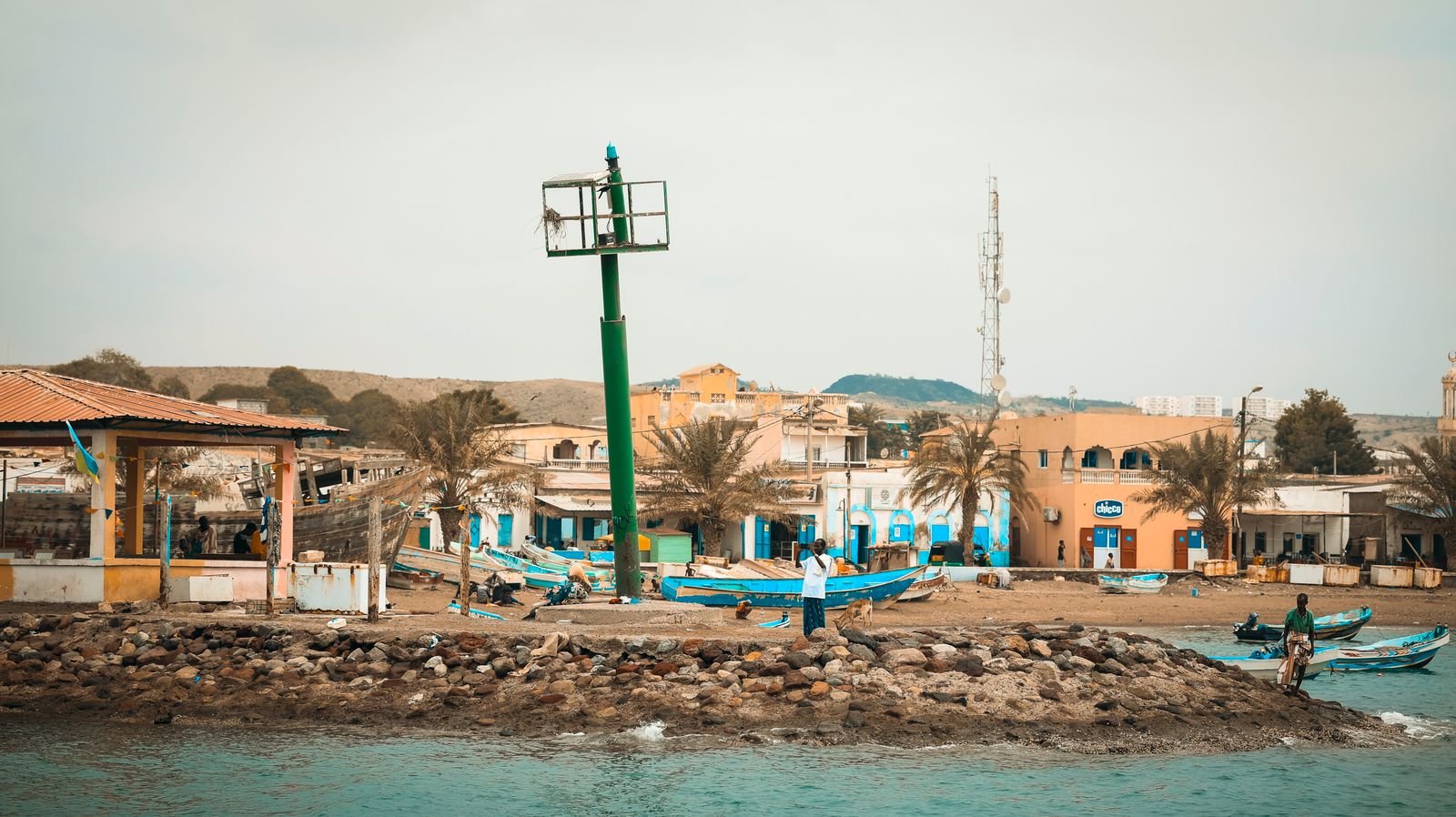
Djibouti is a tiny republic at the mouth of the Red Sea — a volcanic moonscape of salt lakes, basalt deserts and one of the world’s most biodiverse marine environments compressed into a country the size of Wales. Lake Assal, a hypersaline crater lake at 155 metres below sea level (the lowest point in Africa and the saltiest body of water outside Antarctica), has a shoreline of blinding white salt crystals that mirrors a sky of improbable blue. The Gulf of Tadjoura and the waters around the Moucha Islands offer some of the best diving in the western Indian Ocean, with whale sharks congregating in enormous numbers from November to January — some of the most reliable whale shark encounters on earth. Despite its strategic military importance (Djibouti hosts bases for France, the USA, Japan and China simultaneously), it remains a rewarding and surprising destination.
Africa’s lowest point (155m below sea level) and the third-saltiest body of water on earth — a crater lake in an extinct volcanic caldera where the shoreline is encrusted with white salt crystals and the water is a luminous turquoise-blue. Swimming here makes you virtually unsinkable; the surrounding landscape of black volcanic rock and white salt flat is completely alien and extraordinary.
The Bay of Ghoubbet and the waters around Arta Beach host one of the world’s most reliable whale shark aggregations from November to January, when upwelling nutrients draw dozens of the world’s largest fish to the surface. Snorkelling alongside 12-metre whale sharks in warm, clear water is one of the world’s great wildlife experiences.
The most surreal landscape in East Africa — a soda lake on the Ethiopian border surrounded by limestone chimneys (some 50 metres tall) venting steam from underground springs, with flocks of flamingos in the shallows. The scene is so otherworldly it was used as the set for Planet of the Apes (1968). Afar nomads and their camel caravans still cross the lake shore.
A cool, juniper-covered mountain forest at 1,500 metres in the Goda Massif — a complete contrast to the surrounding desert and home to an endemic subspecies of francolin and one of Africa’s rarest wild olive forests, the last remnant of what was once a much larger forest cover.
Djibouti (Wikipedia) →Rice cooked with lamb or goat, tomato and spices such as cumin and cardamom — considered the national dish.
A spongy sourdough pancake similar to Ethiopian injera but sweeter, eaten for breakfast with honey, ghee or tea — sold at every market in Djibouti City.
A spiced broth of lamb or goat, eaten with bread. French baguettes and cafes are a colonial legacy in Djibouti City.
Fresh fish split open, spiced and baked in a clay oven — best at the simple fish restaurants in Djibouti City.
Djibouti-Ambouli International (JIB) is a well-connected regional hub. Ethiopian Airlines, Turkish Airlines, Air France and Flydubai serve the main routes.
Turkish Airlines (5h30 from Istanbul) and Air France (9h30 direct from Paris, twice weekly) are the main European gateways. Istanbul is the most convenient hub for most Europeans.
Addis Ababa (1h30 with Ethiopian Airlines, multiple daily) is the most connected regional hub. Dubai (3h) is the most convenient for Gulf and South Asian travellers.
Most attractions require a private vehicle or tour. The government ferry to Tadjoura (1h30) is the most atmospheric crossing in Djibouti. Lake Assal and Lake Abbé both require a 4WD; Lake Abbé requires a guide.
Most visitors hire a local guide and 4WD for the key natural sites (Lake Assal, Lake Abbé, Day Forest — US$80–150/day all-inclusive). The whale shark season (November–February) is the principal reason most independent travellers visit Djibouti.
October to April is the only viable window — bearable temperatures (25–32°C), the whale sharks present November–February, the Lake Assal accessible. May to September is extreme (38–45°C with high humidity — Djibouti City regularly records the highest average temperature of any capital city on earth).
📅 Djibouti is in its best season in January, February, March, April, October, November, December. See where else is good to go in those months, or browse where to go by month.
Djibouti uses the Djiboutian Franc (DJF, approx 177 DJF = 1 USD). It is expensive for Africa — a high cost of living driven by military presence and import dependency.
Canjeero (a thin, spongy fermented flatbread — the Somali version of injera, made from sorghum or teff flour fermented overnight, cooked on a flat pan — eaten at every meal in Djibouti, used to scoop stew, maraq broth and ful)
Djibouti’s lobster (freshly caught from the Gulf of Tadjoura — available at seafood restaurants near the port for US$25–60 grilled with spiced butter, the finest seafood in the Horn of Africa and far cheaper than)
The Kempinski Palace Djibouti (the finest hotel in the country, on the seafront overlooking the Gulf of Tadjoura, with a rooftop infinity pool)
Djibouti City for one day, Lake Assal for one, whale shark snorkel for one, Day Forest for one, Lake Abbé for one, Gulf diving for one, Arta Beach for one. Djibouti — a tiny country at the mouth of the Red Sea — has the world’s most accessible whale shark aggregation, the lowest point in Africa and the most geologically active landscape on earth.
Djibouti City — the capital and only city of Djibouti (a tiny country of 23,000km² at the mouth of the Red Sea, population 1 million, 90% urban — the most strategically important port location in Africa, commanding the Bab-el-Mandeb strait through which 20% of all global trade passes) with the Central Market (the finest frankincense, qat and spice market in the Horn of Africa) and the French Quarter (the colonial legacy of French Somaliland — administered by France 1896–1977).
Djibouti hosts the largest concentration of foreign military bases of any country in the world — France (the former colonial power, with 1,500 troops), the USA (Camp Lemonnier — the largest US military base in Africa, with 4,000 troops), China (the People’s Liberation Army’s only overseas base, established 2017), Japan, Italy and Germany all maintain military presences. This is a direct result of Djibouti’s position commanding the Bab-el-Mandeb strait — the narrow passage through which oil tankers, container ships and naval vessels transit between the Red Sea and the Indian Ocean.
Lake Assal (155m below sea level — the lowest point in Africa and the third-lowest on earth after the Dead Sea and Lake Tiberias, a salt lake in the Afar Triangle with 10x the salinity of the ocean — the salt crystallises on the shoreline in white formations and the water is a blue-green against the barren black lava fields of the Afar volcano zone, the most otherworldly landscape in the Horn of Africa).
Lake Assal (155m below sea level, 10x saltier than the ocean — salt concentration of 34.8%) is the saltiest body of water in the world accessible to visitors, and the lowest point in Africa. The lake is fed entirely by underground seepage from the Gulf of Tadjoura; the water evaporates in the extreme heat, concentrating the salt. The surrounding landscape of black basalt lava from recent eruptions is the visible surface of the Afar Triple Junction — where three tectonic plates are pulling apart simultaneously, the place where a new ocean is forming.
The Whale Shark snorkelling of the Gulf of Tadjoura (November to February — the highest density of whale sharks in any enclosed sea in the world, feeding on fish spawn in the shallower western end of the gulf, approached by boat in groups of 3–5 swimmers at a time — interactions of 30–90 minutes with whale sharks 6–12m long in 5–20m of clear water) — the finest whale shark encounter accessible to snorkellers anywhere on earth.
The Gulf of Tadjoura whale shark aggregation (November–February) is the largest and most accessible whale shark gathering in the Indian Ocean region — the combination of deep cold upwelling water from the Red Sea meeting the warm shallow gulf creates conditions ideal for fish spawning, which attracts whale sharks in numbers exceeding 50 individuals in a small area. The interaction is conducted by snorkelling (not scuba) to minimise disturbance.
Day Forest National Park (the last remnant of the ancient juniper forest that once covered the Goda Mountains — a highland green oasis at 1,000m above the desert, dramatically cooler than the coast, with the Djibouti spurfowl (Pternistis ochropectus — one of the world’s rarest birds, with fewer than 3,500 individuals, endemic to this single forest) and the wild olive trees) and the Goda Mountains plateau.
The Djibouti spurfowl (Pternistis ochropectus) is one of the rarest birds in the world — fewer than 3,500 individuals survive, all in the Day Forest. The species was only described scientifically in 1952 and has never been kept in captivity. The Day Forest (originally 15,000 hectares, reduced to approximately 400 hectares by charcoal cutting and overgrazing) is the only habitat; the species will become extinct if the forest is destroyed.
Lake Abbé (a large salt lake on the Ethiopian border at 240m altitude — surrounded by a field of limestone chimneys up to 50m high, formed by hot spring venting through the lake bed, with steam rising from the vents at dawn — the location used as the alien landscape in the original Planet of the Apes (1968) — flamingo colonies on the lake shore and hot springs accessible by foot at low tide).
Lake Abbé’s limestone chimneys (formed by hot spring venting through the saline lake bottom, depositing calcium carbonate in conical structures up to 50m high, still actively steaming) provided the landscape for the final scenes of the original Planet of the Apes (1968) — director Franklin J. Schaffner chose it for its alien character. The lake and chimneys look like no other landscape on earth; the combination of steam, pink flamingos and the lunar basalt shore is excellent.
The Gulf of Tadjoura (an 80km-long arm of the Indian Ocean opening into the Red Sea, with walls dropping to 200m and resident populations of spinner dolphins, bottlenose dolphins and hammerhead sharks — the finest diving in the Horn of Africa, with excellent visibility (30m+) and the coral gardens of the Maskali Islands Marine Reserve) and the town of Tadjoura (the oldest town in Djibouti, with 11th-century mosques and the finest traditional architecture in the country).
Tadjoura (the oldest continuously inhabited settlement in Djibouti, with mosques dating from the 11th century and a history as the main terminus of the slave trade routes from the Ethiopian interior to the Arabian Peninsula) is the most historically significant town in Djibouti outside the capital. Its architecture — whitewashed coral-stone buildings with carved wooden screens — is closer to Zanzibar or Lamu than to any other Horn of Africa town.
Arta Beach (the finest beach in Djibouti, 45km from the capital on the Gulf of Tadjoura — a sheltered bay of white sand with calm, warm water, the offshore reef accessible by snorkel, and the Arta Marine Reserve protecting the coral garden) and a final plate of lamb maraq (the slow-cooked spiced broth that is the national dish of Djibouti — lamb on the bone simmered with Somali spices, cardamom, coriander and dried lemon, served in a communal clay pot with flatbread). Fly from Djibouti (JIB).
Maraq (a Somali and Djiboutian slow-cooked spiced broth with lamb or goat — the lamb simmered for 3–4 hours in a clay pot with coriander, cumin, cardamom, black pepper and dried limes until the meat falls from the bone, the broth enriched with the marrow — served in a communal pot with canjeero (injera-like flatbread) for dipping) is the national dish of Djibouti and the most celebrated food of the Horn of Africa coast.
E-visa available online before departure for most nationalities. Visa on arrival also possible at the airport.
Connections to Addis Ababa, Dubai, Nairobi and Paris. Ethiopian Airlines, Air France and Flydubai all serve Djibouti.
June-September temperatures exceed 40°C. October-April is comfortable at 25-35°C and is the main tourism season.
1 USD = approximately 177 DJF. USD is accepted in tourist businesses. Cash is essential outside Djibouti City.
Lac Assal (155m below sea level) is the lowest point in Africa and one of the world’s saltiest bodies of water. Its turquoise surface with white salt shore is photogenic.
Summer (Jun–Sep) temperatures reach 45°C in the interior. Visit Oct–Apr for tolerable temperatures; whale sharks are best Nov–Jan.
4WD essential for Lake Abbe and Day Forest; Djibouti City taxis for urban transport. Hire a driver for multi-day desert circuits.
Quick answers to the questions people most often ask before visiting Djibouti.
Fly into Djibouti–Ambouli International Airport (JIB). It's about 1h30 from Addis Ababa and about 3 hours from Dubai, with flights from Istanbul and Paris too.
Yes — most nationalities can apply for an e-visa online before travel. Check the current process for your passport.
Roughly November to February, when whale sharks gather in the Gulf of Tadjoura. This coincides with the cooler season, which is also the best time to visit overall.
October to April, when temperatures are around 25–32°C. From May to September the heat is extreme, often above 40°C with high humidity.
Lac Assal lies about 155 m below sea level — the lowest point in Africa — and is one of the saltiest bodies of water in the world, ringed by dazzling salt flats.
Reasonable in Djibouti City; offline maps essential for desert and lake circuits.
FreeMarine species identification for whale shark and reef encounters.
FreePoint your camera at menus, signs or street text for instant translation. Download the language pack offline before you arrive for full use without data.
FreeReal-time and offline exchange rates for all world currencies — converts prices instantly so you always know what you are paying in your home currency.
FreeFind and book hotels, guesthouses and apartments with free cancellation on most rates — one of the widest selections of accommodation worldwide.
FreeBrowse millions of traveller reviews for restaurants, attractions and hotels — helps identify the best local spots and avoid tourist traps.
FreeDjibouti sits within easy reach of several other destinations — each with a completely different character.
Djibouti is one of the world’s least-visited places. See all 90 in our guide to the world’s least-visited countries & territories.
