ER
Eritrea
Africa's Art Deco capital, Red Sea reefs & ancient Aksumite ruins
Africa's Art Deco capital, Red Sea reefs & ancient Aksumite ruins
Eritrea is one of the world’s most isolated and least-visited countries — a small Red Sea nation that achieved independence from Ethiopia in 1993 after a 30-year liberation struggle and has since followed its own path, largely cut off from global tourism. For those who make the effort, Eritrea offers experiences of startling rarity: Asmara, the capital, is a perfectly preserved Art Deco and futurist city built by Italian colonists in the 1930s, now a UNESCO World Heritage Site — a museum of Modernist architecture frozen in time, its cinemas, filling stations and ministry buildings unchanged for 80 years. The Dahlak Archipelago in the Red Sea has virtually undived coral reefs of great richness. The ancient port city of Massawa is a layered Ottoman, Egyptian and Italian ruin of haunting beauty.
Eritrea’s highland plateau, ancient Aksumite ruins and welcoming people make it one of Africa’s most memorable destinations for travellers willing to navigate the logistical challenges of visiting a country that has deliberately limited outside access.
A UNESCO World Heritage Site of architectural significance — the entire city centre of Asmara was built by Italian architects in the 1930s as a showcase of Fascist-era Modernism, Futurism, Art Deco and Rationalism. The Fiat Tagliero Building (a 1930s filling station shaped like a concrete aeroplane, with no supporting pillars under its 30-metre wings), the Cinema Impero, the Bar Zilli and the Opera House are impressive. The highland climate (2,325 metres) makes Asmara pleasantly cool year-round and the city’s tree-lined boulevards have an almost surreal calm.
The ancient Red Sea port, built partly on two coral islands connected by Ottoman causeways, layers 3,000 years of history — Aksumite trading port, Arab dhow harbour, Ottoman administrative centre and Egyptian-era palace, Italian-colonial port and WWII battle site. The Ottoman coral-block buildings of the old town, their wooden mashrabiya screens still intact, and the ruined Banco d’Italia destroyed in the liberation war create a hauntingly beautiful urban landscape. The beach resorts near Massawa offer good Red Sea swimming.
Over 200 coral and sand islands scattered across the southern Red Sea, the Dahlak Archipelago has some of the least disturbed and least-visited reefs in the world. The Red Sea’s marine biodiversity — dugongs, sea turtles, Napoleon wrasse, hammerhead sharks, mantas — is concentrated here in a marine ecosystem that has had almost no recreational diving pressure. Live-aboard boats from Massawa are the primary access.
Ancient Aksumite and pre-Aksumite ruins scattered across the Eritrean highland plateau date back 2,000 years and more. Qohaito — a vast, largely unexcavated ancient city — has a dam, temple and stele field in a remote grassland setting. Matara has an ancient city with standing monoliths. The highlands contain evidence of one of the ancient world’s most important civilisations.
The Italian-built rack railway descending from Asmara at 2,325 metres to Massawa at sea level in 118 kilometres is one of the world’s great engineering feats — a narrow-gauge line of 30 tunnels, 65 bridges and mountain scenery, restored and operated by Eritrean railway workers. Occasional tourist excursions run sections of the line on original Italian locomotives.
Spongy fermented flatbread (often made from teff) that serves as both plate and utensil.
The ceremonial chicken stew of Eritrea — a whole chicken cooked in rich berbere sauce with onions, niter kibbeh (spiced butter) and a hard-boiled egg, served on injera for honoured guests and at holidays.
Slow-cooked beef or goat in a deep, complex tomato and berbere chilli sauce — one of the richest stews in the Eritrean kitchen, served on communal injera at family meals and celebrations.
A smooth, spiced chickpea stew eaten with injera — the everyday staple.
Baked pasta from the Italian colonial era — Italian dishes remain common in Asmara’s restaurants.
Asmara’s cafes, many in 1930s Italian buildings, serve good, cheap espresso and macchiato.
Italian-style ice cream and pastries are another colonial legacy in Asmara’s cafes.
A home-brewed sorghum or barley beer. In Massawa, grilled Red Sea fish is the local speciality.
Asmara International Airport (ASM) has limited but improving connections. Ethiopian Airlines, flydubai, Qatar Airways and Turkish Airlines serve the main routes. A visa is required and can be issued on arrival for some nationalities.
Turkish Airlines (5h from Istanbul) is the most convenient European connection. The large Eritrean diaspora in Rome and northern Italy sustains charter flights; Italian connections are worth checking.
Addis Ababa (1h, Ethiopian Airlines — despite the Ethiopia-Eritrea political history, this is the most frequent connection) and Dubai (3h30) are the most practical regional gateways.
Travel permits (required for areas outside Asmara — obtained at the Ministry of Tourism in Asmara in 1–2 days, US$10–30) are a bureaucratic necessity but usually straightforward. Arrange before arrival if possible through an Eritrea-specialist tour operator.
Independent travel in Eritrea is possible but requires careful advance planning, travel permits and patience with bureaucracy. An Eritrea-specialist tour operator (arranging the visa, permits and guide from outside the country) is the most efficient approach for first-time visitors.
November to March is the best window — pleasantly warm on the coast (24–28°C), cool in the highlands of Asmara (15–22°C). April and May get hot before the highland rains. June to September: coastal areas reach 40–45°C (Massawa is one of the hottest inhabited cities on earth); the highlands remain liveable.
📅 Eritrea is in its best season in January, February, March, October, November, December. See where else is good to go in those months, or browse where to go by month.
Eritrea uses the Nakfa (ERN, approx 15 ERN = 1 USD — but foreign exchange is complex; US dollars and euros are preferred). One of the most affordable but logistically complex destinations in Africa.
Asmara’s coffee culture (the Italian macchiato and espresso tradition, grafted onto the pre-existing Ethiopian and Eritrean coffee ceremony tradition, producing coffee shops that serve Italian coffee drinks with East African ceremony)
Asmara’s Italian-fusion cuisine (pasta, pizza, panini and espresso served in Art Deco café)
The Asmara–Massawa railway (a narrow-gauge line built by the Italians 1887–1911, climbing from sea level to 2,325m in 118km with 30 bridges and 39 tunnels — one of the engineering wonders of Africa, decommissioned but)
Asmara for two days, Massawa for one, Dahlak Archipelago for one, Keren for one, Qohaito for one, Senafe for one. Eritrea — Africa’s most isolated country — has the world’s finest collection of Italian Modernist architecture, the least-dived reefs in the Red Sea and the most complete Aksumite ruins outside Ethiopia.
Asmara — the capital of Eritrea (a small country of 118,000km² on the Red Sea coast, population 3.5 million, independent from Ethiopia since 1993 after one of the longest independence wars in African history — 30 years, 1961–1991) — with the Asmara UNESCO World Heritage Site (the finest collection of Italian Futurist, Art Deco, Rationalist and Modernist architecture in the world outside Italy — built by Italian colonial architects 1935–1941 on a highland plateau at 2,325m).
Asmara (listed as a UNESCO World Heritage Site in 2017 as “A Modernist City of Africa”) has the largest intact collection of Italian Modernist and Art Deco architecture in the world — approximately 400 buildings from the period 1935–1941 when Mussolini’s colonial architects used Eritrea as a laboratory for Futurist and Rationalist architecture. The Fiat Tagliero Building (1938, a Futurist petrol station with 30m reinforced concrete cantilevered wings, no vertical supports — the architect reportedly held a gun to the builder’s head to force him to remove the temporary supports) is the most celebrated Modernist building in Africa.
The Asmara Art Deco and Modernist walking tour — the Fiat Tagliero Building (1938, the most audacious Futurist building in Africa — a petrol station shaped like an aircraft, with 30m concrete wing-cantilevers), the Cinema Impero (1937, a white streamlined Rationalist cinema still showing films in its original interior), the Enda Mariam Cathedral (1922, a Lombard Romanesque cathedral), and the Great Mosque of Asmara (a Rationalist mosque with a colonnaded courtyard — the finest example of Italian Islamic-fusion architecture in Africa).
The Italian colonial architecture of Asmara is entirely intact primarily because of Eritrea’s extreme isolation since independence in 1993 — the underdeveloped economy, the political closure of the country under President Isaias Afewerki (in power since 1993 with no elections, no opposition parties and a closed press) and the lack of investment capital have inadvertently preserved the colonial urban fabric. The buildings are intact because Eritrea has been too poor and too isolated to develop.
Massawa (the main port of Eritrea, 100km east of Asmara on the Red Sea coast, 2,325m descent in 100km — one of the most dramatic road descents in Africa — with the Massawa Old Town (UNESCO-proposed): a collection of Ottoman, Egyptian, Italian and coral-stone architecture on two islands connected by causeways, with the coral-block Massawa Palace and the war-damaged Sheikh Hanafi Mosque — the town was heavily shelled during the liberation war).
Massawa’s Old Town (built primarily in the Ottoman and Egyptian periods from the 16th to 19th century using coral stone quarried from the Red Sea reef — the same building technique as Zanzibar’s Stone Town and Lamu’s old town) was heavily damaged in the 1990 Battle of Massawa, when Eritrean liberation forces captured the city from Ethiopian control after a 48-hour battle. The bullet-holed ruins of the Imperial Palace and the Ethiopian tanks still parked as monuments in the town square are the most visceral reminders of the 30-year war.
The Dahlak Archipelago (209 islands and atolls in the Red Sea off Massawa, the largest archipelago in the Red Sea — almost entirely uninhabited, with some of the least-dived coral reefs in the world, extraordinary Red Sea biodiversity (mantas, whale sharks, hawksbill turtles, spinner dolphins) in water that has seen minimal fishing pressure since the 1970s — accessible by charter boat from Massawa, 2–4 hours).
The Dahlak Archipelago has one of the least disturbed marine environments in the Red Sea — Eritrea’s isolation and the near-absence of sport fishing boats since the 1970s have allowed coral and fish populations to recover to pre-exploitation levels. The reefs of the inner Dahlak are considered by marine biologists to be among the least disturbed in the Red Sea, comparable to the uninhabited parts of the northern Saudi coast.
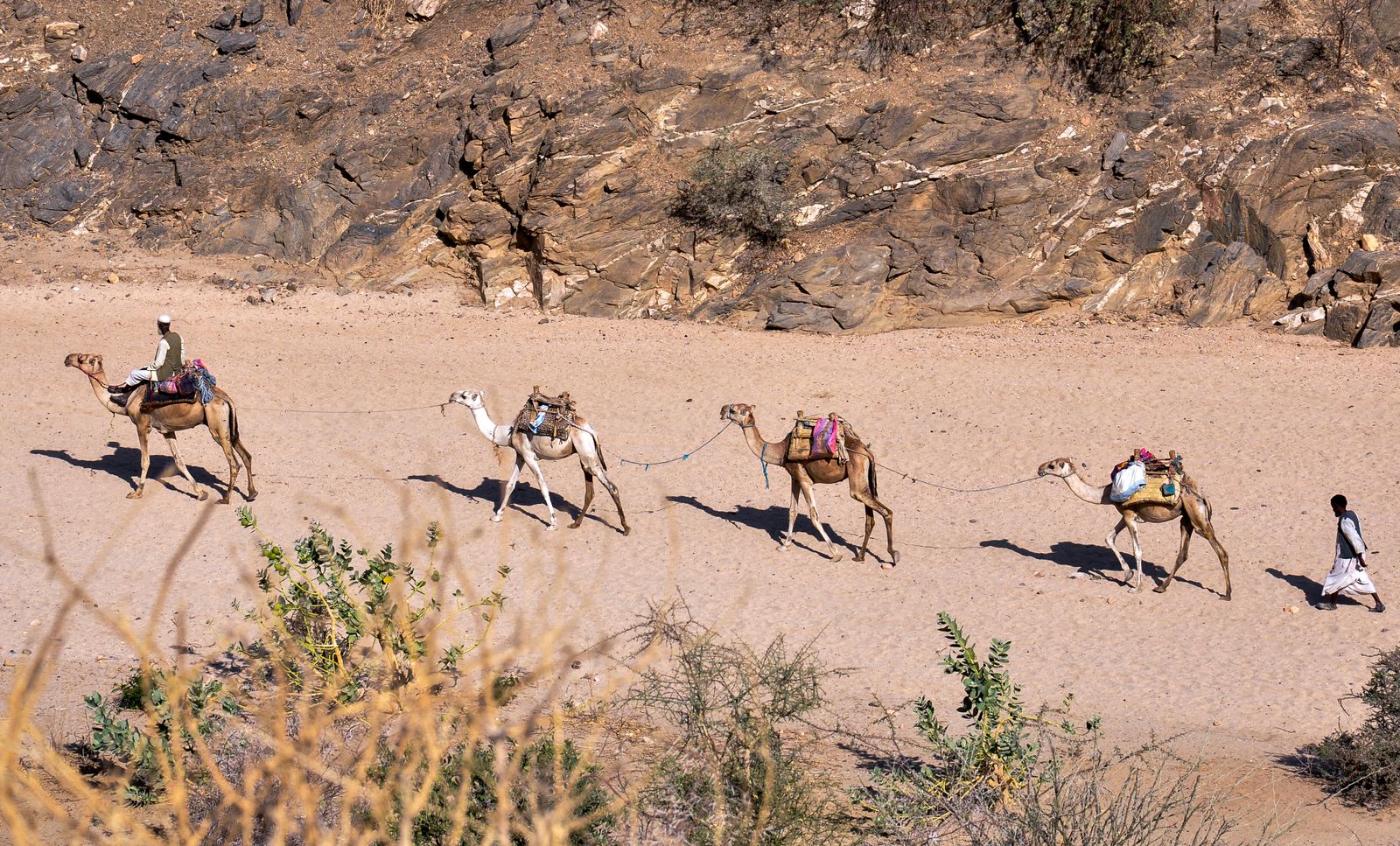
Keren (the second-largest city in Eritrea, 90km northwest of Asmara — the finest market in Eritrea, with the Monday camel market (the largest camel market in the Horn of Africa, where Tigrinya, Bilen, Tigre and Rashaida traders from across the region converge to buy, sell and trade camels, livestock and goods) and the Battle of Keren Memorial (the most important World War II battle cemetery in Africa — both British and Italian soldiers killed in the 1941 battle are buried here).
The Battle of Keren (1941 — a 53-day battle between British-led forces (British, Indian, Free French and Sudanese) and the Italian colonial garrison holding the fortified Keren pass, the key to controlling Eritrea — was the hardest-fought battle of the East African Campaign. 536 British and Commonwealth soldiers were killed; over 3,000 Italians. The battle effectively ended Italian East Africa; both cemeteries are maintained by the Commonwealth War Graves Commission.
Qohaito (a large archaeological site on the eastern escarpment of the Eritrean highlands — the ruins of a substantial ancient city of the Aksumite Empire (1st–7th century AD) including the Temple of Mariam Wakiro, a large dam, a necropolis and the remains of a city of 20,000+ people, with views over the Danakil Depression — and the nearby Saphira Canyon, a 200m-deep gorge accessible by walking).
The Aksumite Empire (c. 100–940 AD, based in northern Ethiopia and Eritrea, at its height one of the four great empires of the ancient world alongside Rome, Parthia and China — according to the 3rd-century Persian prophet Mani) controlled the Red Sea trade routes and minted its own gold, silver and bronze coins. Qohaito and the other highland Eritrean sites (Metera, Matara) are the Eritrean wing of Aksumite civilization, largely unexcavated and rarely visited.
Senafe (a highland town near the Ethiopian border with the ruined Aksumite city of Metera — large stelae, building foundations and inscribed stones of the Aksumite period — and the landscape of the Amba Soira plateau at 3,013m, the highest point in Eritrea) before returning to Asmara for departure. Fly from Asmara (ASM).
The Eritrean independence war (1961–1991 — 30 years, one of the longest guerrilla independence wars in African history, fought by the Eritrean People’s Liberation Front against successive Ethiopian governments, ending with the military defeat of the Ethiopian Derg regime in 1991) cost an estimated 65,000 EPLF fighters and 65,000 civilians. Eritrea became Africa’s newest country on 24 May 1993 after a UN-supervised referendum returned a 99.83% vote for independence.
Visa required for all nationalities — apply in advance at an Eritrean embassy. The process requires patience and time. A travel permit (tourist card) is required in addition to the visa for most regions outside Asmara.
Photography of military installations, government buildings, ports and airports is strictly prohibited and enforced. Ask before photographing people; many Eritreans prefer not to be photographed.
Credit cards are not accepted anywhere in Eritrea. Bring sufficient USD or euros to exchange at official rates. The nakfa is not convertible outside the country.
A government-licensed guide is required for most travel outside Asmara. Your hotel or the tourism office can arrange this. Guides are knowledgeable and the requirement need not limit your experience.
Internet access is extremely limited — a few hotel lobbies and the Asmara Intercontinental. Mobile data does not function for foreign SIM cards. Plan for full digital detox.
Quick answers to the questions people most often ask before visiting Eritrea.
November to March is the best window — pleasantly warm on the coast (24–28°C), cool in the highlands of Asmara (15–22°C). April and May get hot before the highland rains.
Asmara International Airport (ASM) has limited but improving connections. Ethiopian Airlines, flydubai, Qatar Airways and Turkish Airlines serve the main routes. A visa is required and can be issued on arrival for some nationalities.
Expect roughly US$40–80 a day on a budget and US$100–180 mid-range, or US$200+ for a more luxurious trip, per person and excluding flights.
Eritrea uses the Eritrean Nakfa (ERN).
Plug types: Type C / L (230V).
— Download Eritrea offline maps before arriving — the most useful navigation tool given the absence of mobile internet.
Free— Download Tigrinya and Arabic offline translation packs before travelling; they will be invaluable away from Asmara.
Free— For tracking official exchange rates before departure (internet access inside Eritrea is too limited for live use).
FreeDownload offline maps before you travel so navigation works without mobile data — essential for walking, driving and finding local spots.
FreeFind and book hotels, guesthouses and apartments with free cancellation on most rates — one of the widest selections of accommodation worldwide.
FreeBrowse millions of traveller reviews for restaurants, attractions and hotels — helps identify the best local spots and avoid tourist traps.
FreeEritrea sits within easy reach of several other destinations — each with a completely different character.


