SD
Sudan
More pyramids than Egypt — Nubian kingdoms lost in desert solitude
More pyramids than Egypt — Nubian kingdoms lost in desert solitude
Sudan is Africa’s most underestimated archaeological destination — home to more ancient pyramids than Egypt, a succession of Nubian civilisations that ruled their Egyptian neighbours for centuries, and a culture of extraordinary depth and hospitality. The Meroëtic pyramids of Meroe, built by the Kushite kings between 300 BC and 350 AD, number over 200 and rise steeply from the desert sand in a landscape of complete solitude — none of the crowds of Giza, none of the tourist infrastructure, just pure ancient Africa in a timeless setting. The temples of Naga and Musawwarat es-Sufra, the island temples of Naga and the Nubian capital of Kerma predate even the Meroitic period. Sudan is currently emerging from a period of significant political instability; check the latest travel advisories carefully before planning a visit.
Over 200 steep, narrow Nubian pyramids rise from the desert sand of the Butana Plateau, built by the Kushite rulers of the Meroitic Kingdom between 300 BC and 350 AD. Unlike Egypt’s pyramids, Meroe’s are visited by almost no one — you can climb their sandy flanks, peer into open burial chambers and stand beside 2,000-year-old carvings in complete solitude. A UNESCO World Heritage Site of extraordinary atmosphere.
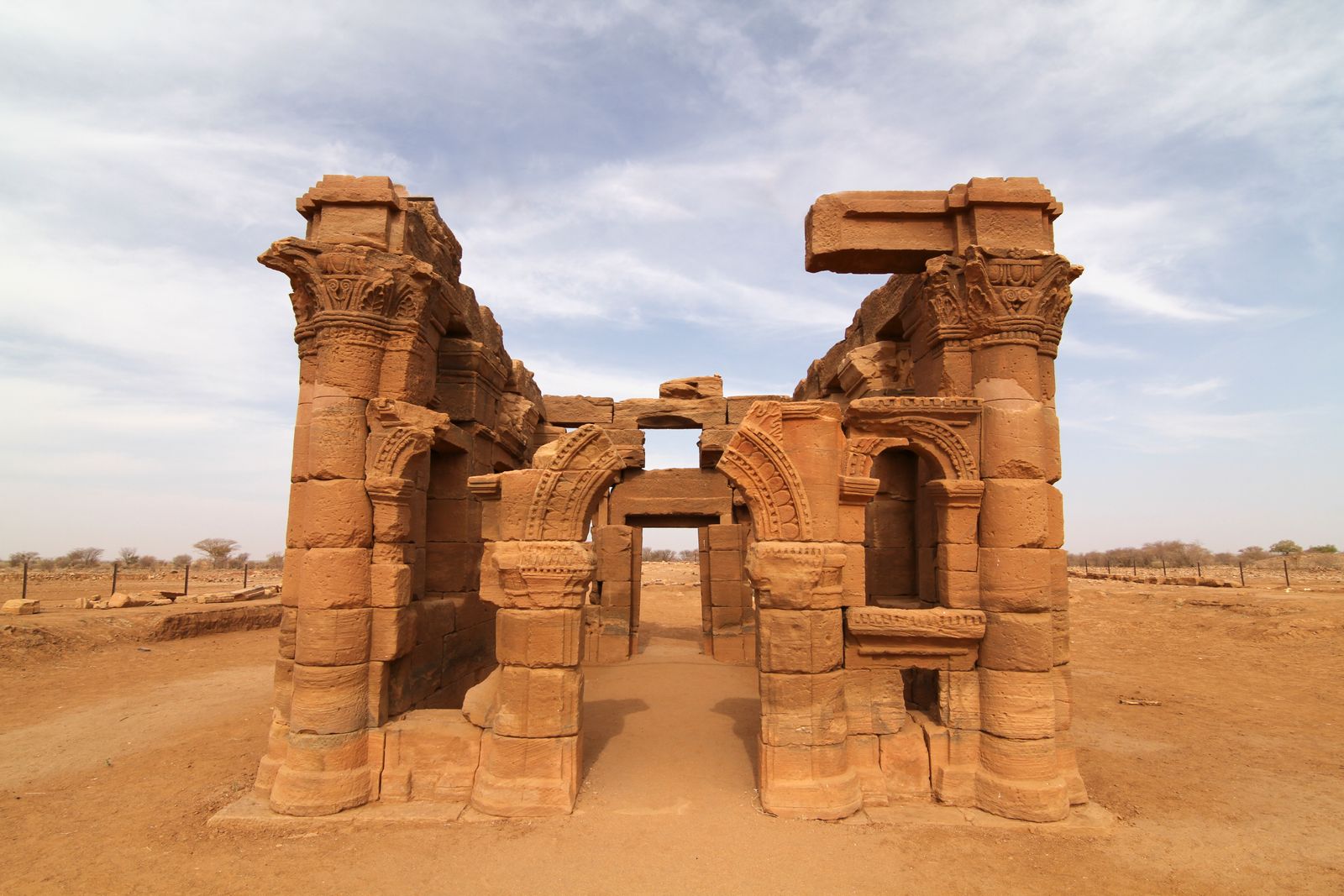
Two ancient Meroitic temple complexes in the desert east of Khartoum. Naga’s Lion Temple (with carvings of the lion-headed war god Apedemak) and Roman kiosk stand in perfect isolation; Musawwarat es-Sufra’s Great Enclosure is a massive sandstone complex decorated with elephant carvings, reflecting Sudan’s role as the ancient world’s supplier of war elephants.
The ancient Nubian kingdom of Kerma, predating Egypt’s New Kingdom, has the massive Deffufa mud-brick temple towers rising from the desert north of Khartoum. The nearby city of Dongola and the Nubian villages along the Nile preserve traditional mud-brick architecture, indigo-dyed textiles and a way of life unchanged for centuries.
slow-cooked fava beans with garlic and cumin, eaten for breakfast throughout northeast Africa) is Sudan’s most universal dish.
Sun-dried and fermented Nile fish ground with peanuts and spices into a pungent dark paste — one of the most distinctive flavours in Sudanese cooking, used to season stews and eaten as a condiment alongside assida and flatbread.
A thick, smooth porridge of sorghum or millet flour — the staple food of Sudan, eaten at every meal by dipping into waika (peanut sauce), mullah (meat stew) or fried onion gravy. The sorghum version has an earthy, slightly smoky depth absent in maize porridges.
okra stew with lamb) are the staples. Sudanese hospitality centres on tea —
Sweet black tea boiled with fresh mint and sometimes ginger, served in small glasses at every tea stall throughout Sudan — the most important social ritual of Sudanese culture. Refusing tea from a host is considered impolite; sharing it is the foundation of hospitality.
thick, spiced coffee in tiny handleless cups) are served to every guest.
iced hibiscus tea, ruby-red and refreshing) is Sudan’s most distinctive non-alcoholic drink.
Khartoum International Airport (KRT) served major routes before 2023. Currently inaccessible due to the civil war. This section is for future reference.
💡 Cairo, Addis Ababa and Istanbul were the most practical gateways pre-2023. All commercial air service to Khartoum has been severely disrupted since the outbreak of fighting in April 2023; check for any resumption when planning future visits.
💡 The Lake Nasser ferry from Aswan, Egypt to Wadi Halfa, Sudan (weekly, 20 hours across the world’s largest artificial lake) was the most atmospheric overland entry point, arriving directly in the heartland of ancient Nubia. This route was used by independent travellers on the Cairo–Cape Town overland route.
💡 Sudan’s main north-south highway (Khartoum to Wadi Halfa, 1,100km) follows the Nile and provides access to most major archaeological sites. A car hire with driver was the most practical option for the Meroe–Naqa–Musawwarat circuit.
💡 When conditions permit, a combination of private car for the main highway and a felucca for the Nile passage between Karima and Kerma gives the finest experience of Sudanese archaeology and landscape.
October to February is the most accessible window — cool, dry conditions in Khartoum (18–28°C) and comfortable for the desert sites. March to May brings extreme heat (40–48°C in the north). June to September is the wet season in the south. Sudan has been in active civil war since April 2023; all governments advise against travel. This content is for future reference.
The Sudanese pound (SDG) is the currency; USD used by NGO/media. Highly affordable when accessible.
Ful medames (stewed fava beans with cumin, garlic and olive oil — the national dish of Sudan and Egypt, the most widely eaten breakfast dish in the Nile Valley for 5,000+ years, available at street stalls throughout Sudan for)
The Meroe archaeological circuit.
A private felucca voyage on the Nile from Karima (Jebel Barkal) north to Kerma &mdash.
Khartoum for one day, Meroe pyramids for one, Naqa and Musawwarat for one, Omdurman dervishes for one, Kerma for one, Jebel Barkal for one, Nubian heritage farewell for one. Sudan — the cradle of Nubian civilisation — has more pyramids than Egypt, the oldest African kingdom at Kerma, the most sacred mountain of the Nile Valley at Jebel Barkal and the only African people who conquered and ruled as Pharaohs of Egypt. Currently in civil war; all governments advise against travel. Content is for future reference.
Khartoum — the capital of Sudan (1.89 million km² — the third-largest country in Africa before the secession of South Sudan in 2011, population 46 million, at the confluence of the Blue and White Nile Rivers — one of the cradles of civilisation, home to the Nubian kingdoms that predated and outlasted the Egyptian pharaohs — currently engulfed in a civil war between the Sudanese Armed Forces (SAF) and the Rapid Support Forces (RSF) that began April 15, 2023, causing massive displacement and humanitarian crisis). All major governments advise against all travel to Sudan.
💡 The Sudan civil war (beginning April 15, 2023 — fighting broke out in Khartoum between the Sudanese Armed Forces and the Rapid Support Forces (the paramilitary successor to the Janjaweed) in a power struggle following the 2019 revolution that removed Omar al-Bashir — has killed tens of thousands of civilians, displaced 7+ million people internally and 1.5+ million to neighbouring countries, and destroyed much of Khartoum’s infrastructure. The RSF have been accused of systematic atrocities in Darfur; the conflict has been described as the world’s worst humanitarian crisis of 2024.
Meroe (UNESCO World Heritage — the capital of the Kingdom of Kush from approximately 300 BCE to 350 CE — with more than 200 pyramids — more pyramids than in the whole of Egypt — the steep-sided Nubian pyramids, smaller and more sharply angled than Egyptian pyramids, built over 700 years as royal tombs for the Kushite rulers — and the remarkable iron-working furnaces of Meroe, the first iron smelting technology in sub-Saharan Africa, a technological revolution that transformed the continent).
💡 The Nubian pyramids of Meroe (200+ royal funerary pyramids built between 300 BCE and 350 CE for the rulers of the Kingdom of Kush — smaller than Egyptian pyramids (typically 6–30m at base) but more numerous, steeper and built with a distinctive Nubian architectural style that combines Egyptian pyramid form with local Kushite construction methods — were largely unknown to the outside world until James Bruce visited in 1772. They represent the longest-lived pyramid-building tradition in human history: 700 years compared to Egypt’s 800 years, and built 1,500 years after the last Egyptian pyramid.
Naqa (the ancient Kushite city with the Temple of Amon and the Lion Temple of Apedemak — the finest surviving Meroitic architectural ensemble, with the Lion Temple’s extraordinary relief carvings of the three-headed, four-armed lion god Apedemak in a style that blends Egyptian and purely African artistic traditions) and Musawwarat es-Sufra (the Great Enclosure — the most unusual ancient monument in Africa: a vast ceremonial complex of walls, ramps and courtyards of unknown function, associated with the training of war elephants for the Kushite army).
💡 Musawwarat es-Sufra (the Great Enclosure — a sprawling complex of interconnected rooms, ramps, courtyards and elephant stables built approximately 3rd century BCE — is the most mysterious ancient monument in the Nile Valley. The complex is generally interpreted as a centre for the capture and training of African forest elephants for the Meroitic army; the ramps and passageways are scaled for elephant-sized animals, and elephant images dominate the decorative programme. The Kushite war elephant tradition, used against the Egyptian army, predates the Roman use of war elephants.
Khartoum’s Nile confluence (the point where the Blue Nile (from Ethiopia) and the White Nile (from Uganda and South Sudan) merge to form the River Nile — one of the most historically and geographically significant confluences in the world, visible from the Tuti Island bridge where the two rivers meet) and Omdurman (the city across the Nile from Khartoum, site of the 1898 Battle of Omdurman where Kitchener’s Anglo-Egyptian army destroyed the Mahdist state, and the remarkable Sufi whirling dervish ceremony at the Hamid al-Nil mosque every Friday evening).
💡 The Battle of Omdurman (2 September 1898 — General Kitchener’s Anglo-Egyptian army defeated the Mahdist Sudanese forces, effectively ending the Mahdist state that had ruled Sudan since 1885 — was the most lopsided major battle of the colonial era: 48 British deaths versus approximately 10,000 Mahdist deaths, with Maxim guns and artillery devastating a force of 60,000 charging on horseback and foot. Winston Churchill, then 23 years old, participated as a cavalry officer in the last full cavalry charge of the British Army and wrote a famous account.
Kerma (the capital of the Kingdom of Kerma — the earliest indigenous African kingdom outside Egypt, approximately 2,500 BCE — with the massive mud-brick deffufa towers (the largest surviving mud-brick structures in sub-Saharan Africa, 18m high, ritual buildings of unknown function in the centre of the ancient city) and the Kerma museum with the extraordinary finds from the royal tombs, including hundreds of sacrificed retainers buried with the Kerma kings — accessible by boat or road from Dongola).
💡 The Kingdom of Kerma (2500–1500 BCE — the most powerful Nubian kingdom before the rise of the Kingdom of Kush, which controlled the gold trade routes from Central Africa to Egypt — was excavated by Charles Bonnet beginning in 1977, revealing a sophisticated urban culture with monumental architecture, a distinctive pottery tradition (Kerma ware, the finest handmade ceramic in the ancient world) and royal burial practices involving mass human sacrifice).
Jebel Barkal (UNESCO World Heritage — a distinctive flat-topped sandstone peak on the Nile at Karima, with a pinnacle of rock that ancient Egyptians and Nubians believed to be the dwelling place of the god Amon, the spiritual centre of all pharaonic religion — with the Temple of Amon built at its base by both Egyptian and Nubian rulers, the royal pyramids of Nuri and El-Kurru nearby, and the extraordinary archaeological park covering the heartland of three successive Nubian kingdoms).
💡 Jebel Barkal (the “Holy Mountain” of the Nubians — a 98m-high sandstone pinnacle on the Nile that was identified by Thutmose III in approximately 1450 BCE as the “primeval hill” of Egyptian creation mythology, making it the most sacred natural monument in the Nile Valley — was the centre of power for the Nubian pharaohs of the 25th Dynasty (780–656 BCE), who conquered Egypt and ruled as Pharaohs from this desert site 2,000km from Cairo — the most southerly point from which Egyptian kings ever ruled).
A final reflection on Sudan’s extraordinary heritage: more pyramids than Egypt, the earliest African kingdom at Kerma, the holiest mountain in the Nile Valley at Jebel Barkal, the iron-smelting revolution at Meroe — the country that stands in the shadow of Egypt but whose civilisations were in many ways its equal and sometimes its conqueror — carrying an archaeological heritage that remains the least known in the world and waits for peace to be revealed. Fly from Khartoum International Airport (KRT) when conditions permit.
💡 The Kushite conquest of Egypt (the 25th Dynasty — Nubian kings from the Napatan kingdom (modern Sudan) conquered Egypt and ruled as Pharaohs 780–656 BCE, the only time in Egyptian history that the country was ruled from the south — produced some of the finest art of the late New Kingdom period: the Kushite pharaohs were deeply Egyptianised and ruled as more traditionally Egyptian than the previous Libyan 23rd and 24th Dynasties, restoring temples and reviving artistic traditions that had lapsed — a historical irony that the most enthusiastically Egyptian pharaohs in a millennium were Nubian Africans.
Sudan has experienced significant political and security instability in recent years. Check your government’s current travel advisory carefully before planning any visit.
Sudan has been in active civil war between the SAF and RSF since April 2023. Most of the country including Khartoum and Darfur is extremely dangerous. Check current advisories; situation changes rapidly.
Connections from Cairo, Dubai, Addis Ababa and Doha when operations permit. Airport has been damaged in the conflict.
The Nubian pyramids at Meroe (UNESCO-listed) are older and less visited than Egyptian pyramids. Sudan has more pyramids than Egypt — over 200 ancient Nubian pyramids, most in the northern desert.
Visa required for most nationalities — apply at a Sudanese embassy before departure.
Photographing bridges, airports, military installations and government buildings is strictly prohibited. Always ask permission before photographing people.
Download offline maps before you travel so navigation works without mobile data — essential for walking, driving and finding local spots.
FreeReal-time and offline exchange rates for all world currencies — converts prices instantly so you always know what you are paying in your home currency.
FreeFind and book hotels, guesthouses and apartments with free cancellation on most rates — one of the widest selections of accommodation worldwide.
FreeBrowse millions of traveller reviews for restaurants, attractions and hotels — helps identify the best local spots and avoid tourist traps.
FreeSudan sits within easy reach of several other destinations — each with a completely different character.