PS
Palestine
Bethlehem, Jericho & Nabulsi knafeh — the world’s most storied land
Bethlehem, Jericho & Nabulsi knafeh — the world’s most storied land
⚠️ Travel advisory: check before you go
Governments advise against all travel to Gaza and urge caution or reconsidering travel to the West Bank, where violence and movement restrictions can change quickly. Check the latest advice before visiting Bethlehem, Jericho or Hebron.
Latest official advice: UK FCDO · US State Department · Reviewed September 2026
The Palestinian Territories — the West Bank and the Gaza Strip — encompass some of the holiest and most historically significant land on earth. Bethlehem, the birthplace of Jesus, has the Church of the Nativity (a UNESCO World Heritage Site and one of the oldest continuously functioning churches in the world); Jericho is one of the world’s oldest cities (continuously inhabited for 11,000 years); and the city of Hebron, with the Cave of Machpelah (sacred to Judaism, Christianity and Islam), is a UNESCO World Heritage Site of immense multi-faith significance. Ramallah is the cultural and political capital, a modern, fast-moving city with good restaurants and a lively arts scene. Visiting the Palestinian Territories is an act of solidarity and economic support for a people and a culture of great depth and hospitality. Travel to the West Bank is possible; consult the latest guidance on the Gaza Strip before any visit.
The birthplace of Jesus has been a Christian pilgrimage site since the 4th century. The Church of the Nativity — built over the grotto traditionally identified as the birthplace — is a UNESCO World Heritage Site and one of the oldest churches in the world, its interior mosaics and icons accumulated over 1,700 years of continuous worship. Manger Square’s Christmas celebrations are one of the world’s great religious events.
The world’s oldest continuously inhabited city (Tell es-Sultan archaeological mound dates to 9,000 BC) and the lowest city on earth (258 metres below sea level), Jericho has Tel es-Sultan’s Bronze Age ruins, the Byzantine-era Hisham’s Palace mosaics and the Mount of Temptation monastery (built into the cliff above the city) all within a pleasant, relatively calm city of palm trees and citrus groves.
A UNESCO World Heritage Site of contested significance — the ancient city of Hebron’s limestone old city and its Ibrahimi Mosque / Cave of Machpelah (the second holiest site in Judaism and revered by Islam as the tomb of Abraham) create a place of immense historical and spiritual weight. Hebron’s ceramic and glass-blowing traditions are among the finest craft industries in the Palestinian Territories.
Ramallah, the de facto administrative capital, is a modern, relatively secular Palestinian city with good restaurants, crowded cafés, a growing arts scene and the Yasser Arafat Museum. Nablus is an older, more traditional city of Ottoman soap factories (Nabulsi soap, made from olive oil, has been produced here for 1,000 years), Roman ruins at Sebastia nearby and the Samaritan community on Mount Gerizim.
Chicken slow-cooked with caramelised onion and sumac, served on thick taboun bread with pine nuts and olive oil — the national dish of Palestine, made for family celebrations.
Small pancakes filled with sweet cheese or walnuts, fried or baked — the classic Ramadan sweet.
“Upside-down” rice with meat, aubergine and cauliflower, flipped onto a platter at the table.
Soft white cheese under a crisp semolina or shredded-pastry crust, soaked in syrup and served hot — Nablus is famous for it. Palestinian olive oil is excellent.
No Palestinian airport. All international access is through Israel (Ben Gurion Airport TLV) or Jordan (Queen Alia AMM) via the Allenby/King Hussein Bridge. For trip planning, see the official Visit Palestine portal.
Ben Gurion Airport (TLV) is the most practical gateway. Service taxis from the Damascus Gate area in Jerusalem reach all major West Bank cities in 30–60 minutes. Carry your passport at all times.
The Allenby/King Hussein Bridge is the only direct Jordan–West Bank route. Israeli security controls the crossing; allow several hours for formalities. Travellers with Arab surnames or stamps from certain countries may face extended questioning.
Service taxis are the primary intercity transport and are inexpensive and frequent between all cities. A Palestinian guide adds essential context and helps navigate checkpoint logistics. Always carry your passport.
The West Bank is generally accessible to tourists in Palestinian-administered cities. Gaza is currently inaccessible. Register with your embassy and check current advisories before travelling.
March to May and October to November are the most comfortable periods (14–24°C in the West Bank). June to August is hot. Access conditions are highly variable; always check current advisories before travelling.
📅 Palestine is in its best season in March, April, May, September, October, November. See where else is good to go in those months, or browse where to go by month.
The New Israeli Shekel (ILS) is the currency. Modest by Middle Eastern standards.
Ka’ak al-Quds (Jerusalem sesame bread — the oval sesame-covered bread sold by street vendors throughout the West Bank, dipped in za’atar and olive oil — available for US$0.50–1 from street vendors — is the)
The Nablus knafeh (shredded wheat pastry filled with white Nabulsi cheese, soaked in rose-water syrup and garnished with pistachios)
A Palestinian cultural immersion package (food tour, cooking class, Nablus soap factory, olive oil tasting, craft shopping)
Ramallah for one day, Bethlehem for one, Jericho for one, Hebron for one, Nablus for one, Dead Sea for one, Ramallah farewell for one. Palestine — the oldest city on earth at Jericho, the most sacred site of three religions at the Cave of the Patriarchs, the finest knafeh in the Arab world at Nablus, the best olive oil soap tradition and the lowest point on earth at the Dead Sea. Access conditions vary; always check current advisories.
Ramallah — the administrative centre of the Palestinian Authority (the West Bank: 5,655km² of historic Mandate Palestine, population approximately 3 million under Palestinian Authority administration — occupied by Israel since 1967, with approximately 700,000 Israeli settlers in the West Bank and East Jerusalem in settlements declared illegal under international law by the International Court of Justice). Check all current advisories; the situation changes rapidly.
The West Bank is administered by the Palestinian Authority under the Oslo Accords framework (1993–present), divided into Areas A (PA full control), B (shared) and C (Israeli military control, covering approximately 60% of the West Bank). Tourism in the Palestinian-administered cities (Ramallah, Bethlehem, Nablus, Jericho, Hebron) has historically been possible and is actively encouraged by the Palestinian Authority as an expression of Palestinian cultural presence.
Bethlehem — the most visited Palestinian city, accessible from Jerusalem via the Bethlehem checkpoint — with the Church of the Nativity (UNESCO World Heritage — built by Constantine in 339 CE over the grotto traditionally identified as the birthplace of Jesus, the oldest continuously used Christian church in the world, with 5th-century floor mosaics and the earliest known image of the Three Magi — the most important Christian pilgrimage site outside Jerusalem) and the Palestinian refugee camp of Dheisheh (one of the largest in the West Bank, inhabited since 1948).
The Church of the Nativity (the oldest continuously used church in the world, built 339 CE — surviving because Persian invaders in 614 CE spared it when they saw the mosaic of the Three Magi wearing Persian dress — contains the Grotto of the Nativity below the main floor, with a silver 14-pointed star marking the traditional birthplace site, continuously venerated since the 2nd century CE).
Jericho — the world’s oldest continuously inhabited city, with evidence of habitation from approximately 9,000 BCE — with Tell es-Sultan (the archaeological mound with 23 occupation layers, containing the world’s oldest known stone tower, 8300 BCE — 2,000 years older than the Great Pyramid of Giza), the Umayyad Hisham’s Palace (8th century CE) and the extraordinary Dead Sea valley landscape at 258m below sea level.
Tell es-Sultan (the Neolithic tower of Jericho, dated to approximately 8300 BCE — the world’s oldest known free-standing stone structure, 8.5m in diameter and 8.5m high, built 4,000 years before the first Egyptian pyramid — makes Jericho the oldest known walled settlement in human history. The biblical “walls of Jericho” that fell to Joshua are a memory of this same ancient fortification tradition, though the exact period of the Exodus narrative remains archaeologically contested.
Hebron (Al-Khalil — the largest Palestinian city in the West Bank — site of the Ibrahimi Mosque / Cave of Machpelah: the tomb of Abraham, Isaac and Jacob, venerated by Jews, Christians and Muslims as the burial place of the patriarchs of the Abrahamic faiths — the most contested holy site after Jerusalem, divided between a mosque and a synagogue since 1994 — and the atmospheric Palestinian souk and traditional glassblowing workshops).
The Cave of Machpelah (Abraham’s tomb — venerated by all three Abrahamic religions as the burial place of Abraham and Sarah, Isaac and Rebecca, Jacob and Leah — has been contested religious space for 3,000 years. The current division of the building between a mosque and a synagogue (enforced since 1994 following the Cave of Machpelah massacre, in which Israeli settler Baruch Goldstein killed 29 Muslim worshippers at prayer) is managed by the Israeli military and remains highly sensitive.
Nablus (Shechem — northern West Bank — with the world’s oldest surviving Samaritan community (800+ people practicing a pre-Babylonian-exile form of Judaism), the finest knafeh in the Arab world (shredded pastry with white cheese and rose-water syrup, made here for centuries), and the nabulsi soap (pure olive oil soap with a 2,000-year history, the ancestor of all European hard soaps, still made in the Nablus old city).
Nablus olive oil soap (made from pure Palestinian olive oil and lye — produced in Nablus since at least the 2nd century CE, exported across the Ottoman Empire and Europe, the direct ancestor of Marseille soap, Castile soap and all European hard soaps — is still made in traditional Nablus soap factories using a cold-process method unchanged for centuries, available at the Nablus souk for US$3–8 per bar).
The Dead Sea coast (430m below sea level, the lowest exposed land surface on earth — the great experience of floating effortlessly in 34% salinity water, 8x saltier than ocean water — accessible from Jericho, with the Dead Sea mineral mud, the desert cliffs of Jordan visible across the water and the sunset landscape that has attracted visitors since the Roman period — one of the most striking and accessible natural wonders in the Middle East).
The Dead Sea is shrinking at approximately 1m per year due to the diversion of Jordan River water for Israeli, Jordanian and Syrian agriculture, reducing the lake to approximately 25% of its 1930 surface area. If current rates continue, the lake could disappear by approximately 2050 — making a visit while it exists both a natural experience and an observation of one of the world’s most visible climate and resource-management crises.
Ramallah’s dense cultural scene (the Khalil Sakakini Cultural Centre, the Palestinian Museum, the Ramallah film festival, the cafes and restaurants of Al-Masyoun — representing the Palestinian cultural determination to maintain intellectual and artistic life — and the Palestinian food markets with za’atar, sumac, freekeh and the finest olive oil in the Middle East) before departing via Ben Gurion Airport (TLV) or the Allenby Bridge to Jordan.
Palestinian cuisine (musakhan — roasted chicken with caramelised onions and sumac on flatbread; maqluba — upside-down rice with lamb; knafeh — the finest cheese pastry in the Arab world; za’atar and olive oil on flatbread for breakfast — is among the most refined in the Middle East, the product of a culinary culture rooted in the fertile land and Mediterranean trade connections of the Levant, now carried and celebrated worldwide by the Palestinian diaspora.
The West Bank is entered via Israel — through Israeli-controlled checkpoints. Most visitors arrive via Tel Aviv’s Ben Gurion Airport or via Jordan (Allenby / King Hussein Bridge). Check current crossing procedures and advisories.
Entry to the Palestinian territories is via Israeli border crossings. Visitors enter through Israel (Ben Gurion Airport, Allenby Bridge from Jordan). Check current conditions carefully as crossing rules change.
The Gaza Strip has been inaccessible to tourists for many years. The West Bank (Bethlehem, Ramallah, Nablus, Hebron, Jericho) is accessible. Check advisories.
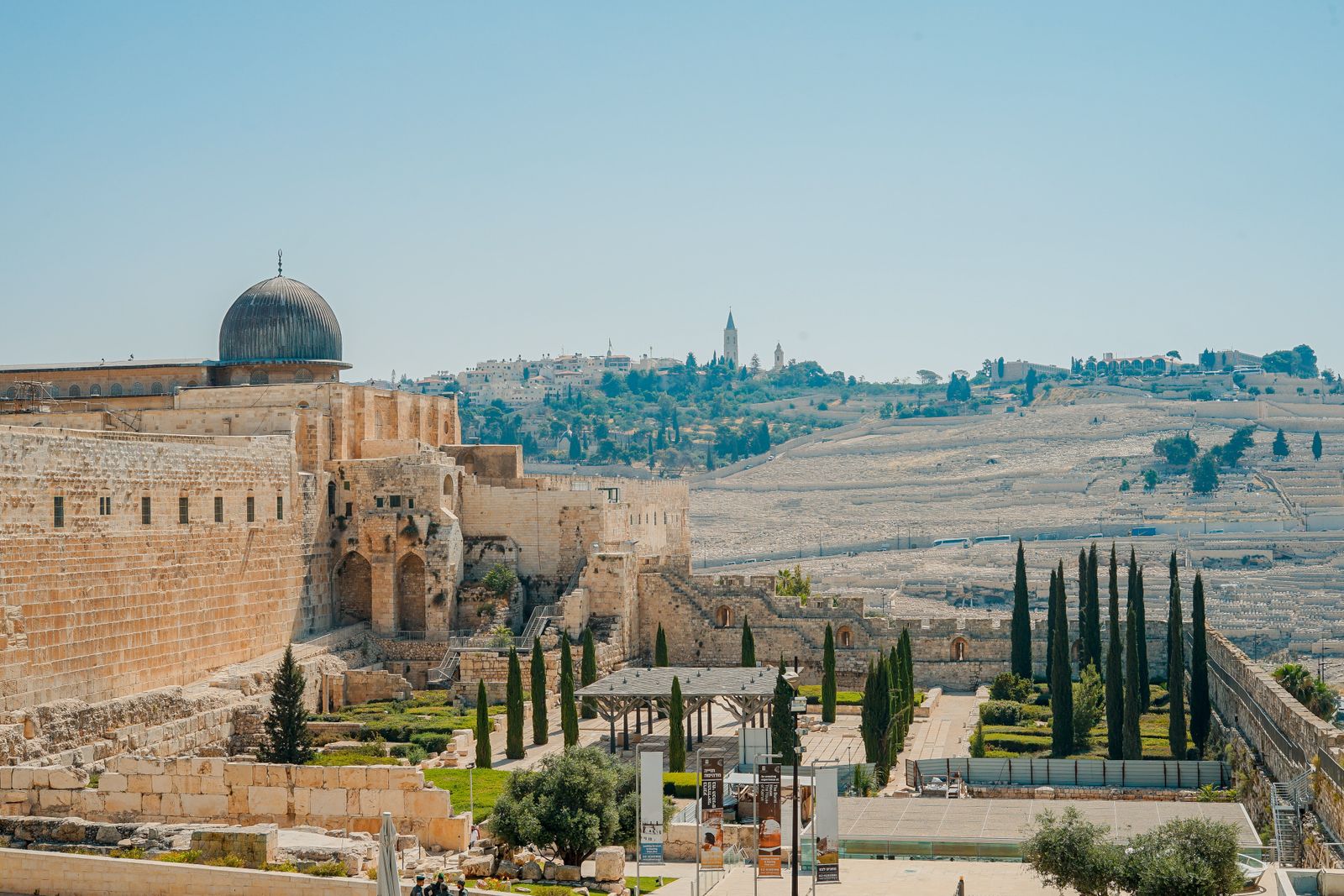
Jerusalem is claimed by both Israel and Palestine. The Old City and the holy sites (Church of the Holy Sepulchre, Western Wall, Al-Aqsa Mosque) are accessible to visitors, but rules change with political conditions.
The West Bank is generally accessible for tourism; the situation can change rapidly. Check your government’s travel advisory and local news before and during any visit.
The Palestinian Territories are a deeply contested political landscape — approach with sensitivity and an open mind to multiple narratives.
Quick answers to the questions people most often ask about visiting Palestine.
There is no Palestinian airport. Visitors fly to Tel Aviv (TLV) and travel into the West Bank by bus or service taxi via Jerusalem, or fly to Amman in Jordan and cross at the Allenby / King Hussein Bridge.
The West Bank has generally been accessible for tourism, but conditions can change rapidly, and Gaza has been inaccessible to tourists for many years. Check your government's current travel advice before and during your trip.
Service taxis and buses run from near Damascus Gate in East Jerusalem — the trip takes around 30 minutes plus time at the checkpoint. Carry your passport.
The Israeli new shekel (ILS). Costs are modest — around US$30–60 per day on a budget and US$80–150 mid-range.
March to May and September to November are the most comfortable (14–24°C). Summers are hot.
Point your camera at menus, signs or street text for instant translation. Download the language pack offline before you arrive for full use without data.
FreeReal-time and offline exchange rates for all world currencies — converts prices instantly so you always know what you are paying in your home currency.
FreeFind and book hotels, guesthouses and apartments with free cancellation on most rates — one of the widest selections of accommodation worldwide.
FreeBrowse millions of traveller reviews for restaurants, attractions and hotels — helps identify the best local spots and avoid tourist traps.
FreePalestine sits within easy reach of several other destinations — each with a completely different character.
Palestine is one of the world’s least-visited places. See all 90 in our guide to the world’s least-visited countries & territories.

