KN
Saint Kitts and Nevis
Brimstone Hill fortress, the last Caribbean railway & Alexander Hamilton’s birthplace
Brimstone Hill fortress, the last Caribbean railway & Alexander Hamilton’s birthplace
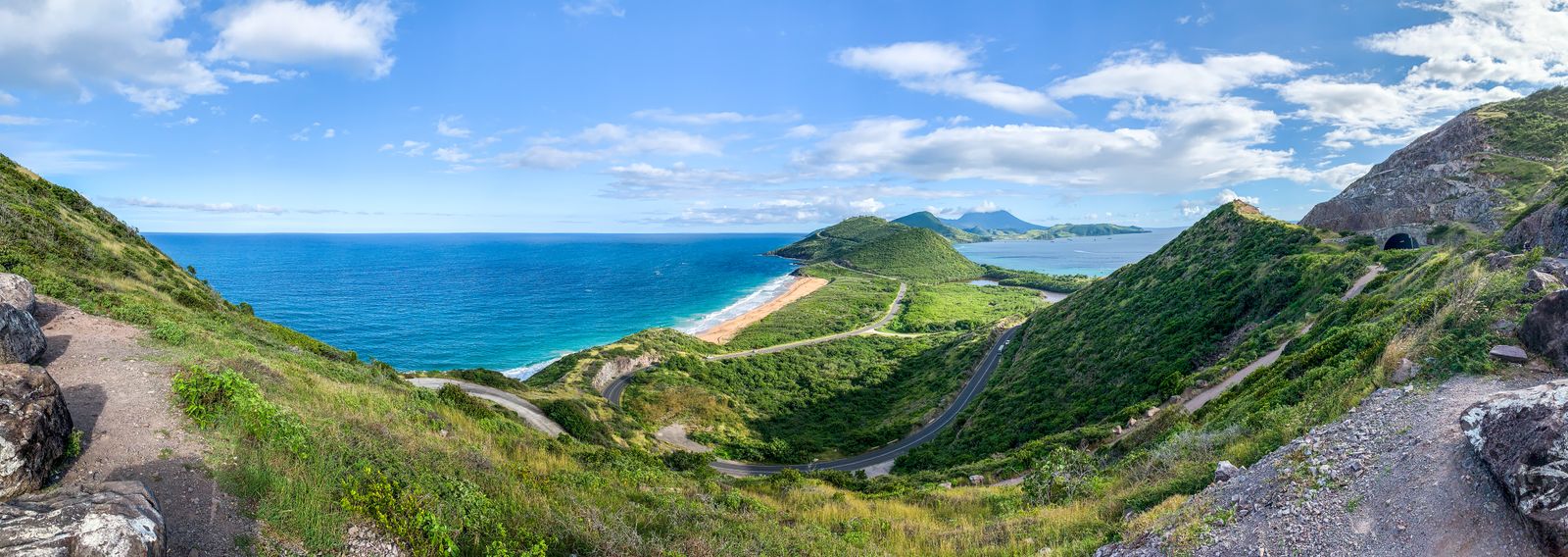
Saint Kitts and Nevis is a two-island federation in the northern Caribbean that was Britain’s first Caribbean colony (1623) and one of the most historically significant islands in the age of sugar. Brimstone Hill Fortress — the “Gibraltar of the Caribbean”, a massive 18th-century British fortification on a 240-metre volcanic hill — is a UNESCO World Heritage Site and the most impressive colonial fortification in the eastern Caribbean. Nevis, separated from Saint Kitts by a 3-kilometre channel, is a single, perfectly round volcanic island where Alexander Hamilton was born and where Lord Nelson married Frances Nisbet in 1787. Both islands have excellent beaches, dramatic rainforest interiors and a pace of life that remains unhurried.
A UNESCO World Heritage Site — a massive British fortification built by enslaved Africans between 1690 and 1790 on a 240-metre volcanic hill, capable of housing 1,000 soldiers and commanding views across six neighbouring islands. The Fort George citadel, barracks and magazine are intact, and the panoramic views make it the finest viewpoint in the northern Caribbean.
A narrow-gauge railway — the last in the Caribbean — circles the entire island of Saint Kitts in 3.5 hours through former sugar plantation land, with views of the sea, the mountains and the agricultural landscape that produced the sugar wealth of the British Empire. The double-decker carriages and rum punch aboard are part of the experience.
The single volcanic cone of Nevis Peak (985m) rises almost perfectly symmetrically from the sea, its summit usually wreathed in cloud. The 4-hour hiking circuit through rainforest, past abandoned plantation ruins and through the cloud forest near the summit, reveals extraordinary biodiversity including green vervet monkeys and the endemic Nevis subspecies of birds.
Stewed saltfish with spicy plantain, coconut dumplings and seasoned breadfruit — the national dish.
A thick goat stew spiced with cloves and served at celebrations, especially on Nevis.
Local spiny lobster, grilled with garlic butter and lime at beach restaurants.
Queen conch harvested from the banks around Saint Kitts — stewed in butter with local seasonings or served as a fresh salad cured in lime juice. Requires hours of tenderising; the reward is a firm, subtly oceanic flavour that has no substitute.
CSR, a clear spirit made from fresh sugar cane on St Kitts, often mixed with Ting grapefruit soda.
Robert L. Bradshaw International (SKB) on Saint Kitts is the main gateway. American, Delta and British Airways connect through hubs; LIAT/Caribbean Airlines serve inter-island. For trip planning, see the official St Kitts and Nevis tourism portal.
American Airlines operates some direct US services to SKB in winter. Most visitors connect through Antigua (ANU) or San Juan (SJU).
Antigua (30 min) is the most convenient hub for connections from Europe. San Juan (1h) is the most convenient hub for US connections.
The Nevis ferry (35 min, US$10 return, departing from Basseterre Port) runs multiple times daily and is the most practical inter-island connection. The ferry schedule is worth checking in advance as it can be irregular.
Nevis has one road circling the island (approximately 20km); the entire island is easily explored by car or taxi in a day. Saint Kitts requires a car for the southeastern peninsula and beach access.
December to April is peak — dry, clear (24–28°C), the Nevis Peak hike accessible. January to March is optimal. May to November is the wet season with hurricane risk; the islands are quieter and prices drop considerably.
📅 Saint Kitts and Nevis is in its best season in January, February, March, April, December. See where else is good to go in those months, or browse where to go by month.
The Eastern Caribbean Dollar (XCD, approx 2.70 XCD = 1 USD) is the currency. Mid-range for the Caribbean — slightly cheaper than Antigua, comparable to St Lucia.
Stewed saltfish with johnnycakes (deep-fried cornmeal flatbreads, a.k.a. journey cakes or johnny cakes)
The Saint Kitts Scenic Railway circuit (3h, with double-decker open-air carriages, local commentary, live calypso music and unlimited rum punch)
The Four Seasons Resort Nevis (on Pinney’s Beach, with Nevis Peak rising behind and the finest golf course in the Leeward Islands, from US$400–800/night) is the defining luxury address in Saint Kitts and Nevis.
Basseterre for one day, Brimstone Hill for one, Scenic Railway for one, Nevis for two days, Pinney’s Beach for one, St Kitts beaches for one. Saint Kitts and Nevis — the smallest nation in the Americas — is the Mother Colony of the British Caribbean, with Alexander Hamilton’s birthplace and the finest fortress in the Leeward Islands.
Basseterre — the capital of Saint Kitts and Nevis (a twin-island federation, the smallest sovereign nation in the Americas by both area and population — 261km², 55,000 people) with the Independence Square (the octagonal town square where enslaved Africans were once sold — the island’s most historically layered site, now peaceful with a fountain and Georgian buildings) and the St George’s Anglican Church (built 1869, the fourth church on the site).
Saint Kitts was the first English settlement in the Caribbean — Sir Thomas Warner landed on 28 January 1623 and established a settlement at Old Road on the southwestern coast, making it the “Mother Colony of the West Indies” from which England colonised much of the rest of the Caribbean. The first successful sugarcane cultivation in the English Caribbean began on Saint Kitts; by 1700 the island was one of the most valuable pieces of real estate in the British Empire.
Brimstone Hill Fortress National Park (UNESCO World Heritage — a British fortress built on a 240m volcanic plug between 1690 and 1790, the most complete and best-preserved British fortress in the Caribbean — the “Gibraltar of the West Indies” — with the citadel, barracks, magazines and fortifications visible in their entirety, with views of Nevis, Sint Eustatius, Saba and St Barts from the battlements).
Brimstone Hill Fortress was built almost entirely using enslaved African labour between 1690 and 1790 — a century of construction using 800,000+ tons of volcanic basalt quarried on-site. The fortress was designed by British engineers on the principles of the Vauban fortification system; its construction represents the most intensive military engineering project undertaken in the Caribbean. It was captured by the French in 1782 after a month-long siege but returned to Britain by treaty the following year.
The Saint Kitts Scenic Railway (a narrow-gauge railway originally built in 1912 to transport sugarcane from the island’s fields to the central mill in Basseterre, now the last remaining passenger railway in the Caribbean, running a 30km circuit around the entire island with double-decker carriages, commentary and rum punch — the most panoramic journey in the Leeward Islands).
The Saint Kitts sugar industry (introduced 1640, the single crop that defined the island’s economy for 360 years) ended in July 2005 when the government closed the last operating sugar mill, ending what was at that point the longest continuously operating sugar industry in the western hemisphere. The closure was economically necessary (EU sugar subsidies were ending) but socially devastating; the Scenic Railway and tourism are the primary replacements.
35 min ferry. Nevis (a nearly circular volcanic island dominated by the cloud-wreathed Nevis Peak at 985m — the birthplace of Alexander Hamilton, the first US Secretary of the Treasury, born 11 January 1755 or 1757 at Charlestown) with the Museum of Nevis History (in the reconstructed house where Hamilton was born, the finest Hamilton museum outside the US) and the Bath Hotel (a Georgian thermal spa hotel of 1778 — the oldest hotel in the Caribbean).
Alexander Hamilton was born on Nevis in 1755 or 1757 (the date is disputed — Hamilton himself gave both years at different times, possibly to conceal his illegitimate birth) and left the island at age 17 to study in New York. He became George Washington’s aide-de-camp, co-authored the Federalist Papers, founded the US financial system as the first Secretary of the Treasury and was killed in a duel with Aaron Burr in 1804. The 2015 Broadway musical Hamilton (by Lin-Manuel Miranda) brought his Nevis origins to global attention.
Nevis Peak (985m — the summit of the near-perfect volcanic cone that forms most of Nevis island, requiring 4–5 hours return and a certified guide, through the four ecological zones of the island: dry scrub, fruit tree forest, montane rainforest and cloud forest at the summit — the finest mountain hike in the Leeward Islands, with views from the top extending to Saint Kitts, Montserrat, Antigua and Sint Eustatius on clear days).
Nevis Peak is almost always shrouded in cloud — the summit is so frequently hidden that Columbus named the island “Nuestra Señora de las Nieves” (Our Lady of the Snows) in 1493, thinking the cloud-covered summit resembled a snow-capped mountain. The name was shortened to Nevis by English settlers. The cloud that gives the island its name is a permanent orographic cloud formed by the Trade Wind hitting the volcanic cone.
Pinney’s Beach (the finest beach on Nevis — a 5km strip of golden sand on the northwestern coast, calm Caribbean water, the Four Seasons Nevis and the beach bars of the Sunshine’s Beach Bar & Grill — home of the Killer Bee cocktail, the most popular beach drink in Nevis) and the Nevis Heritage Trail (the ruins of the plantation houses and sugar mills dotted across the island’s hillsides).
Sunshine’s Beach Bar (Pinney’s Beach, Nevis) and its Killer Bee cocktail (rum, guava, passion fruit, grenadine and a “secret ingredient” — the proportions are Sunshine’s trade secret, served in a plastic cup at US$7–12) have been written about in virtually every major travel publication since the 1990s. Sunshine Caines has run the bar since the 1980s; it was one of the first Caribbean beach bars to attract international celebrity visitors.
A return to Saint Kitts for Frigate Bay Beach (the most popular beach on the island, with the lively beach bar strip of the South Frigate Bay and the calmer North Frigate Bay Atlantic side) and a final plantation dinner at one of the island’s converted sugar mill hotels before flying from Saint Kitts (SKB).
Saint Kitts’s plantation hotels (former sugar plantation great houses converted into boutique hotels — Ottley’s Plantation Inn, Rawlins Plantation, The Belle Mont Farm on Mount Liamuiga) represent the finest examples of Caribbean plantation hotel conversion, presenting the beauty of the colonial architecture with (increasingly) honest interpretation of the enslaved labour that built it.
Visa-free for EU, UK, USA, Canada and most Commonwealth nationalities.
Direct flights from London (British Airways), New York and Miami. Connections via Barbados, Antigua or Puerto Rico.
Saint Kitts is larger, more developed, with heritage sites and a scenic railway. Nevis is smaller, quieter, with some of the best beaches in the Eastern Caribbean.
Regular water taxis cross the 3km Narrows channel between Basseterre and Charlestown several times daily.
A short ferry (45 min) or water taxi from Basseterre connects to Charlestown, Nevis — easily combined in a two-island itinerary.
Temporary local driving permit required — obtained at a police station with your home licence.
Quick answers to the questions people most often ask before visiting Saint Kitts and Nevis.
Fly into Robert L. Bradshaw International Airport (SKB) on Saint Kitts. There are seasonal direct flights from the US and connections via Antigua, San Juan and other Caribbean hubs; from London, flights usually route via Antigua.
By ferry or water taxi across the 3 km Narrows — regular ferries between Basseterre and Charlestown take about 45 minutes, and water taxis are quicker.
December to April is the dry peak season (24–28°C), with January to March ideal. May to November is the wet season with hurricane risk, but it's quieter and cheaper.
Yes, with a temporary local driving permit, which you can get using your home licence. Driving is on the left.
The East Caribbean dollar (XCD), about 2.7 to the US dollar; US dollars are widely accepted. Expect around US$70–120 per day on a budget.
Point your camera at menus, signs or street text for instant translation. Download the language pack offline before you arrive for full use without data.
FreeReal-time and offline exchange rates for all world currencies — converts prices instantly so you always know what you are paying in your home currency.
FreeBrowse millions of traveller reviews for restaurants, attractions and hotels — helps identify the best local spots and avoid tourist traps.
FreeThe most widely used messaging app worldwide — used heavily for bookings, tour operators and local contact throughout most of the world outside the US.
FreeSaint Kitts and Nevis sits within easy reach of several other destinations — each with a completely different character.
Saint Kitts and Nevis is one of the world’s least-visited places. See all 90 in our guide to the world’s least-visited countries & territories.

