GP
Guadeloupe
Butterfly island — active volcano, Cousteau diving & rhum agricole
Butterfly island — active volcano, Cousteau diving & rhum agricole
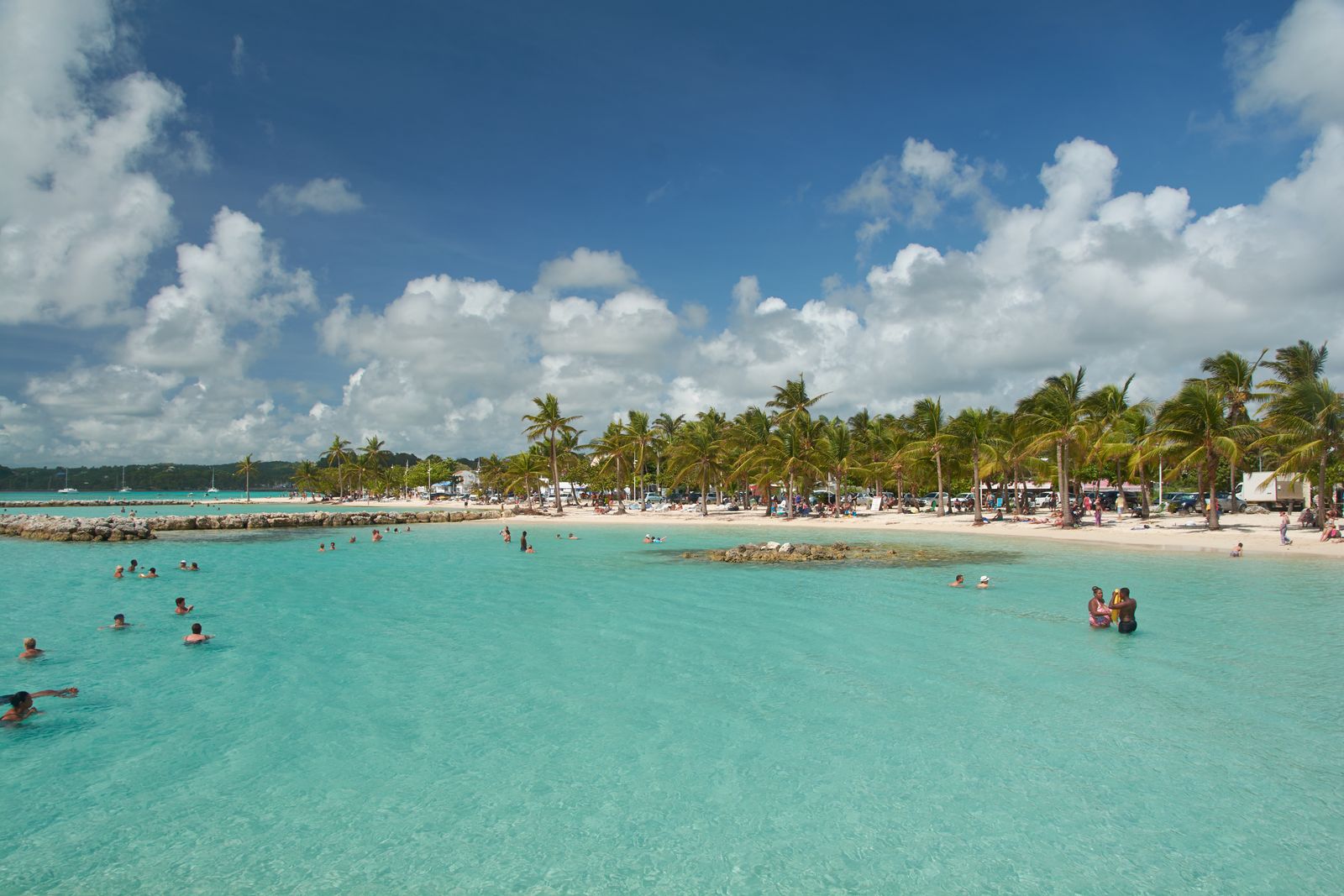
Guadeloupe is two islands connected by a bridge — the butterfly-shaped French overseas department of the eastern Caribbean, where the larger Basse-Terre (volcanic, rainforested, with the active La Grande Soufrière volcano and the finest beaches in the French Caribbean on its southern coast) and Grande-Terre (flat limestone, coral beaches, resorts and the market city of Pointe-à-Pitre) form a destination of great variety. The Parc National de la Guadeloupe protects 30,000 hectares of rainforest around the volcano; the Cousteau Reserve off Pigeon Island is one of the finest dive sites in the Caribbean. Guadeloupe’s Creole cuisine, its rhum agricole (from some of the finest distilleries in the Caribbean), and the offshore archipelagos of Les Saintes and Marie-Galante round out one of the most complete Caribbean destinations.
An active stratovolcano (1,467m) in the Basse-Terre national park, accessible by a 1.5-hour hike through tropical forest to a steaming, fumarole-covered summit with views. The volcano last erupted in 1976 and remains active — a sulphuric, otherworldly landscape at the top of a Caribbean island.
Jacques Cousteau described Pigeon Island’s marine reserve as “one of the world’s ten best diving sites” in 1960 — the two rocky islets off Malendure Beach have exceptional coral gardens, sea turtles, seahorses and the French Caribbean’s finest snorkelling directly from the beach.
Eight small islands 15km south of Guadeloupe — Terre-de-Haut, the main island, is a perfect Caribbean village of colourful wooden houses, the Fort Napoléon fortress, excellent beaches and superb French bakeries, accessible by ferry from Pointe-à-Pitre in 45 minutes. The bay of Les Saintes was the site of the Battle of the Saintes (1782), a decisive British naval victory over France.
Guadeloupe (Wikipedia) →Goat meat slow-cooked with the Colombo spice blend (cumin, turmeric, fenugreek and coriander) — the signature curry of the French Caribbean, brought by South Asian indentured labourers and now inseparable from Guadeloupean cuisine.
Spicy Creole blood sausage, often eaten as a snack or starter.
Crispy salt cod fritters — the essential Guadeloupean aperitif snack, served at every family gathering and restaurant as the starter before the main meal. Best eaten hot from the oil with a glass of ti’ punch.
Spiny lobster grilled with garlic butter and lime, served at beach restaurants.
Mahi-mahi caught around the islands and grilled with herbs and citrus butter.
The classic aperitif: agricole rum, cane syrup and lime, mixed to taste. Damoiseau, Longueteau and Domaine de Sévérin are well-known distilleries.
Pointe-à-Pitre Pôle Carïbées (PTP) is the main hub. Air France, Corsair and Air Caraïbes connect via Paris; American Airlines via Miami. For trip planning, see the official Guadeloupe tourism portal.
Paris is the only European gateway with direct connections — Air France, Corsair and Air Caraïbes all serve PTP directly from CDG and ORY. From the UK, connect through Paris.
American Airlines via Miami (3h30) is the most convenient US connection. Martinique (45 min) is the natural companion island.
The ferry network (Express des Iles and CTM Deher) connects Guadeloupe to Les Saintes (30 min), Marie-Galante (45 min), Dominica (2h) and Martinique (3h) — essential for the island circuit.
Car hire (€35–65/day) is the most practical option — public transport exists but is infrequent outside the Pointe-à-Pitre area. Drive on the right (French system).
December to April is the best window — dry season across both islands of the butterfly-shaped archipelago, the La Soufrière volcano accessible, the beaches of Sainte-Anne calm. January to March are peak season. June to November brings the hurricane risk and heavy rains.
📅 Guadeloupe is in its best season in January, February, March, April, May, December. See where else is good to go in those months, or browse where to go by month.
Guadeloupe is a French département using the euro — the most expensive island group in the Eastern Caribbean. Local Creole restaurants and supermarkets offer affordable options; accommodation ranges widely.
Bokits — a fried bread sandwich unique to Guadeloupe (a dough ball deep-fried in oil, split open and filled with grilled chicken, tuna, plantain, crudites and hot sauce) — were invented in Pointe-à-Pitre in the 1960s and have.
Damoiseau rhum agricole (Distillerie Damoiseau, the largest distillery in Guadeloupe)
La Toubana Hôtel & Spa (Sainte-Anne, cliff-top bungalows above the Caribbean, the most beautiful hotel in Guadeloupe, from €250–700/night) and Le Jardin Malang.
Pointe-à-Pitre for one day, La Soufrière for one, the Basse-Terre rainforest for one, Grande-Terre beaches for two, Marie-Galante for one, Les Saintes for one. Guadeloupe — two islands shaped like a butterfly joined by a mangrove bridge — is the largest and most diverse island in the French Caribbean.
Pointe-à-Pitre — the economic capital of Guadeloupe (technically Basse-Terre is the administrative capital, but Pointe-à-Pitre is the largest city) — with the Marché de Pointe-à-Pitre (the finest Creole food market in the French Caribbean — soursop, piment antillais, christophine, dumé and ti-nain plantains) and the Mimôsa rum bar on the waterfront.
Guadeloupe is an outermost region of the European Union — not a colony or territory but a full French département and région, with the euro, French law and representation in Paris. The island was the most important French sugar colony in the Caribbean in the 18th century; at one point it was considered more valuable than Canada and was nearly traded away in the 1763 Treaty of Paris.
2h from Pointe-à-Pitre. La Soufrière (1,467m, the highest peak in the Lesser Antilles — an active volcano with steaming fumaroles and sulphur vents at the summit, erupting in phreatic explosions in 1976 that forced the evacuation of 73,000 people, with ongoing seismic activity) — the most dramatic hike in the French Caribbean.
La Soufrière erupted in a series of phreatic explosions in 1976, causing the evacuation of the entire southern half of Basse-Terre — 73,000 people. The French volcanologist Haroun Tazieff argued the eruption would be minor and the evacuation unnecessary; he was wrong about the risk assessment. The event remains controversial in volcanology and emergency management.
The Guadeloupe National Park (74,000 hectares, the largest national park in the French Antilles, covering the rainforest interior of Basse-Terre with 43 plant ecosystems) — the Carbet Falls (three cascades from 115m, 110m and 20m in a volcanic gorge, accessible by forest trail) and the Ravine Chaude (hot spring thermal pools at 37°C in the forest, the finest natural spa in the Caribbean).
The Grand Carbet waterfall system — the three Cascades de Carbet, with the highest (“first cascade”) at 115m — is the tallest waterfall system in the Lesser Antilles. The water source is directly the rainfall of the volcanic heights of La Soufrière, which receives over 9,000mm of annual precipitation — among the highest in the Caribbean.
45 min from Pointe-à-Pitre. Sainte-Anne — the finest beach resort town in Guadeloupe, with the Plage de Sainte-Anne (1.5km of white sand, calm Caribbean water, shade from sea grape trees) and the Plage du Bois Jolan (wide, white, with the offshore Les Saintes islands visible on clear days). The Rhumerie Sainte-Marie distillery for afternoon ti-punch.
The Grande-Terre island of Guadeloupe (the eastern “wing” of the butterfly) is flat limestone karst compared to the volcanic Basse-Terre — a completely different landscape from the mountains and rainforest 15 minutes away across the Rivière Salée. Driving between the two gives a geological education in the space of 30 minutes.
Saint-François — the golf and marina resort of eastern Grande-Terre, with the Pointe des Châteaux (the dramatic eastern tip of Guadeloupe, a limestone promontory with cliffs falling to the Atlantic, wild surf and views east to Antigua and La Désirade on clear days) and the Anse de la Gourde (flat, calm, turquoise, the finest snorkel beach in Grande-Terre).
Pointe des Châteaux is the most exposed point of Guadeloupe — the full fetch of the Atlantic arrives here after 6,000km of open ocean, creating dramatic surf that contrasts completely with the calm Caribbean west coast. The limestone formations are identical to those of the Yucatan peninsula — part of the same Caribbean limestone shelf.
45 min ferry from Pointe-à-Pitre. Marie-Galante — a flat circular island (158km², population 12,000) still largely given over to sugar cane, with traditional ox-driven mills (the last working traditional sugar mills in the Caribbean), the finest rhum agricole outside Martinique (Distillerie Bellevue and Domaine de Bellevue) and the Capesterre beaches (clean, rarely crowded).
Marie-Galante has three functioning rum distilleries — Capesterre, Bielle and Bellevue — making it the island with the highest density of rum production per km² in the world. The rhum agricole of Marie-Galante is considered the closest equivalent to Martinique AOC rum; the Domaine de Bellevue 59% blanc is a benchmark Caribbean agricole.
30 min ferry from Terre-de-Bas or Pointe-à-Pitre. Les Saintes (Terre-de-Haut — a tiny French island of immaculate white-and-blue buildings, the finest beach in the French Antilles at Anse Crawen, a fort above the bay and the characteristic salako (a flat-brimmed Chinese-derived fisherman’s hat worn by the fishermen of Les Saintes since the 17th century). Fly from Pointe-à-Pitre Guadeloupe (PTP).
The salako (a flat, broad-brimmed straw hat with a circular crown, worn exclusively in Les Saintes) was apparently adapted from Chinese coolie hats brought to the Caribbean by Chinese labourers in the 19th century. It is now worn by the white Creole fishing community of Terre-de-Haut as a symbol of their distinct identity.
French/EU territory. EU citizens enter freely; UK, US, Australian citizens enter visa-free up to 90 days.
Direct connections from Paris (8.5h, Air France), Montreal and Miami. Guadeloupe is a French overseas department — no visa for EU nationals; standard French rules apply.
Guadeloupe’s “butterfly” shape is two islands joined by a bridge: Grande-Terre (urban, flat, resort beaches) and Basse-Terre (volcanic, rainforested, waterfalls). They are very different in character.
Cards and Euro accepted everywhere. Expensive by Caribbean standards due to French import costs.
Car hire recommended; ferry services connect Les Saintes and Marie-Galante. Public buses cover main routes on Grande-Terre.
Quick answers to the questions people most often ask before visiting Guadeloupe.
Fly into Pointe-à-Pitre (PTP). Direct flights from Paris take about 8h30, and there are direct flights from Miami (about 3h30). From the UK, connect via Paris.
Guadeloupe is part of France and the EU. EU citizens enter freely, and UK, US and Australian citizens can visit visa-free for up to 90 days. Other nationalities follow French entry rules.
December to May, the dry season, is best — with January to March the peak. June to November brings heavy rain and hurricane risk.
The main island is really two islands joined by a bridge: flat Grande-Terre, with the resort beaches, and mountainous Basse-Terre, with rainforest and La Soufrière volcano. Ferries connect to Les Saintes and Marie-Galante.
It is one of the pricier Eastern Caribbean destinations because of French import costs — around €70–120 per day on a budget and €170–290 mid-range. The currency is the euro.
Point your camera at menus, signs or street text for instant translation. Download the language pack offline before you arrive for full use without data.
FreeReal-time and offline exchange rates for all world currencies — converts prices instantly so you always know what you are paying in your home currency.
FreeFind and book hotels, guesthouses and apartments with free cancellation on most rates — one of the widest selections of accommodation worldwide.
FreeBrowse millions of traveller reviews for restaurants, attractions and hotels — helps identify the best local spots and avoid tourist traps.
FreeGuadeloupe sits within easy reach of several other destinations — each with a completely different character.
Guadeloupe is one of the world’s least-visited places. See all 90 in our guide to the world’s least-visited countries & territories.

