GD
Grenada
Spice Isle of nutmeg, coral sculpture park & Grand Anse beach
Spice Isle of nutmeg, coral sculpture park & Grand Anse beach
Grenada is the Spice Isle of the Caribbean — a nutmeg-scented island of natural beauty, warm hospitality and the finest beaches in the southern Caribbean. The island produces 20% of the world’s nutmeg (along with mace, cinnamon, cloves and turmeric), and the fragrance of spice processing perfumes every breeze. Grand Anse Beach — three kilometres of white sand on the sheltered southwest coast — is consistently ranked among the Caribbean’s top five beaches. Grenada also has the most striking dive site in the Caribbean: the Underwater Sculpture Park, where dozens of life-size human figures placed on the seabed have become encrusted with coral, creating an otherworldly reef gallery.
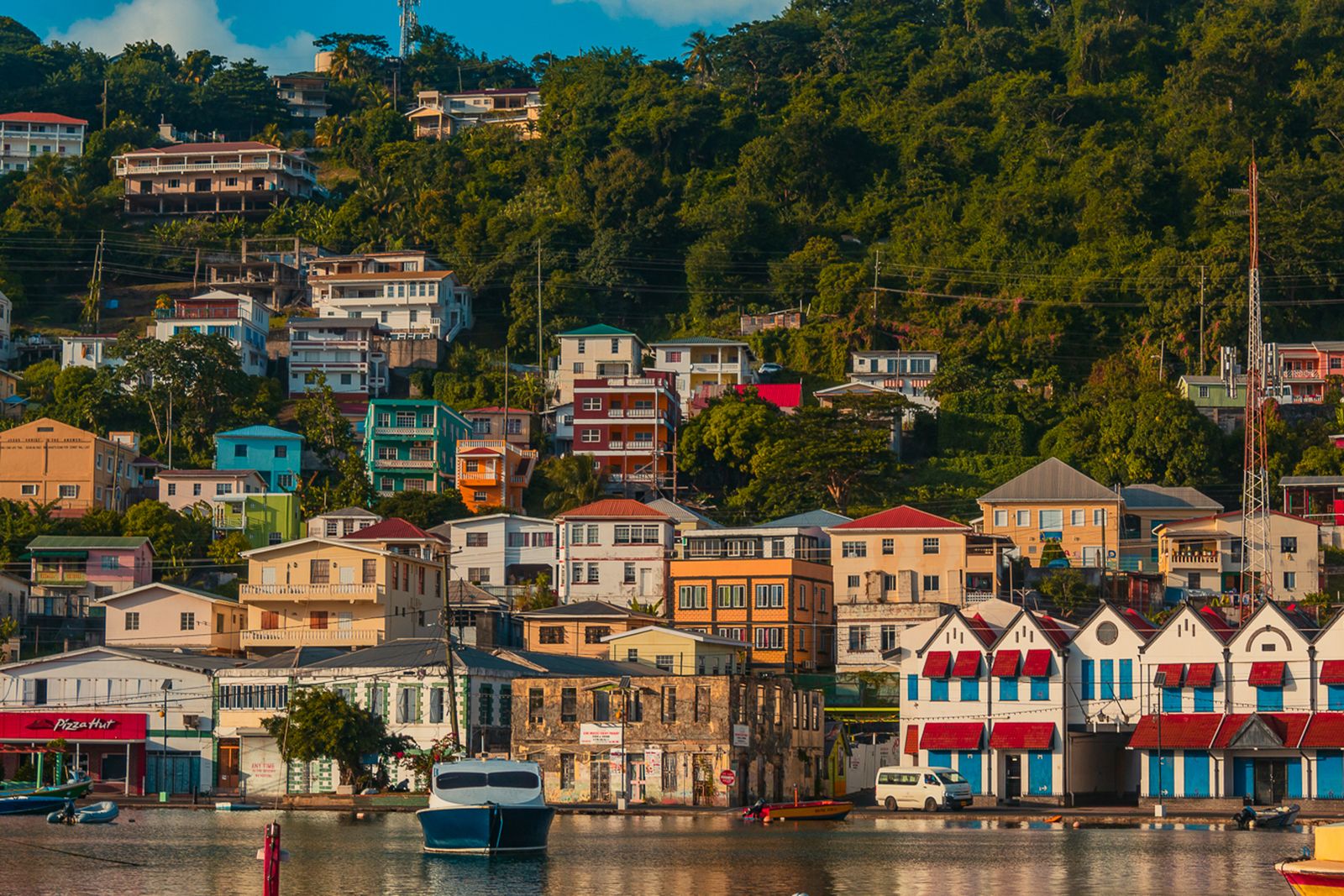
One of the most beautiful capital cities in the Caribbean — St George’s horseshoe harbour is ringed by colourful 18th-century warehouses (now restaurants and rum shops), overlooked by the 18th-century Fort George on the headland and Fort Frederick above. The inner Carenage and outer Esplanade are the social heart of a town that has barely changed in 200 years.
Three kilometres of white sand and calm turquoise Caribbean water backed by palm trees and the hills of St George’s — Grand Anse is consistently ranked among the Caribbean’s top five beaches. The clear water, fine sand and easily walkable length make it the finest beach on a reef-less sheltered coast in the region.
Jason deCaires Taylor’s installation of 65 life-size human figures, placed on the seabed between 3 and 8 metres depth in Moliniere Bay, has over 10 years become a living coral reef. The figures — a ring of children, a man at his desk, a bicycle rider — are encrusted with brain coral, sea fans and sponges in one of the world’s most striking snorkelling and diving experiences.
The volcanic crater lake at the heart of Grenada’s rainforest interior — reached by the trans-island road through nutmeg, cocoa and spice plantations — is the setting for excellent hiking trails, swimming and encounters with Mona monkeys brought to Grenada from West Africa centuries ago.
Grenada (Wikipedia) →Grenada’s national dish, a one-pot coconut milk stew of breadfruit, salt meat, callaloo and ground provisions simmered until the oil from the coconut separates and drops to the bottom — is cooked communally for celebrations.
Ice cream flavoured with Grenada’s own nutmeg — the “Spice Isle” speciality.
Grilled spiny lobster with garlic butter and lime, in season from September to April; Gouyave’s Fish Friday street party is a good place for seafood.
Queen conch meat tenderised by pounding, then stewed with butter, garlic and thyme or served as a fresh salad cured in lime juice — a Caribbean delicacy requiring patience; the flesh is firm and subtly oceanic when properly prepared.
Kingfish, grilled or stewed, sold fresh by local fishermen.
Made at a distillery in St Patrick where a water wheel has driven the cane crusher since the 18th century — a working piece of history.
Maurice Bishop International (GND) serves the island. British Airways and Virgin Atlantic fly direct from London; American Airlines and JetBlue connect via the US. For trip planning, see the official Grenada tourism portal.
British Airways and Virgin Atlantic operate direct London Gatwick–Grenada services year-round, making Grenada one of the most directly accessible Caribbean islands from the UK.
Barbados (50 min) is the main Eastern Caribbean hub connection. American Airlines via Miami (3h45) is the most convenient US gateway.
The Osprey Lines catamaran to Carriacou departs twice daily from the Carenage in St. George’s — the most convenient option. Planes take 20 min but are more expensive.
Grenada is compact — 34km × 19km. Car hire (XCD 130–200/day) enables a full island circuit in an afternoon. Drive on the left; the mountain roads are narrow but paved.
January to April is peak dry season — the spice island at its most fragrant, the beaches of Grand Anse calm and clear. December is also excellent. June to November is hurricane season — Grenada lies just south of the main hurricane belt and is rarely directly hit, but Ivan (2004) devastated the island.
📅 Grenada is in its best season in January, February, March, April, May, December. See where else is good to go in those months, or browse where to go by month.
Grenada uses the Eastern Caribbean Dollar (XCD) at XCD 2.70 = US$1. It is mid-range for the Caribbean — more affordable than Barbados or the BVI, with excellent local food and good-value guesthouses.
Oil down — the national dish of Grenada (a one-pot stew of salted meat (usually pig tail), breadfruit, dumplings, callaloo, dasheen and coconut milk, simmered until all the liquid is absorbed — “the oil goes down”)
Grenadian rum punch (Rivers Royale rum — from the Rivers distillery, making a pure sugarcane rum from an old pot still — mixed with fresh lime, sugar syrup, Angostura bitters and nutmeg grated on top) is the definitive.
Calabash Luxury Boutique Hotel (Grand Anse, 30 suites with a private plunge pool each, consistently ranked in the top Caribbean boutique hotels, from US$300–800/night) is Grenada’s finest address.
St. George’s for one day, Grand Anse for one, the Grand Etang rainforest for one, the spice estates for one, Carriacou for two, Petite Martinique for one. Grenada — the Spice Island — produces 20% of the world’s nutmeg and has the Caribbean’s most intact rainforest interior.
St. George’s — a horseshoe harbour ringed by pastel-painted colonial buildings climbing the hillside, with the Carenage (the inner harbour) below and Fort George (1705, British colonial fort with cannon pointing over the harbour) above — is consistently described as the most photogenic small capital in the Caribbean. The fish market on the Carenage is the social heart of Grenada.
Grenada was the site of the only US invasion of a Caribbean island in the Cold War period — Operation Urgent Fury (October 1983), launched after a violent coup within the Grenadian government. The US cited the protection of American medical students and concern about Cuban military construction (an airport runway). The invasion is still debated; the Grenadians were asked to vote on it in a referendum in 1984 and largely approved.
Grand Anse — a 3km arc of white sand on the southwest coast, with calm Caribbean water and the hills of the interior visible above the palms — is consistently listed among the finest beaches in the Caribbean. The Grenada Underwater Sculpture Park (the world’s first underwater sculpture park, 26 cast concrete figures at 3–5m depth, covered in coral after 20+ years, accessible by snorkel from Grand Anse Beach).
The Grenada Underwater Sculpture Park (created by British sculptor Jason deCaires Taylor beginning in 2006) contains 70+ sculptures at 3–8m depth, now entirely colonised by Caribbean coral, sponges and fish. The figures — a ring of life-sized people holding hands, a man at a desk, a woman reading — have become the most visited underwater art installation in the world.
Grand Etang National Park — a volcanic crater lake at 530m altitude in the centre of the island, surrounded by intact cloud forest (the largest surviving primary forest in the Eastern Caribbean), with Mona monkeys (Cercopithecus mona, introduced from West Africa by enslaved people in the 17th century, now naturalised) and the Seven Sisters Waterfalls (a series of 7 cascades, accessible by a 45-min forest hike).
The Mona monkeys of Grenada were brought from West Africa by enslaved people in the 17th century — possibly as companions, possibly accidentally. They have been on the island for 350+ years and are now fully integrated into the forest ecosystem. Grenada is one of only three Caribbean islands with wild monkeys.
Grenada produces 20% of the world’s nutmeg and significant quantities of mace, cinnamon, cloves, ginger and cocoa — the Island of Spice. The Gouyave Nutmeg Station (the largest nutmeg processing station in the Western Hemisphere, open to visitors, with the hand-sorting of nutmeg shells from mace by workers who have done this their whole lives) and the Belmont Estate (a working cocoa estate, 17th-century, with tours of the cacao drying and fermentation process).
Grenada’s nutmeg industry was devastated by Hurricane Ivan (2004) — which destroyed 90% of the island’s nutmeg trees — and took 15 years to recover. Before Ivan, Grenada produced 40% of the world’s nutmeg; the share has settled at approximately 20% after replanting. Nutmeg appears on the Grenadian flag — one of only a handful of countries to feature a spice on their national emblem.
2h30 ferry from Grenada. Carriacou — a small island (34km², population 8,000) with the finest boatbuilding tradition in the Caribbean (the wooden sloop boats of Carriacou, built without plans by eye from local cedar, have been racing since 1882 in the Big Drum Dance festival tradition), the Big Drum National Dance (an African-derived ritual dance and feast performed at boat launches, weddings and the anniversary of death) and the healthy coral reefs of Sandy Island.
The Carriacou boat-building tradition uses a technique of “building by eye” — no plans, no drawings, entirely from memory and measurement by feel, passed from master boatbuilder to apprentice over generations. The Carriacou model sloops are considered the most graceful working sailing vessels in the Caribbean.
Sandy Island — a tiny uninhabited cay of white sand surrounded by clear water, 10 min by boat from Hillsborough, with snorkelling on the coral garden — and the Harvey Vale boatyard (where traditional wooden vessels are still built and launched in ceremonies accompanied by the Big Drum Dance, one of the most alive living boat-building traditions in the world).
The Big Drum Dance of Carriacou is one of the most directly African-derived cultural practices in the Caribbean — the rhythms, ritual structure and cosmology trace to specific Akan (Ghanaian) and Igbo (Nigerian) traditions, surviving 300 years of cultural pressure. It is performed at boat launches, house warmings and the anniversaries of ancestors’ deaths.
30 min from Carriacou by water taxi. Petite Martinique — an island of 1km² and 900 people, with no cars and no tourism infrastructure — the most remote and quiet inhabited island in the Grenadines, where fishing and boatbuilding are still the primary occupations. Return to Grenada for departure. Fly from Maurice Bishop International (GND).
Petite Martinique is almost entirely dependent on fishing and the small ferry trade — it has one guesthouse, one restaurant, a primary school and a church. The island has no airport and no car road; everything arrives by boat. It is as close to a pre-tourism Caribbean community as exists in the Eastern Caribbean.
Visa-free for EU, UK, USA, Canada and most Commonwealth nations.
Direct flights from London (Condor) and connections via Barbados or Trinidad. The airport is on the south coast, convenient for Grand Anse Beach.
Grenada produces 20% of the world’s nutmeg. The spice markets in St George’s and the nutmeg estates in Gouyave (which processes 1/3 of all Grenadian nutmeg) are open for tours.
Grenada drives on the left. Road conditions are moderate. The interior mountain roads to the Grand Etang crater lake require caution.
Minibuses cover main routes cheaply. Taxis are unmetered — agree on the fare before setting off. Car hire recommended for exploring the interior and north coast.
The Underwater Sculpture Park is accessible to snorkellers from shore — no boat or dive equipment required. Best visibility in the dry season (Dec–May).
Quick answers to the questions people most often ask before visiting Grenada.
Fly into Maurice Bishop International Airport (GND) on the south coast. There are direct flights from London (about 8h30), New York, Miami and Toronto, plus connections via Barbados and Trinidad.
January to April is the peak dry season, and December is also excellent. Grenada lies at the southern edge of the hurricane belt and is less often hit than islands further north, though storms are possible from June to November.
Grenada is one of the world's leading nutmeg producers and also grows cinnamon, cloves and cocoa. You can visit spice markets in St George's and nutmeg processing stations such as Gouyave.
Yes — parts of the Underwater Sculpture Park at Moliniere Bay are shallow enough for snorkellers, while divers can see the deeper pieces. Boat trips run from Grand Anse and St George's.
The East Caribbean dollar (XCD), at about 2.7 to the US dollar. Grenada is mid-range for the Caribbean — around US$60–100 per day on a budget. Driving is on the left.
Point your camera at menus, signs or street text for instant translation. Download the language pack offline before you arrive for full use without data.
FreeReal-time and offline exchange rates for all world currencies — converts prices instantly so you always know what you are paying in your home currency.
FreeBrowse millions of traveller reviews for restaurants, attractions and hotels — helps identify the best local spots and avoid tourist traps.
FreeThe most widely used messaging app worldwide — used heavily for bookings, tour operators and local contact throughout most of the world outside the US.
FreeGrenada sits within easy reach of several other destinations — each with a completely different character.
Grenada is one of the world’s least-visited places. See all 90 in our guide to the world’s least-visited countries & territories.

