SY
Syria
Damascus, Palmyra, Krak des Chevaliers — the cradle of civilisation awakening
Damascus, Palmyra, Krak des Chevaliers — the cradle of civilisation awakening
Syria is one of the cradles of human civilisation — a country whose depth of history is almost incomprehensible, from the Neolithic village of Tell Qaramel (one of the world’s earliest settlements, 11,000 years old), through the Bronze Age city of Ebla and the empires of Ugarit, Assyria and Babylon, to the Hellenistic, Roman, Byzantine and Islamic periods that left layer upon layer of extraordinary monuments. Damascus is the world’s oldest continuously inhabited capital; Aleppo’s old city, the Dead Cities of the limestone massif, Palmyra’s Roman colonnaded streets in the Syrian desert and the Krak des Chevaliers (the finest Crusader castle on earth) are among the world’s greatest cultural sites. The devastating civil war since 2011 has caused severe damage to many sites and ongoing security concerns; check current advisories carefully, as parts of Syria are beginning to reopen to visitors following recent political changes.
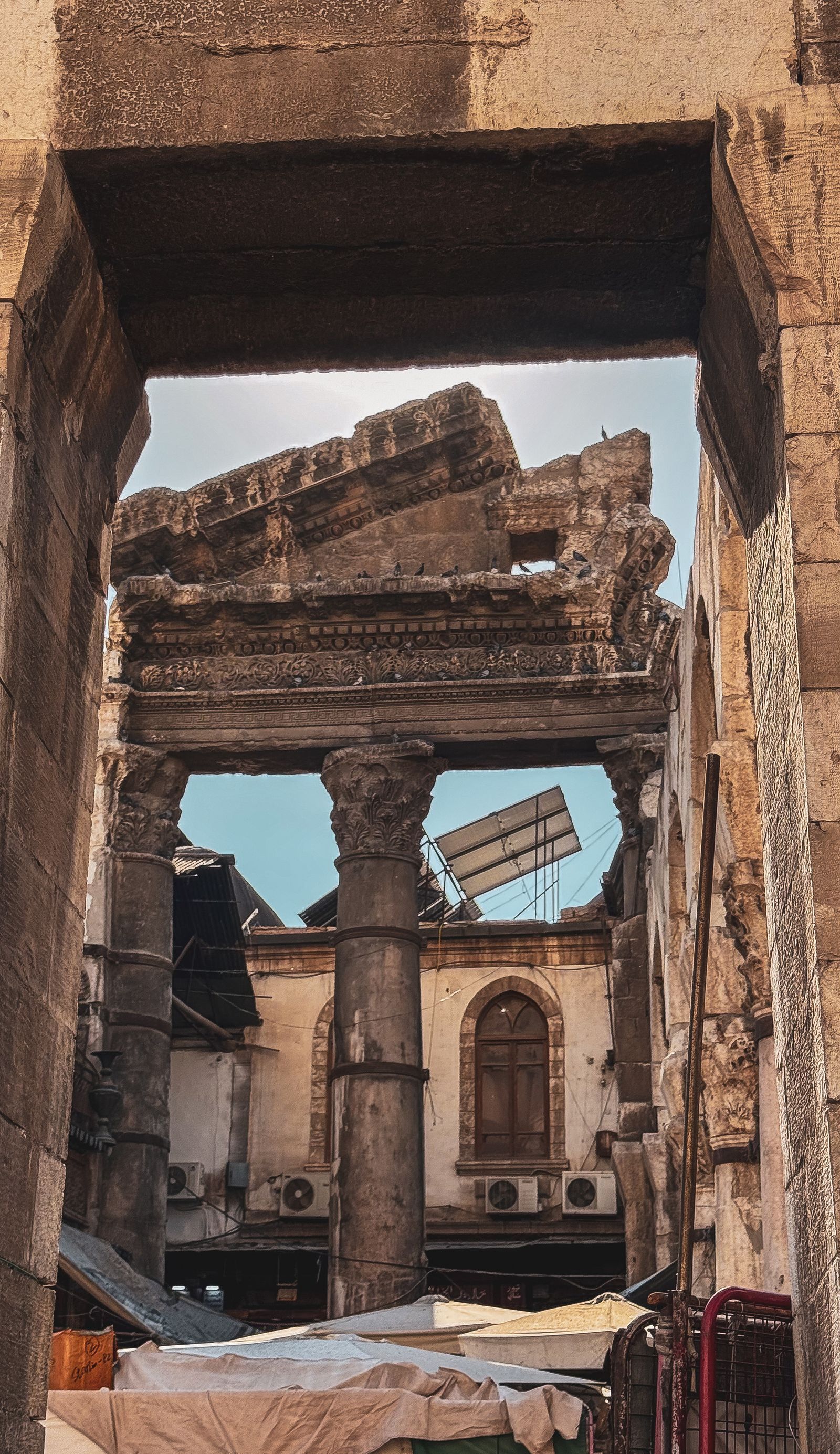
A UNESCO World Heritage Site and one of the world’s great historic cities — the Umayyad Mosque (built on the site of a Roman temple and Byzantine cathedral, one of Islam’s holiest sites), the Straight Street (Via Recta, unchanged since Roman times), the medieval Souq al-Hamidiyya, the Azm Palace and the extraordinary layering of 5,000 years of continuous habitation in a single city.
The “Bride of the Desert” — a UNESCO-listed Roman city in the Syrian Desert whose colonnaded main street, Temple of Bel, Arch of Triumph and magnificent Valley of the Tombs made it one of the ancient world’s great Silk Road entrepots. The site suffered significant deliberate destruction during the ISIS occupation (2015–2016); restoration work is ongoing.
A UNESCO-listed Crusader castle of extraordinary completeness — described by T.E. Lawrence as “the best-preserved and most wholly admirable castle in the world.” The concentric fortifications, Great Hall and chapel have survived remarkably intact since the 12th century. The castle suffered some damage during the civil war but remains one of the world’s finest medieval fortifications.
A UNESCO World Heritage Site that suffered catastrophic damage during the battle for Aleppo (2012–2016) — the ancient souqs, Umayyad Mosque and the Citadel are in various stages of reconstruction. The resilience of Aleppo’s people and the scale of reconstruction underway make a visit today an extraordinary witness to both loss and regeneration.
ground lamb and bulgur wheat formed into shells, stuffed with spiced minced meat, pine nuts and onion — dozens of regional variations) is Syria’s national obsession.
A bright Syrian salad of toasted or fried pita pieces with cucumber, tomato, radish, spring onion and parsley, dressed with pomegranate molasses, sumac and olive oil — the tangiest, most refreshing salad in the Levantine repertoire.
of extraordinary depth (muhammara — red pepper and walnut paste, a Syrian invention — hummus, labneh, stuffed vine leaves), Aleppo’s
Minced lamb mixed with fat, dried cherry (Aleppo sour cherry) and warm spices, grilled on a flat skewer — the signature dish of Aleppo, with a sweet-savoury complexity that distinguishes it from any other kebab in the region.
Damascus is considered the finest source of baklawa in the Arab world — papery layers of filo pastry filled with pistachios or walnuts, soaked in fragrant sugar syrup scented with orange blossom and rose water. Local patisseries take immense pride in theirs.
the world’s most prized chilli, fruity and moderately spiced — flavours half the dishes of the Middle East.
Damascus International Airport (DAM) has resumed limited operations. Syrian Arab Airlines, Cham Wings and regional carriers serve the current routes. Check all current advisories before planning.
💡 Damascus Airport (DAM) has operated under various levels of disruption throughout the conflict. Beirut (BEY, 45 min) is the closest international hub and the most commonly used gateway for journalists and aid workers.
💡 Beirut (45 min from Damascus by road, 3h including border formalities) is the most commonly used overland gateway for Syria. The Beirut–Damascus route has remained open for much of the conflict, used by journalists, aid workers and Syrians with dual nationality.
💡 Damascus is 30km from the airport by road. Within Syria, the Damascus–Aleppo highway and the southern Syria routes (Bosra, Deraa) are generally among the more accessible routes when conditions allow.
💡 A private car and driver is the most practical option for intercity travel in Syria, allowing flexibility and the ability to respond to changing road conditions. Local guides with up-to-date knowledge of safe routes are essential.
March to May and October to November are the most pleasant periods (15–25°C in Damascus and Aleppo). June to August is hot (35–40°C). December to February is cool with occasional rain and snow in the mountains. Syria remains in a state of conflict and political transition; check all current advisories. The situation changed significantly in December 2024 with the fall of the Assad government.
The Syrian pound (SYP) is the currency; USD preferred. Costs have been distorted by the war economy.
Aleppo soap (saboun ghar — the brown-barked, green-centered soap made from olive oil and laurel berry oil in Aleppo, the world’s oldest mass-produced soap with a 2,000-year history — is the finest skin care product available at)
A full Syrian mezze (30–40 small dishes including hummus, moutabal (smoked aubergine), fattoush, kibbeh, mutabal, labneh, grilled meats and the finest flatbreads in the Middle East — the most elaborate and diverse table of any)
Pre-war Syria was one of the best-value cultural destinations in the Middle East &mdash.
Damascus for two days, Palmyra for one (security check), Aleppo for one, Krak des Chevaliers for one, Bosra for one, Damascus farewell for one. Syria — one of the oldest inhabited places on earth — has the oldest continuous city in the world at Damascus, the most intact Roman theatre at Bosra, what Lawrence of Arabia called the best castle in the world at Krak des Chevaliers and the ruins of Palmyra. The situation is actively evolving post-December 2024; check all current advisories.
Damascus (Dimashq) — one of the oldest continuously inhabited cities in the world, with a history of settlement dating to approximately 8,000–10,000 BCE — the capital of Syria (185,180km² at the historic crossroads of Mesopotamia, the Mediterranean, Arabia and Anatolia, population 21 million — devastated by a civil war that began in 2011 and caused the displacement of 12 million Syrians, with the Assad government falling in December 2024 after a rebel offensive). Check current advisories; the security situation is actively evolving.
💡 The Syrian civil war (March 2011 — present — began as part of the Arab Spring protests against President Bashar al-Assad, escalating into a multi-sided conflict involving the Assad government, the Free Syrian Army, ISIS/ISIL, Kurdish forces (SDF/YPG), Turkish-backed factions, Iranian militias, Hezbollah and Russian forces. By 2024 the war had killed approximately 500,000 people, displaced 12 million (6.7 million internally displaced + 5.5 million refugees in neighbouring countries), and destroyed an estimated 30% of the built environment, including large parts of Aleppo, Homs and Palmyra.
The Old City of Damascus (UNESCO World Heritage — one of the best-preserved historic city centres in the Middle East, with the Umayyad Mosque (705 CE — built on the site of a Byzantine cathedral, on the site of a Roman temple of Jupiter, on the site of an Aramean temple — the fourth most important mosque in Islam for Sunni Muslims), the Souq al-Hamidiyye (the 19th-century covered bazaar), the Azem Palace (the finest Damascene domestic architecture) and the Street Called Straight — mentioned in the Acts of the Apostles).
💡 The Umayyad Mosque of Damascus (built 705–715 CE by the Umayyad Caliph al-Walid I — incorporating the Byzantine Cathedral of St John the Baptist, which itself incorporated a Roman temple of Jupiter Damascenus — is considered one of the finest examples of early Islamic architecture in the world and houses the Shrine of John the Baptist (whose head is venerated there by both Muslims and Christians). The mosque has been destroyed and rebuilt multiple times; the current structure dates primarily from the 8th and 11th centuries.
Palmyra (Tadmur — the ancient desert city at the oasis between the Mediterranean world and Mesopotamia — UNESCO World Heritage, one of the great archaeological sites of the ancient world: the Colonnade Street, the Temple of Bel, the funerary towers and the remarkable fusion of Greco-Roman and Oriental art — severely damaged by ISIS during their 2015–2017 occupation, with the Temple of Bel, the Temple of Baalshamin and the Arch of Triumph destroyed). Check current security for the Palmyra/Homs region before any visit.
💡 The ISIS destruction of Palmyra (2015–2017 — ISIS captured Palmyra in May 2015 and systematically destroyed the Temple of Bel, the Temple of Baalshamin, the Arch of Triumph, the Lion of Athena sculpture and executed the 82-year-old archaeologist Khaled al-Asaad, who refused to reveal the locations of stored antiquities — was described by UNESCO as a war crime. The destruction was livestreamed on social media. Despite partial reconstruction of the Arch of Triumph, Palmyra remains one of the most significant archaeological losses of the 21st century.
Aleppo (the second city of Syria, with a continuous history of 8,000 years — UNESCO World Heritage Old City — the Al-Madina Souq (the largest covered historic market in the world, 13km of vaulted souks selling soap, spices, silk and craft goods), the Aleppo Citadel (one of the oldest and largest castles in the world, at the centre of the city), the Great Mosque of Aleppo — severely damaged in the civil war battles of 2012–2016 but with reconstruction underway).
💡 The Battle of Aleppo (July 2012 – December 2016 — the longest urban battle of the Syrian civil war, lasting 4.5 years, destroying large parts of the historic city centre and displacing approximately 1 million of the city’s 2.3 million residents. The ancient covered souks, the minaret of the Great Mosque and significant parts of the residential areas around the citadel were destroyed. UNESCO and international donors have begun restoration work; the speed of recovery depends entirely on political stability.
Krak des Chevaliers (UNESCO World Heritage — the 12th-century Crusader castle in the Homs Governorate, described by Lawrence of Arabia as “perhaps the best preserved and most wholly admirable castle in the world” — the most impressive surviving Crusader fortification, built by the Knights Hospitaller on a hilltop 650m above sea level commanding the Homs Gap, the primary pass between the Syrian interior and the Mediterranean coast — partially damaged during the civil war but structurally intact).
💡 Krak des Chevaliers (Arabic: Qalat al-Husn — built and expanded by the Knights Hospitaller between 1142 and 1271, when it fell to Mamluk Sultan Baybars after a short siege — is the most complete example of Crusader military architecture in existence, preserving two concentric rings of walls, towers, a great hall, chapel, storage facilities and all the elements of a fully functional medieval castle. Its structural preservation over 850 years is largely due to its subsequent use as a village by local Syrian families from the 14th to 20th century.
Bosra (UNESCO World Heritage — the ancient Nabataean, then Roman, then Byzantine, then Islamic city in southern Syria — with the most completely preserved Roman theatre in the world (2nd century CE, seating 15,000, built from the black basalt that gives the city its distinctive appearance), the Cathedral of Bosra (514 CE, one of the earliest centrally-planned domed churches in the world), the Old City walls and the remarkable stratification of 3,000 years of continuous urban occupation).
💡 The Bosra Roman theatre (2nd century CE — the best-preserved Roman theatre in the world, built from black basalt, seating 15,000, preserved intact because it was incorporated into a medieval Arab fortress in the 11th–13th century, whose walls protected the theatre from quarrying and reuse — was the site of annual music and drama festivals attended by 100,000+ visitors before the Syrian civil war. The fortress walls that surround the theatre are now part of the UNESCO heritage designation.
A final morning in Damascus: the Christian Quarter of Bab Touma (one of the oldest continuously Christian communities in the world, with the Church of Ananias — built in a first-century house where Saint Paul regained his sight after the Damascus Road vision — and the Chapel of Saint Paul where tradition says Paul escaped the city by being lowered in a basket over the wall), the damascene soap market (the world’s oldest continuously produced soap, Aleppo soap with laurel oil and olive oil, made in Syria for 3,000+ years) and the airport before flying from Damascus International Airport (DAM).
💡 Aleppo soap (made from a blend of olive oil and laurel berry oil in a cold-process saponification, produced in Aleppo since at least the 2nd century BCE and exported throughout the Mediterranean world by Arab traders from the 7th century CE — is the direct ancestor of all European hard soaps, the technique and formula taken to Marseille, Castile and Venice by returning Crusaders — and remains the world’s oldest commercially produced soap, made in Syria from the same basic recipe for over 2,000 years.
Syria’s security situation has evolved significantly following recent political changes. Parts of Syria are beginning to reopen but conditions remain fragile and vary by region. Check your government’s current travel advisory before any planning.
Syria has been in civil war since 2011. While the fall of the Assad government in December 2024 has changed the political situation, security conditions remain fluid. Check current advisories; independent travel is not possible for most nationalities.
Limited international connections from Beirut, Dubai and Cairo. The airports have been affected by conflict damage. Situation evolving post-Assad.
Palmyra, Bosra, Damascus Old City, Crac des Chevaliers and Aleppo Old City are all UNESCO World Heritage sites. Most were partially damaged in the war but many structures survived intact.
Requirements are changing as the new government establishes procedures; check current requirements before departure.
Download Syria offline maps before arrival; internet access can be unreliable.
FreeDownload offline maps before you travel so navigation works without mobile data — essential for walking, driving and finding local spots.
FreeReal-time and offline exchange rates for all world currencies — converts prices instantly so you always know what you are paying in your home currency.
FreeFind and book hotels, guesthouses and apartments with free cancellation on most rates — one of the widest selections of accommodation worldwide.
FreeBrowse millions of traveller reviews for restaurants, attractions and hotels — helps identify the best local spots and avoid tourist traps.
FreeSyria sits within easy reach of several other destinations — each with a completely different character.
