GU
Guam
America's Pacific island — where history and reef meet
America's Pacific island — where history and reef meet
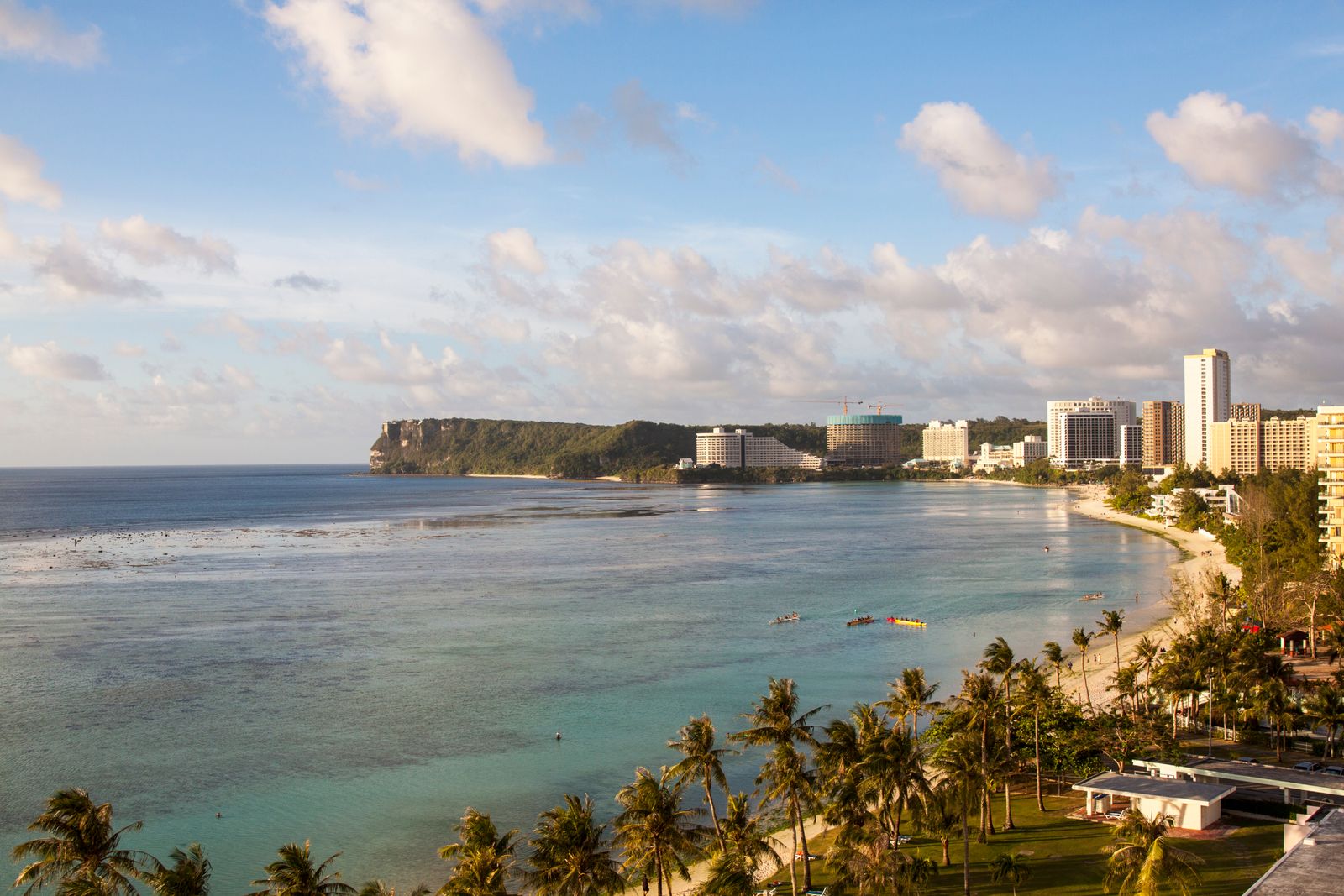
Guam’s main resort strip — a sweeping bay of calm turquoise water and white sand backed by hotels, duty-free shops and restaurants. The water clarity is exceptional and the beach is one of the finest in Micronesia; popular with Japanese, Korean and Chinese travellers as a short-haul beach destination.

A US National Park commemorating the fierce WWII fighting for Guam — Battle of Guam (1944) sites include Asan Beach (US landing beach), Japanese gun emplacements, jungle bunkers and the Piti Guns. The combination of tropical jungle and battle ruins is haunting and historically extraordinary.
Ancient pillars of the Chamorro people — latte stones are the stone support pillars of pre-colonial Chamorro houses, carved from limestone or coral between 800-1700 AD. The stones in Hagàtña are among the largest known; the quarry at Rota island produced stones over 5m tall.
A dramatic limestone cliff 120m above the Philippine Sea — named for a Chamorro legend of two lovers who tied their hair together and leapt rather than be separated by a forced marriage. The view north along the coast from the clifftop observation deck is extraordinary.
An uninhabited coral island off Guam’s south coast accessible by ferry — a Marine Preserve with outstanding snorkelling on pristine reef, sea turtles, manta rays and abundant fish life. One of Guam’s most popular day trips.
The wildest corner of Guam — a pristine stretch of white sand beach at the island’s northern tip within a US Fish and Wildlife Refuge. Ancient Chamorro cave paintings in the adjacent limestone cliffs date back over 1,500 years; sea turtles nest on the beach from July to December.
Guam (Wikipedia) →The defining dish of Guam — white rice cooked with annatto seeds (achiote), garlic and onion until it turns a deep brick red. Served at every meal alongside nearly every Chamorro dish; the red colour from annatto has no real flavour impact but is so deeply cultural that Chamorros feel a meal is incomplete without it.
Raw or lightly grilled chicken marinated in fresh lemon juice, coconut, green onion and finadene (Chamorro soy-based hot sauce) — the curing action of the lemon juice “cooks” the chicken over several hours. Guam’s most distinctive and celebrated dish, served at every fiesta.
A rustic broth of beef or chicken simmered with vegetables, achote and taro leaves — the most comforting of Chamorro home-cooked dishes, eaten for breakfast and lunch throughout Guam. The taro leaves give the broth a slightly earthy depth.
Fermented coconut sap — tapped daily from coconut flower buds and drunk fresh as a slightly sweet, mildly alcoholic palm wine. Traditional Chamorro tuba is increasingly rare but found at cultural festivals and village fiestas. A living connection to pre-Spanish Chamorro culture.
A traditional Chamorro dessert of sponge cake topped with a thick custard made from coconut milk, vanilla and cinnamon — served cold, it appears at every fiesta, village celebration and family gathering. Deeply sweet and completely specific to Guam.
A Japanese-American-Guamanian hybrid — a block of rice topped with teriyaki-glazed Spam and wrapped in nori. Reflecting Guam’s unique position between American military culture and Japanese culinary influence; sold at every convenience store from sunrise.
Antonio B. Won Pat International Airport (GUM) is a major Pacific hub. United Airlines serves the main transpacific routes; Japan Airlines, ANA and Korean Air serve Asian connections. For trip planning, see the official Guam tourism portal.
💡 United Airlines dominates Guam’s US connections — direct flights from Honolulu (8h), Los Angeles (12h) and San Francisco (11h). United’s “Island Hopper” flight (HNL–GUM via Micronesian atolls — Majuro, Kosrae, Pohnpei, Chuuk) is one of the world’s most memorable commercial flights.
💡 Tokyo (3h30) is the most frequent international connection to Guam, served by multiple daily JAL, ANA and United flights reflecting the massive Japanese tourism market. Seoul (4h), Manila (3h30) and Taipei are all well connected.
💡 Guam is 48km long; a car hire is practically essential for independent exploration beyond Tumon Bay. The main road (Route 1, Marine Drive) runs the length of the west coast; most sites are within 30 minutes of Tumon.
💡 A car hire is the most practical transport on Guam — the island has no public bus service and taxis are expensive for distances outside Tumon. Most hotel chains offer free airport pickup.
December to June is the dry season — the best weather (26–29°C), clearest seas, the Japanese diving tourism season. July to November is typhoon season with heavy rain; Guam is struck by an average of one typhoon per year.
The US dollar is the currency. Affordable for a US territory — cheaper than Hawaii, with Japanese-oriented duty-free shopping and competitive hotel prices.
Kelaguen (finely chopped grilled chicken or seafood marinated in lemon juice, fresh coconut, hot pepper and green onion &mdash)
The Wednesday night Chamorro Village market (in Hagatna — the outdoor evening market with traditional Chamorro food, dance performances, artisan crafts and the most authentic local social scene in Guam — free entry, food from)
Guam’s golf courses (6 championship courses in a 544km² island — the highest golf course density in the Pacific — developed primarily for Japanese tourists, who are the primary users, at US$60–120 per round)
Hagatna for one day, Latte Stone Park for one, Tumon Bay for one, Blue Hole diving for one, Inarajan for one, WWII sites for one, northern Guam farewell for one. Guam — the westernmost US territory — has 4,000 years of Chamorro latte stone culture, the finest dive site in Micronesia at the Blue Hole and the most poignant WWII liberation story in the Pacific.
Hagatna (Agana) — the capital of Guam (a US territory of 544km² — the largest and southernmost island in the Mariana Islands archipelago, the westernmost US territory, population 160,000, with a unique Chamorro indigenous culture and an outsized military presence — approximately 27% of the island is US military land) with the Guam Museum (the finest museum in Micronesia, covering 4,000 years of Chamorro history, Spanish colonialism and World War II) and the Plaza de Espana (the Spanish colonial government complex).
💡 Guam is the westernmost US territory — at 144°E longitude, it is closer to Manila (3h flight) than to Hawaii (8h). As a US territory, Guam residents are US citizens but cannot vote in US presidential elections (a status shared with Puerto Rico, American Samoa, the US Virgin Islands and the Northern Mariana Islands). Guam’s strategic position in the western Pacific has made it the site of one of the largest US military concentrations outside the continental US, with Andersen Air Force Base hosting B-52 bombers and Anderson submarine base.
Latte Stone Park (the ancient Chamorro megalith structures — latte stones are large mushroom-shaped pillars of coral limestone, 2–7m high, with a hemispherical capstone (tasa), used as the foundation pillars of traditional Chamorro houses from approximately 900–1700 AD — the most significant archaeological monuments in Micronesia, visible at the park in Hagatna and at numerous sites across the island) and the Chamorro Village Wednesday Night Market.
💡 The latte stones of Guam (large limestone column-and-capstone structures used as the foundation pillars of traditional Chamorro houses — the largest known example is at Rota, standing 4.7m high — are unique to the Mariana Islands. Their exact purpose (as house foundations, as status markers for high-ranking families, or as ceremonial structures) remains debated by archaeologists. The Chamorro people who built them were largely destroyed by the Spanish colonisation of 1668 and subsequent population collapse.
Tumon Bay (the main resort beach of Guam — a 3km strip of white coral sand with 20+ hotels, duty-free shopping at the PIC (Pacific Islands Club), and the largest concentration of Japanese tourists in any US territory — Guam receives 1.5 million Japanese visitors per year, approximately 10x the island’s population — making Guam the most visited Pacific US territory and one of the most Japanese-influenced places in American territory).
💡 Guam’s Japanese tourism (developed from the 1980s as a short-haul honeymoon and holiday destination for Japanese visitors — Guam is 3h30 from Tokyo, visa-free for Japanese nationals, and offers American-style shopping with Pacific beaches) peaked at 1.8 million Japanese visitors per year before COVID-19. The Japanese influence is visible in hotel design, restaurant menus, duty-free retail and the signage throughout Tumon — much of the island’s tourist economy is essentially a Japanese-American hybrid.
The Blue Hole (the signature dive site of Guam — a vertical shaft in the outer reef edge descending from 12m to 130m+, opening into the open Pacific wall, with pelagic fish, grey reef sharks, hammerhead sharks at depth and the extraordinary transition from the shallow reef into the open ocean — one of the most dramatic dive sites in the Pacific, accessible by boat from Tumon Bay in 20 minutes) and the Sharks Cove reef (surface current and eagle rays).
💡 The Blue Hole dive site (a circular chimney in the Guam outer reef edge, approximately 20m in diameter at the top, descending to a depth of 130m+ where it opens to the outer reef wall) is the most celebrated dive site in the Mariana Islands. The chimney effect creates upwellings of cold, nutrient-rich water that attract large pelagic fish; schools of barracuda, surgeonfish and grey reef sharks are regular encounters.
Inarajan (the most authentic village on Guam — in the southern part of the island, with traditional Spanish-era coral-stone houses and the Inarajan Natural Pool, a large tidal pool carved into the reef flat by wave action over centuries, filled and refreshed by the tide, with clear water and fish swimming in the enclosed pool — one of the finest natural swimming experiences in Guam, the most authentic village atmosphere on the island) and the Jeff’s Pirates Cove beach bar.
💡 Inarajan (the southernmost village on Guam, the most complete example of the traditional Chamorro-Spanish colonial village architecture — the coral-stone houses, the parish church and the village layout are essentially unchanged from the Spanish colonial period — is on the National Register of Historic Places as the best-preserved village in the Mariana Islands.
Guam’s WWII sites — the War in the Pacific National Historical Park (covering the key battle sites of the July 1944 US liberation of Guam from Japanese occupation: the Asan Beach Unit (the main US landing beach), the Piti Unit (the Japanese shore defences) and the Nimitz Memorial) and the Sergeant Major Ague Garden of Remembrance — the most significant WWII memorial landscape in Micronesia, commemorating the 1,200+ Chamorros killed during the Japanese occupation 1941–1944.
💡 The Japanese occupation of Guam (8 December 1941 — 21 July 1944: 31 months) was a traumatic period for the Chamorro people, who were subjected to forced labour, internment, torture and execution. Approximately 1,170–1,250 Chamorros were killed by Japanese forces during the occupation. Liberation Day (21 July) is the most important public holiday in Guam, commemorating the US landing at Asan Beach and the beginning of the battle that liberated the island after 76 days of fighting.
Two Lovers Point (Puntan Dos Amantes — a 120m cliff above the Philippine Sea with the finest panoramic view on Guam, named for a Chamorro legend of two young lovers who jumped from the cliff together when their families forbade their marriage — one of the most visited natural landmarks in Guam) and the Ritidian Point Wildlife Refuge (the undeveloped northern tip of Guam — the most pristine beach and reef on the island, within a US Fish and Wildlife Refuge protecting the last nesting beach for hawksbill turtles in the Marianas). Fly from Guam (GUM).
💡 Guam is a global biodiversity hotspot for invasive species damage — the brown tree snake (Boiga irregularis), introduced accidentally in the late 1940s on military cargo, has driven 9 of 12 native forest bird species to extinction in Guam (the most bird extinctions on any single island in recorded history), eliminated most native lizards, and now threatens the island’s electricity system (snakes regularly cause power outages by climbing electricity poles). The US spends US$12 million per year on brown tree snake control.
United Airlines, Japan Airlines, Korean Air and Philippine Airlines all serve Antonio B. Won Pat International (GUM). Flight time from Tokyo is 3.5 hours; Guam is the closest US territory to Asia.
US citizens need no documentation. Japanese, South Korean and other Asian passport holders receive a 45-day visa-waiver. Citizens of most Western nations also receive visa-free entry.
Standard US Type A/B plugs; 120V. Asian visitors (and most Europeans) need adaptors and potentially voltage converters for older appliances.
Guam has good roads and cheap car rental from the airport. International driving licences are accepted; driving is on the right.
Guam lies in Typhoon Alley; the season peaks July-November. Outside typhoon season, the island has 27°C+ temperatures and generally reliable sunshine year-round.
Guam’s duty-free status and USD pricing makes it a major shopping destination for Japanese, Korean and Chinese visitors. Electronics, cosmetics and luxury goods can be significantly cheaper than at home.
Guam sits at the crossroads of the Pacific, connecting Asia and Oceania — Japan, the Philippines, Australia, New Zealand and Indonesia are all within the wider Pacific neighbourhood, with American Samoa representing another US Pacific territory.