AU
Australia
A whole continent to yourself
A whole continent to yourself

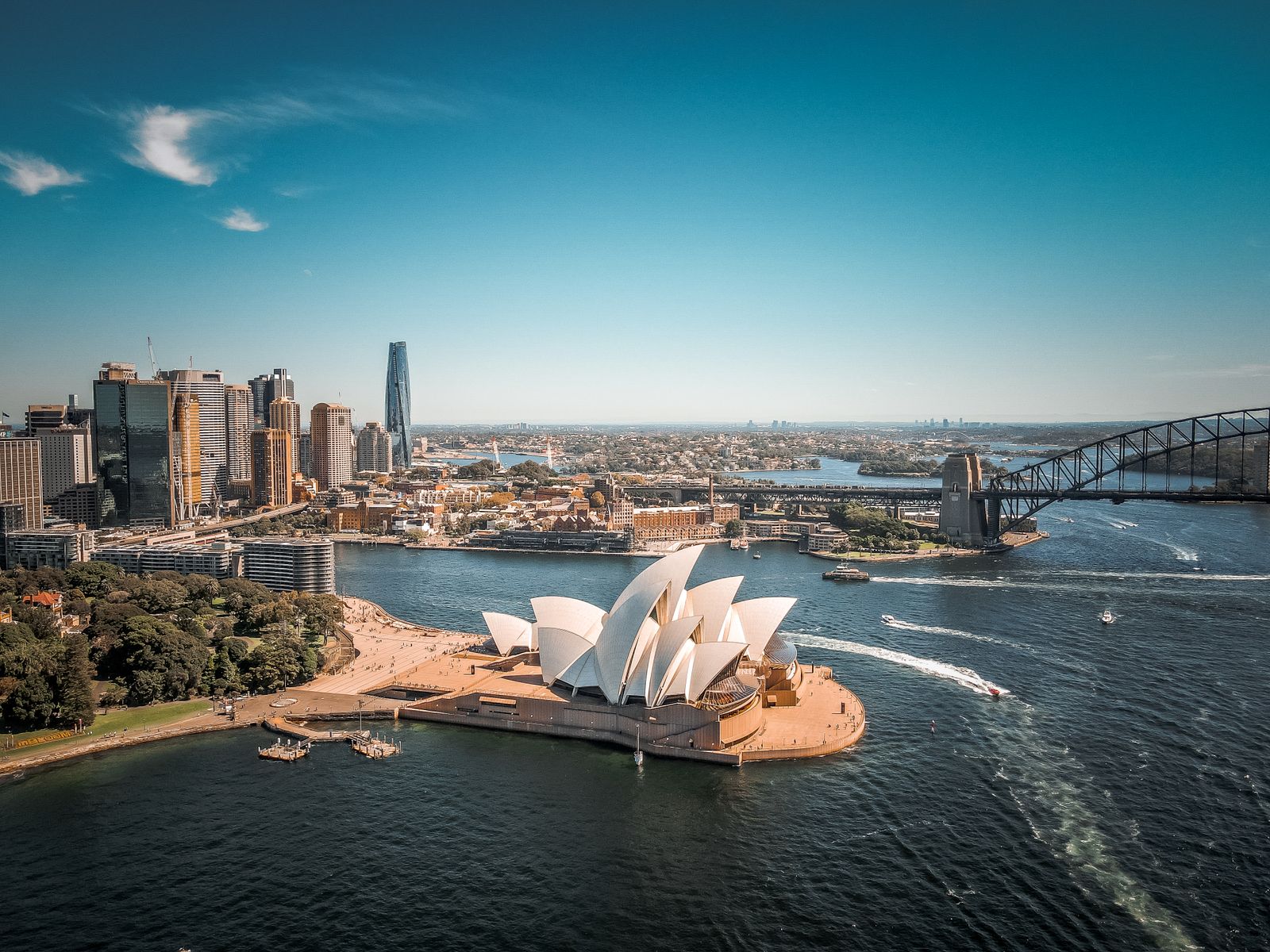
The Opera House (Jorn Utzon’s 1973 shell-vaulted masterpiece) and the Harbour Bridge (the BridgeClimb gives a view of the harbour’s 600km of shoreline) above Bondi Beach’s 1km arc of white sand.
Photo: Diliff, CC BY-SA 3.0

The world’s largest living structure (344,400km²): accessible by boat from Cairns or the Whitsundays for snorkelling, diving or glass-bottom boat tours. The Ribbon Reefs and Cod Hole are the finest dive sites.
Photo: Ank gsx, CC BY-SA 4.0

Uluru (348m high, 9.4km circumference) is the world’s largest sandstone monolith, sacred to the Anangu people: the colour changes from orange to crimson to purple at sunset. Climbing is now prohibited; the base walk at sunset is the correct experience.
Photo: Dietmar Rabich, CC BY-SA 4.0

The most scenic coastal drive in Australia: 243km of clifftop road with the Twelve Apostles sea stacks, the Loch Ard Gorge and the rainforest of Otways National Park.
Photo: Bobak Ha'Eri, CC BY 3.0

The world’s most contested coffee capital: Degraves Street’s espresso bars, the Federation Square arts complex, the Heide Museum, the Queen Victoria Market and the Great Ocean Road 90 minutes south.
Photo: Alpha from Melbourne, Australia, CC BY-SA 2.0

The world’s oldest tropical rainforest (135 million years): accessible from Cairns, with cassowaries, tree kangaroos and the beach at Cape Tribulation where reef and rainforest meet.
Photo: Robert Linsdell from St. Andrews, Canada, CC BY 2.0

A wilderness island 240km south of Melbourne: Cradle Mountain’s dolerite pinnacles above a glacial lake, the Freycinet Peninsula’s Wineglass Bay and the dark history of Port Arthur (the finest convict heritage site in Australia).
Photo: Ovico, CC BY-SA 4.0

The Kimberley’s ancient gorge country (El Questro, Emma Gorge), Broome’s Cable Beach and the Margaret River wine and surf region 3 hours south of Perth.
Photo: Philiphist, CC BY 3.0
A large, firm-fleshed freshwater fish from Australia’s tropical north, grilled over coals. The finest eating fish in Australia, also known as Asian sea bass in export markets.
A short-pastry pie filled with minced beef and gravy, topped with tomato sauce. The definitive Australian fast food since the gold rush era.
A cube of sponge cake dipped in chocolate icing and rolled in desiccated coconut. The national cake: found at every school fete, Country Women’s Association meeting and morning tea in Australia.
A concentrated yeast extract spread on hot buttered toast: salty, umami, and profoundly divisive to non-Australians. Australians eat it thick; everyone else should start thin.
Barossa Valley Shiraz (rich, peppery, full-bodied), Clare Valley Riesling (the driest in the world, ages spectacularly) and Yarra Valley Pinot Noir are the three great Australian wine contributions.
The craft beer revolution in Melbourne and Sydney has been extraordinary: Stone & Wood, Balter, Pirate Life. Carlton Draught remains the pub-table standard.
A cabbage and beef-filled spring roll, deep-fried, sold from the same takeaway counter as fish and chips since 1951. The most Australian snack that no Australian will admit to loving.
A double espresso with steamed milk and no foam: invented in either Sydney or Melbourne (both claim it). Starbucks added it to its menu; the original tastes different in an Australian laneway cafe.
Sydney (SYD) and Melbourne (MEL) are the main international gateways. Brisbane (BNE), Perth (PER), Cairns (CNS) and Adelaide (ADL) all have direct long-haul services. Qantas and Virgin Australia serve domestic routes. For trip planning, see the official Australia tourism portal.
Qantas Project Sunrise (direct London–Sydney, ~19h) has begun scheduled service — the only non-stop UK–east-coast-Australia route. Singapore Airlines via Singapore (~22h total) is the most consistently well-rated long-haul option.
Emirates serves 5 Australian cities direct from Dubai — excellent connections for travellers combining Australia with an Indian Ocean or European stopover.
Sydney–Melbourne is the busiest air route in the world — flights every 30 minutes, from AUD$49 one-way on Jetstar with advance booking.
Melbourne’s CBD tram zone is completely free — any tram within the inner city circle costs nothing. The best free public transport in Australia.
Australia’s seasons are the reverse of the Northern Hemisphere. Summer (Dec–Feb) is beach season in the south but extreme heat in the outback. Winter (Jun–Aug) is the best time for tropical north Queensland and the NT. Sydney and Melbourne are good year-round.
📅 Australia is in its best season in January, February, March, April, September, October, November, December. See where else is good to go in those months, or browse where to go by month.
Australia is expensive — one of the most expensive countries in the world for travellers. Accommodation, food and transport are all significantly pricier than Europe. Budget carefully.
A flat white in Sydney or Melbourne costs AUD$4.50–5.50 — expensive by global standards but the coffee culture is excellent.
Australian brunch — avocado toast, corn fritters, eggs with proper coffee — is a cultural institution. Budget AUD$25–35 for a full sit-down brunch in any city.
Quay in Sydney and Vue de Monde in Melbourne are Australia’s benchmark fine dining restaurants — tasting menus at AUD$250–350pp. The local wine list alone justifies the price.
Sydney for two days, the Blue Mountains for one, the Great Barrier Reef for two, Uluru for one. Seven days barely scratches Australia’s surface — most people need at least two weeks to do it justice.
The Sydney Harbour is the best-looking harbour of any city in the world — the Opera House and the Harbour Bridge from Mrs. Macquarie’s Chair at dusk is the shot. Walk across the Harbour Bridge (free on foot) or climb it (paid, views).
The Sydney Opera House tour (90 min) goes backstage and explains Jorn Utzon’s design — worth doing. There’s a bar inside with a harbour view.
Bondi is the most famous beach in Australia and excellent — swimmers, surfers, the icebergs ocean pool. The coastal walk from Bondi to Coogee (6km south) follows the clifftop with views and passes several ocean pools.
Bondi is best early morning — 7am, before the crowds. The Icebergs Dining Room above the ocean pool serves one of the best brunches in Sydney.
2h by train from Sydney Central. The Blue Mountains are a sandstone plateau cut by deep river gorges — the Three Sisters rock formation above Jamison Valley is the view. The Grand Canyon walking track (3.5h) goes down into the canyon and back.
Stay overnight in Katoomba if you can — the mountain atmosphere in the evening (and the eclectic guesthouses) is worth it.
3h flight from Sydney to Cairns — the gateway to the Great Barrier Reef. The outer reef (Agincourt, Norman, Flynn Reef) is 45–90 minutes by fast catamaran — the colours and clarity are impressive. Snorkel or dive.
The outer reef is far better than the inner reef — clearer water, more coral, more fish. Book a full-day reef trip rather than a half-day.
The Daintree Rainforest north of Cairns is 180 million years old — older than the Amazon. The Cape Tribulation road (where the rainforest meets the reef coast) is one of the most striking drives in Australia. Night walk for nocturnal wildlife.
The Daintree is a UNESCO World Heritage Site. A guided night walk with a local guide gives the best chance of seeing tree kangaroos, ringtail possums and Boyd’s Forest Dragons.
3h30 flight from Cairns to Uluru/Ayers Rock Airport. Uluru is a 348m sandstone monolith in the desert — it changes colour through the day, most dramatically at sunrise and sunset. The base walk (10.6km) takes 3.5 hours and circumnavigates the entire rock.
The climb is permanently closed (since 2019) out of respect for the Anangu traditional owners. The base walk and sunset viewing area are the experiences.
Morning: Field of Light at dawn (Bruce Munro’s 50,000-light art installation — book ahead). Fly to Melbourne (3h) or back to Sydney for your international flight. Melbourne has 3 days’ worth of galleries, coffee culture and food if you can extend.
Melbourne vs Sydney is a genuine debate among Australians. Melbourne is the food and coffee capital; Sydney has the harbour. If you can do both, do both.
🛂 Entry rules: every visitor needs a visa or ETA
Everyone except New Zealand citizens needs a visa or electronic authority before travelling to Australia. Passport holders from the US, Canada, the UK, Japan, Singapore and several other countries can use an ETA (subclass 601): apply in the official Australian ETA app, which charges an AUD 20 service fee. It allows stays of up to three months at a time for 12 months.
EU and some other European passport holders can instead get a free eVisitor (subclass 651) online. Other nationalities need a Visitor visa.
Official information: Australian Department of Home Affairs: ETA · Reviewed September 2026
Sydney to Perth is 4 hours by plane (4 days by car). Qantas, Virgin Australia and Jetstar connect all major cities.
Public transport is limited outside Sydney, Melbourne and Brisbane.
Australia has the world’s highest rate of skin cancer. SPF 50+ sunscreen, a hat and long sleeves are not excessive in the Australian summer.
First names are used immediately; formality is considered pretentious.
A restaurant meal in Sydney: AUD 30-50. Coffee: AUD 5-6. Comparable to London and Scandinavia.
Many individual state and national park entry fees are reduced with annual passes.
Crocodiles are present in northern Australia’s waterways. Snake and spider awareness is important in rural areas.
Everyone except New Zealanders needs one. US, Canadian, UK, Japanese and some Asian passport holders can use the ETA app (AUD 20); EU passport holders can get a free eVisitor online.
Quick answers to the questions people most often ask before visiting Australia.
Australia's seasons are the reverse of the Northern Hemisphere. Summer (Dec–Feb) is beach season in the south but extreme heat in the outback.
Sydney (SYD) and Melbourne (MEL) are the main international gateways. Brisbane (BNE), Perth (PER), Cairns (CNS) and Adelaide (ADL) all have direct long-haul services. Qantas and Virgin Australia serve domestic routes.
Expect roughly AUD$90–140 a day on a budget and AUD$200–300 mid-range, or AUD$400+ for a more luxurious trip, per person and excluding flights.
Australia uses the AUD.
Plug types: Type I (three flat pins at an angle, 230V).
Dominant ride-hailing across Australia — available in all major cities and airports.
FreeUber’s competitor in Australia — often 10-20% cheaper; available in Sydney, Melbourne, Brisbane and Perth.
FreeAustralia’s most widely used food delivery app — covers all capital cities and regional towns.
FreeBook Great Barrier Reef dives, Uluru sunrise tours, Sydney Harbour cruises and Australian experiences.
FreeBook intercity buses and trains across regional Australia.
FreeExplore Australia’s top city destinations — from Melbourne to Sydney, each with its own distinct character.
Australia sits within easy reach of several other destinations — each with a completely different character.


