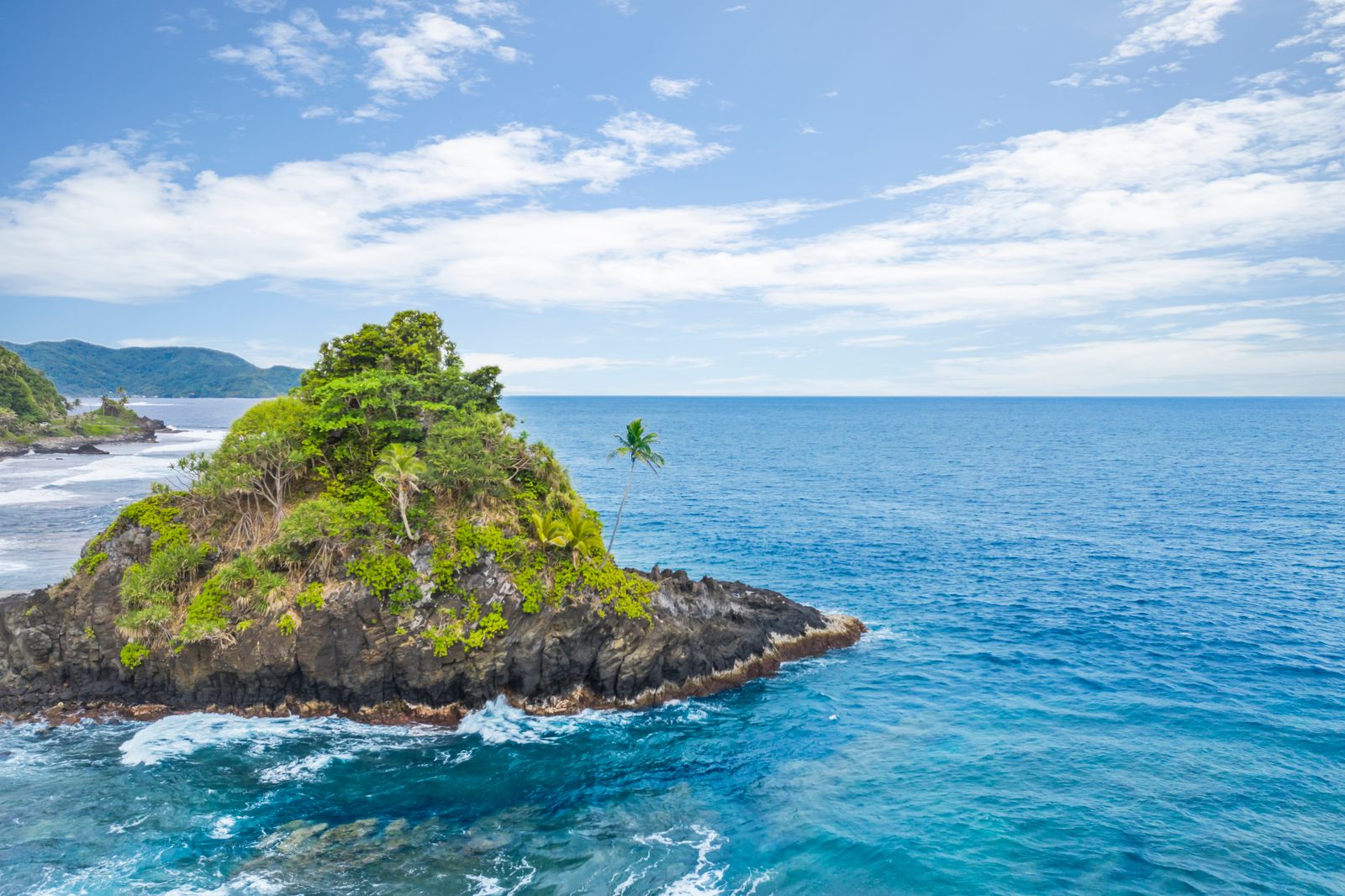
AS
American Samoa
The last traditional Samoan kingdom in the US Pacific
The last traditional Samoan kingdom in the US Pacific

One of the finest natural deepwater harbours in the South Pacific — enclosed by dramatic volcanic mountains that plunge directly into the water, creating a harbour so deep that WWII naval vessels used it extensively. The combination of mirror-calm water, jungle-clad cliffs and tuna cannery activity is like no other harbour in Polynesia.
Photo: LCDR Eric Johnson, NOAA Corps., Public domain

The only US National Park in the Southern Hemisphere — covering rainforest, coral reef and traditional Samoan villages on three separate islands (Tutuila, Ofu and Ta’u). The park preserves the fa’asamoa (Samoan way) through formal agreements with village councils.
Photo: Tavita Togia, National Park Service, Public domain
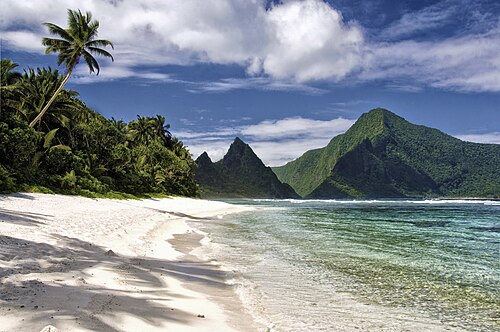
Consistently rated one of the most beautiful beaches in the South Pacific and among the least visited — an undeveloped arc of white sand with some of the world’s healthiest and most intact coral reefs in the shallows. Accessible only by a twice-weekly flight from Pago Pago.
Photo: The U.S. National Park Service (public domain), Public domain

A 2.4km aerial cable car from the TV station to the mountaintop — offering extraordinary views over Pago Pago Harbour from 491m. The cable car was built for a TV relay station in 1965 and now provides one of the most striking panoramas in Polynesia.
Photo: Eddy23, CC BY-SA 4.0

The largest and most traditional village in American Samoa — a classic Samoan fale (open-sided thatched house) village on a bay. The Leone cathedral, built in 1830 by the first Christian missionaries to reach Samoa, is the oldest church in American Samoa.
Photo: Jerrye & Roy Klotz MD, CC BY-SA 3.0
Ancient Samoan earthen mounds used for pigeon snaring — a pastime of the Samoan chiefly class, where trained pigeons were used to lure wild Pacific pigeons into the mounds. The structures are among the most intact pre-European earthworks in American Samoa.
Coconut cream wrapped in taro leaves and baked in an umu (underground oven) until the coconut cream thickens and the taro leaves soften — the defining celebration dish of all of Polynesia, prepared for every fa’a’umu (feast) from weddings to funerals. Rich, smoky and profoundly comforting.
Whole chicken simmered in fresh coconut cream with taro leaves, onion and salt — one of the most ubiquitous Samoan main dishes, served at home and at every village feast. The coconut cream thickens as it cooks to produce a rich, velvety sauce.
Taro leaves packed with corned beef, coconut cream and onion, wrapped tightly and baked or boiled — a Samoan staple that blends the traditional palusami technique with canned corned beef introduced by American naval provisioning. Completely emblematic of Pacific island fusion cooking.
Though technically brewed in independent Samoa (Western Samoa), Vailima is the Pacific’s most recognised Samoan beer and widely available in American Samoa — a clean, light lager named after Robert Louis Stevenson’s estate near Apia.
A dense, slightly sweet Samoan bread made with coconut cream and coconut milk baked into a hard, almost biscuit-like loaf — broken apart by hand and eaten with stews or as a snack. The distinctive dense texture comes from baking twice: once steamed and once baked.
Toasted raw cacao beans ground into a paste with water and coconut sugar — Samoa produces some of the world’s finest cacao, and this traditional drinking chocolate is completely different from commercial cocoa: intensely aromatic, slightly bitter and deeply satisfying.
Pago Pago International Airport (PPG) is the gateway. Hawaiian Airlines and Samoa Airways serve the main routes. For trip planning, see the official American Samoa tourism portal.
Honolulu (5h30, Hawaiian Airlines, three times weekly) is the only direct US connection. All mainland US visitors connect through Honolulu. Book early as the flights fill quickly.
Apia in independent Samoa (20 min, Samoa Airways — multiple daily) is the closest hub. Auckland (via Apia) and Sydney are convenient for Australian and New Zealand visitors.
Polynesian Air Samoa operates the inter-island flights to Ofu and Tau in the Manu’a group. Book well in advance — the 9-seat Twin Otters are often full during summer months when families travel between islands.
Tutuila has one main road running east-west; a car hire (US$50–80/day) is the most practical option for independent exploration. The aiga buses (privately owned family minivans) are cheap but irregular.
May to October is the dry season — the best hiking weather, calmer seas, lower humidity (26–29°C). November to April is the wet season with occasional cyclones; the rainforest is lush. The island is warm and humid year-round.
📅 American Samoa is in its best season in May, June, July, August, September, October. See where else is good to go in those months, or browse where to go by month.
The US dollar is the currency. Affordable for the South Pacific — US prices but significantly cheaper than Hawaii or Tahiti.
Palusami (taro leaves stuffed with coconut cream and onion, wrapped and cooked in an umu)
The national park homstay programme.
American Samoa is one of the most affordable places in the world to participate in coral reef citizen science.
Pago Pago for one day, Mount Alava for one, Ofu Island for two days, rainforest and Vatia for one, Tisa’s Bar for one, Leone farewell for one. American Samoa — the only US territory south of the equator — has the healthiest coral reef in the US Pacific at Ofu Lagoon, flying foxes in the National Park and the most intact Polynesian culture in any American territory.
Pago Pago — the capital of American Samoa (a US territory of 76km² — the only US territory south of the equator, population 55,000, the most remote American territory, with the most dramatic harbour in the South Pacific — a deep-water caldera harbour enclosed by steep volcanic mountains and the ridge of Mount Alava) with the Jean P. Haydon Museum (covering Samoan history and fa’a Samoa — the Samoan Way) and the tuna canneries that are the largest employer on the island.
American Samoa is the only US territory permanently south of the equator — located at 14°S, 170°W, roughly equidistant between Hawaii and New Zealand. Residents of American Samoa are US nationals (they carry a US passport marked “national” rather than “citizen”) and are the only US nationals who are not automatically US citizens at birth, the result of a Supreme Court decision that has never been overturned. The tuna canneries (operated by StarKist and others) process approximately 50% of the tuna sold in the US.
Mount Alava (491m — the ridge above Pago Pago Harbour, accessed by a hiking trail from Vatia village (3–4 hours return) or by a cable car that runs only for special events — with the finest panoramic view in the South Pacific: the entire Pago Pago Harbour below, the outer bays, the Manu’a Islands on the horizon and the steep green ridges of the national park) and the National Park of American Samoa (the only US National Park in the Southern Hemisphere, protecting 3,645 hectares of reef and rainforest).
The National Park of American Samoa (established 1988) is unique among US National Parks: it is managed under a 50-year lease from the Samoan people, who retain ownership of the land in accordance with Samoan communal land tenure (fa’a Samoa). No land in American Samoa can be sold to non-Samoans; the national park is the only significant exception, and even then the land is leased rather than sold. The park protects 3 species of flying fox (Pteropus) found only in Samoa and the American Pacific.
45 min flight. Ofu Island (one of the Manu’a group, 8km² — the most remote and little-visited of the American Samoan islands, with Ofu Beach (the finest beach in American Samoa and one of the finest in all Polynesia — a 3km barrier beach of white sand fronting a shallow coral lagoon with the most intact coral reef in all US territories, ranked by marine biologists as the healthiest reef under US jurisdiction, with 150+ coral species and 900+ fish species in the lagoon) and the adjacent Olosega Island connected by a bridge.
Ofu Lagoon (the coral reef inside the fringing reef of Ofu Island — consistently ranked by NOAA and AIMS scientists as the healthiest coral reef in all US Pacific territories, with high coral coverage, minimal bleaching impacts even during mass bleaching events affecting all surrounding reefs, and great biodiversity) is one of the most resilient coral reefs in the Pacific. Scientists are studying the unusual temperature dynamics of the lagoon that may make it a “refugium” from warming ocean temperatures.
A full day in Ofu Lagoon (snorkelling the fringing reef at 1–5m — the least disturbed coral accessible from a beach in the US Pacific, with fish density among the highest ever recorded in a US reef survey — giant clams, black-tip reef sharks in the passages, hawksbill turtles feeding on the reef, and the largest remaining stands of staghorn and table coral in American Samoa) and the coastal walk from Ofu village to the viewpoint above the lagoon.
The black-tip reef shark (Carcharhinus melanopterus — the most commonly encountered reef shark in the shallow Indo-Pacific, characterised by the distinctive black tips on all fins, growing to 1.6m — present in the Ofu Lagoon passages at low tide in numbers of 5–20 individuals) are completely habituated to snorkellers and pose no danger to humans. Their presence is an indicator of a healthy reef ecosystem; heavily fished reefs have no sharks.
Return to Tutuila. The National Park of American Samoa trail network — the Tuafanua Trail (2.5 hours return, through intact cloud forest on the ridge above Pago Pago Harbour, with flying foxes roosting in the canopy) and the Village of Vatia (a traditional Samoan village accessible only by road from the national park, the most authentic fa’a Samoa (Samoan Way) village accessible in American Samoa, with traditional fale (thatched open-air houses) and the communal village life of extended family units (aiga).
Fa’a Samoa (the Samoan Way — the traditional system of social organisation, values and practices that governs Samoan society across both independent Samoa and American Samoa) is one of the most intact indigenous cultural systems in Polynesia. The matai system (hereditary chief titles held by extended family units, governing village affairs and land use) continues to operate as the primary social structure on both islands, with the American Samoa Fono (legislature) recognising both English common law and Samoan custom.
Tisa’s Barefoot Bar (the most famous beach bar in American Samoa — on the eastern coast at Alofa Beach, run by Tisa Faamuli since 1983, with the most authentic fa’a Samoa cultural experience available to visitors: a beach fire, umu (earth oven) cooking demonstration, traditional dance performance and the most genuine expression of Samoan hospitality in a tourist context) and the final snorkel on the east coast fringing reef.
The umu (earth oven — a traditional Polynesian cooking method using heated volcanic stones in a pit covered with banana leaves, cooking whole pigs, fish, taro, breadfruit and palusami (taro leaves cooked in coconut cream) for 3–4 hours) is the centrepiece of every Samoan celebration. The Sunday umu (prepared after church for the extended family meal) is the most important weekly ritual in fa’a Samoa; the food cooked in an umu has a distinctive smoky, earthy flavour impossible to replicate in a conventional oven.
Leone (the second-largest village in American Samoa — with the finest example of traditional Samoan fale (open-sided thatched houses with no walls) architecture in the territory, the Leone Catholic Cathedral and the Leone Ala Moana (the beach park with the Sadie Thompson Hotel — named for the W. Somerset Maugham character from the 1919 short story “Rain,” set in Pago Pago) and a final plate of palusami (taro leaves in coconut cream baked in an umu) before flying from Pago Pago (PPG).
Somerset Maugham visited Pago Pago in 1916 while en route to Tahiti, was delayed by a quarantine and spent two weeks at the Sadie Thompson rooming house. His story “Rain” (1919 — later dramatised as “Sadie Thompson” and filmed multiple times) is set entirely in Pago Pago Harbour during a storm, making the harbour one of the most literarily significant locations in the South Pacific.
The only realistic direct connection to American Samoa is Hawaiian Airlines from Honolulu (HNL) to Pago Pago (PPG). Inter-island flights to Ofu and Ta’u operate twice weekly on small aircraft.
US citizens and nationals need no passport to enter American Samoa (a US territory). Non-US citizens need a valid passport and may need an entry permit; check current requirements before travel.
American Samoa is UTC-11 — one of the last places on earth to experience each day. Unlike neighbouring Samoa (independent), which moved to UTC+13, American Samoa deliberately remains on the US side of the date line for commercial reasons.
The main island of Tutuila has a well-maintained coastal road. Car hire from the airport is the best way to reach remote villages and viewpoints.
When visiting villages, dress modestly, ask permission to photograph, and be aware that Sunday is strictly observed — many villages restrict activity on Sundays and visitors should plan accordingly.
ATMs are available in Pago Pago; outside the capital, cash is preferred. The economy is heavily reliant on US federal funding and tuna cannery employment.
Quick answers to the questions people most often ask before visiting American Samoa.
Fly into Pago Pago International Airport (PPG). The main long-haul route is from Honolulu (about 5h30, a few times a week), and there are short flights from Apia in Samoa (about 20 minutes).
US citizens and nationals don't need a passport to enter, though American Samoa runs its own entry controls, so carry ID. Non-US citizens need advance entry authorisation — check the current requirements before booking.
May to October, the dry season, brings the best hiking weather, calmer seas and lower humidity (26–29°C). November to April is wetter and hotter, with an occasional cyclone.
The US dollar. ATMs are available in Pago Pago, but cash is preferred elsewhere on the islands.
It is affordable for the South Pacific — around US$60–100 per day on a budget and US$130–220 mid-range, noticeably cheaper than Hawaii or Tahiti.
American Samoa sits at the heart of Polynesia, surrounded by independent Samoa, Tonga, Fiji, French Polynesia and Vanuatu — each offering a different expression of Pacific island culture and landscape.
American Samoa is one of the world’s least-visited places. See all 90 in our guide to the world’s least-visited countries & territories.
