
BE
Ghent
A lively university city with medieval waterfronts, a castle, three towers and the Ghent Altarpiece
A lively university city with medieval waterfronts, a castle, three towers and the Ghent Altarpiece

Two quays facing each other across the River Leie, lined with guildhalls from the 12th to the 17th century. On summer evenings people sit along the water’s edge.
Take a short boat trip from here.
Photo: Michielverbeek, CC BY-SA 4.0

The Castle of the Counts was built in 1180 and later used as a court and prison. Visitors can walk the ramparts, which have views over the old town.
Photo: Trougnouf (Benoit Brummer), CC BY 4.0

The 91m tower, topped by a gilded dragon, held the city’s charters and bells. A lift goes most of the way to the top. It is part of the UNESCO-listed Belfries of Belgium and France.
Photo: Suicasmo, CC BY-SA 4.0

A Gothic cathedral with a baroque interior, a carved pulpit and a painting by Rubens.
Photo: Fred Romero, CC BY 2.0
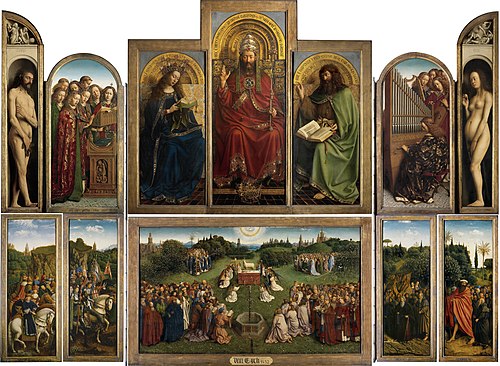
Completed in 1432 by the brothers Hubert and Jan van Eyck, the Adoration of the Mystic Lamb is one of the most important paintings of the Middle Ages. It is shown in a visitor centre inside St Bavo’s, with an augmented-reality tour.
Book a timed ticket in busy periods.
Photo: Jan van Eyck / Hubert van Eyck, Public domain
Try Gentse waterzooi (a creamy chicken or fish stew), stoverij (beef stew), cuberdons (cone-shaped raspberry sweets) and Tierenteyn mustard. Ghent has many vegetarian restaurants.
The streets around the Vrijdagmarkt and Patershol have a wide choice of restaurants and bars.
Ghent-Sint-Pieters station has trains from Brussels (about 30 minutes) and Bruges (about 25 minutes). Trams run from the station to the centre in about 15 minutes.
The centre has a car-free core and a low-emission zone; use the park-and-ride sites. Belgium is in the Schengen area. Non-EU visitors are registered in the EU Entry/Exit System on arrival, and visa-exempt travellers will need an ETIAS travel authorisation once it launches, expected from late 2026. Check current rules before you travel.
Belgium uses the euro. Prices are similar to neighbouring France and the Netherlands; trains are good value, especially with weekend or multi-trip tickets.
Hotels fill up during the Gentse Feesten in July.
Towers, castle and waterfront.
See the Ghent Altarpiece in St Bavo’s, go up the Belfry, then walk to the Graslei for a boat trip.
Visit the Gravensteen, explore the Patershol and the Vrijdagmarkt, and see the city lit up at night.
🛂 Entry rules: EES and ETIAS
Belgium is in the Schengen area, which has two EU border systems for non-EU visitors.
EES (in force): since 10 April 2026 the EU’s Entry/Exit System registers non-EU visitors’ passport details, fingerprints and a photo the first time they enter the Schengen area, replacing passport stamps. Allow extra time at the border on your first trip; later crossings are quicker. EU, EEA and Swiss citizens are not registered.
ETIAS (not yet running): a €20 online travel authorisation for visitors who don’t need a visa, such as UK, US, Canadian and Australian citizens. It hasn’t started and no start date has been confirmed, so nobody can apply yet; ignore websites that offer to “pre-register” you for a fee.
Visa-free visitors can stay up to 90 days in any 180-day period across the whole Schengen area, not per country.
Official information: EU: Travel to Europe (EES & ETIAS) · Reviewed September 2026
The Gentse Feesten, a 10-day festival of music and street theatre, takes place in July.
Ghent’s lighting plan makes the old centre worth seeing after dark.
Ghent has a low-emission zone and a car-free centre.
Consider a CityCard for museums and public transport.
Quick answers for planning time in Ghent.
In St Bavo’s Cathedral, where it is displayed in a dedicated visitor centre with timed tickets.
Bruges is smaller and more picturesque; Ghent is livelier and less crowded. They are 25 minutes apart by train, so many people see both.
By train, which takes about 30 minutes to Ghent-Sint-Pieters.
A large free festival of music and street theatre in the city centre for 10 days in July.
April to September; July is busiest because of the Gentse Feesten.
Dutch is spoken in Flanders, French in Wallonia; both are used in Brussels, and English is widely understood.
Free
Planning a wider trip? Our Belgium travel guide covers getting there, costs, when to go and more.