BE
Belgium
Medieval cities, world-class beer and chocolates
Medieval cities, world-class beer and chocolates

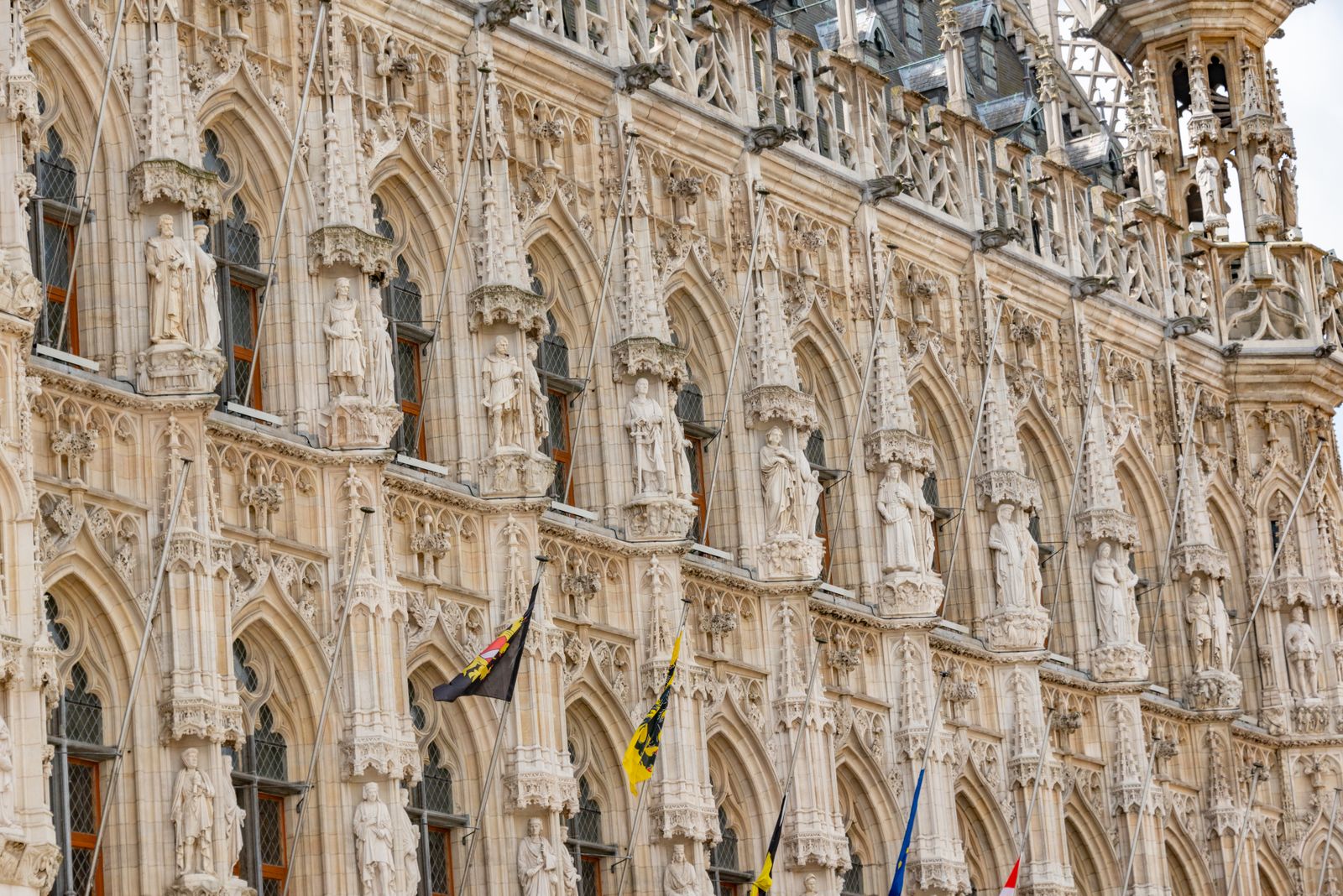
The Grand Place: surrounded by 17th-century guild houses of gilded Gothic facades, rated by Victor Hugo as the world’s most beautiful square. The Manneken Pis statue and the nearby Jeanneke Pis.

The best-preserved medieval city in Northern Europe: the Belfry tower above the market square, the Minnewater lake, the Groeningemuseum (Jan van Eyck’s Adoration of the Mystic Lamb panel) and chocolate shops on every corner.

A medieval city on two rivers with three towers (the Belfort, St Bavo’s Cathedral and St Nicolas Church) forming the most photographed skyline in Belgium. The Friday Market and the Patershol restaurant quarter.

The site of Napoleon’s final defeat (June 18, 1815): the Lion’s Mound panorama, the Memorial Museum and the battlefield that ended Napoleon’s empire and reshaped European borders.

The Menin Gate (every night at 8pm, the Last Post is played by the Ypres Fire Brigade – a ceremony unbroken since 1928 except during WWII) and the Tyne Cot Cemetery (the largest Commonwealth war cemetery in the world).

The world’s diamond capital (80% of the world’s rough diamonds are cut and polished here), the MAS waterfront museum, the Rubenshuis (Rubens’ home and studio) and the most internationally regarded fashion school in Europe.

The cliffside citadel of Dinant (birthplace of Adolphe Sax, inventor of the saxophone), kayaking on the Lesse River and the Ardennes’s forest, castles and WWI/WWII history.

The Belgian coast tram (the longest tram route in the world, 68km from De Panne to Knokke) and the Ghent Floralien flower show (every 5 years).
Belgium has 1,700+ beer varieties including Trappist ales (Westvleteren 12 is arguably the world’s finest beer), Gueuze (spontaneously fermented lambic), Witbier (Hoegaarden), Dubbel and Tripel. Drinking Belgian beer is a curriculum, not a choice.
Belgian frites are made from specific varieties of potato (Bintje), double-fried: crispy outside, fluffy inside, served in a cone with andalouse, samurai or tartare sauce. Not ketchup.
Neuhaus (invented the praline in 1912), Godiva, Leonidas and Pierre Marcolini: Belgian chocolate uses 100% cocoa butter and a minimum cocoa content of 35%. The technique is different from Swiss.
Steamed mussels in white wine, shallots and celery (or cream, or beer) with Belgian frites. The national dish: eaten from September to April, when the mussels are in season.
Beer-braised beef with thyme and bay leaf, served with frites: a Flemish version of boeuf bourguignon using Belgian dark beer instead of red wine.
A Flemish cream-based stew of chicken (or fish) with vegetables: a medieval Ghent dish that is still the city’s most traditional restaurant offering.
Belgian genever (the original gin) from Hasselt and Ghent distilleries: older, maltier and more complex than London Dry.
Rectangular raised waffles with pearl sugar caramelised in the iron: denser and sweeter than Brussels waffles. Sold warm from street stalls; available everywhere.
Brussels Airport (BRU) is the main hub; Brussels Charleroi (CRL) serves budget carriers. Brussels Midi (Zuid) station is Europe’s best-connected rail hub — Eurostar to London (2h), Thalys to Paris (1h22) and Amsterdam (1h50). For trip planning, see the official Belgium tourism portal.
💡 The Eurostar from London St Pancras to Brussels Midi takes 2 hours city centre to city centre — generally faster than flying once airport time is included. Book ahead for fares under £60.
💡 Brussels Airlines flies direct from New York to Brussels — a useful gateway for onwards travel to central and sub-Saharan Africa (Brussels’s historic connection).
💡 Belgian trains are frequent, comfortable and reasonably priced. A B-Excursion day pass (return fare to any Belgian city + free public transport in that city) is excellent value for day trips.
💡 The SNCB Airport Express runs every 15 minutes from Brussels Airport to the three main Brussels stations — the fastest and cheapest way into the city.
April to October is the most practical window. May and June are the sweet spot — long days, outdoor cafes, manageable crowds. July and August are warm and lively. December brings Europe’s finest Christmas markets to Bruges, Ghent and Brussels. Winter is cold but atmospheric.
Belgium is mid-range Western Europe — comparable to the Netherlands or Germany. Beer and chocolate are the best-value treats; restaurants are reasonable by UK standards.
Belgian frites — twice-fried in beef fat, served in a paper cone with your choice of 20+ sauces — cost €3–5 from a frituur (chip van). This is the national food, not a tourist attraction.
A Trappist beer — Chimay Blue, Orval, Rochefort 10 — costs €4–7 in a Brussels or Bruges cafe. At a specialist beer bar (Delirium Café in Brussels has 2,000+ beers), €5–9.
Hof van Cleve (three Michelin stars, near Ghent) and Bon Bon (Brussels, two stars) are Belgium’s benchmark restaurants — tasting menus at €150–250pp, among the best value in Europe.
Brussels for two days, Bruges for two, Ghent for one, Antwerp to finish. Belgium is compact — every city is under an hour by train from every other.
The Grand Place is one of the finest medieval squares in Europe — the gilded guild houses surrounding the Gothic Town Hall, particularly dramatic at night when lit. The Atomium (a 102m steel atom structure from the 1958 World’s Fair) is the most original thing in Belgium and worth the trip alone.
💡 The Grand Place flower carpet (every two years in August) covers the entire square in 75,000 begonias — extraordinary and free to view. The Manneken Pis (the small urinating bronze boy) is a five-minute walk away and always disappointing in scale.
The Belgian Comic Strip Center (in a Horta Art Nouveau building — Belgium invented comics: Tintin, the Smurfs, Spirou) and the Musical Instruments Museum (for the Art Nouveau building as much as the instruments). Afternoon: the EU quarter, Place Schuman, the Cinquantenaire arch. Moules-frites for dinner.
💡 A Belgian praline box (Neuhaus, Godiva, Leonidas — all Belgian) from a chocolate shop in Brussels costs €15–30 for 500g. Leonidas is the best value; Neuhaus the most elegant.
1h by train from Brussels Midi. Bruges is a UNESCO World Heritage city of medieval Flemish architecture, canal bridges and belfries — remarkably intact. The Markt (main square) and Burg squares, the Groeningemuseum (Flemish Primitives), a canal boat tour.
💡 Bruges is overrun with day-trippers in summer — the streets are quiet before 10am and after 6pm when the coaches have left. Stay overnight for the real experience.
The Halve Maan (Half Moon) brewery has been brewing in Bruges since 1546 — the tour ends with a Brugse Zot on the rooftop. Afternoon: the train to Ostend (15 min) for a North Sea beach and a plate of grey shrimps on toast (grijze garnalen — tiny Belgian shrimps, exceptional).
💡 The Belgian coast has a tram line running its entire 67km length — the Kusttram, the longest tram route in the world. Take it from Ostend west to De Panne or east to Knokke for the full experience.
30 min by train. Ghent is larger and less precious than Bruges — a university city with a lively food and bar scene, the finest medieval tower cluster in Belgium (Gravensteen castle, the Belfry, St Bavo’s Cathedral) and the Van Eyck Altarpiece (the Adoration of the Mystic Lamb, 1432).
💡 The Adoration of the Mystic Lamb (St Bavo’s Cathedral) is one of the most important paintings in Western art — complex, detailed, and with a genuinely extraordinary restoration completed in 2020. Book timed entry.
40 min from Ghent. Antwerp is Belgium’s second city — the diamond district (80% of the world’s rough diamonds are traded here), the Rubenshuis (Peter Paul Rubens’ home and studio, 17th century), the fashion district around the Nationalestraat (Antwerp is one of Europe’s fashion capitals — the Antwerp Six).
💡 The MAS (Museum aan de Stroom) on the riverside has a rooftop with the best view of Antwerp — free to access, remarkable panorama.
Belgian beer: there are 180+ breweries in a country the size of Wales. The Trappist beers (Westvleteren, Chimay, Orval, Rochefort) are brewed by monks and genuinely outstanding. A final Trappist in a Antwerp or Brussels cafe before your train or flight.
💡 Brussels Midi (Zuid) station has direct Eurostar services to London (2h) and Thalys to Paris (1h22) and Amsterdam (1h50). The best-connected station in Belgium by far.
Both work in Brussels, Antwerp and Ghent.
Flanders has 2,000km of cycling routes; a bike is the correct way to see Bruges and the coast.
Brussels to Bruges: 1h. Brussels to Ghent: 28 minutes. Brussels to Antwerp: 40 minutes.
Flemish, Walloon and Brussels-capital are each distinct. An appreciation of this complexity is welcomed.
Asking for “a beer” in Belgium is not specific enough. Know your Trappist from your Gueuze.
A restaurant meal: EUR 15-30. Belgian beer in a cafe: EUR 3-6.
London to Brussels: 2h; Paris to Brussels: 1h20; Amsterdam to Brussels: 1h50.
Belgians are proud of their country but express it through irony rather than boosterism.
Belgian national railway app — buy intercity, IC and IC-Direct tickets between Brussels, Bruges, Ghent and Antwerp.
FreeBrussels’ official transit app — real-time metro, tram and bus departures; buy tickets in-app.
FreeBook Brussels Grand Place tours, Bruges canal tours, Chocolate Museum entry and Belgian experiences.
FreeReserve tables at Belgian restaurants — Belgium has the highest density of Michelin stars per capita in Europe.
FreeExplore Belgium’s top city destinations — from Bruges to Brussels, each with its own distinct character.
Belgium sits within easy reach of several other destinations — each with a completely different character.


